
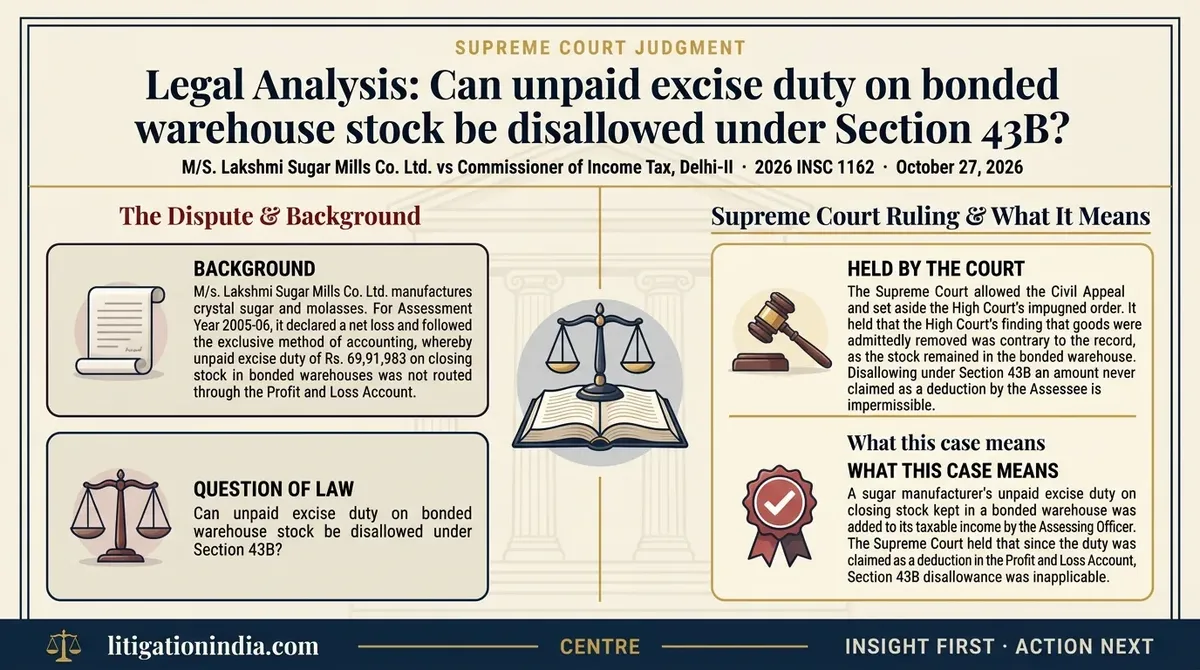
Full text of the judgment
Text extracted from M/S. Lakshmi Sugar Mills Co. Ltd. vs Commissioner of Income Tax, Delhi-II. For the authoritative version refer to the Supreme Court of India's official website.
2026 INSC 1162
NON-REPORTABLE
IN THE SUPREME COURT OF INDIA CIVIL APPELLATE JURISDICTION
CIVIL APPEAL NO. 8932 OF 2013
M/S. LAKSHMI SUGAR MILLS CO. LTD. … APPELLANT(S)
COMMISSIONER OF INCOME TAX, DELHI -II
… RESPONDENT(S)
J U D G M E N T
S.V.N. BHATTI, J. 1. M/s. Lakshmi Sugar Mills Company Limited/Assessee is the Appellant. The Appellant manufactures crystal sugar using the vacuum pan process and, as a by-product, produces molasses. 2. The subject Appeal concerns the Return filed for the Assessment Year 2005-06 corresponding to the Financial Year 2004-05. In the Return dated 28.10.2005, filed under Section 139(3) of the Income Tax Act, 1961 (“Act, 1961”), the Appellant declared a net loss of Rs. 28,36,167/- (Rupees Twenty- Eight Lakhs Thirty-Six Thousand One Hundred and Sixty-Seven). The Tax Auditor’s Report in Form 3CD, in Annexure-A, noted that the excise duty leviable on the closing stock of sugar and molasses is Rs. 2,80,56,430/- (Rupees Two Crores Eighty Lakhs Fifty-Six Thousand Four Hundred and Thirty). The Assessee follows the standard mercantile accounting method. Digitally signed by LOKESH ARORA Date: 2026.10.27 18:49:51 IST Reason: Signature Not Verified
After accounting for Rs. 2,10,64,447/- (Rupees Two Crores Ten Lakhs Sixty- Four Thousand Four Hundred and Forty-Seven) paid up to 30.09.2005, the Auditor showed an unpaid balance of Rs. 69,91,983/- (Sixty-Nine Lakhs Ninety-One Thousand Nine Hundred Eighty-Three) as payable towards excise duty. The Auditor noted that this balance should be added back under Section 43B of the Income Tax Act, 1961, as it had not been paid before signing this Report. The Tax Auditor's Report, in clause 12(b), certified that, after giving effect to Section 145A of the Act, 1961, the net impact on profitability from the inventory valuation was Nil. In Annexure-E, the Tax Auditor's Report refers to disallowable liabilities covered under Section 43B, declared to be the outstanding excise duty liable at the close of the year, as Nil. 3. The Assessing Officer (“AO”) issued Notices under Sections 143(2) and 142(1) of the Act, 1961. On 14.11.2007, the Assessee replied to the AO’s queries, explaining that Section 43B allows deductions for expenses claimed by an Assessee if paid before the ITR due date. As the Assessee followed the exclusive method and never debited the unpaid excise duty of Rs.69,91,983/- (Rupees Sixty-Nine Lakhs Ninety-One Thousand Nine Hundred and Eighty- Three) to its Profit & Loss Account, it claimed no deduction. The proposed disallowance is incorrect. According to the Assessee, under the Central Excise Act, 1944 (“Act, 1944), liability to pay excise duty crystallises only upon the removal of manufactured finished goods from the factory premises or the bonded warehouse. The stock on which excise duty remained payable was kept in the bonded godowns. Under excise law, no actual tax liability had accrued. The Government controls the movement of sugar, and the Assessee
could not move the goods out of the bonded warehouse on its own. The Assessee is not expected to pay excise duty without movement of stock from the warehouse. Therefore, the proposed disallowance is untenable. The payable excise duty cannot be included in the value of the closing stock. 4. The AO, vide Order dated 20.11.2007, rejected the Assessee's reply and passed an Order under Section 143(3), adding Rs.69,91,983/- (Sixty-Nine Lakhs Ninety-One Thousand Nine Hundred and Eighty-Three) under Section 43B read with Section 145A of the Act, 1961, on the ground that unpaid excise duty on closing stock must be added to the returned income. The AO's findings are as follows: A. Annexure-A of the Tax Audit Report showed Rs.69,91,983/- (Sixty-Nine Lakhs Ninety-One Thousand Nine Hundred and Eighty-Three) as excise duty payable on the closing stock as on 31.03.2005, with an auditor’s remark that it was disallowable under Section 43B of the Act, 1961. B. As per the Audit Report, the total excise duty leviable on closing stock was Rs.2,80,56,430/- (Rupees Two Crores Eighty Lakhs Fifty-Six Thousand Four Hundred and Thirty), of which Rs.2,10,64,447/- (Rupees Two Crores Ten Lakhs Sixty-Four Thousand Four Hundred and Forty-Seven) had been paid as on 30.09.2005, leaving an outstanding balance of Rs.69,91,983/- /- (Sixty- Nine Lakhs Ninety-One Thousand Nine Hundred and Eighty-Three). C. Section 145A of the Act, 1961 mandates the valuation of opening stock, purchases, sales, and closing stock, inclusive of all duties. The AO refused to adjust the opening stock on the ground that doing so would affect the
preceding year’s assessment and instead chose to enhance only the closing stock. D. Since the Assessee failed to furnish proof of payment of the remaining Rs. 69,91,983/- (Sixty-Nine Lakhs Ninety-One Thousand Nine Hundred and Eighty-Three) before filing the Return, the AO disallowed the amount under Section 43B read with Section 145A of the Act, 1961, and added it to the returned income. E. It rejected the Assessee's plea that Section 43B of the Act, 1961 could apply only to amounts debited to the Profit & Loss Account. 5. Aggrieved by the Assessing Officer's redetermination of net taxable income in the Order dated 20.11.2007, the Assessee filed Appeal No. 90/2007- 08 before the Commissioner of Income Tax (Appeals), New Delhi. During the pendency of the Appeal, the Assessee placed additional evidence under Rule 46A of the Income Tax Rules, 1962. The Certificate dated 14.01.2010 was issued by the Tax Auditor on the net impact on profitability of the disputed entry. The CIT (Appeals), vide Order dated 27.05.2010, deleted the addition of Rs.69,91,983/- (Sixty-Nine Lakhs Ninety-One Thousand Nine Hundred and Eighty-Three) on the ground that the Assessee had not claimed the expenditure in the Profit and Loss Account and that the net profit impact under Section 145A was Nil. The disallowance of Rs.69,91,983/- (Sixty-Nine Lakhs Ninety-One Thousand Nine Hundred and Eighty-Three) is untenable in the circumstances of the case. The findings of the CIT (Appeals) are summarised as follows:
A. The CA Certificate dated 14.01.2010, issued by M/s. Kumar, Grover & Co., is admitted after calling for a Remand Report, on the ground that sufficient cause existed under Rule 46A of the Income Tax Rules, 1962. B. In his Report dated 01.04.2010, the AO did not dispute the factual position that Annexure-A showed Nil impact on profit under Section 145A and that Annexure-E showed Nil outstanding liability under Section 43B clause (b) of the Act, 1961. C. The AO had acted mechanically on the remark in Annexure-A to the Tax Auditor’s Report without verifying whether any debit entry or deduction had been claimed in the Profit and Loss account. As no expenditure was claimed, Section 43B was inapplicable. D. The disallowance was legally unsustainable, and the AO was directed to delete the addition of Rs. 69,91,983/- (Sixty-Nine Lakhs Ninety-One Thousand Nine Hundred and Eighty-Three). 6. The Revenue preferred Appeal No. 3445/Del/2010 before the ITAT, Delhi Bench (“Tribunal”), challenging the CIT (Appeals) Order dated 27.05.2010. On 06.05.2011, the Tribunal dismissed Appeal No. 3445/Del/2010. The Tribunal considered the findings recorded by the CIT (Appeals) and, in the circumstances of the case, recorded findings of fact as follows: A. The Revenue did not dispute that if the opening and closing stock were valued on the basis that excise duty was leviable on the date of manufacture, the effect on the company’s profit would be Nil.
B. The Assessee did not claim any expenditure on account of excise duty in its Profit & Loss Account. C. It noted a possible view that both the opening and closing stock of the year must be valued on the same basis to determine the effect of Section 145A of the Act, 1961. D. The Tribunal relied on the Gujarat High Court's decision in ACIT v. Narmada Chematur Petrochemicals Ltd.1, which held that liability to excise duty arises only upon removal of the goods from the factory premises or a bonded warehouse. Accordingly, the CIT(Appeals)'s Order was confirmed, and the Revenue’s appeal was dismissed. 7. The Revenue carried the matter in Appeal under Section 260A of the Act, 1961 on the following substantial question of law: “Whether the Ld. ITAT erred in deleting the addition of Rs.69,914,983/- made by the Assessing Officer under Section 43B read with Section 145A of the Act on account of Excise Duty?”
8. Through the impugned Order, the Revenue's Appeal was allowed. The conclusions arrived at by the impugned Judgment are summarised and stated hereunder: A. Section 145A of the Act, 1961, begins with a non-obstante clause and thus overrides other provisions, directing the inclusion of the amount of any tax, duty, cess or fee actually paid by the Assessee for the purpose of valuation alone.
1 (2010) 327 ITR 369.
B. Section 43B regulates the deduction of liabilities incurred but unpaid, whereas Section 145A of the Act, 1961, operates strictly for the purpose of stock valuation. C. Relying on Orient Paper Mills Ltd. v. Union of India2, it was held that Section 3 and Section 4 of the Act, 1944 must be read together, and that removal of excisable goods implies the duty is leviable and not postponed. D. In the present case, the sum of Rs. 69,91,983/- (Sixty-Nine Lakhs Ninety-One Thousand Nine Hundred and Eighty-Three), no doubt, was unpaid. However, the Assessee's contention is not merited, because the goods were admittedly removed, and therefore the duty was payable. E. The Assessee cannot profit or derive an advantage from its own omission or default in not paying the duty after the goods were removed. The AO’s opinion could not be faulted. The substantial question of law was answered in favour of the Revenue, and the orders of the CIT(A) and ITAT were reversed. 9. Hence, the Appeal at the instance of the Assessee. 10. In view of the above, the issue in the circumstances of the Appeal is whether the unpaid central excise duty of Rs.69,91,983/- (Sixty-Nine Lakhs Ninety-One Thousand Nine Hundred and Eighty-Three) on uncleared closing stock of processed sugar/goods can be added to the value of the closing stock and, thereafter, to the Assessee’s taxable income, and whether the disallowance under Section 43B read with Section 145A of the Act, 1961, is maintainable.
2 AIR 1967 SC 1564.
11. Advocate Memoon Zehra, appearing for the Assessee, argues that the Assessee followed the exclusive method of accounting under AS-2, as provided under the Companies Act, 2013. The indirect taxes and duties were routed through the balance sheet and were not charged to the Profit and Loss Account. As the Assessee followed this practice, it did not claim any deduction of Rs.69,91,983/- (Sixty-Nine Lakhs Ninety-One Thousand Nine Hundred and Eighty-Three) towards unaccrued excise duty. Consequently, disallowing the said amount and adding it to the Assessee's taxable income is unsustainable. 11.1 The Assessee manufactures and, as per the Government Orders issued from time to time, releases finished sugar stock into the market. The Assessee has no obligation to pay excise duty on stocked goods. The impugned Judgment is unsustainable insofar as the substantial question of law framed by the Revenue is an accusation of fact, which the CIT (Appeals) and ITAT rejected. The substantial question has not been independently examined and decided by the impugned Judgment. Further, the impugned Judgment proceeded on the erroneous assumption that the closing stock had been removed. This observation in the impugned Judgment is illegal and contrary to the record. To sum up, it is argued that the impugned Judgment has not taken into account that the dutiability of excisable goods is determined with reference to the date of movement, and the date of excise duty payable is determined with reference to the date of clearance of the goods. In the case on hand, the closing stock remained within the factory premises/bonded warehouse of the Assessee. Therefore, the Assessee has no obligation to pay
excise duty, and it cannot be treated as excise duty payable by the Assessee. The High Court exercised jurisdiction beyond Section 260A of the Act, 1961. 11.2 She relies on the Judgment in ITA No. 4297 of 20093, dated 22.06.2011, of the High Court of Bombay, and contends that the circumstances, consideration, and conclusion of that Judgment squarely apply to the case at hand. She prays for setting aside the impugned Judgment and for allowing the Appeal. 12. Mr. S Dwarakanath, learned ASG appearing for the Revenue, argues that the AO did not rely on any extrinsic or external material in disallowing Rs. 69,91,983/- (Sixty-Nine Lakhs Ninety-One Thousand Nine Hundred and Eighty-Three). The Tax Auditor's Report indicates that the amount is payable. Accordingly, the AO was right in disallowing the said sum. It is further argued that the CIT (Appeals) and the Tribunal liberally construed the circumstances of the case and arrived at an erroneous finding. According to the learned Counsel, the High Court rightly interfered with the findings of fact and allowed the Revenue's appeal. 13. We have heard the Counsel appearing for the parties and perused the record. 14. First, we consider whether the premise on which the High Court interfered with the Orders of the CIT (Appeals) and the Tribunal is supported by the record. The impugned Judgment, in paragraph 15, noted that the goods were admittedly removed and, therefore, excise duty was payable. The findings of the CIT (Appeals), the Tribunal, and the AO are not to that effect. On the
3 CIT-III v. Loknete Balasaheb Desai S.S.K. Ltd., (2011) 339 ITR 288.
contrary, in the AO's Remand Report, the CIT (Appeals) and the Tribunal found that the stock on which no excise duty was paid or treated as payable remained in the Assessee's bonded warehouse. Therefore, the very basis on which the High Court determines excise duty payability is contrary to the record, unsustainable, and liable to be set aside. The AO committed a serious error of fact by disallowing Rs.69,91,983/- (Sixty-Nine Lakhs Ninety-One Thousand Nine Hundred and Eighty-Three) under Section 43B of the Act, 1961 and adding it to the value of the closing stock and the Assessee's taxable income. Because (i) the Assessee is following the Standard Accounting System; (ii) the Assessee has not routed the disputed entry through the Profit and Loss Account, more so without actually paying the excise duty; (iii) Section 43B firstly allows allowance of expenses only in the year in which the sum is paid; and (iv) the actual payment on accrual method paid beyond 31st March but before the Tax Return date is accepted, then notwithstanding the payment beyond 31st March, is still allowable as expense of the Financial Year for which Return is filed. To wit, a statutory payment made on 01.08.2005 for the liability accrued prior to 31.03.2005 can still be claimed in the subject Financial Year. Conversely, if statutory dues are not paid before the ITR date, no amount can be claimed as an allowable expense. In the case on hand, since the amount was neither paid nor, for accounting purposes, treated as payable, except for the remark in the Tax Audit Report, no other basis exists to disallow Rs.69,91,983/- (Sixty-Nine Lakhs Ninety-One Thousand Nine Hundred and Eighty-Three). The AO's Order would have merited acceptance if it had stated reasons with reference to the accounts/Return filed by the Assessee, how the
entry is factored in, and how the net taxable income is affected negatively. Disallowing an amount not treated as an allowance by the Assessee is impermissible under the Act, 1961. The negative impact on the taxable income stated by the Assessee should have been taken into account; i.e., by factoring in this entry, the income has come down, and therefore the tax has come down. The Revenue, having failed to show where and how the Assessee claimed the allowance in the books of account, ought not to disallow such amount. The AO's order is illegal and was rightly interfered with by the CIT (Appeals) and the Tribunal. 15. We have perused the unreported Judgment in ITA No. 4297 of 2009 and are of the view that the said decision, on all fours, is nearer to the facts and circumstances of the case. It considers the interplay between Sections 43B and 145A of the Act, 1961. 16. For the above reasons and discussion, the impugned Order is set aside. The Civil Appeal is allowed accordingly. 17. Pending application(s), if any, stand disposed of accordingly.
...……….…………………J.
[S.V.N. BHATTI]
.....…………………………J.
[N. V. ANJARIA]
New Delhi; October 27, 2026.