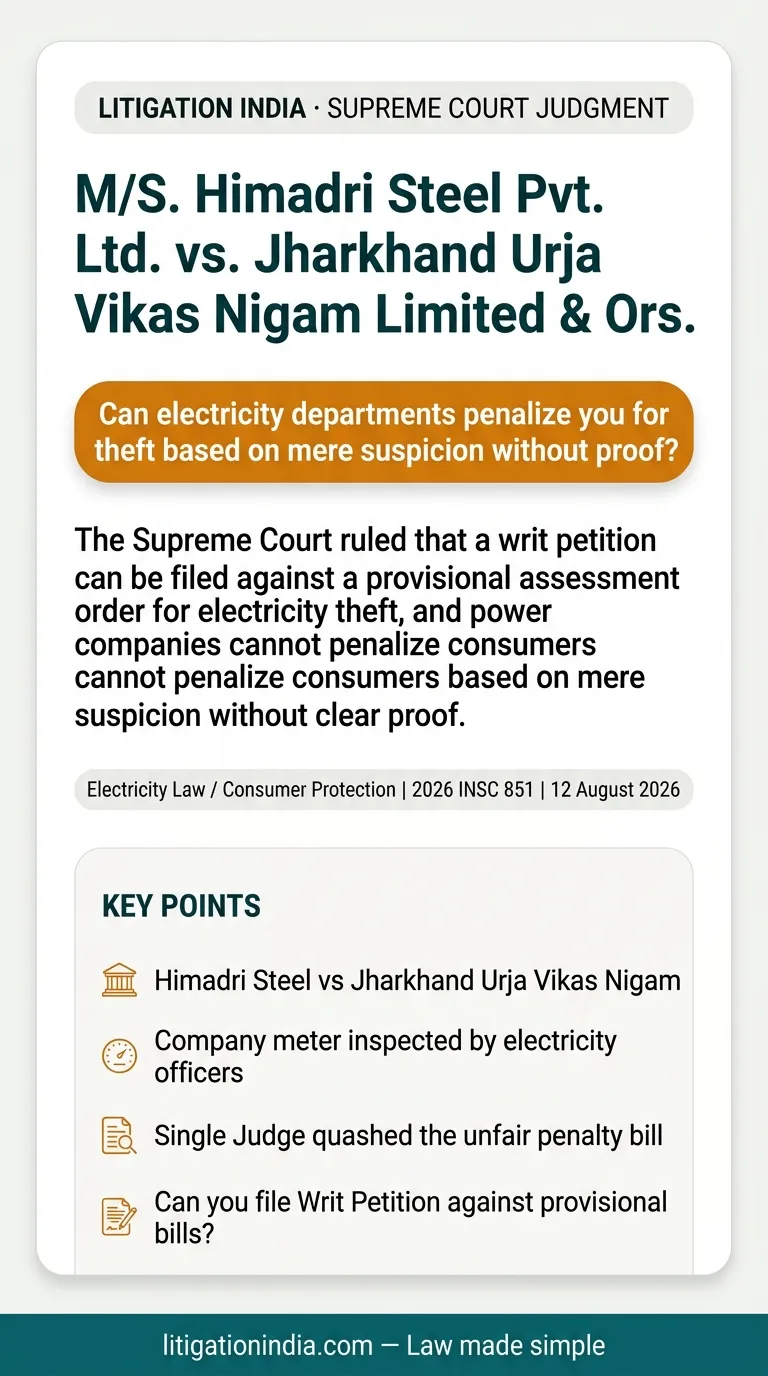
M/S. Himadri Steel Pvt. Ltd. vs. Jharkhand Urja Vikas Nigam Limited & Ors.
The big legal question
Can electricity departments penalize you for theft based on mere suspicion without proof?
“The Supreme Court ruled that a writ petition can be filed against a provisional assessment order for electricity theft, and power companies cannot penalize consumers based on mere suspicion without clear proof.”
Story Slides
In short
The Supreme Court of India delivered a landmark ruling clarifying the difference between 'unauthorized use of electricity' (Section 126) and 'theft of electricity' (Section 135) under the Electricity Act, 2003. The case arose when a steel company was accused of electricity theft, had its power disconnected, and was issued a massive provisional assessment bill of over Rs. 3.23 crores based on a vague inspection report. While a Single Judge of the High Court quashed this bill due to a lack of evidence, the Division Bench reversed this, claiming the company should have used internal department appeals instead of filing a writ petition. The Supreme Court set aside the Division Bench's order. It held that since the Electricity Act does not provide a statutory appeal against a provisional assessment order, a writ petition in the High Court is completely maintainable. On merits, the Court emphasized that 'theft' is a criminal offense requiring dishonest intention (mens rea) and strict proof. A vague inspection report showing intact seals and minor, non-tampering adjustments (like covering a meter to protect it from rain) cannot justify a theft charge. Suspicion, no matter how strong, cannot replace actual proof. Power companies cannot use 'protection of revenue' as an excuse to arbitrarily cut connections and issue massive penalties without clear, recorded evidence of theft.
Background
The electricity department inspected a steel company's premises, suspected electricity theft due to some minor placement issues around the meter (which was covered with metallic sheets for weather protection), registered an FIR, disconnected their electricity, and issued a provisional penalty bill of over Rs. 3.23 crores. The company challenged this directly in the High Court via a Writ Petition.
The Decision
The Supreme Court ruled in favor of the consumer, stating that a writ petition is maintainable against a provisional assessment order because no statutory appeal exists for it. The Court quashed the multi-crore penalty, holding that the inspection report showed no evidence of tampering or theft, and mere suspicion cannot replace strict proof of a criminal mind.
Why it matters for you
This judgment protects ordinary citizens and businesses from arbitrary harassment and heavy penalties by electricity departments. It clarifies that power officials cannot cut off your electricity or accuse you of theft on mere suspicion without solid, recorded proof of dishonest tampering.
AI-assisted summary, reviewed and verified by our editorial team.
Need help with your case?
Facing a similar legal challenge in the Supreme Court or High Court? Connect with our pro bono volunteer advocates today.
Related Supreme Court services