Courts cannot limit an arbitrator's power to decide their own jurisdiction over contract disputes
M/s. GVV Constructions Private Limited vs. The Union of India & Ors.
The big legal question
Can a court restrict an arbitrator from deciding if a dispute is within their jurisdiction
What this case means
A railway contractor's agreement was terminated, and the dispute went to an arbitrator. The High Court told the arbitrator to decide strictly as per contract terms, which threatened to stop the arbitrator from checking if the termination itself was illegal. The Supreme Court ruled that only the arbitrator has the power to decide what they can or cannot judge, and courts must not restrict this power beforehand.
“The Supreme Court clarified that courts cannot restrict an arbitrator's power to decide their own jurisdiction, including whether a dispute is an excepted matter.”
Story Slides
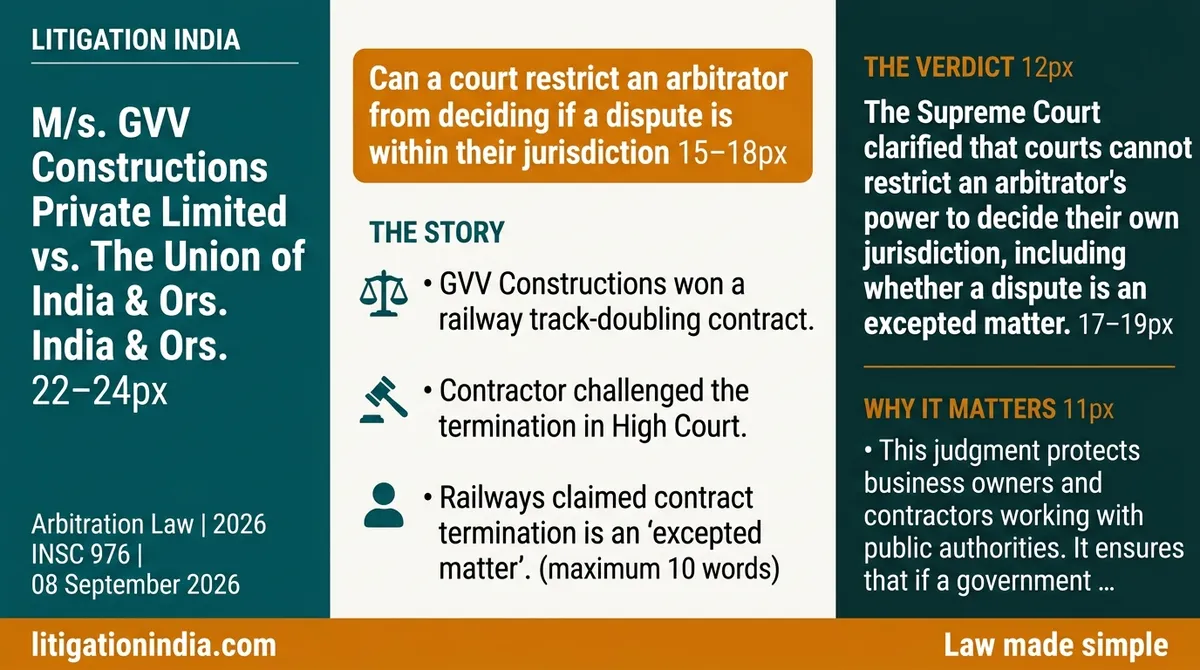
In short
This case arose from a contract dispute between M/s GVV Constructions Private Limited and the South Central Railway. The railway invited bids for track-doubling work, and the appellant's bid was accepted. However, due to delays, the railway terminated the contract under Clause 62 of the General Conditions of Contract (GCC), forfeiting the performance security. The contractor challenged this termination in the High Court. While the Single Judge dismissed the writ petition citing complex factual disputes, the Division Bench directed the dispute to an arbitrator. Crucially, the Division Bench added a direction that the arbitrator must decide all claims "strictly in accordance with the terms of the contract." The contractor approached the Supreme Court, fearing this phrase would prevent the arbitrator from deciding whether the termination of the contract was illegal, as the railways argued termination was an "excepted matter" (not open to arbitration) under the GCC. The Supreme Court ruled in favor of the contractor's autonomy in arbitration. It held that under Section 16 of the Arbitration and Conciliation Act, 1996, the arbitrator has the primary jurisdiction (known as the Kompetenz-Kompetenz principle) to decide whether a particular dispute is arbitrable or if it is an "excepted matter". A High Court exercising discretionary writ jurisdiction under Article 226 of the Constitution cannot restrict or dictate in advance how an arbitrator should determine their own jurisdiction. Therefore, the Supreme Court clarified that the High Court's directions would not limit the arbitrator's power to decide on the validity of the contract's termination.
Background
The South Central Railway terminated GVV Constructions' railway line contract due to delays and forfeited their security deposit. The contractor challenged this in the High Court, which referred the matter to an arbitrator but restricted the arbitrator to decide strictly within the contract terms, raising fears that the validity of the termination itself could not be questioned.
The Decision
The Supreme Court clarified that High Court directions cannot limit or block the arbitrator's authority. Under Section 16 of the Arbitration Act, the arbitrator alone must first decide whether the contract's termination is an "excepted matter" or if they have the power to judge it.
Why it matters for you
This judgment protects business owners and contractors working with public authorities. It ensures that if a government body unfairly terminates a contract, the independent arbitrator has full authority to scrutinize the action without being constrained by pre-emptive court directions.
Relevant Legal Provisions
Key Acts and sections cited or relied upon in this judgment
“Empowers the arbitrator to decide whether they have the authority to hear a case, including any objections regarding the scope of the agreement.”
“Gives High Courts the power to issue orders and writs to protect fundamental and legal rights, but this power should not interfere with the independent role of an arbitrator.”
AI-assisted summary, reviewed and verified by our editorial team.
In the Court's words
“Whether the dispute regarding termination is, in whole or in part, an “excepted matter” outside the Arbitrator's jurisdiction, and, if so, what remedy survives to the appellant in that behalf, are questions that Section 16 of the Act commits to the Arbitrator in the first instance.”
“It was not open to the Division Bench, in the exercise of its writ appellate jurisdiction, to prescribe in advance the manner of, or to place constraints upon, that adjudication.”
Need help with your case?
Facing a similar legal challenge in the Supreme Court or High Court? Connect with our pro bono volunteer advocates today.
Related Supreme Court services