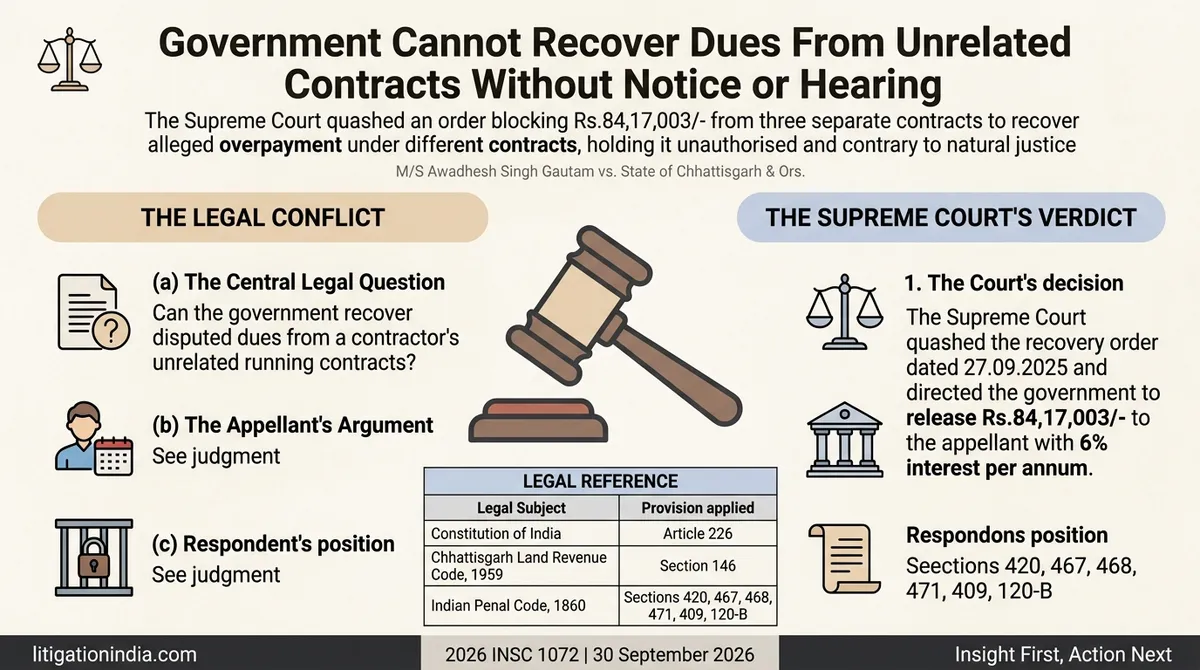
Full text of the judgment
Text extracted from M/S Awadhesh Singh Gautam vs. State of Chhattisgarh & Ors.. For the authoritative version refer to the Supreme Court of India's official website.
2026 INSC 1072 1 NON-REPORTABLE IN THE SUPREME COURT OF INDIA CIVIL APPELLATE JURISDICTION
CIVIL APPEAL NO. OF 2026 (@ S.L.P. (C) No. 10464 of 2026)
M/S AWADHESH SINGH GAUTAM ... APPELLANT Vs. STATE OF CHHATTISGARH & ORS. ... RESPONDENTS WITH CIVIL APPEAL NO. OF 2026 (S.L.P. (C) No. 12766 of 2026)
AND CIVIL APPEAL NO. OF 2026 (@ S.L.P. (C) No. 12346 of 2026)
J U D G M E N T ALOK ARADHE, J. 1. Leave granted. 2. These three appeals arise out of three orders, each dated 07.01.2026, passed by the High Court1, whereby three writ petitions instituted by M/s Awadhesh Singh Gautam, a partnership firm ("the appellant"), were dismissed. Since the three orders are, in substance, identical and the appeals turn upon a common question arising from a common factual
1 High Court of Chhattisgarh at Bilaspur Digitally signed by KAPIL TANDON Date: 2026.09.30 17:41:28 IST Reason: Signature Not Verified
2 matrix, they were heard together and are disposed of by this common judgment. THE FACTUAL MATRIX 3. The controversy has its genesis in three works awarded to the appellant. Pursuant to notices inviting tenders issued by the Chhattisgarh Rural Road Development Agency ("CGRRDA"), the appellant was awarded three packages under the Pradhan Mantri Gram Sadak Yojana ("PMGSY"), for which work orders came to be issued on 01.09.2023 and 05.11.2024 ("the subsequent works"). 4. Having executed approximately 40% of the work under each of the subsequent works, the appellant raised running bills aggregating Rs.39,78,500/- (Rupees Thirty-Nine Lakh Seventy- Eight Thousand Five Hundred only), Rs.45,62,000/- (Rupees Forty-Five Lakh Sixty-Two Thousand only) and Rs.23,55,000/- (Rupees Twenty-Three Lakh Fifty-Five Thousand only) respectively. Reminders followed on 22.09.2025 and 25.09.2025, but the amounts billed remained unreleased. 5. The appellant had earlier, on 03.01.2023, been awarded two separate contracts for construction of two roads at 10.10% above the Schedule of Rates, at an approved cost of
3 approximately Rs.437.43 lakhs ("the earlier works"), under which a substantial part of the contract value had already been paid. 6. Complaints of irregularity in execution of the earlier works led the Collector, South Bastar, Dantewada, to constitute a fivemember committee. The committee, by its report dated 09.01.2024, found that although Rs.3,55,82,055/- (Rupees Three Crore Fifty-Five Lakh Eighty-Two Thousand Fifty Five only) had been paid to the appellant, the value of work actually executed was only about Rs.1,54,75,938/- (Rupees One Crore Fifty-Four Lakh Seventy-Five Thousand Nine Hundred Thirty- Eight only), disclosing an excess payment of Rs.2,01,06,117/- (Rupees Two Crore One Lakh Six Thousand One Hundred Seventeen only). It recommended recovery of the said sum, blacklisting of the appellant, a probe into its other works, and departmental action against the concerned officers of the CGRRDA. 7. Acting on this report, the Collector, by memo dated 03.06.2024, directed the Tehsildar to recover Rs.2,01,06,117/- (Rupees Two Crore One Lakh Six Thousand One Hundred Seventeen only) from the appellant. The Tehsildar accordingly registered a
4 revenue case and issued a demand note dated 16.12.2024 under Section 146 of the Chhattisgarh Land Revenue Code, 1959, calling upon the appellant to pay the amount within ten days. 8. The demand note was assailed in a writ petition. By order dated 05.03.2025, the High Court quashed it for want of notice or hearing to the appellant, being violative of natural justice, while reserving liberty to the respondents to act upon the committee's report afresh, in accordance with law and after complying with the principles of natural justice. 9. In the meanwhile, upon a complaint by an Assistant Engineer of CGRRDA, a First Information Report came to be registered against Mr. Awadhesh Singh Gautam, partner of the appellant firm, and officers of CGRRDA, for offences under Sections 420, 467, 468, 471, 409 and 120-B of the Indian Penal Code, 1860. A chargesheet was filed on 30.12.2025 upon completion of investigation. 10. Independently of the criminal proceedings, and drawing upon the inspection report of the District Level Investigation Team dated 18.12.2024, the reinspection report of the Departmental Supervising Engineer dated 28.10.2024, and a final re-
5 evaluation undertaken by the Departmental Sub-Engineer, the Executive Engineer-cum-Member Secretary, Project Implementation Unit K-01 ("the Executive Engineer"), passed an order dated 27.09.2025 ("the recovery order"). By this order, a sum of Rs.84,17,003/- (Rupees Eighty-Four Lakh Seventeen Thousand and Three only) was blocked out of amounts currently payable to the appellant, to be recovered by deduction from the three subsequent works in the sums of Rs.28,00,000/- (Rupees Twenty Eight Lakh only), Rs.38,00,000/- (Rupees Thirty Eight Lakh only) and Rs.18,17,003/- (Rupees Eighteen Lakh Seventeen Thousand and Three only) respectively. 11. The appellant's representation dated 09.10.2025 to the Executive Engineer, pointing out that the deductions were being made from bills payable under contracts wholly distinct from the earlier works out of which the alleged liability arose, and seeking a refund of Rs.84,17,003/- (Rupees Eighty-Four Lakh Seventeen Thousand and Three only) within fifteen days, elicited no response. 12. Three writ petitions came to be filed assailing the recovery order and seeking release of the amounts deducted. By the impugned common order dated 07.01.2026, the High Court held that the
6 relief claimed was contingent upon adjudication of disputed questions of fact, which could not be undertaken in proceedings under Article 226 of the Constitution, and dismissed the writ petitions, reserving liberty to the appellant to pursue such alternate remedy as may be available in law. 13. It is in this backdrop that these appeals fall for our consideration. RIVAL SUBMISSIONS 14. Mr. Gaurav Agrawal, learned senior counsel for the appellant, submitted that the recovery order was passed without notice or opportunity of hearing, in violation of Clause 4.1 of the Special Conditions of Contract contained in the Standard Bidding Document ("SBD"), which alone contemplates recovery consequent upon technical audit and that too after hearing the contractor. It was urged that appropriation of amounts payable under one contract towards a liability alleged to arise under an altogether different contract is impermissible, and that Clauses 43 and 53, dealing respectively with security deposit and payment upon termination, have no bearing on the recovery in question. It was highlighted that a sum of Rs.1,07,02,594/- (Rupees One Crore Seven Lakh Two Thousand Five Hundred
7 Ninety-Four only) remained payable to the appellant under the very earlier works out of which the alleged liability is said to arise, yet the respondents chose to recover from three unconnected and ongoing contracts instead. Reliance was placed on a decision of this Court2. 15. Mr. Bishwajit Dubey, learned Additional Advocate General for the State, submitted that the power of cross-contract recovery flows expressly from the contract. Reliance was placed on Clause 7(iv) of the Pre-Contract Integrity Pact and Clause 38 of the Conditions of Contract, both of which, it was submitted, permit recovery of dues under one contract from sums payable under another, and on Clauses 44.1 and 53.1(ii) of the General Conditions of Contract in the SBD. It was submitted that the allegation against the appellant is not a mere billing discrepancy but one of manipulation of measurement books to draw excess payments from public funds, that a contractual set-off founded on agreement is enforceable on that basis alone, and that the appellant cannot claim the benefit of the contract while disowning the burden it places upon it. Reliance in
2 ABL International Ltd. & Anr. v. Export Credit Guarantee Corporation of India Ltd. & Ors., (2004) 3 SCC 553, paras 26-28
8 support of these submissions was placed on the decisions of this Court3. 16. We have heard learned counsel for the parties and perused the record. POINTS FOR DETERMINATION 17. The following questions arise for determination in these appeals: (i) Whether the recovery order dated 27.09.2025 is traceable to the contractual clauses relied upon by the respondents? (ii) Whether, even if so traceable, it satisfies the conditions that such a clause prescribes and whether the recovery order has been passed in violation of principles of natural justice? (i) WHETHER THE IMPUGNED RECOVERY IS TRACEABLE TO THE CONTRACT? 18. We deal with the clauses of the General Conditions of Contract, the Special Conditions of Contract, the Pre-Contract Integrity
3 Caretel Infotech Ltd. v. Hindustan Petroleum Corporation Limited (HPCL) & Ors., (2019) 14 SCC 81, para 24; Bharti Airtel Ltd. & Anr. v. Vijaykumar V. Iyer & Ors., (2024) 4 SCC 668, paras 15-19; State of Gujarat & Anr. v. Amber Builders, (2020) 2 SCC 540, paras 20-21; H.M. Kamaluddin Ansari and Co. v. Union of India & Ors., (1983) 4 SCC 417, paras 29 and 31; Nabha Power Limited (NPL) v. Punjab State Power Corporation Limited (PSPCL) & Anr., (2018) 11 SCC 508, para 72 and Union of India & Ors. v. N. Murugesan & Ors., (2022) 2 SCC 25, para 26
9 Pact, and the Conditions of Contract on which the respondents have placed reliance, to examine whether the recovery order can be justified by reference to any of them. 19. Clause 44.1 of the General Conditions of Contract in the SBD reads thus: "44.1 In the event of failure on part of the Contractor to achieve timely completion of the project, including any extension of time granted under Clause 27, he shall, without prejudice to any other right or remedy available under the law to the Employer on account of such breach, pay as agreed liquidated damages to the Employer and not by way of penalty in a sum calculated at the rate per week or part thereof as stated in the Contract Data. For the period that the Completion Date is later than the Intended Completion Date, liquidated damages at the same rate shall be withheld if the Contractors fails to achieve the milestones prescribed in the Contract Data. However, in case the Contractor achieved the next milestone, the amount of the liquidated damages already withheld shall be restored to the Contractor by adjustment in the payment certificate. Both the Parties expressly agree that the total amount of liquidated damages shall not exceed 10% (ten percent) of Initial Contract Price and that the liquidated damages payable by the Contractor are mutually agreed genuine preestimated loss and without any proof of actual damage likely to be suffered and incurred by the Employer; and the Employer is entitled to receive the same and are not by way of penalty.
10 The Employer may, without prejudice to any other method of recovery, deduct the amount of such damages from any sum due, or to become due to the Contractor or from Performance Security or any other dues from Government or semi Government bodies within the state. The payment or deduction of such damages shall not relieve the Contractor from his obligations to complete the Works, or from any other of his duties, obligations or responsibilities under the Contract. The Contractor shall use and continue to use his best endeavours to avoid or reduce further delay to the Works, or any relevant Stages.” 19.1 On a plain reading, this clause is confined to liquidated damages for delay in achieving completion or contractual milestones, capped at ten per cent of the initial contract price. The recovery order has never been founded on a claim, quantified or otherwise, for liquidated damages for delay; it proceeds instead from an allegation of overpayment detected on technical audit, a subject dealt with specifically, and exclusively, by Clause 4.1 of the Special Conditions of Contract. Clause 44.1, therefore, furnishes no foundation for the recovery order. 20. We next consider Clause 53.1(ii) of the General Conditions of Contract, which reads:
11 "53.1(ii) If the Contract is terminated because of a fundamental breach of contract by the Contractor due to non compliance of the requirements of clause 32 of GCC regarding defects liability period and routine maintenance of roads for five years, the Engineer will assess the cost of having the defect corrected. If the total amount due to the Employer exceeds any payment due to the Contractor, the difference shall be recovered from the Security Deposit and Performance Security. If any amount is still left un-recovered, it will be recovered from any dues payable to the Contractor from State PMGSY works, any other State Government works including State Public Sector works executed by the Contractor. If any amount still remains unrecovered, it shall be recovered as arrears of land revenue. " 20.1 This clause is attracted only where a contract is terminated for the contractor's fundamental breach of its defects-liability and five-year maintenance obligations under Clause 32, and only to the extent the assessed cost of rectification exceeds what can be recovered from the security deposit and performance security of that very contract; recourse to dues under other State works follows only in that residual contingency. There is nothing on record to show that either the earlier works or the subsequent works were ever terminated, still less terminated on the ground of breach of defects-liability or maintenance obligations under Clause 32. The recovery here rests on an
12 allegation of manipulation of measurement books during execution, a ground altogether distinct from post-completion default in defect-liability maintenance. Clause 53.1(ii) is thus not attracted, and the cross-contract mechanism it contains cannot be pressed into service to sustain the recovery order. 21. Clause 7(iv) of the Integrity Pact, described as a sanction for its violation, reads as follows: “7. SANCTIONS FOR VIOLATIONS 7(iv) To recover all sums already paid by the BUYER, and in case of the Indian BIDDER with interest thereon at 2% higher than the prevailing Prime Lending Rate. While in case of a BIDDER from a country other than India with interest thereon at 2% higher than the LIBOR. If any outstanding payment is due to the BIDDER from the BUYER in connection with any other contract such outstanding payment could also be utilized to recover the aforesaid sum and interest.” 21.1 This clause does contemplate recovery, with interest, from dues payable under any other contract; but its invocation necessarily presupposes a prior determination, arrived at through whatever process the pact itself prescribes, that the bidder has in fact violated the pact in relation to the contract in question. The recovery order neither refers to the Integrity Pact nor records any finding that it stands violated. It cannot, therefore, be said that
13 the recovery has in fact been made under Clause 7(iv) of the Integrity Pact. 22. Clause 38 of the Conditions of Contract, reads as follows: “CONDITIONS FOR CONTRACT Clause 38- On the breach of any term or condition of this contract by the contractor the said Governor shall be entitled to forfeit the Security deposit or the balance thereof that may at the time be remaining, and to realise and retain the same as damages and compensation for the said breach but without prejudice to the right of the Governor to recover further sums as damages from any sums due or which may become due to the contractor by Government or otherwise howsoever.” 22.1 The language of Clause 38 is undoubtedly wide enough, once validly invoked, to permit recovery of sums payable under other contracts. But its invocation is conditional upon breach of a term or condition of the contract being first ascertained, and upon forfeiture being effected as damages and compensation for that breach; this in turn obliges the Government to ascertain the breach and to apprise the contractor of it, so that he may meet the allegation. The recovery order records no finding of breach, and no notice preceded it. The action in question cannot, therefore, be said to have been taken under Clause 38.
14 23. This brings us to Clause 4.1 of the Special Conditions of Contract, which alone answers the description of what the respondents purported to do, namely, a technical audit of the earlier works resulting in a finding of overpayment and consequential recovery. It reads:
4.1 Technical Examination “The Government / CGRRDA /C.E. /C.E.O /S.E./ Engineer-in-charge shall have the right to cause Audit and Technical Examination of the works and the final bills of the contractors including all supporting vouchers, abstracts etc., to be made as per payments of the final bills and if as a result of such Audit & Technical Examination any sum found to have been overpaid in respect of any work done by the contractor under the contract or any work claimed by him to have been done under the contract and found not to have been executed, the contractor shall be liable to refund the amount of over payment and it shall be lawful for the Government of Chhattisgarh /CGRRDA/ Engineerin-charge to recover the same from the security deposit of the contractor or from any dues payable to the contractor from the Engineer-in-Charge account. If it is found that the contractor was paid lesser than what was due to him under the contract in respect any work executed by him under it, the amount of such under payment shall be duly paid by the Engineer-in-Charge to the contractor. In the case of any audit examination and recovery consequent on the same the contractor shall be given an opportunity to explain
15 his case and decision of the government/employer shall be final binding and conclusive. In the case of Technical Audit, consequent on which there is a recovery from the contractor, no recovery should be made without orders of CEO, CGRRDA whose decision shall be final. All action under this clause should be initiated and intimated to the contractor within a period of twelve months from the date of completion.”
23.1 This clause permits recovery from the security deposit of the contractor, or from dues payable to the contractor, from the account pertaining to the very work audited, that is, the earlier works. It is not in dispute that a sum of about Rs.1.07 crore remained due to the appellant under the earlier works themselves, yet the respondents took no step to appropriate that amount; they chose instead to recover from three unconnected and ongoing packages. Clause 4.1 further makes it obligatory that the contractor be given an opportunity to explain his case before any recovery consequent on audit, and mandates that "no recovery should be made without orders of CEO, CGRRDA whose decision shall be final". It is common ground that no such opportunity was afforded, and the recovery order, issued by the Executive Engineer alone, does not disclose that the approval of the Chief Executive Officer, CGRRDA, was ever obtained. The clause additionally requires that action be initiated and
16 intimated to the contractor within twelve months of completion of the audited work, and no material has been placed before us to establish the date of completion of the earlier works. Clause 4.1, therefore, also cannot sustain the recovery order. 24. It follows that none of the clauses relied upon by the respondents, whether read singly or cumulatively, authorises either the deduction of the disputed amount from the three subsequent contracts, or the manner in which it was effected. (ii) WHETHER THE RECOVERY ORDER SATISFIES THE CONDITIONS THAT THE CLAUSE PRESCRIBES AND WHETHER THE RECOVERY ORDER HAS BEEN PASSED IN VIOLATION OF PRINCIPLES OF NATURAL JUSTICE?
25. We are not unmindful that the allegations against the appellant in respect of the earlier works are of a serious character and are already the subject of departmental inquiry and of criminal proceedings arising out of Chargesheet No. 87 of 2025; nothing said in this judgment touches upon their merits. That, however, does not answer the second question framed above, namely, whether the manner of recovery satisfies the conditions Clause 4.1 itself prescribes. Clause 4.1 incorporates within itself, certain principles of natural justice. As already noticed, the recovery order was passed without notice, consent and sanction,
17 and no other clause, nor any provision of law, permits the amount said to be due under the earlier works to be adjusted against sums payable under a separate and subsisting contract without the contractor's consent. Until the alleged overpayment is established in accordance with law, it remains, a disputed and unadjudicated claim for damages and not a debt presently due4; and a party to a contract cannot, merely because it also holds amounts otherwise payable under it, treat such a claim as though it were an ascertained debt and appropriate those amounts in satisfaction of it. Therefore, the recovery effected by the recovery order was not only in contravention of the conditions prescribed in the clause but also in flagrant violation of principles of natural justice. 26. The High Court fell into error on the ground that the relief claimed was contingent upon resolution of disputed questions of fact touching the earlier works, which could not be gone into under Article 226 of the Constitution. The question before it was whether the respondent-State was justified in appropriating that very disputed amount from money admittedly payable to the
4 Union of India v. Raman Iron Foundry, (1974) 2 SCC 231
18 appellant under the three subsequent contracts, contracts that have nothing to do with the earlier works. 27. For the reasons set out above, neither the agreement governing the contracts consented to by the contractor nor any provision of law permits such appropriation, and that question turns entirely on the construction of the contract and compliance with its terms, not on the resolution of the disputed facts pertaining to the earlier works. CONCLUSION AND DIRECTIONS 28. For the foregoing reasons, the recovery order dated 27.09.2025 cannot be sustained in law and is quashed and set aside. The respondents are directed to release to the appellant the sum of Rs.84,17,003/- (Rupees Eighty-Four Lakh Seventeen Thousand and Three only), together with interest thereon at the rate of 6% per annum from 27.09.2025 till the date of actual payment. 29. We clarify that this judgment shall not preclude the respondents from taking recourse to appropriate proceedings, in accordance with law, for recovery of any amount that may ultimately be found due from the appellant in respect of the earlier works. We further clarify that the observations contained in this judgment
19 are confined to the legality of the manner in which the impugned recovery was effected, and shall have no bearing on: (a) the pending criminal proceedings arising out of Chargesheet No. 87 of 2025; or (b) the correctness or quantum of the alleged overpayment in respect of the earlier works, both of which shall be examined and decided independently and strictly on their own merits. 30. The appeals are allowed in the above terms. There shall be no order as to costs. 31. Pending application(s), if any, shall stand disposed of.
........................................................J. [PAMIDIGHANTAM SRI NARASIMHA]
........................................................J. [ALOK ARADHE]
NEW DELHI; SEPTEMBER 30, 2026.