Full text of the judgment
Text extracted from M/S ASJ Finsolutions Pvt. Ltd. vs Vikram Bajaj. For the authoritative version refer to the Supreme Court of India's official website.
2026 INSC 1062 CA No. 13023 of 2025 Page 1 of 15
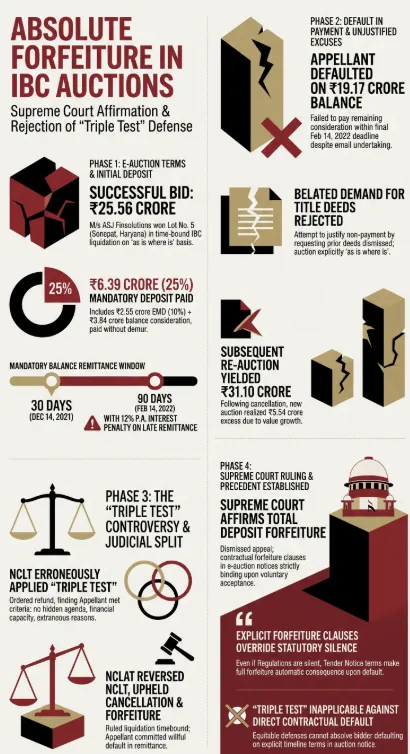
Non-Reportable
IN THE SUPREME COURT OF INDIA CIVIL APPELLATE JURISDICTION
Civil Appeal No.13023 of 2025
M/S ASJ FINSOLUTIONS PVT. LTD. ...Appellant(s)
VIKRAM BAJAJ
...Respondent(s)
J U D G M E N T
K. VINOD CHANDRAN, J.
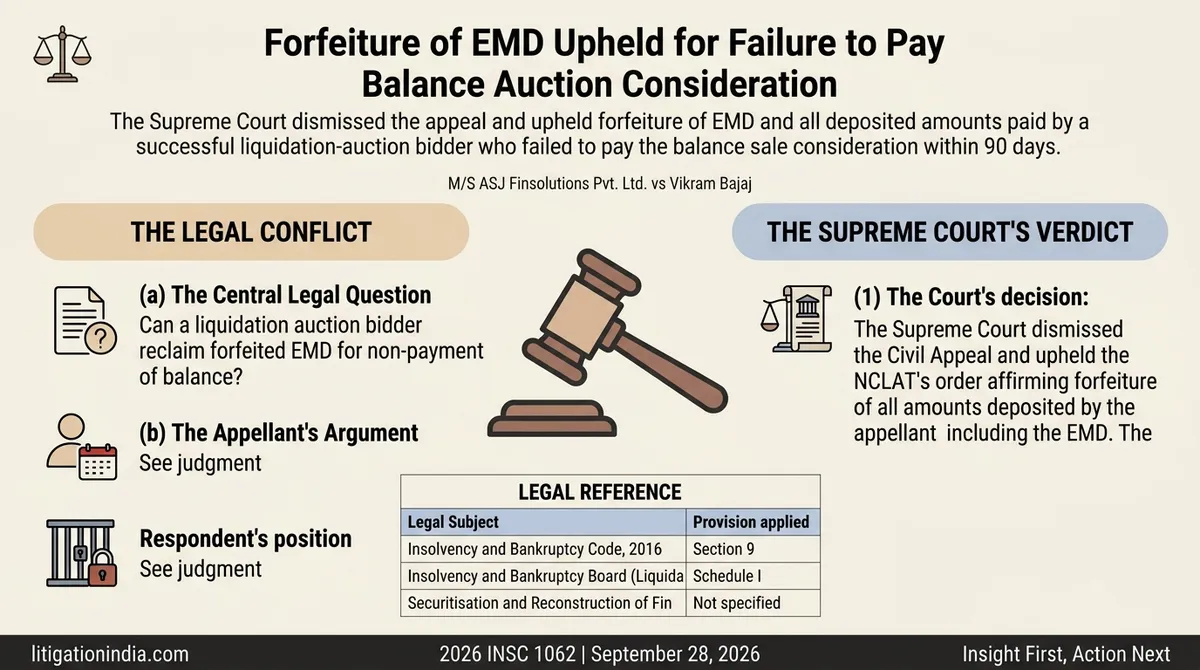
The appellant is the successful bidder in an auction conducted in the liquidation process initiated by the Resolution Professional (RP) appointed under the Insolvency and Bankruptcy Code, 20161, aggrieved with the impugned order of the National Company Law Appellate Tribunal (NCLAT), which reversed the order of the National Company Law Tribunal (NCLT) and affirmed the forfeiture of Earnest Money Deposit (EMD) for reason of the successful bidder having not paid the balance sale consideration within 90 days.
1 Hereinafter referred to as ‘IBC’ Digitally signed by VISHAL ANAND Date: 2026.09.28 18:35:39 IST Reason: Signature Not Verified
CA No. 13023 of 2025 Page 2 of 15
2. We heard Ms.Meenakshi Arora, learned Senior Counsel for the appellant and Mr. Abhishek Anand, learned Counsel for the respondent-Resolution Professional (RP) of the Corporate Debtor (CD). 3. The subject property; Lot No.5-measuring 68K, 17M situated at Village Nangal Khurd Tehsil, Sonepat, Haryana, with a reserve price of Rs.25.56 crores was auctioned along with many other properties owned by the CD, through an e-auction notice for sale dated 25.10.2021. On the background facts, suffice it to notice that an Operational Creditor had approached the NCLT under Section 9 of the IBC. After admitting the CP, an Interim Resolution Professional (IRP) was appointed and later, the first respondent, as the RP. Despite expression of interest having been received by the IRP, none submitted a Resolution Plan. After replacement of the IRP by the RP, time was extended, within which, no Resolution Plan came to be filed, in which circumstance, a liquidation was proposed and approved by the NCLT. A suspended Director approached the NCLAT against the order of liquidation, which was dismissed by the NCLAT. Public notice was taken out and even according to the appellant with respect to Lot No.5, it was specifically indicated in a Note that
CA No. 13023 of 2025 Page 3 of 15
there was a civil suit pending, regarding the sale deed of the land pertaining to 6M and the Liquidator was filing an application for obtaining the custody of the same. The sale was also on an ‘as is where is’ basis and the appellant bid at the reserve price and succeeded. 4. At the time of bidding, the appellant, as required under the E-Auction Notice, had furnished EMD. The auction was conducted on 15.11.2021 and within 30 days i.e., by 14.12.2021, the balance was to be remitted. There was also a further provision for remitting the balance within 90 days from the date of auction, provided interest is paid @12% per annum. The 90 days period would have expired on 14.02.2022. Admittedly on 15.12.2021, the appellant e-mailed the RP, specifically indicating their intention to pay the balance of Rs.19.17 crores within 14.02.2022, with interest @12% per annum. 5. Later noticing an order obtained by one M/s Agarwal Trading Company, from the Punjab & Haryana High Court at Chandigarh, wherein the writ petition, though, rejected, there was a direction to approach the NCLT, Chandigarh Bench, for seeking appropriate relief. The High Court had also directed that no sale deed was to be executed by the Liquidator herein, since
CA No. 13023 of 2025 Page 4 of 15
M/s Agarwal Trading Company was granted time till 14.02.2022; which was the last date to make the full payment, of the balance sale consideration with 12% interest, as applicable to the appellant. M/s Agarwal Trading Company, concerned with the very same Lot No.5 filed an application before the NCLT on 11.02.2022 and withdrew the same on 22.09.2022. 6. The appellant admittedly did not pay the balance sale consideration and is said to have sought for the prior deeds with respect to the property on 11.02.2022, by Company Application No.85 of 2022 before the NCLT, which was rejected on 31.03.2023. An appeal filed, also stood dismissed by order dated 21.04.2023 which was challenged in a Writ Petition before the Punjab and Haryana High Court. While the writ petition was pending, fresh auction of the subject property took place and the same was sold for a price of Rs.31.10 crores; Rs.5.54 crores in excess of the bid of the appellant. The High Court subsequently rejected the prayer of the appellant for prior deeds and reserved liberty to the appellant to avail remedies as available in accordance with law. 7. Banking on the said liberty reserved, the appellant again initiated proceedings before the NCLT seeking annulment of
CA No. 13023 of 2025 Page 5 of 15
forfeiture of EMD and refund of the same. The NCLT allowed it, which was reversed by the NCLAT, which order is impugned herein. 8. Learned Senior Counsel for the appellant contended that as per the Insolvency and Bankruptcy Board (Liquidation Process) Regulations, 20162, specifically Schedule I, there was no stipulation of forfeiture of EMD. In fact, the Schedule specifically stipulates that there can be only 10% of the estimated value demanded as EMD. It is further argued that there were other bidders, who were granted extension of time beyond the 90 days by the NCLT and the appellant was discriminated. It is also pointed out that the NCLT specifically looked at the Triple Test as propounded by this Court and found the same in favour of the appellant, thus, resulting in the direction to refund. It is argued, placing reliance on Authorised Officer, Central Bank of India v. Shanmugavelu3, that therein the forfeiture was found to be a statutory imprimatur under the Securitisation and Reconstruction of Financial Assets and Enforcement of Security Interest Act, 2002, which being absent
2 Regulations, 2016 3 (2024) 6 SCC 641
CA No. 13023 of 2025 Page 6 of 15
in the present case, the forfeiture itself is wrong. If at all, without prejudice to the arguments addressed, the learned Senior Counsel for the appellant submits, if the forfeiture is approved, then it can be only of 10% of the reserve price of the property. 9. Learned Counsel for the respondent-RP, however, points out that the appellant very well knew about the dispute with respect to the sale deed of the property and with open eyes, bid at the auction. The EMD as per the auction notice was only 10% of the reserve price. The 25% deposit was including a portion of the balance sale consideration, as required by the Liquidator; which was complied without any protest. The appellant cannot be allowed to turn around and rely on the statutory regulations to raise arguments against the forfeiture of amounts deposited including the EMD, on failure to deposit the balance amounts, since it is a condition in the e-auction notice. 10. It is pointed out that if the appellant had deposited the amounts and there was any difficulty in handing over the possession and ownership, definitely the appellant would have had the remedy of seeking refund with interest. As of now, a third-party who succeeded in a subsequent auction, has been inducted into the property and there was no difficulty expressed
CA No. 13023 of 2025 Page 7 of 15
by that third-party in taking over ownership and possession. The forfeiture was a specific term in the e-auction notice and none can resile from it. The order of the NCLT on the Triple Test is against the order of the NCLT and the NCLAT in the earlier round; when the request of prior deeds was declined, specifically finding default on the appellant, leading to cancellation of the bid. When cancellation has been upheld, there is no question of raising contentions against the forfeiture, which is a necessary consequence. 11. That the appellant who was the successful bidder did not pay the balance sale consideration within the initial 30 days or with 12% interest within 90 days, is admitted. What remains is only the consideration as to whether the refusal was bona fide, especially in the circumstances as pointed out by the appellant. We see from Schedule I of the Liquidation Process Regulations that there is a stipulation that EMD should not be more than 10%; brought in on 30.09.2021 and there is no forfeiture expressly provided, in the event of failure to pay the balance sale consideration. As pointed out by the learned Counsel for the respondent, the terms are explicit in the Tender Notice and the appellant, with open eyes, bid in auction as also deposited the
CA No. 13023 of 2025 Page 8 of 15
amounts demanded without any protest. Having deposited 10% of the reserve price, along with a portion of the balance sale consideration, which itself is an undertaking to pay the balance amounts within a period of 30 days or 90 days with interest, brings in the consequences of forfeiture, on failure; which is automatic. 12. In the present case, the bidder had specifically sent an email just one day after the 30-day period was over, undertaking to pay the balance amounts with interest due before the 90th day. A request was made for prior deeds, which, in any event, was not permissible at that distance of time, since the auction notice was issued on an ‘as is where is’ basis and it specifically indicated the non-availability of sale deeds with respect to a portion of the property. The appellant having not sought for verification of title deeds before the bid was made or the EMD was deposited, cannot project it as a requirement to resile from payment of the balance sale consideration. The argument of absence of stipulation of forfeiture, in the regulations also falls flat in the wake of the specific condition in the auction notice, which made forfeiture an inevitable consequence on failure to deposit the balance sale consideration.
CA No. 13023 of 2025 Page 9 of 15
13. The NCLT also specifically noticed and extracted the condition in the auction notice, which threatened forfeiture of the EMD and any other amounts deposited, if the successful bidder fails to pay the balance sale consideration as per the terms of the sale. However, the NCLT relied on the decisions of this Court and found the Triple Test to be satisfied in the case of the appellant. The Triple Test propounded is with respect to the bidder having: (i) acted with a hidden agenda to rig the auction; (ii) turned out to be not a genuine bidder with adequate financial capacity; or (iii) been prevented by any extraneous reasons from making full payment of the balance sale consideration. 14. The NCLT found that in the forfeiture communication, there was no hidden agenda mentioned and in the facts and circumstances coming out from the case, there is nothing to show the mala fide intention of the appellant to frustrate the auction process. Insofar as the financial capacity, the NCLT referred to the e-mail communication dated 15.12.2021, where the appellant had promised to pay the balance sale consideration within 14.02.2022 and the offer made by the appellant even after dismissal of the appeal by the NCLAT, to make the payment with interest. As to any extraneous considerations, the direction in the
CA No. 13023 of 2025 Page 10 of 15
writ petition filed by M/s Agarwal Trading Company, was found to have given the appellant a bona fide reason not to make a deposit. 15. The NCLAT disagreed with the order of the Tribunal and we agree with such disagreement expressed. The NCLAT specifically noticed the Note with respect to the sale deed of the land covered by Lot No.5, explicitly mentioned in the auction notice and the forfeiture clause on failure of the successful bidder to pay the balance sale consideration within the time stipulated. The NCLAT found that in the earlier round, the appellant had sought for prior sale deeds of the subject property and it was categorically found that the appellant had wilfully defaulted in the payment of the balance amount of Rs.19.17 crores within the stipulated period. Especially considering the fact that the liquidation proceedings are strictly timebound and sufficient time had already elapsed from the default in payment. The NCLAT in its earlier order also blamed the appellant for not making the balance payment within the stipulated time, which was found to be a wilful default on the part of the appellant. The contention of the appellant that merely because the cancellation
CA No. 13023 of 2025 Page 11 of 15
of the bid was upheld, that would not affect refund of EMD, cannot at all be countenanced. 16. Looking at the specific clause threatening forfeiture on failure of payment of balance sale consideration, on cancellation, forfeiture is a necessary consequence and there is no application of the Triple Test, on facts herein, to absolve the appellant from such forfeiture. The mere failure to make the balance sale consideration was to rig the auction proceedings, in which circumstance, admittedly, there was a fresh auction proposed and there was a higher value received on such auction. The higher value received is only because of the inherent value of the property and is not in set off, of the expenses incurred. The proof of financial capacity, is not in the repeated communications agreeing to pay the money, but should be insofar as materials produced substantiating the capacity and not mere assertions made. In fact, the assertion made, specifically by an e-mail communication, also emphasized by the NCLAT, was long prior to the expiry of the 90 days, at which point, the appellant was aware of the cloud over the sale deeds. There was no query made as to the verification of sale deeds any time during the bid
CA No. 13023 of 2025 Page 12 of 15
process which, in any event, was not possible at a later point of time, that too, just prior to the date of full deposit. 17. The extraneous consideration pointed out by the appellant is just an afterthought. M/s Agarwal Trading Company, based on the directions in the writ petition, merely filed an application and withdrew the same, a little later. The fallacy of the claim is evident from the facts, and this is merely projected as an excuse to scuttle the process of auction and to absolve the appellant from the liability to pay the balance sale consideration. 18. The appellant also has an argument with respect to discrimination insofar as another auction purchaser having been granted time to deposit the balance sale consideration, which benefit was not given to the appellant. For one, this was a contention, the appellant could have taken at the first instance when the proceedings were initiated before the NCLT for supply of prior deeds which travelled upto the High Court and attained finality on the rejection of the prayer made. Again, none of the orders were produced before us for the respondent to respond on the same. The orders have been produced along with the written submissions which we are not inclined to look into. In any event, as we found, it is too late in the day for the
CA No. 13023 of 2025 Page 13 of 15
appellant to raise a contention of discrimination, especially when, but for the assertion of willingness to pay, there is nothing produced to substantiate the capacity to pay the balance consideration, as on the last date. 19. Be that as it may, one contention raised by the learned Senior Counsel for the appellant is that under Schedule I of the Regulation of 2016, it is specifically provided that the EMD shall not exceed 10% of the reserve price. The respondent relies on the decision in Westcoast Infraprojects Private Limited v. Mr. Ram Chandra Dallaram Choudhary4 and Potens Transmission & Power Pvt Ltd v. Apex Buidlsys Ltd (In Liquidation)5, which decisions have been affirmed by this Court respectively in Civil Appeal No.4087 of 2023 and Civil Appeal No.4116 of 2022. Westcoast Infraprojects Private Limited4 approved by this Court in a Civil Appeal, upheld the forfeiture, as per the clause in the e-auction notice, of both the EMD and any other deposit made by the bidder, in the event of the failure of the successful bidder to pay on time the balance sale consideration.
4 Company Appeal (AT) (Ins) No.1258 of 2022 5 Company Appeal (AT) (Ins) No.1543 of 2023
CA No. 13023 of 2025 Page 14 of 15
20. The respondent points out from Annexure R12, that in fact, the EMD stipulated was only Rs.2.55 crores which is only 10% of the reserve price of Rs.25.56 crores for Lot No.5. The Liquidator, vide email dated 15.11.2021 informed the appellant that against the total bid of Rs.25,56,00,000/-, 25% of the bid amount amounting to Rs.6,39,00,000/- which included Rs.2.55 crores EMD and a portion of the balance consideration coming to Rs.3.84 crores, were to be deposited by 16.11.2021. 21. In this context, we also have to observe that hence the payment was made of Rs.6.39 crores without demur and the eauction notice specifically contained the following clause: The entire amount paid by the applicant/bidder including the Earnest Money Deposit can be forfeited at any time, upon the occurrence of any of the following events; I. xxx
xxx xxx xxx
xxx xxx xxx
III. If the bidder(S) is/ are identified as the Successful Bidder(S) and fails to pay balance sale consideration as per terms of the sale. IV. xxx xxx xxx xxx
22. The appellant having paid the money voluntarily and the terms and conditions stipulated in the e-auction notice having provided for the entire amount paid by a successful bidder, including EMD to be forfeited, if he fails to pay the balance sale
CA No. 13023 of 2025 Page 15 of 15
consideration as per the terms of the sale, there is no reason to order refund. We find no reason to interfere with the impugned order. 23. The appeal is hence dismissed. 24. Pending application(s), if any, shall stand rejected.
.......…….……………………. J.
(J. B. PARDIWALA)
....……….……………………. J. (K. VINOD CHANDRAN)
NEW DELHI; SEPTEMBER 28, 2026.