M/s. Amalgam Steels and Power Ltd. vs Energy Watchdog
The big legal question
Can public groups join disputes between private companies and the government?
“The Supreme Court allowed a public group to participate in an electricity inquiry to share information, refusing to stop the High Court's interim order.”
Story Slides
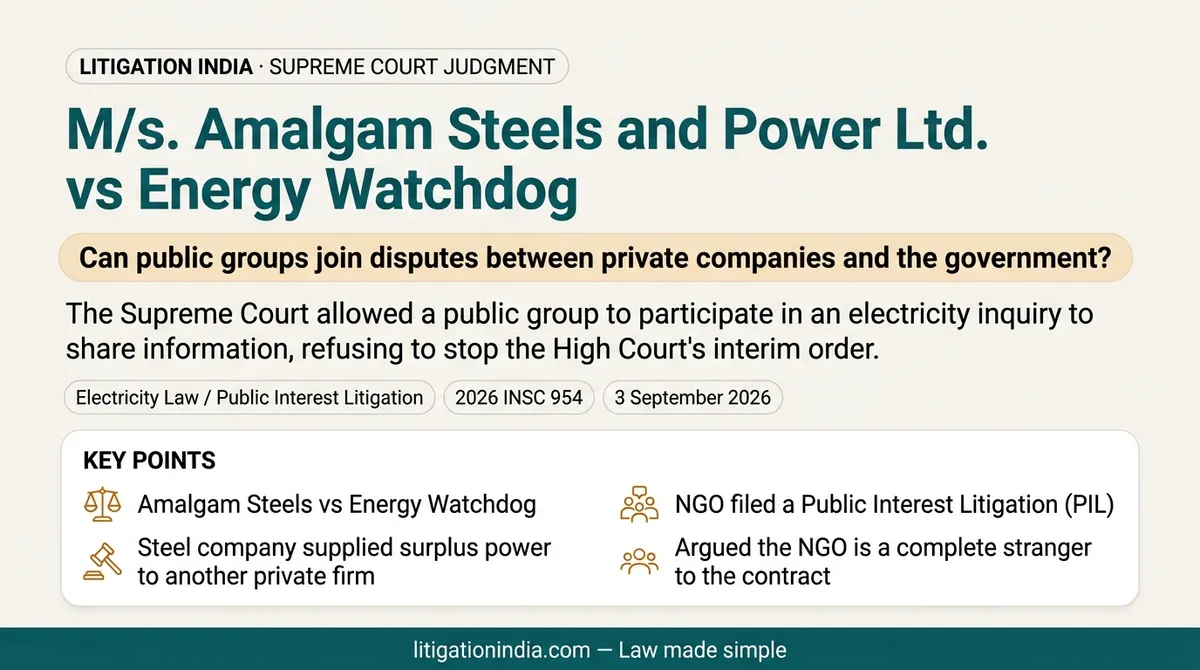
In short
This case is about whether an outside public interest group (Energy Watchdog) can participate in an electricity dispute. Amalgam Steels (the petitioner) had an agreement to supply excess power from its captive power plant to another private company. Energy Watchdog, a public welfare group, made a complaint to the Jharkhand government. They claimed that the power supply was illegal because the second company did not have a valid 'captive user' status under the Electricity Rules, 2005. Based on this complaint, the state electricity utility, Jharkhand Bijli Vitran Nigam Ltd (JBVNL), started a fact-finding inquiry. They issued a massive demand notice of over Rs. 280 crores to both companies for unpaid cross-subsidy surcharges. Energy Watchdog also filed a Public Interest Litigation (PIL) in the Jharkhand High Court. The High Court passed an interim order saying that since the public utility had delayed taking action, the public group should also be heard along with the steel companies during JBVNL's inquiry. This would ensure all facts come to light. Amalgam Steels challenged this in the Supreme Court. They argued that Energy Watchdog is a complete stranger to their agreement and has no legal standing (locus standi) to interfere in a contract. They claimed the Electricity Act, 2003 is a complete code and does not allow such third-party interventions. The Supreme Court refused to cancel the High Court's interim order. It held that under these special circumstances, letting the public group share information was not wrong. However, the Court clarified that this hearing is only a way to collect information for JBVNL, not a formal court trial. The final legal question of whether third parties can intervene in electricity cases will be decided by the High Court during the final hearing.
Background
Amalgam Steels entered into an agreement to supply excess power to another company. A public group complained that this supply was illegal because the receiving company lacked 'captive user' status, leading to a huge tax demand by the state electricity board.
The Decision
The Supreme Court refused to block the High Court's interim order allowing the public group to participate. It clarified that this participation is only to collect information and not a formal trial, leaving the final legal question open for the High Court's final decision.
Why it matters for you
This judgment shows that in public interest matters like electricity distribution and state revenue losses, courts may allow external public groups to bring hidden facts to light, even if they are not part of the original business contract.
AI-assisted summary, reviewed and verified by our editorial team.
In the Court's words
“the High Court came to the conclusion that it is necessary to bring full facts to the notice of JBVNL through a party other than the petitioners”
“shall not convert the direction for oral hearing to that of a Court or Tribunal but a means to collect information to enable it to initiate necessary action.”
Need help with your case?
Facing a similar legal challenge in the Supreme Court or High Court? Connect with our pro bono volunteer advocates today.
Request Free Callback