M/S ABC Express vs. State of Gujarat
The big legal question
Can police keep your seized vehicle rotting in the station forever?
“The Supreme Court ruled that police cannot keep a seized vehicle rotting in the station indefinitely and must release it to the owner on interim custody during the trial, even if caught with illegal liquor.”
Story Slides
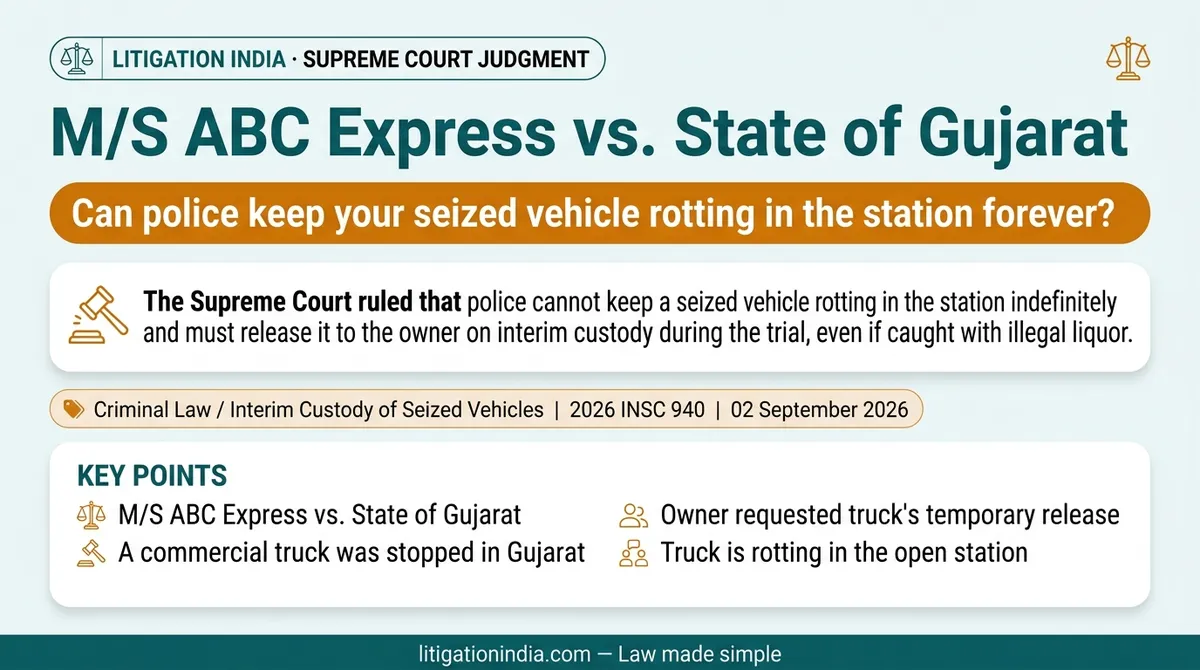
In short
This judgment by the Supreme Court of India clarifies that the police cannot keep a seized vehicle parked indefinitely in a police station during a criminal trial. In this case, a transport truck belonging to M/S ABC Express was caught carrying over 8,000 bottles of illegal liquor in Gujarat. Under the Gujarat Prohibition Act, 1949, lower courts and the High Court refused to return the truck to its owner, believing that Section 98(2) of the Act strictly banned releasing any vehicle caught with illegal alcohol. However, the Supreme Court disagreed. It ruled that keeping a vehicle parked in the open at a police station causes it to decay, lose value, and have its parts stolen, which serves no purpose and destroys a person’s livelihood. The Court emphasized that Section 451 of the Code of Criminal Procedure (now Section 497 of the Bharatiya Nagarik Suraksha Sanhita, or BNSS) gives judges the power to return seized property to its owner on a temporary basis (interim custody). To protect the case, the police can record the vehicle’s condition using photographs, videos, and a written report (panchnama) instead of keeping the physical truck. The Supreme Court ordered the truck to be released to the owner upon furnishing a personal bond of fifteen lakh rupees and agreeing to conditions like not selling the truck. This ruling helps common people protect their commercial vehicles from getting ruined in police custody while waiting years for a trial to finish.
Background
The appellant's truck was seized in Gujarat for carrying 8,064 bottles of illegal liquor hidden under transport goods. The owner applied to get the truck back during the trial, but the lower courts and the High Court refused, saying the law completely barred releasing vehicles caught with liquor.
The Decision
The Supreme Court set aside the lower court orders and directed the police to return the truck to the owner. The release is subject to a personal bond of Rs. 15,00,000, and conditions that the owner will not sell the truck and will produce it whenever required.
Why it matters for you
This judgment protects vehicle owners from losing their livelihood when their vehicles are seized by police. It ensures that valuable commercial assets do not rot away in police stations during long-running trials, as photos and videos can be used as evidence instead.
AI-assisted summary, reviewed and verified by our editorial team.
In the Court's words
“vehicles, prevented from being released back to their owners... languish and deteriorate sitting in a police station or court compound... This benefits no one and causes major losses to the owner.”
“A court ought not sit on seized property for years without cause.”
Need help with your case?
Facing a similar legal challenge in the Supreme Court or High Court? Connect with our pro bono volunteer advocates today.
Related Supreme Court services