M.R.R. Setty (Dead) by LRs vs. Government of Karnataka and others
The big legal question
Can the government reopen land survey records after forty years to check for encroachments?
“The Supreme Court ruled that the government cannot reopen or revise decades-old land survey records beyond the legally prescribed three-year time limit.”
Story Slides
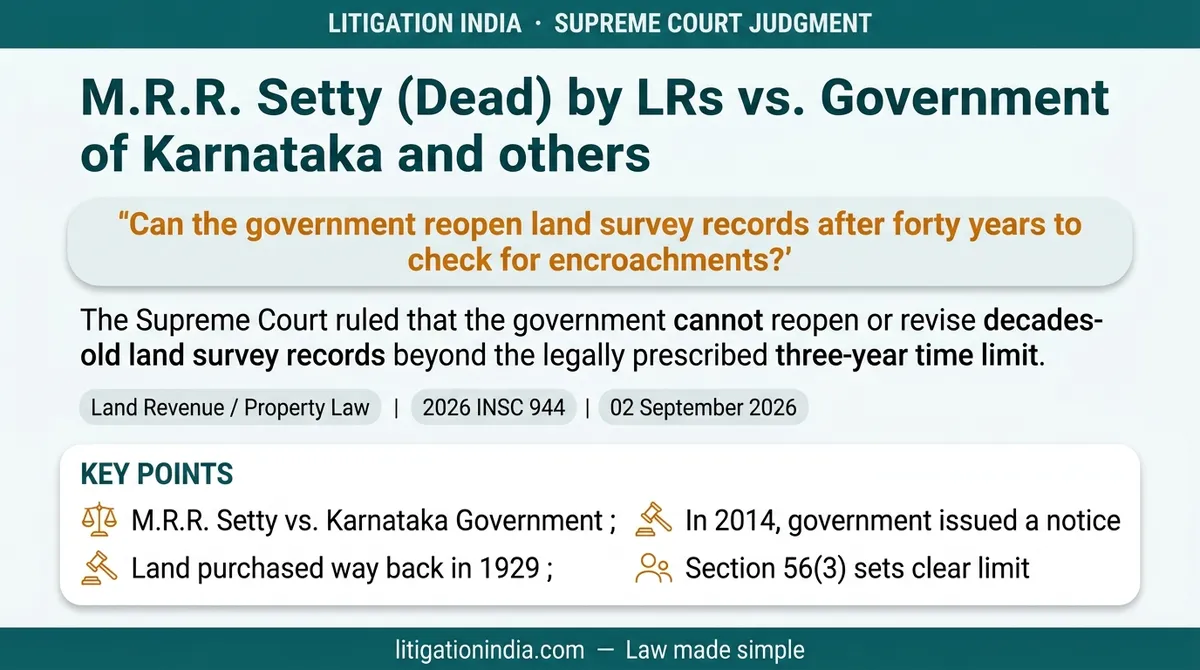
In short
This landmark judgment by the Supreme Court of India clarifies the strict limits on the government's power to review and change old land survey records. Under Section 56 of the Karnataka Land Revenue Act, 1964, government land revenue authorities have a 'power of revision' to correct past survey errors. However, the law explicitly sets a three-year time limit to exercise this power. In this case, the original owner, M.R.R. Setty, bought the land in 1929 and was allotted City Title Survey (CTS) numbers in 1974. Decades later, in 2004, he got building permissions, built residential apartments, and sold them to private home buyers who moved in. Suddenly, in 2014—nearly 40 years after the land survey allotment—the Joint Director of Land Records issued a notice to cancel the old entries and start a fresh enquiry, claiming the land encroached on the nearby Yediyur Lake. The High Court's Division Bench permitted this enquiry, but the Supreme Court completely disagreed. The Supreme Court ruled that because the law sets a strict three-year deadline, the government cannot start a fresh enquiry after 40 years. Furthermore, the Court reiterated a golden rule of law: even when a law does not mention a specific time limit, government officials must exercise their powers within a 'reasonable time'. Reopening forty-year-old administrative records disrupts settled lives, creates chaos for innocent third-party property buyers, and is an abuse of power. The Supreme Court quashed the government's notice, protecting the landowners from delayed and unfair legal harassment.
Background
M.R.R. Setty bought a parcel of land in 1929, which was given specific survey numbers in 1974. He later constructed apartment buildings on this land with official government approvals, and residents moved in. In 2014, the land revenue department suddenly issued a notice to cancel the 1974 records and hold a fresh inquiry based on a complaint alleging lake encroachment.
The Decision
The Supreme Court allowed the appeal and set aside the High Court's order. The Court quashed the government's 2014 notice, holding that the department had no power to initiate revision proceedings forty years after the land survey was finalized.
Why it matters for you
This judgment protects homeowners and land buyers from sudden government actions based on decades-old records. It establishes that government departments cannot bypass statutory deadlines or take action after an unreasonable delay, ensuring security of property rights.
AI-assisted summary, reviewed and verified by our editorial team.
In the Court's words
“Once the proviso to Section 56(3) stipulated in categorical terms that the power of revision... could be exercised... within three years... the provisions of the Limitation Act, 1963, cannot be smuggled in...”
“every authority has to exercise power within a reasonable period and, though no hard and fast rules can be laid down... the rights and liabilities thereunder... are relevant factors...”
“In the light of the clear embargo on exercise of such revisionary power... beyond the period of three years... the very invocation of such power... was without any mooring in the statute.”
Need help with your case?
Facing a property, eviction, or landlord-tenant dispute? Consult our property lawyers for a free initial review.
Related Supreme Court services