
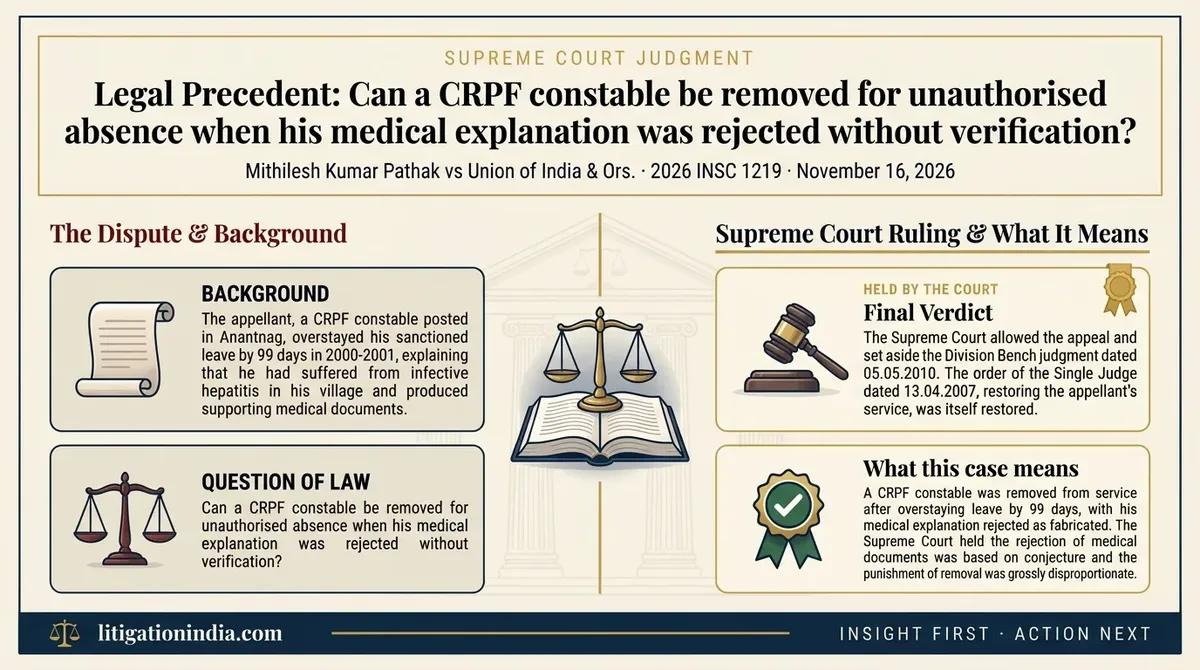
Full text of the judgment
Text extracted from Mithilesh Kumar Pathak vs Union of India & Ors.. For the authoritative version refer to the Supreme Court of India's official website.
2026 INSC 1219 C. A. No. 4411 of 2011 Page 1 of 10
IN THE SUPREME COURT OF INDIA CIVIL APPELLATE JURISDICTION
CIVIL APPEAL NO. 4411 OF 2011
MITHILESH KUMAR PATHAK …APPELLANT(S) VERSUS UNION OF INDIA & ORS. …RESPONDENT(S)
J U D G M E N T
SATISH CHANDRA SHARMA, J.
1. The present appeal arises out of the judgment and order dated 05.05.2010 passed by the High Court of Judicature at Patna (hereinafter referred to as the “High Court”) in Letters Patent Appeal No. 921 of 2007, whereby the Division Bench set aside the order dated 13.04.2007 passed by the learned Single Judge in CWJC No. 5308 of 2004 and restored the order dated 29.03.2001 removing the Appellant from service as a Constable in the Central Reserve Police Force (hereinafter referred to as the “CRPF”). Digitally signed by RAHUL KUMAR Date: 2026.11.16 18:13:08 IST Reason: Signature Not Verified
C. A. No. 4411 of 2011 Page 2 of 10
2. The facts necessary for adjudication of the present appeal are as follows: 2.1 The Appellant, posted with the 54th Battalion, CRPF, at Anantnag, Jammu and Kashmir, was granted casual leave from 21.09.2000 to 12.10.2000 on the ground of his wife’s illness. He was supposed to rejoin duty on 13.10.2000, but failed to do so. The Company Commander sent two registered letters dated 26.10.2000 and 08.11.2000 directing the Appellant to report for duty. However, he failed to respond to the letters and finally reported for duty on 19.01.2001, thereby overstaying the sanctioned leave by 99 days. 2.2 By an application dated 22.01.2001 addressed to the Commandant, the Appellant explained that he had himself fallen ill on 09.10.2000 while at his village in District Munger, Bihar, and had undergone treatment for infective hepatitis under Dr. S.N. Singh, a Medical Officer attached to Sadar Hospital, Banka. He relied upon medical prescriptions, pathological reports, receipts for purchase of medicines and a certificate declaring him fit for duty on 13.01.2001. He further stated that his illness, the absence of postal facilities in his village and his wife’s inability to read or write had prevented him from responding to the letters.
C. A. No. 4411 of 2011 Page 3 of 10
2.3 A memorandum of charges dated 25.01.2001 was issued to the Appellant alleging firstly, unauthorised absence for 99 days and, secondly, disobedience of orders in not responding to the two letters. The Appellant pleaded not guilty and produced twelve documents in support of his case, including medical certificates, pathological reports, etc. The Enquiry Officer, in his report dated 17.03.2001, held both charges proved. The medical documents were disbelieved principally because they did not bear an indoor or outdoor patient number, the treatment appeared to have been obtained privately, and the prescriptions and medicine bills appeared to have been written with the same pen. On this basis, the Enquiry Officer inferred that the documents had been prepared on the same day and were fabricated. Acting on the report, the Commandant, by order dated 29.03.2001, imposed the penalty of ‘Removal from Service’ on the Appellant with effect from the afternoon of 31.03.2001. 2.4 The departmental appeal and revision preferred by the Appellant were rejected vide orders dated 11.01.2002 and 26.03.2004, respectively. During this period, the Appellant had also approached the High Court in CWJC No. 8712 of 2001 and CWJC No. 3333 of 2002. 2.5 Thereafter, the Appellant filed CWJC No. 5308 of 2004. The learned Single Judge, by order dated 13.04.2007, allowed
C. A. No. 4411 of 2011 Page 4 of 10
the writ petition. It was held that the fact of overstay was admitted and that the only question was whether the Appellant had furnished a sufficient explanation for it. The learned Single Judge found that the reasons given for rejecting the medical documents rested on conjectures and surmises, and that the reason given by the enquiry officer to disbelieve the absence or overstayal of the Appellant for the period in question was not based on sound reasoning. Accordingly, the orders of the disciplinary, appellate and revisional authorities were quashed and the Respondents were directed to accept the Appellant’s joining. 3. Aggrieved thereby, the Respondents preferred Letters Patent Appeal No. 921 of 2007. By the impugned judgment and order dated 05.05.2010, the Division Bench allowed the appeal, holding that the learned Single Judge had exceeded the limits of judicial review by reappreciating the evidence as an appellate authority. The Division Bench upheld the rejection of the medical evidence and reasoned that, once the absence was held to be unauthorised, the plea of illness failed and the charge of insubordination stood established. It further held that past conduct was relevant to the quantum of punishment and emphasised the need to maintain discipline in a uniformed force deployed in a sensitive area. The order of removal was
C. A. No. 4411 of 2011 Page 5 of 10
consequently restored. Aggrieved thereby, the Appellant has approached this Court. 4. Learned counsel appearing on behalf of the Appellant submitted that the learned Single Judge had rightly interfered with findings which were founded on conjecture. It was contended that the medical documents could not have been treated as fabricated merely by reference to the pen or ink used, or the absence of a hospital registration number, without examining the treating doctor or otherwise verifying the documents. It was further submitted that the earlier periods of overstay had already been dealt with and could not justify rejection of the explanation furnished in the present proceedings. Learned counsel also urged that the penalty of removal was disproportionate and that the procedure adopted in the enquiry did not comply with Rule 27(c)(4) of the CRPF Rules, 1955, concerning the opportunity to submit a written statement and lead evidence in defence. 5. Per contra, learned counsel appearing on behalf of the Respondents submitted that the Appellant, despite being a member of a disciplined force posted in a sensitive area, remained absent for 99 days without permission and failed to comply with two directions to report for duty. It was contended that the medical documents were procured to justify the overstay and that the Appellant’s earlier absences demonstrated
C. A. No. 4411 of 2011 Page 6 of 10
repeated disregard of discipline. The Respondents relied upon earlier periods of overstay of 71 days in 1994 and 175 days in 1999. It was further submitted that adequate opportunity had been afforded to the Appellant during the enquiry and that the learned Single Judge had impermissibly substituted his own assessment of the evidence for that of the departmental authorities. 6. We have heard learned counsel appearing for the parties and perused the material placed on record. 7. The principal question which arises for consideration is whether the Division Bench was justified in setting aside the order of the learned Single Judge and restoring the penalty of removal from service. 8. The limits of judicial review in disciplinary matters are well settled. In State of Andhra Pradesh & Ors. v. S. Sree Rama Rao, 1963 SCC OnLine SC 6, wherein this Court held that: “7. …The High Court may undoubtedly interfere where the departmental authorities have held the proceedings against the delinquent in a manner inconsistent with the rules of natural justice or in violation of the statutory rules prescribing the mode of enquiry or where the authorities have disabled themselves from reaching a fair decision by some considerations extraneous to the evidence and the merits of the case or by allowing
C. A. No. 4411 of 2011 Page 7 of 10
themselves to be influenced by irrelevant considerations or where the conclusion on the very face of it is so wholly arbitrary and capricious that no reasonable person could ever have arrived at that conclusion, or on similar grounds. But the departmental authorities are, if the enquiry is otherwise properly held, the sole judges of facts and if there be some legal evidence on which their findings can be based, the adequacy or reliability of that evidence is not a matter which can be permitted to be canvassed before the High Court in a proceeding for a writ under Article 226 of the Constitution.”
9. Similar principle was reiterated in B.C. Chaturvedi v. Union of India & Ors., (1995) 6 SCC 749, wherein this Court further observed that: “18. A review of the above legal position would establish that the disciplinary authority, and on appeal the appellate authority, being fact-finding authorities have exclusive power to consider the evidence with a view to maintain discipline. They are invested with the discretion to impose appropriate punishment keeping in view the magnitude or gravity of the misconduct. The High Court/Tribunal, while exercising the power of judicial review, cannot normally substitute its own conclusion on penalty and impose some other penalty. If the punishment imposed by the disciplinary authority or the appellate authority shocks the conscience of the High Court/Tribunal, it would appropriately mould the relief, either directing the disciplinary/appellate authority to reconsider the penalty imposed, or to shorten the litigation, it may itself, in exceptional and rare
C. A. No. 4411 of 2011 Page 8 of 10
cases, impose appropriate punishment with cogent reasons in support thereof.”
10. Tested on the aforesaid principles, we are of the considered view that the Division Bench erroneously set aside the order passed by the Single Judge. Absence from duty without prior permission may constitute unauthorised absence; however, unauthorised absence and wilful absence are not necessarily synonymous. The circumstances in which an employee remained absent, the explanation furnished, and the material supporting that explanation must be considered before determining the nature and gravity of the misconduct. Illness or other circumstances beyond an employee’s control may be relevant to that determination, though they do not, by themselves, automatically excuse the entire period of absence. 11. In the present case, the Appellant’s explanation was that he had suffered from infective hepatitis and had undergone treatment during the period of his absence. In support of this explanation, he produced a series of documents, including medical prescriptions, pathological reports, receipts relating to the purchase of medicines and a certificate declaring him fit to resume duty. The Enquiry Officer disregarded the said documents, inter alia, on the ground that certain entries appeared to have been made with the same pen and that the documents did not bear an outpatient department number. On
C. A. No. 4411 of 2011 Page 9 of 10
the basis of these circumstances, the Enquiry Officer questioned the authenticity of the documents and proceeded to disbelieve the explanation furnished by the Appellant. No verification from the treating doctor, the medical establishment or the pharmacy supported that inference. Similarity in the writing or ink, without material connecting it to fabrication, could not reasonably sustain the conclusion drawn in the present case. 12. The absence of an indoor or outdoor patient number, and the circumstance that the doctor appeared to have treated the Appellant privately while affixing his official seal to the fitness certificate, could call for clarification. These features did not, by themselves, establish either that no treatment had been received or that the documents were forged. The learned Single Judge, therefore, rightly held that the rejection of the medical documents rested on conjectures and surmises. 13. Furthermore, the punishment given to the Appellant ought to have been proportionate to the magnitude and gravity of the misconduct. We are conscious that the Appellant was a member of a disciplined force posted in a sensitive area, and that compliance with orders and timely reporting for duty are essential obligations of such service. However, the punishment imposed must satisfy the requirement of proportionality. In the present case, the punishment of removal from service for overstaying the period of 99 days is unduly harsh considering the
C. A. No. 4411 of 2011 Page 10 of 10
relevant circumstances. Even after taking into account the earlier periods of overstay and the Appellant’s failure to maintain communication, we are satisfied that the penalty of removal from service, in these particular circumstances, is grossly disproportionate in the facts of this case. 14. In the result, the appeal is allowed. The impugned judgment and order dated 05.05.2010 passed by the High Court in Letters Patent Appeal No. 921 of 2007 is set aside, and the order dated 13.04.2007 passed by the learned Single Judge in CWJC No. 5308 of 2004 is restored. The respondents are directed to reinstate the appellant with immediate effect with a direction to pay him 50% of the back wages for the period he was removed from service till his reinstatement. He will be entitled for all other consequential benefits. 15. Pending application(s), if any, shall also stand disposed of.
.…………….…………………………………J. [SATISH CHANDRA SHARMA]
..………………………………………………J. [NONGMEIKAPAM KOTISWAR SINGH]
New Delhi November 16, 2026