Updates
Criminal Law / Quashing of FIR / Consent and Promise to Marry
31 views

Supreme Court Quashes Rape Chargesheet Arising from Three-Year Consensual Relationship

Martanda Singh vs State of Chhattisgarh and Anr.

The big legal question

Can a consensual three-year relationship become rape when marriage does not happen?

What this case means

The case involved a criminal FIR filed against the appellant for allegedly raping a woman under the pretext of marriage, after their three-year consensual relationship ended. The Supreme Court found no criminal culpability as the relationship was fully consensual and consent was neither coerced nor obtained by misrepresentation. The Court quashed the chargesheet, emphasising that criminal prosecution cannot be used as a coercive tactic.

“The Supreme Court quashed the rape chargesheet against the appellant, holding that a three-year consensual relationship ending without marriage does not establish criminal liability.”

Share:

Story Slides

Case at a glance1 / 5

Supreme Court of India

Consensual Relationship Cannot Become Rape When Marriage Fails

Martanda Singh vs State of Chhattisgarh | 2026 INSC 1081 | October 01, 2026

Court: Supreme Court of India, Criminal Appellate JurisdictionBench: Justice J. B. Pardiwala and Justice K. Vinod ChandranArea of Law: Criminal Law — quashing of FIR and chargesheet, consent in rape casesChargesheet quashed; session case proceedings closed
Martanda Singh vs State of Chhattisgarh and Anr. · 2026 INSC 1081October 01, 2026
The legal question2 / 5

Does a three-year consensual relationship become rape if marriage does not happen?

Core legal question before the Supreme Court

  • Appellant: The relationship was consensual over three years; no false promise from the start; no criminal liability.
  • Respondent (State): FIR alleged sexual exploitation on pretext of marriage; chargesheet filed after appellant refused to marry.
  • 2nd Respondent: Stated she would withdraw the complaint if the appellant agreed to marry her.
Martanda Singh vs State of Chhattisgarh and Anr. · 2026 INSC 1081October 01, 2026
The Court's reasoning3 / 5

How the Court Reasoned to Quash the Chargesheet

Step-by-step legal reasoning

  1. 1Step 1: Applied Deepak Gulati v. State of Haryana (2013) 7 SCC 675 — no criminal liability unless accused never intended to marry from the start.
  2. 2Step 2: Found the relationship was mutually consensual for three years, with both families involved in marriage talks.
  3. 3Step 3: Noted the second respondent herself facilitated meetings; consent was not coerced or obtained by misrepresentation.
  4. 4Step 4: The undertaking at the counselling centre was given under threat and was unenforceable; not a fresh promise to marry.
  5. 5Step 5: The complainant's offer to drop charges if he married her showed the prosecution was a coercive tactic, not a genuine criminal case.
Martanda Singh vs State of Chhattisgarh and Anr. · 2026 INSC 1081October 01, 2026
The verdict4 / 5

The Court's Final Decision

Chargesheet quashed; proceedings closed

  • The Fact: Three-year consensual relationship; FIR lodged only after marriage proposal fell through.
  • The Law: Section 90 IPC requires proof that accused never intended to marry from the very beginning; mere failure to marry is insufficient.
  • The Result: Charge Sheet No.199 of 2025 quashed; S.C. No.216 of 2025 before the Additional Sessions Judge (FTC), Bilaspur closed.
Charge Sheet No.199 of 2025 quashed; S.C. No.216 of 2025 before Additional Sessions Judge (FTC), Bilaspur shall stand closed.
Martanda Singh vs State of Chhattisgarh and Anr. · 2026 INSC 1081October 01, 2026
Why it matters5 / 5

What This Judgment Means for Ordinary People

Practical significance

  • A consensual adult relationship that ends without marriage is not automatically a criminal offence.
  • Criminal law cannot be weaponised as a bargaining tool to force marriage after a relationship ends.
  • Courts will examine whether consent was truly coerced from the start, not merely whether the relationship ended unhappily.
  • An educated adult's willing participation over years negates a later claim that consent was based on misconception.
Criminal prosecution cannot be reduced to a strong-arm tactic to compel marriage after a consensual relationship ends.
Martanda Singh vs State of Chhattisgarh and Anr. · 2026 INSC 1081October 01, 2026

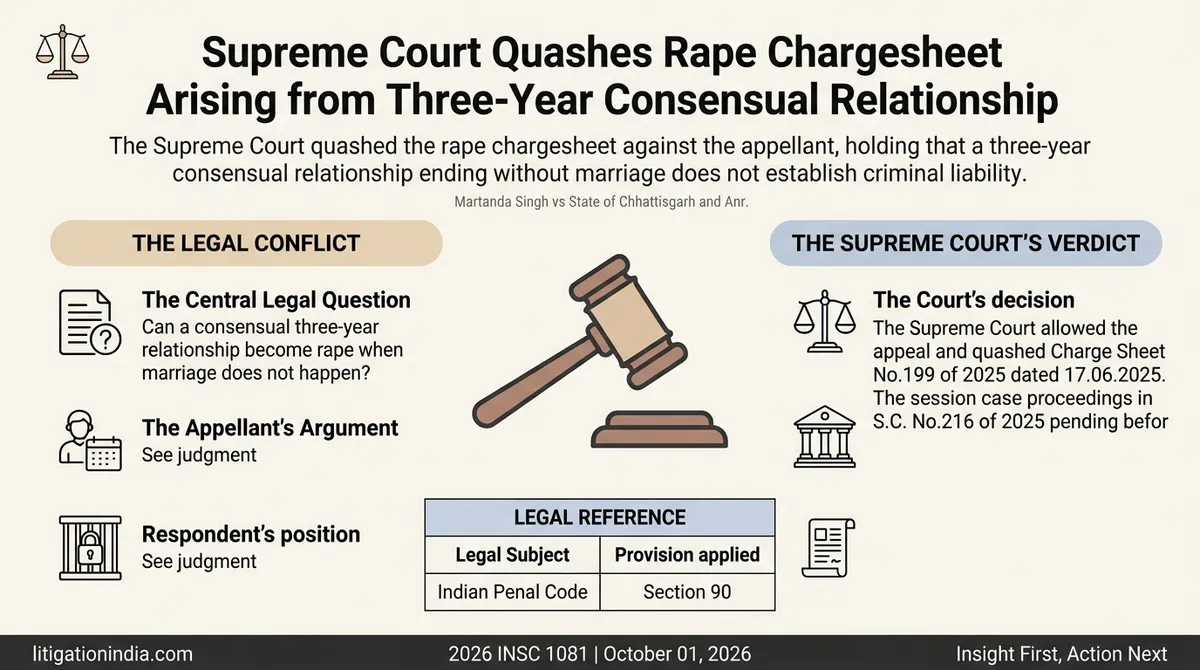
At a glance (infographic)

Martanda Singh vs State of Chhattisgarh and Anr. — infographic summary
Download infographic

In short

Martanda Singh, the appellant, was in a three-year consensual romantic relationship with the second respondent, an engineering graduate. Both met at an academy, fell in love, and their families also met. On the understanding of marriage, the appellant visited the second respondent's home and they entered into a physical relationship, which continued for approximately three years. After the relationship ended and the marriage proposal fell through, the second respondent lodged FIR No.191 of 2025 at Sirgitti Police Station, Bilaspur, alleging that the appellant had sexually exploited her on the pretext of marriage. A chargesheet was filed, and the case had progressed to Session Case No.216 of 2025 before the Additional Sessions Judge (FTC), Bilaspur. The appellant challenged these proceedings before the Supreme Court. The Court referred to the settled legal principle in Deepak Gulati v. State of Haryana (2013) 7 SCC 675, which holds that to establish criminal liability, there must be clear evidence that the accused never intended to marry from the very beginning, and that a mere failure to keep a promise about a future uncertain date does not amount to misconception of fact under Section 90 IPC. Applying this principle, the Court noted that the second respondent is a well-educated woman who willingly continued the relationship for three years, that she herself facilitated meetings by informing the appellant when her mother was away, and that her own statement that she would drop the charge if he married her revealed that the prosecution was being used as leverage. The Court found no evidence of coercion or misrepresentation and quashed the chargesheet entirely, closing the session case proceedings.

Background

The appellant and the second respondent met at an academy, fell in love, and their families were also in contact. Over three years, they had a physical relationship at her home, often when her mother was absent. When the relationship ended and marriage did not materialise, the second respondent filed FIR No.191 of 2025 alleging she was sexually exploited on the pretext of marriage.

The Decision

The Supreme Court allowed the appeal and quashed Charge Sheet No.199 of 2025 dated 17.06.2025. The session case proceedings in S.C. No.216 of 2025 pending before the Additional Sessions Judge (FTC), Bilaspur were ordered to stand closed, with no further proceedings to be taken against the appellant.

Why it matters for you

This judgment reaffirms that a consensual adult relationship, which both parties willingly maintained over several years, cannot be converted into a criminal case merely because the relationship ended without marriage. It protects individuals from misuse of criminal law as a bargaining tool. It also highlights that an educated adult woman's informed participation in a relationship negates a later claim of consent by misconception.

Relevant Legal Provisions

Key Acts and sections cited or relied upon in this judgment

“Section 90 IPC deals with consent given under fear or misconception; the Court held it cannot be loosely invoked to fasten criminal liability when both parties admittedly shared a consensual relationship over three years.”

Full text of the judgment

Text extracted from Martanda Singh vs State of Chhattisgarh and Anr.. For the authoritative version refer to the Supreme Court of India's official website.

2026 INSC 1081 NON-REPORTABLE IN THE SUPREME COURT OF INDIA CRIMINAL APPELLATE JURISDICTION CRIMINAL APPEAL NO.4722 OF 2026 (Arising out of SLP (Crl.) No.1582 of 2026) Martanda Singh ...Appellant(s) Versus State of Chhattisgarh and Anr. ...Respondent(s) O R D E R Leave granted. 2. A consensual relationship spreading over three years has eventually ended with a criminal case lodged against the appellant. On the First Information Statement (FIS) of the 2nd respondent, FIR No.191 of 2025 was registered at the Sirgitti Police Station, District Bilaspur, on the allegation of refusal to marry, after exploiting the 2nd respondent sexually on the pretext of marriage. 3. Heard Dr. Rajesh Pandey, learned Counsel for the appellant and Sri Vinayak Sharma, learned Standing Counsel for the respondent-State. The 2nd respondent, though served through the Assistant Sub-Inspector of the Police Station, Sirgitti, none appeared for her. Page 1 of 6 Digitally signed by VISHAL ANAND Date: 2026.10.05 16:47:39 IST Reason: Signature Not Verified

4. Before we look into the facts, we look at Deepak Gulati v. State of Haryana1 and extract paragraph 24 as hereunder: ‘24. Hence, it is evident that there must be adequate evidence to show that at the relevant time i.e. at the initial stage itself, the accused had no intention whatsoever, of keeping his promise to marry the victim. There may, of course, be circumstances, when a person having the best of intentions is unable to marry the victim owing to various unavoidable circumstances. The “failure to keep a promise made with respect to a future uncertain date, due to reasons that are not very clear from the evidence available, does not always amount to misconception of fact. In order to come within the meaning of the term “misconception of fact”, the fact must have an immediate relevance”. Section 90 IPC cannot be called into aid in such a situation, to pardon the act of a girl in entirety, and fasten criminal liability on the other, unless the court is assured of the fact that from the very beginning, the accused had never really intended to marry her.’ [underlining by us for emphasis] 5. With the principle in the above extract in our minds, we look at the facts of the present case. The 2nd respondent is an engineering graduate who had been 1 (2013) 7 SCC 675 Page 2 of 6

studying for competitive examinations. She met the appellant at an academy, wherein both were enrolled. Admittedly, they fell in love and their family members also talked to each other. On an understanding that they would be married, the appellant used to visit the house of the 2nd respondent, who lived with her mother and brother. When nobody was at home, they entered into a physical relationship, which continued thereafter for about three years. The specific allegation is that when her mother was not in station, the appellant used to frequently come to her house and they had physical relationship. Obviously, the information that the mother has left, was passed on by the 2nd respondent herself, since we cannot presume that the appellant had mounted a constant surveillance of the 2nd respondent’s house for this purpose. 6. Admittedly, the physical relationship continued for three years unabated and later they separated. The marriage proposal mooted by both the families, also fell through, upon which the present complaint was raised. It was also asserted that the appellant had Page 3 of 6

agreed to marry the 2nd respondent before the Mahila Thana Counselling Centre, Bilaspur which was not complied with. Immediately, we have to observe that the undertaking would have been on the threat of criminal prosecution; which even otherwise is unenforceable. The undertaking also cannot be alleged to be a promise to marry, since by then admittedly there was a courtship of three years, when the 2nd respondent admittedly had permitted physical relationship. The consent obviously was not on coercion or misrepresentation. 7. We cannot but reiterate the proposition as enumerated in the above extract that the consent under fear or misconception cannot be loosely inferred to fasten criminal liability on one of the parties when both admittedly, had a consensual relationship and the other party willingly permitted physical relationship. Even on a bare reading of the complaint, there is no clear assurance or a promise made of marriage, since the specific allegation is that they entered into a physical relationship after courtship, fully knowing the Page 4 of 6

consequences, but alleged to be under the pretext of marriage; clearly an afterthought. The 2nd respondent is a well-educated woman, who entered into a consensual relationship and carried it on, for three years, allegedly on the pretext of marriage, which never fructified. She categorically states that she would drop the charge, if he marries her. A criminal prosecution cannot be reduced to a strong-arm tactic. 8. We are unable to find any criminal culpability on the appellant who entered into a consensual relationship with the 2nd respondent, which consent cannot be said to be coerced or obtained on a misrepresentation. 9. We find absolutely no reason to allow the continuance of the proceedings. The chargesheet filed as Charge Sheet No.199 of 2025 dated 17.06.2025, produced as Annexure P4, before the Judicial Magistrate First Class, Bilaspur, District Bilaspur, has now matured into Session Case No.216 of 2025 pending before the Additional Sessions Judge (FTC), Bilaspur (C.G.). Annexure P6 is the order posting the Page 5 of 6

case for framing of charges. The charge-sheet filed in the said case shall stand quashed. There shall be no further proceedings taken on the said charge levelled against the appellant and the proceeding in S.C. No.216 of 2025 pending before the Additional Sessions Judge (FTC), Bilaspur (C.G.) shall stand closed. 10. The appeal stands allowed. 11. Pending application(s), if any, shall stand rejected. .......…….……………………. J.

(J. B. PARDIWALA) ....……….……………………. J. (K. VINOD CHANDRAN) NEW DELHI; OCTOBER 01, 2026. Page 6 of 6

AI-assisted summary, reviewed and verified by our editorial team.

In the Court's words

“The failure to keep a promise made with respect to a future uncertain date, due to reasons that are not very clear from the evidence available, does not always amount to misconception of fact.”
“A criminal prosecution cannot be reduced to a strong-arm tactic.”
“We are unable to find any criminal culpability on the appellant who entered into a consensual relationship with the 2nd respondent, which consent cannot be said to be coerced or obtained on a misrepresentation.”
“The consent under fear or misconception cannot be loosely inferred to fasten criminal liability on one of the parties when both admittedly, had a consensual relationship and the other party willingly permitted physical relationship.”

Need help with your case?

Facing a similar legal challenge in the Supreme Court or High Court? Connect with our pro bono volunteer advocates today.

Related Supreme Court services

Request Free Callback
Litigation India

Insight First, Action Next. A public-service initiative to make justice understandable for every Indian.

contact@litigationindia.com

+91 9956486585

New Delhi, India

Quick Links

Our Mission

To empower ordinary citizens, litigants, and junior advocates across India by translating complex Supreme Court of India judgments into editor-verified, plain-language summaries in both English and Hindi. We aim to bridge the gap between judicial proceedings and everyday citizens by delivering verified legal insights and offering free, pro bono guidance from experienced Supreme Court advocates—ensuring no individual suffers injustice merely for lack of correct guidance.

Legal Disclaimer: The information provided on this website is for general informational purposes only and does not constitute legal advice. Accessing this website or receiving any guidance does not create an attorney-client relationship. A formal attorney-client relationship is established only upon signing a formal engagement agreement with a lawyer. Litigation India is an informational platform — it does not provide legal representation, legal services, or legal advice.

Disclaimer: These summaries are provided for general public understanding only and do not constitute legal advice. Please consult a qualified advocate before acting on any information relating to your specific matter.

© 2026 Litigation India. All rights reserved.