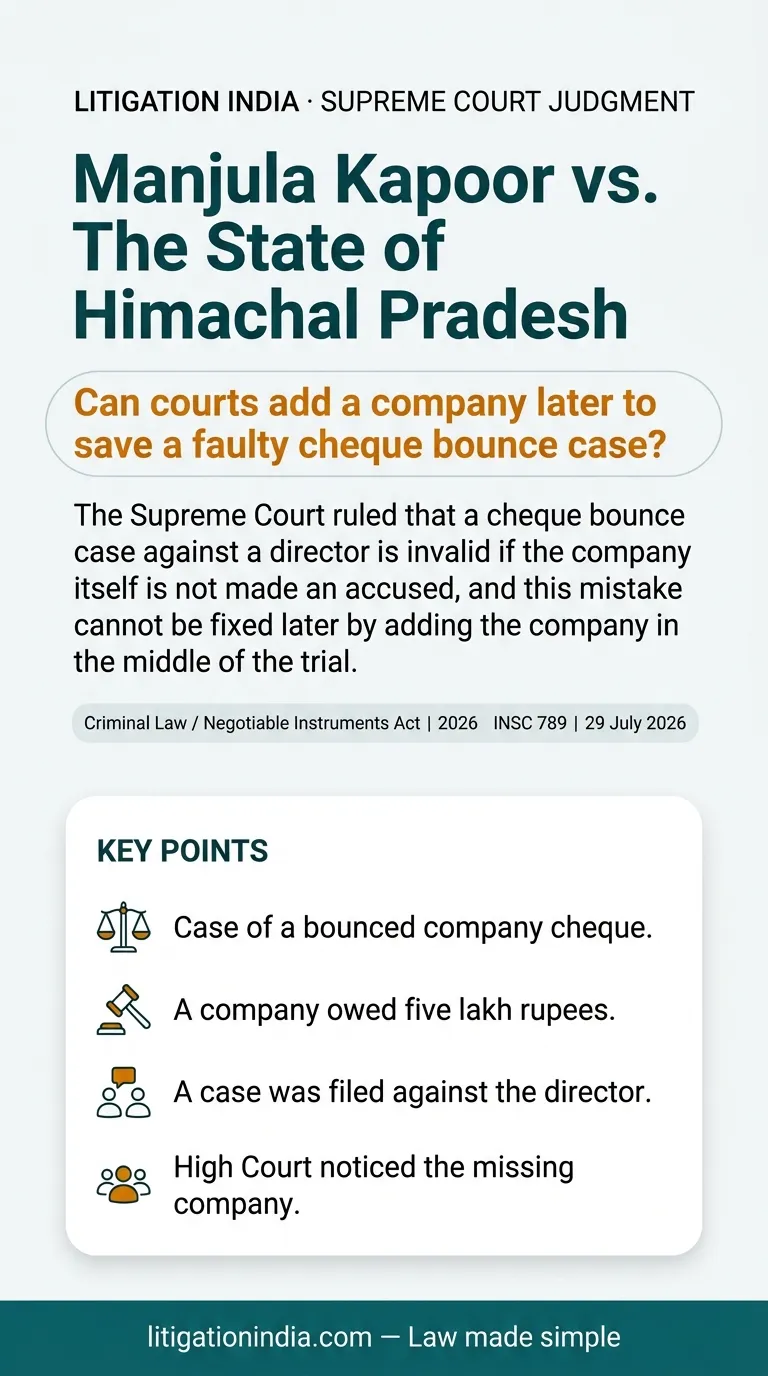
Manjula Kapoor vs. The State of Himachal Pradesh
The big legal question
Can courts add a company later to save a faulty cheque bounce case?
“The Supreme Court ruled that a cheque bounce case against a director is invalid if the company itself is not made an accused, and this mistake cannot be fixed later by adding the company in the middle of the trial.”
Story Slides
In short
In this case, a business partner filed a criminal complaint against a lady director because a cheque of five lakh rupees had bounced. The cheque belonged to the company's bank account, but the partner only made the director an accused, completely leaving out the company. When the trial was near its end, the director requested the High Court to close the case. She argued that under Indian law, you cannot prosecute a director for a company's cheque bounce unless the company itself is also charged. The High Court agreed that the company was a necessary party, but instead of dismissing the case, it ordered the trial court to add the company as a new accused and restart the trial. The director appealed to the Supreme Court. The Supreme Court set aside the High Court's order and dismissed the entire case. It explained that if a complaint does not include the company from the very beginning, it has a major defect that makes the whole case legally dead. The law has a strict time limit for filing cheque bounce cases. The courts cannot use their special powers to add the company later in the trial to bypass this time limit and save a fundamentally broken complaint. Therefore, the case against the director was completely canceled.
Background
A cheque of five lakh rupees drawn on a company's bank account bounced. The complainant filed a case only against the company's director, completely omitting the company as an accused.
The Decision
The Supreme Court dismissed the case against the director. It held that the company must be made an accused from the start, and the court cannot add the company later in the trial to fix this fatal mistake.
Why it matters for you
This judgment protects company directors from facing illegal trials when the complainant makes a major procedural error. It clarifies that strict legal procedures and time limits in cheque bounce cases must be followed, and courts cannot bypass them.
AI-assisted summary, reviewed and verified by our editorial team.
Need help with your case?
Facing a similar legal challenge in the Supreme Court or High Court? Connect with our pro bono volunteer advocates today.
Related Supreme Court services