Full text of the judgment
Text extracted from Mahanadi Coalfields Ltd & Ors. vs M/s GSCO (Gurmeet Singh and Company) Infrastructure Pvt. Ltd.. For the authoritative version refer to the Supreme Court of India's official website.
2026 INSC 1038 1
Reportable IN THE SUPREME COURT OF INDIA CIVIL APPELLATE JURISDICTION C I V I L A P P E A L N O . O F 2 0 2 6 (@ SPECIAL LEAVE PETITION (C) NO. 2 1 3 7 5 O F 2 0 2 5 ) MAHANADI COALFIELDS LTD & ORS. .…. APPELLANT (S) VERSUS M/S GSCO (GURMEET SINGH AND COMPANY)
INFRASTRUCTURE PVT. LTD. ..…RESPONDENT(S) J U D G M E N T SANJEEV SACHDEVA, J. 1. Leave granted. 2. Subject appeal impugns judgment dated 20.06.2025 passed by the High Court in Writ Petition (C) No. 12707 of 2024, whereby the High Court has allowed the Writ Petition filed by the Respondent under Articles 226 and 227 of the Constitution of India and thereby held that the petition under Section 34 of the Arbitration and Conciliation Act, 19961 filed by the Appellants was not maintainable. The High Court has held that the petition filed under Section
1 ‘Act’ for short Digitally signed by babita pandey Date: 2026.09.23 17:01:53 IST Reason: Signature Not Verified
34 of the Act before the Court of the District Judge, Sundargarh, was not maintainable for want of jurisdiction and also being time barred. 3. On 07.11.2012, a tender was issued by the Appellants for hiring of HEMM (Shovel, Drill, Dozer etc.) for transfer and transportation of materials in various strata including drilling, excavation, dumping spreading dozing and other allied works in specified areas of dumping as per the instructions of project officer/management of Kulda OCP, Basundhara – Garjanbahal areas of MCL at Sundargarh. 4. Respondent was the successful bidder, and accordingly, a contract was executed between the parties. It is an admitted position that the agreement did not contain any arbitration clause. 5. On 03.07.2016, a completion certificate was issued by the Project Officer of the Appellants, acknowledging the competition of the assigned scope of work on 29.06.2016. However, during and after the execution of the work, certain disputes arose between the parties in relation to various claims under the contract. Aggrieved by the same, Respondent approached the High Court of Orissa at Cuttack in W.P.(C). Nos. 19909 of 2016, 473 of 2017 and 474 of 2017.
6. By a common order dated 25.03.2019, the Hon’ble High Court at Cuttack appointed Mr. Justice M.M. Das (Retd.) as the Sole Arbitrator under Section 11(6) of the Act, to adjudicate the disputes between the parties. Relevant portion of the common order is reproduced herein: “by way of this writ petition, the petitioner (GSCO in that case) has prayed for a direction to the opposite parties (MCL in that case) to release the withheld amount……………….For the record, it seems that this matter relates to interpretation of the condition of the contract. Appropriate remedy for the parties is to approach the Arbitrator. Learned counsels for the parties on mutual consent submit that this matter may be referred to the Arbitrator…..” 7. Being aggrieved by the appointment, Respondent challenged the appointment before this Court in SLP (C) No. 9676 of 2019, SLP (C) No.11969 of 2019 and SLP (C) No.11551 of 2019. This Court, vide orders dated 22.04.2019 and 01.07.2019 held that: “the main contention of the Ld. Senior Counsel appearing on behalf of the Petitioner (respondent herein) is that the Counsel appeared before the High Court has not consented with the order which was passed by the said Court agreeing for arbitration. We are not inclined to hear any other contention raised…petitioner (respondent herein) is at liberty to approach the High Court for
filing of Review Petition bringing it to the notice of the High Court.” 8. Respondent filed two Review Petitions before the High Court, being RVWPET No. 145 of 2019 (arising out of W.P.(C) No. 19909 of 2016) and RVWPET No. 223 of 2019 (arising out of W.P.(C) No. 473 of 2017) and a Recall Petition bearing I.A. No. 14601 of 2019 (arising out of W.P.(C) No. 474 of 2017) before the High Court to recall the order dated 25.03.2019. The High Court dismissed both the Review Petitions as withdrawn by orders dated 19.03.2021 and 18.06.2021. The Recall Petition was also dismissed as withdrawn on 15.03.2021. 9. Thereafter, the arbitration proceedings were commenced by the Arbitrator and the proceedings were held at Cuttack. The Sole Arbitrator, on 25.10.2021, passed a common Arbitral Award in favour of the Respondent. 10. Appellants filed 3 separate petitions under Section 34 of the Act on 08.12.2021 being Arbitration Case Nos. 05, 06 and 07 of 2021 before the District Court, Sundargarh, seeking setting aside the arbitral award. 11. Respondent on 27.09.2022 filed Miscellaneous Application under Section 151 Code of Civil Procedure seeking rejection of the petition filed by
the Appellants under Section 34 of the Act raising preliminary objections to the maintainability of the proceedings on the following two grounds: (a) That the Section 34 petitions were barred by limitation, having been filed beyond the statutory period as prescribed in Section 34(3) of the Act, as claimed by GSCO. (b) That the District Judge, Sundargarh lacked territorial jurisdiction to entertain the Section 34 petitions, owing to the seat of arbitration being at Cuttack. 12. Said application was dismissed by the District Judge on 06.03.2024, pursuant to which subject Writ Petition was filed by the Respondent before the High Court of Orissa at Cuttack. 13. By the impugned order dated 20.06.2025, the High Court has allowed the Writ Petition and dismissed the petition filed under Section 34 of the Act holding the same to be non-maintainable for want of jurisdiction and also on ground that the petition was filed beyond the period of limitation. 14. The High Court held that the seat of arbitration was at Cuttack. The fulcrum of the decision of the High Court is based on the fact that the appointment of the Arbitrator was made by the High Court in exercise of its jurisdiction under Section 11(6) of the Act and that as the seat of the High
Court is at Cuttack, Cuttack must be ordered as juridical seat of arbitration and the courts at Cuttack alone are vested with exclusive jurisdiction to entertain any application under Part I of the Act, including a petition under Section 34 of the Act. 15. The High Court was of the view that Respondent had rightly invoked Section 42 of the Act to buttress its case on jurisdiction and since Section 42 begins with a non-obstante clause and mandated that once a party had approached the Court for any application under Part I of the Act, all subsequent applications shall be made in the same court and no other. 16. The High Court held that, since the Section 11(6) petition for appointment of an Arbitrator was filed before the High Court at Cuttack, by operation of Section 42 of the Act, that Court alone would have jurisdiction over all subsequent applications arising from the same arbitration agreement. Consequently, the High Court held that the Section 34 petition filed before the Sundargarh Court would be barred by Section 42 of the Act. 17. On the question of limitation, the High Court held that the Arbitral award was passed and received by the parties long before the filing of the petition at Sundargarh. The High Court held that the delay in filing the petition
far exceeded the period of three months and even if the condonable grace period of 30 days was considered, the petition under Section 34 of the Act would be clearly barred by limitation. The High Court held that, even if the petition at Sundargarh were treated to be initially filed in the wrong Court and the time spent therein could be excluded, since the Appellants chose to persist in the wrong Court and by the time the issue was decided, the delay would far exceed what is condonable. Thus, the High Court held that the petitions were clearly barred by limitation. 18. Aggrieved therefrom, subject appeal has been filed by the Appellants. 19. On the question of limitation, Learned Attorney General, appearing on behalf of the Appellants, submitted that the objection petition under section 34 of the Act was filed within the period of limitation. He submitted that the common Arbitral Award was dated 25.10.2021 and the applications under Section 34 of the Act were filed on 08.12.2021, well within the three month period prescribed in Section 34(3) of the Act. 20. He submitted that the finding recorded by the High Court that the applications under Section 34 of the Act were barred by limitation is contrary to the admitted facts on record.
21. Mr. Ashok Panigrahi, learned Senior Counsel for the Respondent fairly conceded on the question of limitation and acknowledged that the finding of the High Court is erroneous. 22. On the question of jurisdiction, Learned Attorney General submitted that the dispute arose out of a contract for execution of works at the Kulda Open Cast Project, Sundargarh, and that the contract itself contemplated that disputes would be subject to the jurisdiction of the competent court within whose territorial jurisdiction the work was executed. Since, the cause of action substantially arose at Sundargarh, and therefore, the Court at Sundargarh was the competent Court within the meaning of Section 2(1)(e) of the Act. 23. Reference may be had to Clause 12 the General Terms and Conditions of the Notice Inviting Tender, which reads as under: “12. SETTLEMENT OF DISPUTES *****
**** If differences still persist, the settlement of dispute with Government Agencies shall be dealt with as per the guidelines issued by the Ministry of Finance; Government of India in this regard, in case of parties other than Govt. Agencies, the redressal of the dispute may be sought in the court of law within the
jurisdiction of District Court/High Court, where the work will be executed.” 24. Clause 40 of the eTender Notice dated 07.11.2012 reads as under: “Matter relating to any dispute or differences arising out of this tender and subsequent contract awarded based on this tender shall be subject to the Jurisdiction of District Court, where the subject work is to be executed.” 25. It is not in dispute that the subject work was executed within the district of Sundargarh. Reference be also had to the Circular dated 13.11.2020 issued by the Law Department, State of Odisha in consultation with the High Court of Orissa, which shows that no Commercial Court was assigned to the district of Sundargarh. It is also not the case of the Respondent that the Commercial Court at Cuttack exercises jurisdiction over cases arising out of the district of Sundargarh. The notification demarcates territorial jurisdictions of Commercial Courts, and since no Commercial Court had been established for Sundargarh at the relevant point of time, the applications under Section 34 could only be presented before the learned District Judge, Sundargarh. 26. The High Court has erred in holding that Cuttack constituted the “seat of Arbitration” merely because the arbitral proceedings were conducted there.
Order dated 25.03.2019 whereby the disputes were referred to the sole arbitrator does not specify any seat or venue. There is also no agreement between the parties, agreeing to Cuttack being the seat of Arbitration. 27. As per the Appellants, the arbitral proceedings were held at Cuttack only for the sake of convenience of the Arbitrator. Nothing to the contrary has been pointed out by learned senior counsel for the Respondent. Thus, mere conduct of arbitral proceedings could not per se determine the juridical seat of arbitration. 28. There is a distinction between “seat” and “venue” of arbitration. While ‘Seat’ determines the Courts exercising supervisory jurisdiction over the arbitration proceedings, ‘Venue’ merely denoted the physical location where the sitting are held. In the absence of any express designation of Cuttack as the seat, the High Court clearly erred in treating the venue of the arbitration as the seat. 29. The judgments in the case of Bharat Aluminium Co. v. Kaiser Aluminium Technical Services Inc. (BALCO)2, Indus Mobile Distribution Pvt.
2 (2012) 9 SCC 552
Ltd. v. Datawind Innovations Pvt. Ltd.3, BGS SGS Soma JV v. NHPC Ltd.4 do not further the case of the Respondent for the reason that there is no “Seat” expressly designated or consented to by the parties. Cuttack was only a venue of the arbitration due to administrative convenience. 30. The High Court has clearly erred in also holding the ‘Seat’ as Cuttack because the disputes were referred to the Arbitrator by the High Court which has its seat at Cuttack. Merely because the seat of the High Court is at Cuttack would not confer jurisdiction on the District or Commercial courts at Cuttack. The High Court has clearly erred in restricting the jurisdiction of the High Court to the District within the territory of which the High Court is physically situated, i.e. Cuttack. 31. A High Court of a State exercises jurisdiction over the entire State and as such all the Commercial Courts/District Courts (where no commercial Court has been set up) within the territorial jurisdiction of the High Court would have jurisdiction to entertain a petition under section 34 of the Act, unless there is an agreement of the parties to the contrary or a specific
3 (2017) 7 SCC 678 4 (2020) 4 SCC 234
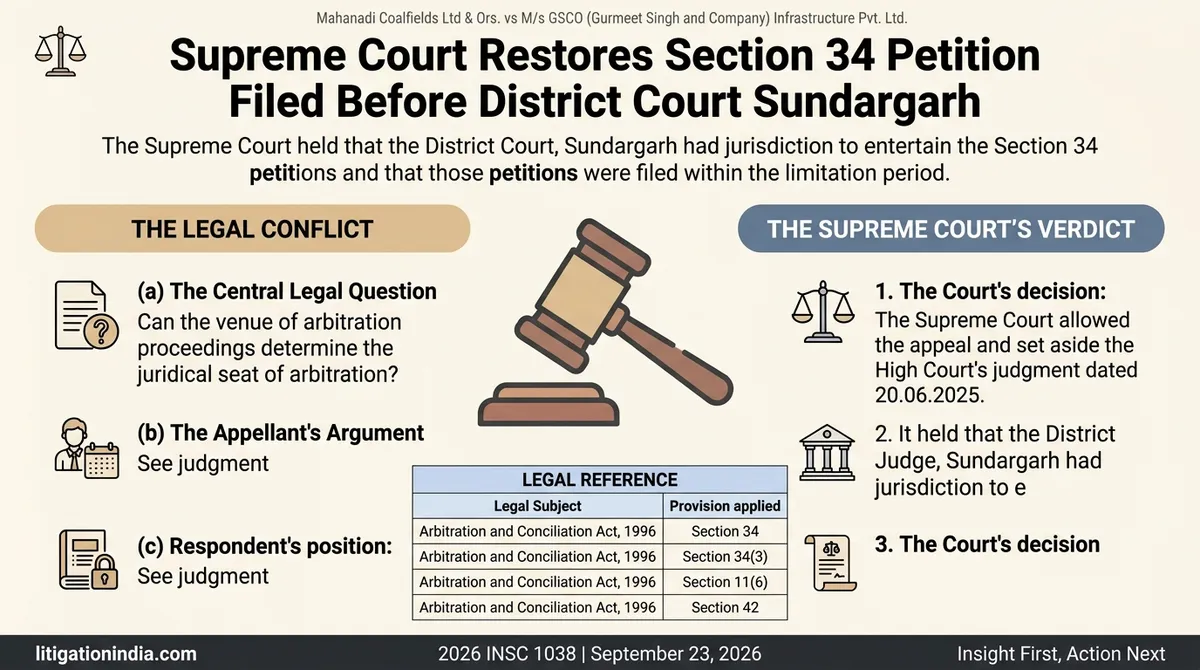
determination of a ‘Seat’ in the order of appointment or any such stipulation/direction by the Court. 32. In view of the above, the appeal is allowed and the impugned order of the High Court dated 20.06.2025 holding that the petition filed by the Appellants, under Section 34 of the Act before the Court of the District Judge, Sundargarh, was not maintainable for want of jurisdiction and also being time barred is not sustainable and is accordingly set aside. The Petition under Section 34 of the Act, filed by the Appellants, is restored on the file of the District Judge, Sundargarh, who shall decide the same in accordance with law expeditiously. ………………………….J. [SANJAY KUMAR]
…………………………….J. [SANJEEV SACHDEVA] New Delhi; September 23, 2026