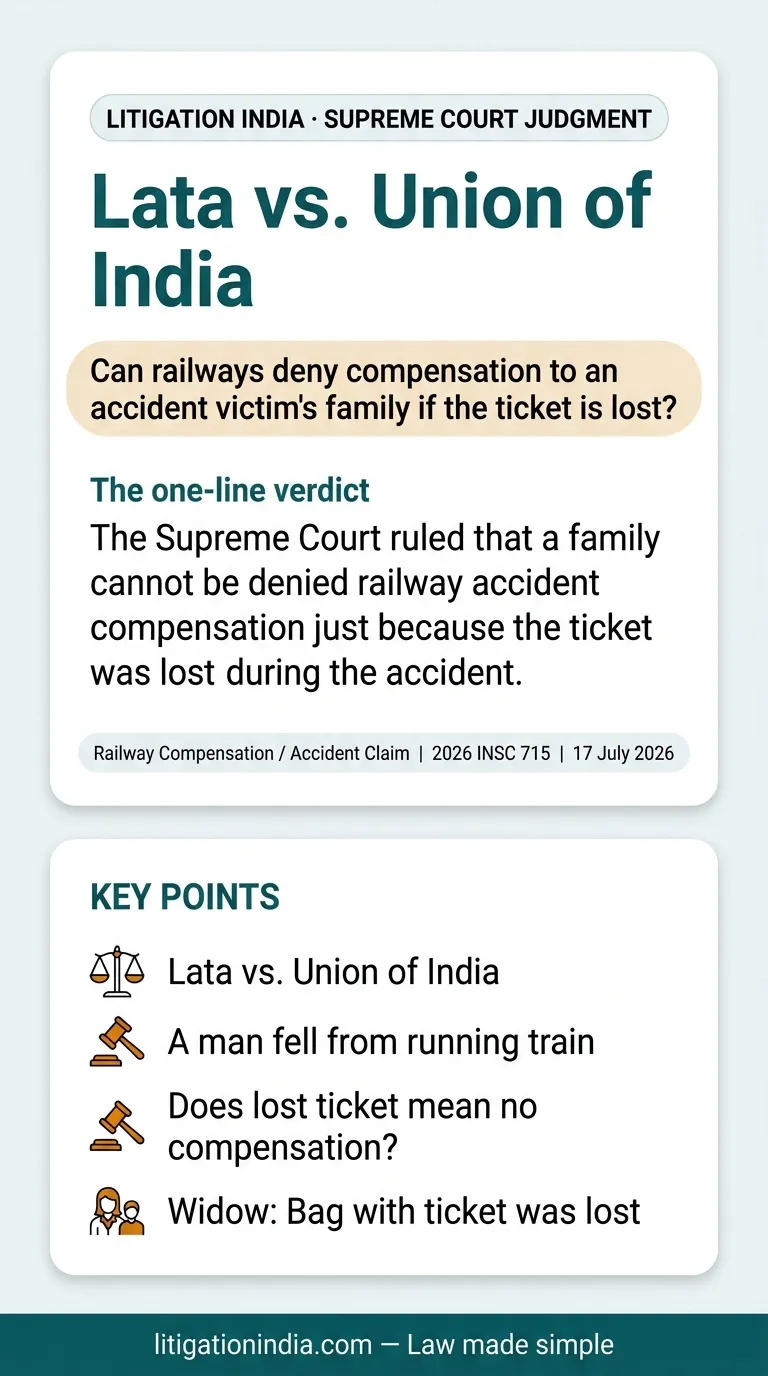
Lata vs. Union of India
The big legal question
Can railways deny compensation to an accident victim's family if the ticket is lost?
“The Supreme Court ruled that a family cannot be denied railway accident compensation just because the ticket was lost during the accident.”
Story Slides
In short
This judgment brings great relief to families of train accident victims. A man named Chandrakant Thakkar fell from a running train in 2015 and died on the spot. His wife, Lata, filed a claim for compensation. However, both the Railway Claims Tribunal and the High Court rejected her claim. They argued that because the police did not find a train ticket on his body or in his wallet, he could not be proven as a genuine passenger. The wife explained that his travel bag, which held the ticket, was lost during the accident. The Supreme Court overturned these lower court decisions. The Court clarified that under the Railways Act, getting compensation is a welfare right based on "no-fault liability." This means the family does not have to prove the railway was negligent to get help. The Court held that simply because a ticket is missing from a victim's body does not prove they were travelling illegally. A family can easily prove the victim was a genuine passenger by filing a sworn statement (affidavit) stating the facts. Once they do this, it is up to the Railways to prove otherwise. Since the Railways could not prove the deceased was travelling without a ticket, the Supreme Court ordered the Railways to pay Rs 8,00,000 compensation to the widow within four weeks.
Background
In 2015, a passenger fell from a running train and died instantly. The Railway Tribunal and High Court refused to pay his widow any compensation because no physical train ticket was recovered from his body or wallet, as his main luggage was lost in the accident.
The Decision
The Supreme Court set aside the lower courts' orders and allowed the claim. It ordered the Railways to pay Rs 8,00,000 compensation to the widow within four weeks, failing which it would carry an 8% annual interest from the date the claim was filed.
Why it matters for you
This judgment protects ordinary citizens from being denied compensation due to technicalities like lost tickets in accidents. It clarifies that a simple sworn affidavit is enough to initially prove a victim was a genuine passenger, shifting the burden onto the Railways to prove otherwise.
AI-assisted summary, reviewed and verified by our editorial team.
Need help with your case?
Need help securing compensation under the Motor Vehicles Act? Our accident claims advocates can guide you.
Related Supreme Court services