Banks can use fast-track recovery laws for loans bought from private financial companies
Kotak Mahindra Bank Limited vs Trupti Sanjay Mehta and others
The big legal question
Can banks use strict recovery laws for loans bought from private financial companies
What this case means
A bank bought old unpaid loans from a financial company that did not have special property-seizing powers under the SARFAESI Act. The Supreme Court decided that the bank can still use these powerful recovery laws to seize properties and recover the money. This means borrowers cannot escape quick recovery actions simply because their original lender was a private financial company.
“Banks are fully entitled to use the SARFAESI Act to recover unpaid loans purchased from private financial companies.”
Story Slides
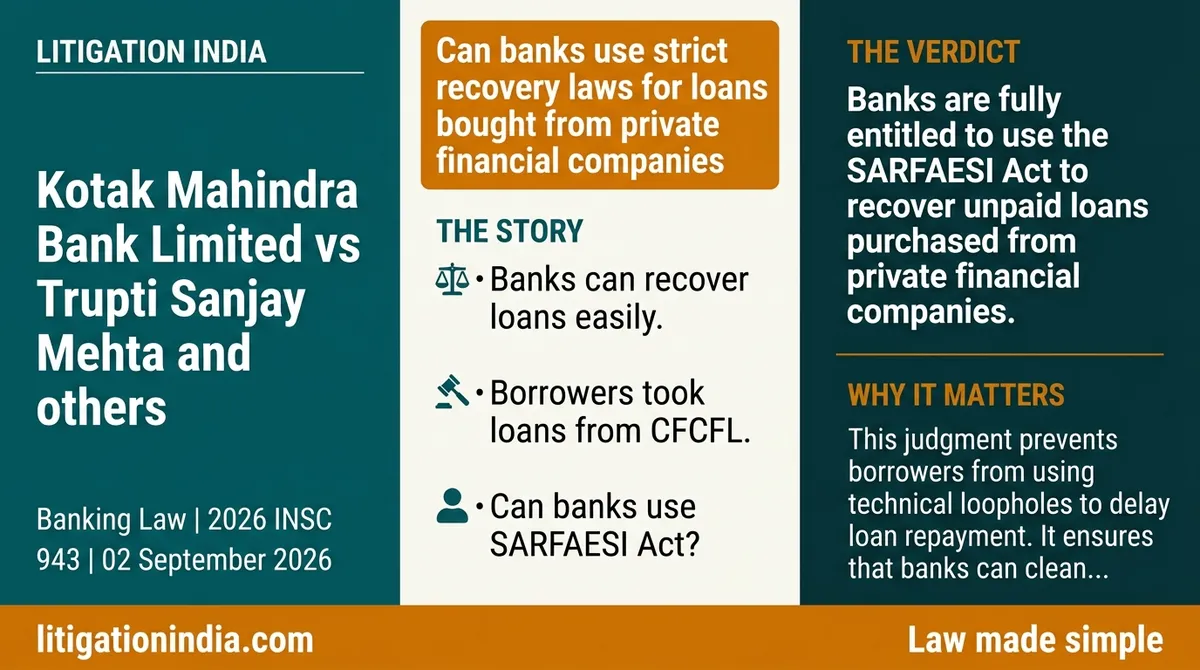
In short
This case resolved a major legal dispute regarding the debt recovery powers of banks. In these appeals, borrowers had taken home or business loans from City Financial Consumer Finance Limited (CFCFL), a non-banking financial company (NBFC). At the time the loans were given, CFCFL was not recognized as a 'financial institution' under the SARFAESI Act, meaning it could not bypass civil courts to seize properties for unpaid debts. Later, Kotak Mahindra Bank Limited (KMBL), which is a registered bank under the Act, bought these bad loan accounts from CFCFL. When the borrowers defaulted, KMBL initiated recovery actions under the SARFAESI Act to take physical possession of the mortgaged properties. The borrowers challenged this, arguing that because the original lender did not have SARFAESI recovery powers when the loan was created, the bank could not acquire those special powers simply by purchasing the loan. The Debt Recovery Tribunal and the Bombay High Court initially agreed with the borrowers. However, the Supreme Court reversed this view, clarifying that once a bank (which is governed by the SARFAESI Act) purchases a live and outstanding debt, that debt automatically becomes a 'secured debt' under the Act. The Court emphasized that every borrower has a legal and moral obligation to repay their loan. Restricting banks from using swift recovery processes for assigned debts would allow defaulting borrowers to escape their liabilities through long, drawn-out civil court proceedings, harming the economy. Therefore, the Supreme Court ruled that banks are fully entitled to use the SARFAESI Act to recover loans purchased from any private financial entity.
Background
Borrowers took loans from a private financial company (CFCFL) which did not have the power to seize properties directly under the SARFAESI Act. When the borrowers defaulted, Kotak Mahindra Bank bought these loan accounts and tried to seize their properties under the SARFAESI Act. The borrowers argued that since the original lender had no SARFAESI powers, the bank could not use them either.
The Decision
The Supreme Court ruled in favor of Kotak Mahindra Bank, holding that once a registered bank takes over a live debt, it can use the SARFAESI Act to recover it, regardless of who the original lender was. The Court set aside the Bombay High Court's order but allowed one family of borrowers to argue other merits of their case before the tribunal upon depositing an extra Rs. 25 lakh.
Why it matters for you
This judgment prevents borrowers from using technical loopholes to delay loan repayment. It ensures that banks can clean up their balance sheets by efficiently recovering bad loans they purchase from smaller financial companies, keeping the overall banking system healthy.
Relevant Legal Provisions
Key Acts and sections cited or relied upon in this judgment
“These provisions define who qualifies as a bank or financial institution and detail their powers to seize and sell mortgaged properties without going to a civil court.”
AI-assisted summary, reviewed and verified by our editorial team.
In the Court's words
“once a claim is 'live and owing' as on the date of coming into force of the SARFAESI Act, the provisions thereof would be available, as and when it becomes applicable to the institution holding that loan account.”
“acquisition of a non-performing secured loan account by such institution from an entity, that does not come within the ambit of the SARFAESI Act, would immediately clothe the said loan account with the attributes of a 'secured debt'”
Need help with your case?
Facing a similar legal challenge in the Supreme Court or High Court? Connect with our pro bono volunteer advocates today.
Related Supreme Court services