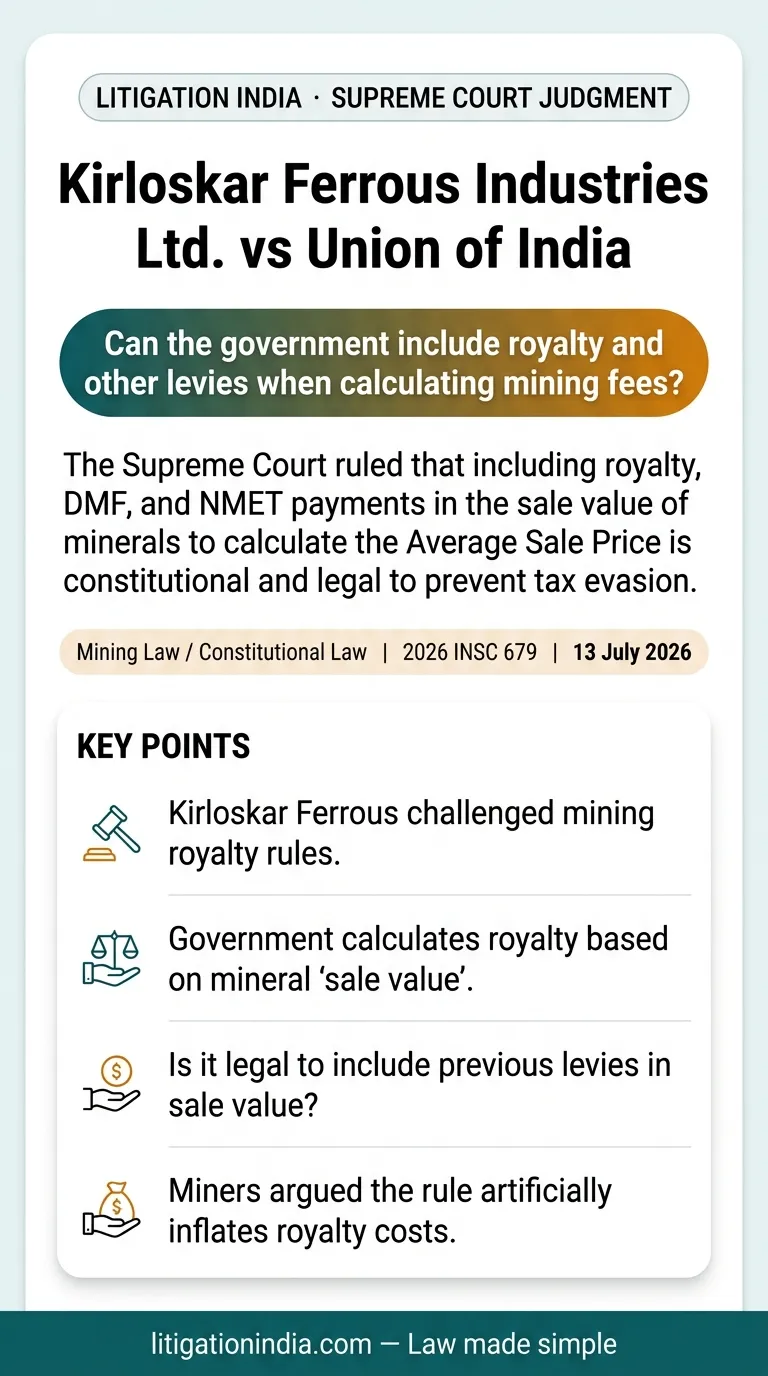
Kirloskar Ferrous Industries Ltd. vs Union of India
The big legal question
Can the government include royalty and other levies when calculating mining fees?
“The Supreme Court ruled that including royalty, DMF, and NMET payments in the sale value of minerals to calculate the Average Sale Price is constitutional and legal to prevent tax evasion.”
Story Slides
In short
The case was filed by mining company Kirloskar Ferrous Industries. They challenged rules under the Mines and Minerals Act that define how the 'sale value' of minerals like iron ore is calculated. These rules state that when determining the sale value (which is used to calculate the Average Sale Price and consequently the royalty), no deductions can be made for already paid royalty, District Mineral Foundation (DMF) charges, or National Mineral Exploration Trust (NMET) charges. The petitioners argued this creates a cascading 'royalty on royalty' effect, making payments rise unfairly. They also complained that coal mining enjoys these deductions, making the rules discriminatory. The Supreme Court rejected these arguments. It explained that the rules were specifically brought in to stop private miners from manipulating and under-reporting mineral sale prices to evade taxes. By showing lower sale prices, miners were paying less royalty. The Court noted that since coal production is largely controlled by government monopolies, the risk of price manipulation is low, justifying different rules for coal and iron ore. The Court held that the government has broad powers to frame fiscal policies to check tax evasion. When public welfare and state revenue are at stake, private profit interests must take a back seat.
Background
Mining companies challenged rules that included previously paid royalty and welfare contributions (DMF and NMET) in a mineral's sale value. They argued this created a double-taxation effect, making their mining costs unfairly high compared to coal miners.
The Decision
The Supreme Court dismissed the petition and upheld the rules. The Court held that this calculation method is a valid regulatory policy designed to stop private miners from artificially manipulating prices to evade taxes.
Why it matters for you
This judgment clarifies that the government has wide freedom to design tax and royalty calculation methods to prevent evasion. Private business hardships cannot override public welfare and state revenue protection.
AI-assisted summary, reviewed and verified by our editorial team.
Need help with your case?
Facing a similar legal challenge in the Supreme Court or High Court? Connect with our pro bono volunteer advocates today.
Related Supreme Court services