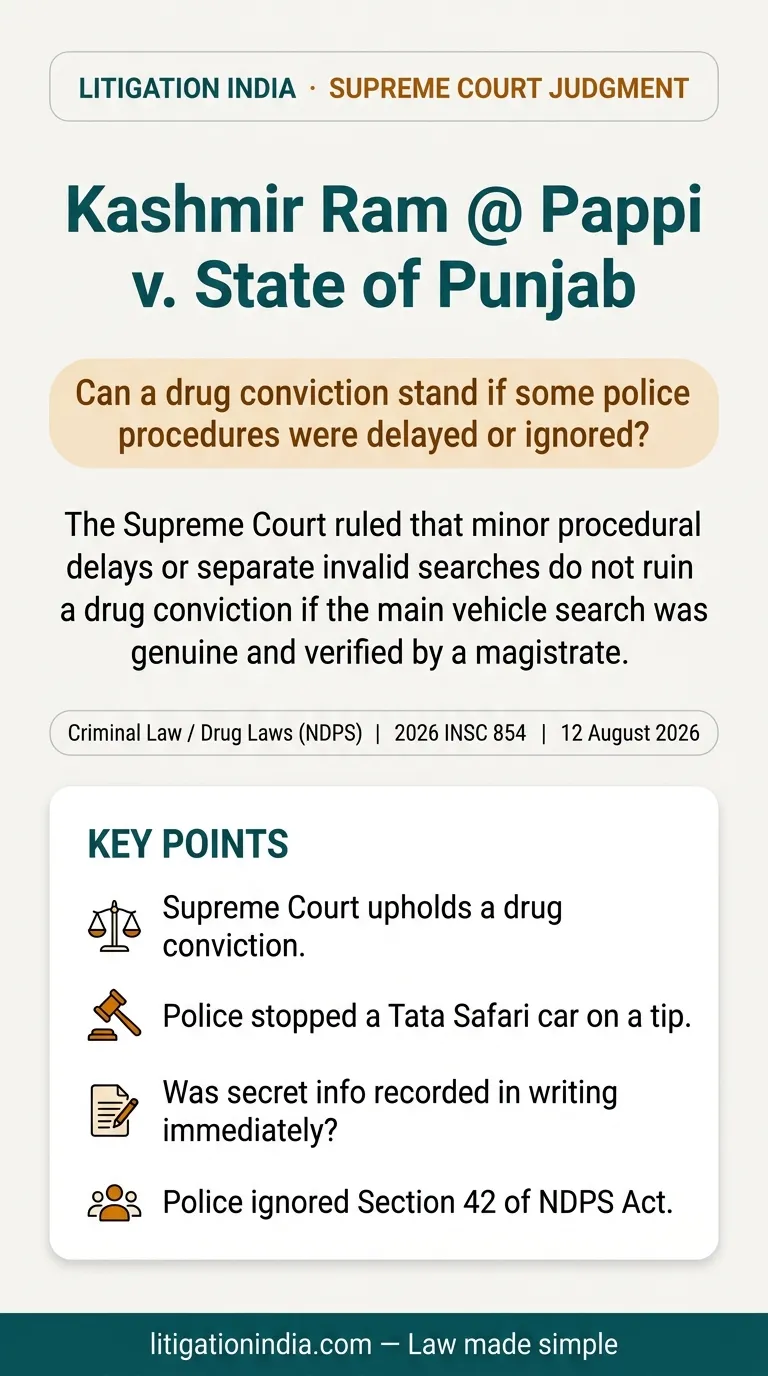
Kashmir Ram @ Pappi v. State of Punjab
The big legal question
Can a drug conviction stand if some police procedures were delayed or ignored?
“The Supreme Court ruled that minor procedural delays or separate invalid searches do not ruin a drug conviction if the main vehicle search was genuine and verified by a magistrate.”
Story Slides
In short
The Supreme Court of India rejected the appeal of Kashmir Ram, who was sentenced to 10 years in prison for carrying 200 kilograms of poppy husk (drug) in a vehicle. The appellant argued that the police violated strict rules of the Narcotic Drugs and Psychotropic Substances (NDPS) Act. Specifically, they claimed the police did not write down the secret tip immediately (Section 42), delayed sending samples to the lab, and conducted the search without independent public witnesses. The Supreme Court clarified important rules. First, it held that if police receive a tip while on patrol, they must act immediately to prevent the suspect from escaping. Writing down the tip can be done later; immediate action followed by calling a senior officer to the spot counts as proper compliance. Second, the court held that strict body search rules (Section 50) do not apply when drugs are recovered from a vehicle. Third, the court explained that the delay in sending samples to the lab was only a minor procedural issue because a magistrate had checked and locked the seals the very next day, proving no tampering occurred. Finally, the Court ruled that even if a separate search of the suspect's house was declared invalid for lack of witnesses, the valid search of the car remains fully usable. The conviction was upheld.
Background
In May 2014, Punjab police stopped a Tata Safari car after a secret tip-off and found 200 kg of poppy husk hidden under a sheet. The driver and the passenger, Kashmir Ram, were arrested, but they claimed the police framed them due to village politics.
The Decision
The Supreme Court dismissed Kashmir Ram's appeal and confirmed his 10-year prison sentence. The Court held that all key legal safeguards were substantially followed and the evidence from the car search was solid.
Why it matters for you
This judgment clarifies that minor technical errors or delays by the police will not let drug traffickers walk free if the core evidence is secured safely under a magistrate's supervision. It balances public safety with fair procedures.
AI-assisted summary, reviewed and verified by our editorial team.
Need help with your case?
Facing a similar legal challenge in the Supreme Court or High Court? Connect with our pro bono volunteer advocates today.
Related Supreme Court services