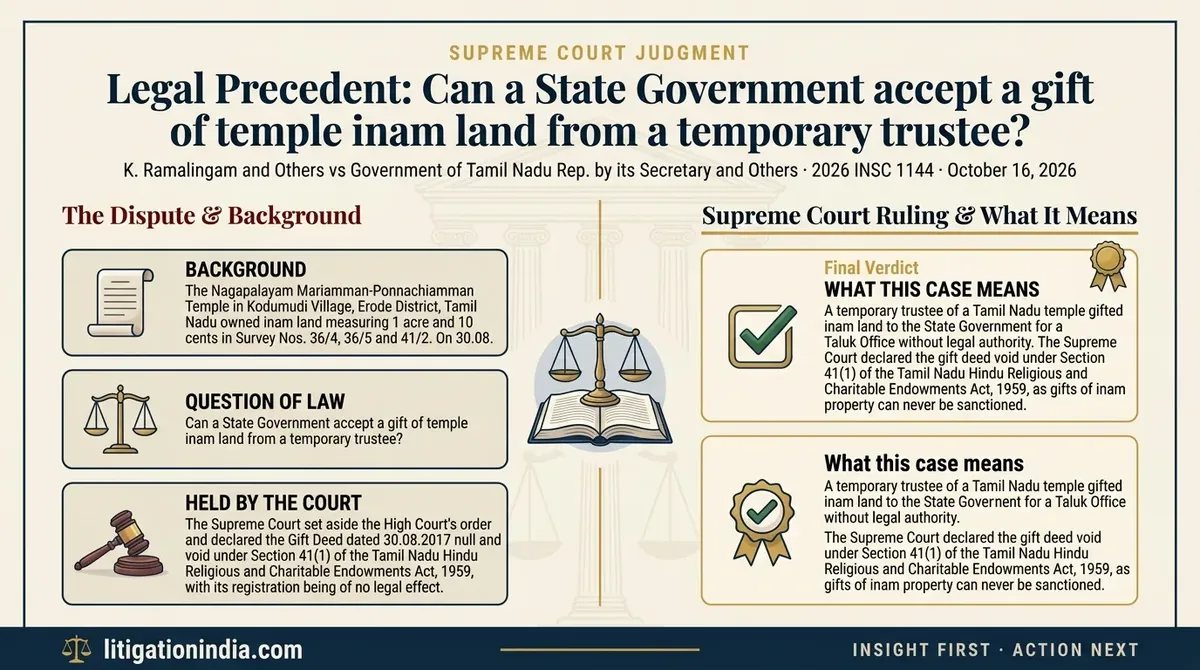
Full text of the judgment
Text extracted from K. Ramalingam and Others vs Government of Tamil Nadu Rep. by its Secretary and Others. For the authoritative version refer to the Supreme Court of India's official website.
2026 INSC 1144 Page 1 of 31
REPORTABLE IN THE SUPREME COURT OF INDIA CIVIL APPELLATE JURISDICTION CIVIL APPEAL NOS. OF 2026 (@ SPECIAL LEAVE PETITION (C) NOS. 20051-20052 OF 2019)
K. RAMALINGAM AND OTHERS … APPELLANTS
GOVERNMENT OF TAMIL NADU REP. BY ITS SECRETARY AND OTHERS … RESPONDENTS
J U D G M E N T
ALOK ARADHE, J 1. Leave granted. 2. The administration of property belonging to a religious/charitable institution carries with it a duty of preservation, not a power of unfettered disposition. The question which arises for consideration in these appeals, stated at its simplest, is whether the State Government, which the law requires to act as a custodian of the properties belonging to religious/charitable institutions, can itself become the recipient of a gift of such property from a temporary trustee of a temple. Digitally signed by KAPIL TANDON Date: 2026.10.16 17:44:51 IST Reason: Signature Not Verified
Page 2 of 31
3. These appeals emanate from the order dated 19.03.20191 passed by the High Court2 by which the writ petition preferred by the eighth respondent (the ‘hereditary trustee’) has been dismissed. FACTS 4. Facts giving rise to the filing of these appeals, briefly stated, are as follows. The land measuring 1 acre and 10 cents in Survey Nos. 36/4, 36/5 and 41/2 of Kodumudi Village, Erode District, Tamil Nadu (the ‘subject land’) belonged to Nagapalayam Mariamman-Ponnachiamman Temple (the ‘Temple’) and was administered by the temple trust. 5. On 30.08.2017, the Tehsildar issued a certificate stating that the seventh respondent, one Mr. S. Bhoopathy, (the ‘temporary trustee’) is the trustee of the Temple, the certificate being issued for the purpose of registration of a deed in the Sub-Registrar’s Office. By a Gift Deed of the same date, the temporary trustee of the Temple, gifted the subject land to the Government of
1W.P. No. 7075 of 2019 and W.M.P No. 7791 of 2019 2High Court of Judicature at Madras
Page 3 of 31
Tamil Nadu, represented by the District Collector and the Tehsildar, and was accepted by the Tehsildar. The stated purpose of the same was for construction of a Taluk Office on the subject land. 6. The Gift Deed was initially challenged by one M. Periyasamy and three others in W.P. No. 26913 of 2017, and subsequently by the hereditary trustee in W.P. No. 7075 of 2019, contending, inter alia, that the alienation of trust property by way of gift violated Section 34 of the Tamil Nadu Hindu Religious and Charitable Endowments Act, 1959 (the ‘1959 Act’), and was, therefore, void and illegal. 7. The writ petition preferred by the villagers was dismissed as withdrawn on 07.03.2018. In the writ petition filed by the hereditary trustee, the High Court by an order dated 19.03.2019, held that the word ‘gift/settlement’ does not appear in Section 34 of the 1959 Act and that alienation by way of gift was, on that account, not prohibited. It was further held that whether the subject land fell within the ambit of the 1959 Act at all was a disputed question of fact unsuited to writ
Page 4 of 31
adjudication. The writ petition was accordingly dismissed, with liberty to the hereditary trustee to file a suit for declaration of title. 8. The hereditary trustee did not pursue the matter further. On 19.08.2019, the appellants, who are devotees of the Temple were granted permission to file Special Leave Petitions against the judgment of the High Court. 9. On 23.03.2022, during the pendency of these appeals, the Principal Secretary to Government, Tourism, Culture and Religious Endowments Department, Tamil Nadu, filed an affidavit before this Court. Paragraphs 6 and 7 of that affidavit, being of some significance, are extracted below: “6. I most respectfully submit that since, the property involved is an INAM Land granted to the deity for its support and maintenance under Inam Title Deed No. 388, only section 41 of the said Act would come into play which prohibits gift/settlement of such lands as null and void. Further I submit that section 34(5) of the said Act also makes it clear that Section 34 of the said Act would not apply to inam lands. The reason for prohibiting gift/settlement is to protect the properties of the deities from being alienated
Page 5 of 31
permanently without any benefit accruing to the deities.” “7. I am advised to state that a meeting was convened in this regard on 04-02-2022 by the High Level Committee with the Chief Secretary to Government as Chairperson constituted by the Government to decide the common view of the Government which will be binding on all concerned Departments in which this land issue was also considered and the Revenue Department has also accepted to cancel the gift settlement deed executed in their favour and agreed to take the land on lease/rent. The High Level Committee also advised that a fair lease amount to be fixed for the gifted land so that it would be beneficial and in the interest of the deities for whose benefit the said inam was granted. Therefore, it was decided to fix a fair rent as contemplated under Section 34- A of the said Act.………………………………Consequently, fair lease rent to the property was fixed by the Committee in existence, consisting of the Joint Commissioner, Hindu Religious and Charitable Endowments Department, Erode, the Fit Person acting in lieu of trustee of the temple and the District Registrar, Erode. It is submitted that the said Committee, after considering all relevant issues and factors, fixed the Fair lease rent as Rs. 13,235/- per month and the lease period is fixed for three years. It was also decided that on expiry of the lease period, the lease would be extended/renewed further, after fixing fresh fair lease rent. This was considered as beneficial to the deity of the Temple…..”
Page 6 of 31
The stand thus taken by the State leaves no doubt that the Temple is the owner of the subject land. SUBMISSIONS 10. Mr. S. Ravi Shankar, learned counsel for the appellants, submitted that the subject land is admittedly the property of the Temple. He contended that a temporary trustee has no authority to alienate it and that the gift, made without sanction under Section 34 of the 1959 Act, is null and void; that its registration is in any event barred by Section 22-A of the Registration Act, 1908, as applicable to the State of Tamil Nadu; and that any rent payable in respect of the land ought to be fixed with reference to its market value. 11. Mr. K.L. Janjani, learned counsel for the temporary trustee, submitted that respondent no. 7/the temporary trustee is the hereditary trustee of the Temple. He argued that the land was transferred to the Government in public interest, for the construction of a Taluk Office, pursuant to a unanimous decision of the devotees and villagers. He submitted that since
Page 7 of 31
Section 34 of the 1959 Act does not in terms mention a gift, the transaction is not rendered unlawful by that provision. 12. Mrs. Haripriya Padmanabhan, learned Additional Advocate General for the State and Mr. M. Sathyanarayanan, learned senior counsel for the Hindu Religious and Charitable Endowment Department, fairly did not dispute that the subject land belongs to the Temple, or that the Gift Deed dated 30.08.2017 cannot be sustained. It was urged, however, that a Taluk Office building has since been constructed on the land out of public funds and serves a genuine public need. 13. Mr. Shailesh Madiyal, learned amicus curiae, submitted that any alienation of property belonging to a religious institution must satisfy the restrictions in Section 34 of the 1959 Act, including sanction of the Commissioner upon a finding that the alienation is necessary or beneficial to the institution. He contended that the State’s own affidavit admits that the land belongs to the Temple, and there is no material on record to show that either the process under Section 34 of the 1959 Act or that under Section 41 of the 1959 Act has been followed.
Page 8 of 31
14. It was urged that a gift, being without consideration, cannot by its very nature be said to be necessary or beneficial to the donor institution, and that a gift of temple land to the Government defeats the very object of the supervisory role assigned to the Commissioner under Sections 23 and 34 of the 1959 Act. Even other modes of alienation of temple property, it was urged, must be approached with circumspection. Reliance in support of these submissions was placed on certain decisions of this Court and the High Court.3 15. We have considered the rival submissions and have perused the record. STATUTORY FRAMEWORK 16. It is convenient, at this stage, to set out the relevant statutory provisions. Section 23 of the 1959 Act, which vests the Commissioner with superintendence over temples and religious endowments, reads:
3Edukanti Kistamma and Ors. v. S. Venkatareddy, (2010) 1 SCC 756; A.A. Gopalakrishnan v. Cochin Devaswom Board, (2007) 7 SCC 482; T.R. Ramesh v. Commissioner and Ors. (W.A. No. 105 of 2025); Suo Motu W.P. No. 574 of 2015 (Judgment dated 07.06.2021) and The Chief Secretary & Ors. v. The Director & Ors., Rev. Appl. No. 169-170 of 2021
Page 9 of 31
“23. Power and duties of the Commissioner in respect of temples and religious endowments.—Subject to the provisions of this Act, the administration of all temples (including specific endowments attached thereto) and all religious endowments shall be subject to the general superintendence and control of the Commissioner and such superintendence and control shall include the power to pass any orders which may be deemed necessary to ensure that such temples and endowments are properly administered and that their income is duly appropriated for the purposes for which they were founded or exist: Provided that the Commissioner shall not pass any order prejudicial to any temple or endowment unless the trustees concerned had a reasonable opportunity of making their representations.”
17. The relevant extract of Sections 27 and 28 of the 1959 Act, which define the obligations of a trustee, read: “27. Trustee bound to obey orders issued under this Act.—The trustee of a religious institution shall be bound to obey all lawful orders issued under the provisions of this Act by the Government, the Commissioner, the Additional Commissioner, the Joint Commissioner, the Deputy Commissioner or the Assistant Commissioner. 28. Care required of trustee and his powers.—(1) Subject to the provisions of the Tamil Nadu Temple Entry Authorisation Act, 1947 (Tamil Nadu Act V of 1947), the trustee of every religious institution is bound to
Page 10 of 31
administer its affairs and to apply its funds and properties in accordance with the terms of the trust, the usage of the institution and all lawful directions which a competent authority may issue in respect thereof and as carefully as a man of ordinary prudence would deal with such affairs, funds and properties if they were his own. (2) A trustee shall, subject to the provisions of this Act, be entitled to exercise all powers incidental to the provident and beneficial administration of the religious institution and to do all things necessary for the due performance of the duties imposed on him.…”
18. Section 34 of the 1959 Act, dealing with alienation of immovable trust property, reads: “34. Alienation of immovable trust property.—(1) Any exchange, sale or mortgage and any lease for a term exceeding five years of any immovable property, belonging to, or given or endowed for the purpose of, any religious institution shall be null and void unless it is sanctioned by the Commissioner as being necessary or beneficial to the institution: Provided that before such sanction is accorded, the particulars relating to the proposed transaction shall be published in such manner as may be prescribed, inviting objections and suggestions with respect thereto; and all objections and suggestions received from the trustee or other persons having interest shall be duly considered by the Commissioner:
Page 11 of 31
Provided further that the Commissioner shall not accord such sanction without the previous approval of the Government. Explanation.—Any lease of the property above mentioned though for a term not exceeding five years shall, if it contains a provision for renewal for a further term (so as to exceed five years in the aggregate), whether subject to any condition or not, be deemed to be a lease for a period exceeding five years. (2) When according such sanction, the Commissioner may impose such conditions and give such directions as he may deem necessary regarding the utilization of the amount raised by the transaction, the investment thereof and, in the case of a mortgage, regarding the discharge of the same within a reasonable period. (3) A copy of the order made by the Commissioner under this section shall be communicated to the Government and to the trustee and shall be published in such manner as may be prescribed. (4) The trustee may, within three months from the date of his receipt of a copy of the order, and any person having interest may, within three months from the date of the publication of the order, appeal to the Court to modify the order or set it aside. (4-A) The Government may issue such directions to the Commissioner as in their opinion are necessary, in respect of any exchange, sale, mortgage or lease of any immovable property, belonging to, or given or endowed for the purpose of, any religious institution and the Commissioner shall give effect to all such directions.
Page 12 of 31
(5) Nothing contained in this section shall apply to the inams referred to in section 41.”
19. Section 34-A (1) and (2) of the 1959 Act, providing for fixation of lease rent, reads: “34-A. Fixation of lease rent.—(1) The lease rent payable for the lease of immovable property belonging to, or given or endowed for the purpose of, any religious institution, shall be fixed by a Committee consisting of the Joint Commissioner, the Executive Officer or the Trustee or the Chairman of the Board of Trustees, as the case may be, of the religious institution and the District Registrar of the Registration Department in the district concerned, taking into account the prevailing market rental value and the guidelines, as may be prescribed, and such lease rent shall be refixed in the like manner once in three years by the said Committee. Explanation.—For the purpose of this subsection, ‘prevailing market rental value’ means the amount of rent paid for similar types of properties situated in the locality where the immovable property of the religious institution is situated. (2) The Executive Officer or the Trustee or the Chairman of the Board of Trustees, as the case may be, of the religious institution concerned, shall pass an order fixing the lease rent and intimate the same to the lessee specifying a time within which such lease rent shall be paid.…”
Page 13 of 31
20. Section 41(1) of the 1959 Act, dealing with inams granted for the support or maintenance of a religious institution, reads: “41. Resumption and re-grant of inam granted for performance of any charity or service.—(1) Any exchange, gift, sale or mortgage and any lease for a term exceeding five years of the whole or any portion of any inam granted for the support or maintenance of a religious institution or for the performance of a charity or service connected therewith or of any other religious charity and made, confirmed or recognized by the Government shall be null and void: Provided that any transaction of the nature aforesaid (not being a gift) may be sanctioned by the Government as being necessary or beneficial to the institution.…”
21. Section 41(2) of the 1959 Act empowers the Collector to resume an inam where the holder or the trustee has made an exchange, gift, sale or mortgage of it, clause (f) thereof directing that the inam so resumed be re-granted as an endowment to the religious institution concerned. 22. Section 22-A of the Registration Act, 1908, as substituted in its application to the State of Tamil Nadu, in relevant part, reads: “22-A. Refusal to register certain documents.—Notwithstanding anything contained in this Act, the registering officer
Page 14 of 31
shall refuse to register any of the following documents, namely:— (1) instrument relating to the transfer of immovable properties by way of sale, gift, mortgage, exchange or lease,— … (ii) belonging to, or given or endowed for the purpose of, any religious institution to which the Tamil Nadu Hindu Religious and Charitable Endowments Act, 1959 is applicable; … unless a sanction in this regard issued by the competent authority as provided under the relevant Act or, in the absence of any such authority, an authority so authorized by the State Government for this purpose, is produced before the registering officer;” ANALYSIS NATURE OF TEMPLE PROPERTY AND THE STATE’S ROLE AS CUSTODIAN
23. Before turning to the rival contentions, it is useful to recall why property belonging to religious institutions is treated differently from ordinary property. Our country’s religious institutions are not merely places of worship, they are, in law and, in fact, repositories of considerable wealth, land, buildings, jewellery and specie, accumulated over centuries through the offerings of ordinary devotees and the endowments of kings and commoners alike, given in the faith that what was dedicated to the deity would remain dedicated to the deity in perpetuity. That wealth, once given, ceases to belong to the donor, to the priest, to the
Page 15 of 31
trustee, or to the State; it vests in the deity, and every hand through which it subsequently passes holds it only in trust for the deity and, through the deity, for the community of worshippers it was meant to serve. Every custodian holds it only in trust for the deity and the worshippers it serves. 24. A seven-Judge Bench of this Court in Commissioner, Hindu Religious Endowments, Madras v. Sri Lakshmindra Thirtha Swamiar of Sri Shirur Mutt4, held that while Articles 25 and 26 of the Constitution protect religious belief and practice, they do not immunise the secular and economic administration of religious property from regulation by law. The same view was reaffirmed in A.S. Narayana Deekshitulu v. State of Andhra Pradesh5, where the administration of temple funds and offices was held to be a secular function distinct from the freedom of worship itself. 25. It is against this backdrop that Sections 23, 27, 28, 34, 34-A and 41 of the 1959 Act, extracted above, must be read. The object of the said provisions is to shield temple property from
4 (1954) 1 SCC 412 5(1996) 9 SCC 548
Page 16 of 31
dissipation, whether at the hands of an improvident trustee or, as the facts of this case illustrate, an overreaching arm of the State itself; a custodian does not cease to be bound by the terms of its custodianship merely because it is also the sovereign. POSITION OF LAW WITH RESPECT TO ALIENATION OF PROPERTIES BELONGING TO RELIGIOUS OR CHARITABLE TRUSTS IN OTHER JURISDICTIONS 26. Even in other countries, laws similarly withhold religious or charitable trust land from free disposal. 26.1 In England and Wales, under Section 117 of the Charities Act 20116, no land held by or in trust for a charity may be disposed of without an order of the court or the Charity Commission, or compliance with a prescribed valuation procedure. 26.2 In the United States, the Attorney General enforces charitable trusts as parens patriae: New York's Religious Corporations Law §127 requires leave of court or the Attorney General's approval
6 117. Restrictions on dispositions of land: general (1) No land held by or in trust for a charity is to be conveyed, transferred, leased or otherwise disposed of without an order of— (a)the court, or (b)the Commission. But this is subject to the following provisions of this section, sections 119 to 121 (further provisions about restrictions on dispositions) and section 127 (release of charity rent charges). 7 § 12. Sale, mortgage and lease of real property of religious corporations. 1. A religious corporation shall not sell, mortgage or lease for a term exceeding five years any of its real property without applying for and obtaining
Page 17 of 31
before a religious corporation sells, mortgages or leases its real property. 26.3 In Canada, Ontario's Religious Organizations' Lands Act, R.S.O. 1990, c. R.23, Section 12(1)8 lets trustees sell or exchange land only on terms the organization approves by resolution, and only after the organization has resolved that the land is no longer needed for its purposes. Section 99 restricts mortgages to debts contracted for acquiring or improving the land or its buildings. Where the organization has ceased to exist, or the required authorization cannot be obtained, section 2310 lets the trustees, an interested person or the Public
leave of the court or the attorney general therefor pursuant to section five hundred eleven of the not-for-profit corporation law as that section is modified by paragraph (d-1) of subdivision one of section two-b of this chapter or section five hundred eleven-a of the not-for-profit corporation law, except that a religious corporation may execute a purchase money mortgage or a purchase money security agreement creating a security interest in personal property purchased by it without obtaining leave of the court therefor. 8 12 (1) The trustees of a religious organization may, upon such terms and conditions as the organization may by resolution approve, sell or exchange at any time land held by them if the organization has by resolution determined that the land is no longer necessary for its purposes. 9 9 (1) The trustees of a religious organization may secure any debt contracted for the acquisition or improvement of land under this Act, or for the building, repairing, extending or improving of any buildings thereon, by a mortgage or charge on all or any part of the land of the organization. 10 23 (1) Where a religious organization has ceased to exist, or where the authorization required under section 6 cannot be obtained for any reason other than a dispute among the members of the organization concerning the organization’s property, the persons in whom the land of the organization is vested as trustees or, upon their failure to do so or where no trustees remain in office, any interested person or the Public Guardian and Trustee may apply to the Superior Court of Justice for directions, and the court may authorize the trustees or may appoint and authorize any other person to exercise any of the powers conferred by this Act. R.S.O. 1990, c. R.23, s. 23 (1); 2006, c. 19, Sched. C, s. 1 (1); 2009, c. 33, Sched. 2, s. 65 (3). 23(2) Upon such an application, the court may direct that the land or any part thereof be disposed of or that it or the proceeds of sale thereof be distributed in such manner as it considers proper, and the court may make such vesting orders as are expedient in the circumstances.
Page 18 of 31
Guardian and Trustee apply to the Superior Court of Justice for directions. 27. These regimes treat the State as a guardian that must consent before religious property is dealt with. The property dedicated to a deity or a charitable purpose has no natural guardian of its own, and the law supplies one through sanction and external oversight rather than private discretion. FINDINGS A. THE CHARACTER OF THE SUBJECT LAND AND THE VALIDITY OF THE GIFT 28. The character of the subject land in the instant case must first be determined, for the applicability of Section 34 or Section 41 of the 1959 Act turns upon it. The affidavit dated 23.03.2022, extracted in paragraph 9 above, states in express terms that the subject land is an inam land granted to the deity for its support and maintenance under Inam Title Deed No. 388. Section 34(5) of the 1959 Act expressly excludes from the operation of Section 34 “the inams referred to in section 41”. It follows that Section 41 of the 1959 Act, and not Section 34, governs the transaction impugned in these appeals.
Page 19 of 31
29. This is not a distinction without a difference; it carries decisive consequence for a transaction of gift. Section 34(1) of the 1959 Act empowers the Commissioner to sanction “any exchange, sale or mortgage and any lease for a term exceeding five years” as being necessary or beneficial to the institution. Section 41(1) of the 1959 Act, while similarly declaring “any exchange, gift, sale or mortgage and any lease for a term exceeding five years” of an inam property to be null and void, permits the Government to sanction only “any transaction of the nature aforesaid (not being a gift)”. 30. The Legislature has thus consciously withheld from a gift of an inam property, the very possibility of subsequent validation, by the Commissioner or the Government alike. A gift of an inam property dedicated to the support of a deity is, in consequence, void ab initio and no sanction, however solemnly accorded, could have breathed life into it. 31. Tested on this anvil, the Gift Deed dated 30.08.2017, executed by temporary trustee in favour of the Government of Tamil Nadu, is null and void under Section 41(1) of the 1959 Act. It
Page 20 of 31
was equally incapable of valid registration, having regard to Section 22-A of the Registration Act, 1908, as applicable to the State of Tamil Nadu, since no sanction “issued by the competent authority as provided under the relevant Act” preceded its registration, and, being a gift of an inam property, no such sanction could at all have been granted. The fact that the document nonetheless came to be registered does not cure this infirmity; registration under one statute cannot validate what another statute, governing the very property in question, declares void. 32. We may add, for completeness, that even upon the alternative hypothesis, contrary to the Government’s own affidavit, that the subject land fell within the general class of properties governed by Section 34 of the 1959 Act rather than Section 41, the outcome would be no different. It is not in dispute that no sanction of the Commissioner, preceded by the publication and invitation of objections contemplated by the first proviso to Section 34(1) of the 1959 Act, and no prior approval of the Government under the second proviso, was obtained before
Page 21 of 31
30.08.2017. The gift on this hypothesis too, would be null and void for want of sanction. 33. We are unable to accept the submission that a temporary trustee’s authority over trust property is unconstrained. Sections 27 and 28 of the 1959 Act oblige every trustee, permanent or temporary, to administer the institution’s properties “as carefully as a man of ordinary prudence would deal with such affairs, funds and properties if they were his own”, and to obey all lawful orders issued under the Act. A gift, being a transfer without consideration, cannot by its very nature be characterised as an act of ordinary prudence in the management of another’s property. It confers no corresponding benefit on the donor institution and does not fit in with the fiduciary character of the office of trustee. A gift of temple property to the Government, being wholly gratuitous, militates against the very object of the supervisory role assigned to the Commissioner under Sections 23 and 34 of the 1959 Act. 34. The submission that the Revenue Department was, in these circumstances, entitled to receive and hold the subject land by
Page 22 of 31
way of gift proceeds upon a misconception. The State, acting through the Commissioner and other functionaries under the 1959 Act, is a custodian and regulator of temple properties, not their owner. An acceptance of a gift of temple land by a Revenue functionary, however laudable the public purpose it is intended to serve, offends the object of the 1959 Act. A temple property is held for the deity and not for gratuitous disposal by whoever happens to hold the office of trustee, however well-intentioned. B. CONDUCT OF THE STATE 35. We are constrained to note that the State did not change its stand on its own initiative. The deed was executed and registered on 30.08.2017. In W.P. No. 26913 of 2017, the Assistant Commissioner, Hindu Religious and Charitable Endowments Department, had asserted on affidavit that the property belongs to the deity and that the executant had no authority to convey it. Even so, the Revenue Department mutated the lands in the name of the Taluk Office, reclassified them as “Sarkar Poramboke” and began construction. Before the High Court, the State defended the transaction and
Page 23 of 31
succeeded. Even after this Court issued notice on 19.08.2019, the State persisted in that defence. In the counter affidavit dated 23.10.2019, it maintained that the lands had vested absolutely in the Government and would “not belong to any others or any religious institutions”. It reiterated that stand in I.A. No. 14519 of 2021, seeking vacation of the order of status quo. 36. The State abandoned the gift only after this Court, by its order dated 21.02.2022, required the Secretary in charge of Endowments to clarify on affidavit whether a trustee can gift away temple property. It was then that the State accepted that the lands belong to the Temple, that a gift of such lands is prohibited by Section 41 of the 1959 Act, and that the Revenue Department could hold them only as a lessee. A department of the State, which is the statutory custodian of temple properties, ought to have recognised this position at the threshold. It should not have taken a challenge before this Court, and the probing of the issue by this Court, to bring it about. The State’s belated concession, cannot obscure the fact that for over four years the property of the Temple was treated as that of the
Page 24 of 31
Government on the strength of a deed which, by the State’s own admission, had no sanction in law. C. DETERMINATION OF FAIR RENT 37. It is noteworthy that the Revenue Department, by using public funds, has already constructed a Taluk Office upon the land which serves the administrative needs of the Taluk. We are, therefore, not inclined to set aside the lease granted in favour of the State Government. However, the issue with regard to the quantum of fair lease rent needs to be dealt with. The Fair Rent Committee, by its decision dated 09.02.2022, fixed the rent at Rs. 13,235/- (Rupees Thirteen Thousand Two Hundred Thirty Five only) per month. The State Government has issued G.O. (MS) No. 200 dated 02.11.2018 under which, lands of religious institutions which are required to be made over to the Government are to be valued at 225% of the guideline value or the market value whichever is higher. The Collector in his communication dated 22.05.2019, while referring to the aforesaid G.O. had proposed that the land belonging to the Trust should be valued in terms of the aforesaid G.O.(MS). We
Page 25 of 31
are conscious of the fact that the State Government has constructed the building. However, since the trust has been wrongfully deprived of use of its property, with a view to ascertain the fair rent, we apply the formula evolved by the Fair Rent Committee. 38. The material on record shows that according to Registration Department, in respect of an adjoining developed land, the market value was indicated at Rs. 167/- (Rupees One Hundred Sixty Seven only) per square feet. To ascertain the fair rent, we take the market value of the subject land at Rs. 167/- (Rupees One Hundred Sixty Seven only) per square feet. Applying 225% thereof as per the aforesaid G.O., the value works out to Rs. 375.75 (Rupees Three Hundred Seventy Five and Seventy Five Paise only) per square feet, and for the subject land admeasuring 47,916 square feet, to Rs. 1,80,04,437/- (Rupees One Crore Eighty Lakh Four Thousand Four Hundred Thirty Seven only). As per the formula adopted by the Fair Rent Committee, the value of the building has to be added to this market value. From a perusal of the Fair Rent Fixation
Page 26 of 31
Statement, it is evident that the depreciated value of the building is Rs.1,24,33,603/- (Rupees One Crore Twenty Four Lakh Thirty Three Thousand Six Hundred Three only). Thus, the total value comes to Rs.3,04,38,040/- (Rupees Three Crore Four Lakh Thirty Eight Thousand Forty only). As per the formula adopted by the Fair Rent Committee, the rent has to be fixed at the rate of 0.1% of the total value. Thus, the fair rent comes to Rs. 30,438/- (Rupees Thirty Thousand Four Hundred Thirty Eight only). We, therefore, enhance the rent and round it off to Rs. 31,000/- (Rupees Thirty One Thousand only) per month which shall be payable with effect from 08.03.2019, that is, the date on which the subject land was handed over for construction. 39. We make it clear that the continuation of this lease is not to be read as conferring upon the Revenue Department any degree of unilateral control over its terms. The trust, acting through its trustee or, in the absence of a duly constituted Board of Trustees, the Fit Person appointed under the 1959 Act, in consultation with the Committee empanelled for the purpose,
Page 27 of 31
shall retain the power to determine, and, as occasion requires, to revise, the terms and conditions of the lease in favour of the Government, including the quantum of rent, on each occasion of renewal, strictly having regard to the prevailing market rental value and the best interests of the institution. An extension or renewal of the lease upon expiry of its current term shall be granted only upon fresh determination of fair rent by the Committee, and not as a matter of course. DIRECTIONS 40. We consider it necessary, in view of what has transpired in this case, where a gift of the temple’s inam property was executed and registered without any authority of law, and was allowed to stand until the State conceded before this Court in 2022, to issue following directions henceforth: (i) the authorities of the State Government and the Hindu Religious and Charitable Endowments Department shall strictly comply with the procedure prescribed under Sections 34, 34-A and 41 of the 1959 Act, and the Rules framed thereunder, before effecting or
Page 28 of 31
sanctioning any exchange, sale, mortgage or lease of property belonging to, or given or endowed for the purpose of, any religious institution. (ii) Every decision touching the properties of a religious/charitable institution must be guided solely by the best interest and benefit of the trust, and never by the administrative convenience of the Government. (iii) The State, as custodian, cannot unilaterally usurp, nor permit any of its officers to usurp, the property of the religious/charitable institutions it is charged to protect; a transaction that offends this principle, whatever its label or ostensible public purpose, is liable to be struck down. CONCLUSION 41. In the result, the judgment and order dated 19.03.2019 passed by the High Court is set aside. It is declared and directed that: (i) The subject land bearing Survey Nos. 36/4, 36/5 and 41/2 of Kodumudi Village, Erode District, is an inam property belonging to and vested in the Temple;
Page 29 of 31
(ii) The Gift Deed dated 30.08.2017 executed in favour of the Government of Tamil Nadu, is declared null and void under Section 41(1) of the Tamil Nadu Hindu Religious and Charitable Endowments Act, 1959, and its registration, being contrary to Section 22-A of the Registration Act, 1908, as applicable to the State of Tamil Nadu, is of no legal effect; (iii) The lease in favour of the Government shall not be annulled. If the lease has expired, it shall be renewed. In either event, the lease rent shall stand enhanced to Rs. 31,000/- (Rupees Thirty One Thousand only) per month with effect from 08.03.2019, the date on which the subject land was handed over for construction. The rent shall be re-fixed once in three years under Section 34-A of the 1959 Act, but not below that amount. The period of the lease, its renewal and the remaining terms shall be determined by the trust of the Temple, in accordance with the 1959 Act, with the benefit of the Temple as the paramount consideration.
Page 30 of 31
(iv) The arrears of rent from 08.03.2019 till date, after adjusting any amount already paid, shall be paid by the State to the Temple within three months from today. (v) The State was under a statutory obligation to act as custodian of the subject land, however, the State not only accepted the gift of temple property but also continued to defend it before the High Court and before this Court, until the Chief Secretary of Endowments was called upon to place his stand on affidavit. Therefore, we deem it appropriate to direct the State to pay costs quantified at Rs.1,00,000/- (Rupees One Lakh only) within a period of eight weeks to the Temple. (vi) The respondent-authorities shall, henceforth, strictly comply with the procedure prescribed under Sections 34, 34-A and 41 of the 1959 Act, as directed in paragraph 40 above. 42. We place on record our appreciation for the able assistance rendered by Mr. Shailesh Madiyal, learned amicus curiae, and by learned counsel for the parties.
Page 31 of 31
43. The appeals are allowed in the above terms. Pending application(s), if any, shall stand disposed of.
......................................................J. [PAMIDIGHANTAM SRI NARASIMHA]
......................................................J. [ALOK ARADHE]
NEW DELHI; OCTOBER 16, 2026