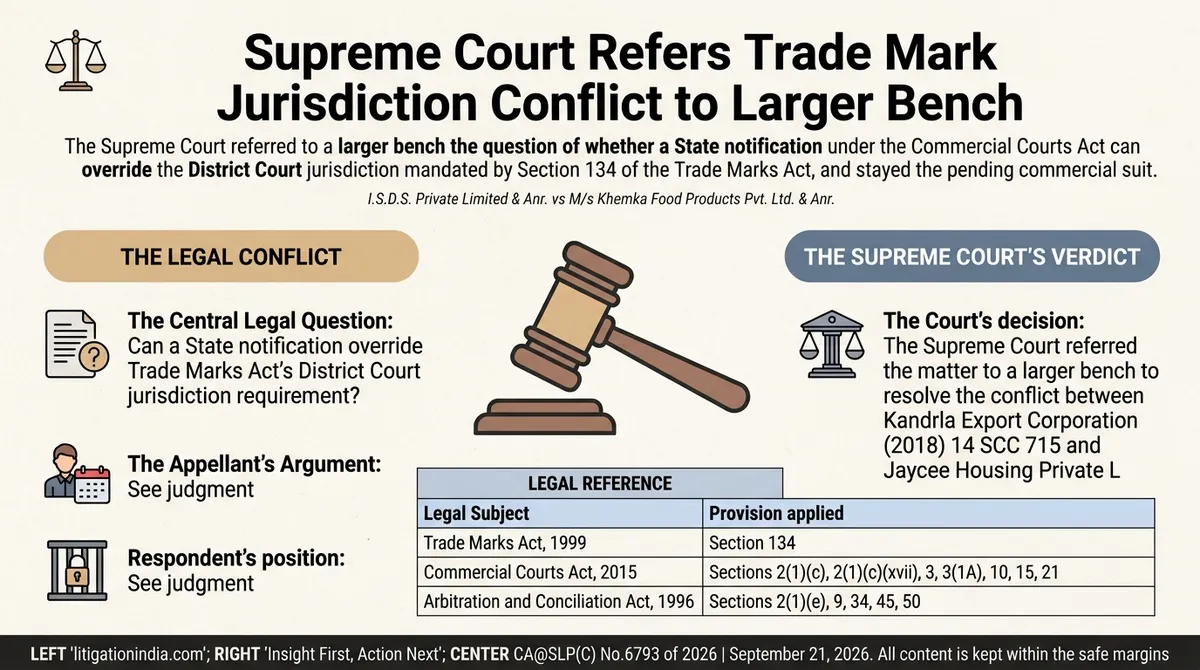
Full text of the judgment
Text extracted from I.S.D.S. Private Limited & Anr. vs M/s Khemka Food Products Pvt. Ltd. & Anr.. For the authoritative version refer to the Supreme Court of India's official website.
Page 1 of 11 CA@SLP(C) No.6793 of 2026 Non-Reportable
IN THE SUPREME COURT OF INDIA CIVIL APPELLATE JURISDICTION
Civil Appeal No……………of 2026 (@Special Leave Petition (C) No.6793 of 2026)
I.S.D.S. Private Limited & Anr.
…. Appellants
Versus M/s Khemka Food Products Pvt. Ltd. & Anr.
…. Respondents
Leave granted.
2. The only question arising in the above appeal is as to whether the restriction contained under Section 134 of the Trade Marks Act, 1999 to institute a suit for infringement etc. before any Court inferior to a District Court having jurisdiction to try the suit would be rendered otiose by the notification issued under the Commercial Courts Act, 2015, by certain States notifying the Civil Judge (Senior Division) as a Commercial Court; herein the State of Jharkhand. 3. The learned Counsel for the appellants submits that the very intention of Section 134 was to ensure that infringement and like
Page 2 of 11 CA@SLP(C) No.6793 of 2026 issues arising under the Trade Marks Act is dealt with by a District Court, which is diluted by a notification issued under the Commercial Courts Act. As of now, in the State of Jharkhand, any suit under Section 134 of the Trade Marks Act would have to be instituted before the Civil Judge (Senior Division) from which an appeal would lie to the District Court as provided under the Commercial Courts Act. This would prejudice the litigant insofar as there being no remedy provided for an appeal to the High Court and the High Courts’ jurisdiction will be confined to a revision or a challenge under Article 227; which inherently is restrictive in its scope, since no re-appreciation of evidence would be possible. The appellant has placed reliance on a number of judgments. 4. The intervener also supports the appellant with the further submission that the expression ‘having jurisdiction to try the suit’ under sub-section (1) of Section 134 of the Trade Marks Act is with reference to territorial jurisdiction and does not digress from the jurisdiction exclusively conferred to a District Court. It cannot at all be said that by the enactment of the Commercial Courts Act enabling suits of a commercial nature to be filed before the Courts
Page 3 of 11 CA@SLP(C) No.6793 of 2026 conferred with jurisdiction by a notification issued by the High Court, to directly interfere with the specific jurisdiction conferred under the Trade Marks Act. It is the submission of the appellant and the intervener that the Trade Marks Act is a special legislation and with reference to the said Act, the Commercial Courts Act, which brings within its ambit many aspects under the definition of commercial disputes under Section 2(1)(c) is a general legislation. 5. The learned Counsel for the respondent on the other hand, specifically points to Section 2(1)(c)(xvii), which deals with Intellectual Property Rights related to registered and unregistered trade marks and other such rights. It is pointed out that the Commercial Courts Act, being a subsequent legislation, which also is a special legislation enacted for expeditious adjudication of commercial disputes, the provisions therein prevail. Section 21 is a non-obstante provision conferring overriding effect on the Commercial Courts Act, which is enacted when the Trade Marks Act was in force. The provisions in the earlier enactment, if inconsistent with the subsequent enactment,
Page 4 of 11 CA@SLP(C) No.6793 of 2026 pales into insignificance by virtue of the non obstante provision. The respondents also rely on the decisions of this Court. 6. Kandla Export Corporation and Anr. v. OCI Corporation and Anr.1 was concerned with the question as to whether an appeal not maintainable under Section 50 of the Arbitration and Conciliation Act,1996 (Arbitration Act), would nonetheless be maintainable under Section 13(1) of the Commercial Courts Act. This Court specifically noticed that the amendment to the Arbitration Act and the Commercial Courts Act were brought into force on the same day. Section 13(1) by its proviso, specifically noticed Section 37 of the Arbitration Act but had not noticed Section 50 of the same enactment. Part II of the Arbitration Act is concerned with enforcement of Foreign Awards and Section 50 enables appeals only from orders; (a) refusing to refer to arbitration under Section 45 and (b) refusing to enforce an award under Section 48. In the present case, the objection against the execution petition was rejected and the execution petition itself was allowed. This Court found that this is in consonance with the speedy resolution of disputes, which motivated both the
1 (2018) 14 SCC 715
Page 5 of 11 CA@SLP(C) No.6793 of 2026 enactments, the Arbitration Act and the Commercial Courts Act. This expedition in enforcement especially is significant vis-a-vis Foreign Awards, for India to remain an equal partner, commercially speaking, in the international community, was the finding. It was held that Section 13(1) of the Commercial Courts Act was a general provision vis-a-vis arbitrations. In relation to appeals arising out of the Arbitration Act, it prevails over Section 13(1) of the Commercial Courts Act and makes it inapplicable to cases covered by Section 50 of the Arbitration Act; that being a self-contained code on matters pertaining to arbitration, which is exhaustive in nature. The Parliament was conscious of Section 50, when it enacted the Arbitration and Conciliation (Amendment) Act, 2015 along with the Commercial Courts Act but not making any amendments with respect to Section 50. 7. We also have to notice a decision of the Gujarat High Court in Fun N. Fud v. GLK Associates2 authored by one of us (J.B.Pardiwala, J. as he then was). The question arising in that case was as to whether by virtue of a notification issued under the Commercial Courts Act, the Civil Judge (Senior Division) is
2 2019 SCC Online Guj 4236
Page 6 of 11 CA@SLP(C) No.6793 of 2026 notified as a Commercial Court, an application under Section 9 of the Arbitration Act should be filed before the CJ(SD) or the Principal District Court having jurisdiction. The Division Bench categorically held that the narrowing down of the definition of the Court as evident from the Arbitration Act makes it clear that an application under Section 9 of the Arbitration Act would be entertained only by the District Court having principal civil jurisdiction. 8. In Jaycee Housing Private Limited and Ors. v. Registrar (General), Orissa High Court and Ors.3 the challenge was to the notification issued by the State of Orissa, which constituted the Court of Civil Judge (Senior Division) as Commercial Courts for the purpose of exercising jurisdiction and powers under the Commercial Courts Act. The writ petitioners who initiated proceedings under Section 34 of the Arbitration Act challenged the notification on the ground that it rendered negatory the provisions of Section 2(1)(e) of the Arbitration Act. It was held so in paragraph 24 and 25, which is extracted hereunder:
3 (2023) 1 SCC 549
Page 7 of 11 CA@SLP(C) No.6793 of 2026 “24. Thus, the Objects and Reasons of the Commercial Courts Act, 2015 is to provide for speedy disposal of the commercial disputes which includes the arbitration proceedings. To achieve the said Objects, the legislature in its wisdom has specifically conferred the jurisdiction in respect of arbitration matters as per Section 10 of the 2015 Act. At this stage, it is required to be noted that the 2015 Act is the Act later in time and therefore when the 2015 Act has been enacted, more particularly Sections 3 & 10, there was already a provision contained in Section 2(1)(e) of the 1996 Act. As per settled position of law, it is to be presumed that while enacting the subsequent law, the legislature is conscious of the provisions of the Act prior in time and therefore the later Act shall prevail. 25. It is also required to be noted that even as per Section 15 of the 2015 Act, all suits and applications including applications under the 1996 Act, relating to a commercial dispute of specified value shall have to be transferred to the Commercial Court. Even as per Section 21 of the 2015 Act, the 2015 Act, shall have overriding effect. It provides that save as otherwise provided, the provisions of this Act shall have effect, notwithstanding anything inconsistent therewith contained in any other law for the time being in force.
Page 8 of 11 CA@SLP(C) No.6793 of 2026 9. We have to notice that Jaycee Hosing Private Limited and Ors.3 had categorically held that Section 9, 14 and 34 has to concede insofar as jurisdiction is concerned, to the Commercial Courts Act, finding it to be a special enactment as is the case with the Arbitration and Conciliation Act. Kandla Export Corporation and Anr.1 on the other hand found that the Arbitration Act is a code unto itself and vis-a-vis the Commercial Courts Act, the former is a special legislation, and the latter is a general legislation. 10. In our humble view too, the Commercial Courts Act deals with the genus of commercial disputes as delineated in clauses (i) to (xxii) of section 2(c) while arbitration is an alternate dispute resolution process, itself a special legislation regulating the procedure. Likewise, intellectual property rights including that of trade marks is only a species [2(c)(xvii)] of the larger genus of commercial disputes. Further the constitution of commercial courts as per Section 3 empowers the High Courts to notify the constitution of Commercial Courts at the District Level, which includes the Higher Judiciary, comprising of the District Courts. Section 21 gives overriding effect to that statute only when there is anything inconsistent in any other law for the time being in
Page 9 of 11 CA@SLP(C) No.6793 of 2026 force. Hence when another special enactment like the Trade Marks Act confers jurisdiction on the District Court by prohibiting institution of suits for specified reliefs in any Court inferior to that of a District Judge, it is not inconsistent with the Commercial Courts Act, which permits the High Courts to notify as Commercial Courts the Courts of District Judges also. The problem occurs only when the notification, constitutes Civil Judges as Commercial Courts. The apparent conflict in the two decisions, according to us, needs to be looked into by a larger bench. 11. In this context we have to notice that the specified value as coming out from the Commercial Courts Act, which determines the pecuniary jurisdiction, should be not less than three lakh rupees as per Section 3, with the nominal heading ‘Constitution of Commercial Courts’. If that be so, in the State of Jharkhand, where the CJ(SD) is notified as a Commercial Court; conferred with pecuniary jurisdiction between Rs.3 lakhs and Rs.1 crore; a suit valued at less than Rs.3 lakhs will nevertheless have to be instituted before the District Court, going by Section 134 of the
Page 10 of 11 CA@SLP(C) No.6793 of 2026 Trade Marks Act, while suits with higher value will have to be filed before the CJ(SD). 12. We also notice that in some States, like the State of Kerala, initially the CJ(SD) was notified as the Commercial Court for suits having valuation above Rs.3 lakhs. Later, under Section 3(1A) of the Commercial Courts Act the pecuniary value for suits before CJ(SD) (termed as Subordinate Judge’s Court in that State) notified as Commercial Courts, was enhanced to Rs.10 lakhs. Presumably reckoning the anomaly as coming out from the two enactments a subsequent notification was brought out under Section 3, designating all District Courts and the Additional District Courts as Commercial Courts at the District Judge level for the purpose of exercising jurisdiction and powers conferred under the Commercial Courts Act to deal with those commercial disputes arising under the Arbitration and Conciliation Act, 1996, the Copyright Act, 1957, the Trademarks Act, 1999, the Patents Act, 1970 and any other statute where the Principal Civil Court of original jurisdiction in a district has to adjudicate the disputes arising therefrom at the first instance.
Page 11 of 11 CA@SLP(C) No.6793 of 2026 13. We are of the opinion that the matter has to be referred to the Larger Bench for resolving the conflict and also settling the law to be uniform throughout the States and the jurisdiction not to be left to the different notifications issued in the various States. In our humble view the legislative imprimatur cannot be diluted by the notifications issued by the High Courts. The matter shall be placed before the Hon’ble the Chief Justice of India for appropriate orders. 14. The Commercial Suit No.11 of 2023 pending before the CJ (SD) – I, Jamshedpur shall stand stayed.
.……………………………... J. (J. B. PARDIWALA)
..………….…………………. J. (K. VINOD CHANDRAN)
NEW DELHI; SEPTEMBER 21, 2026.