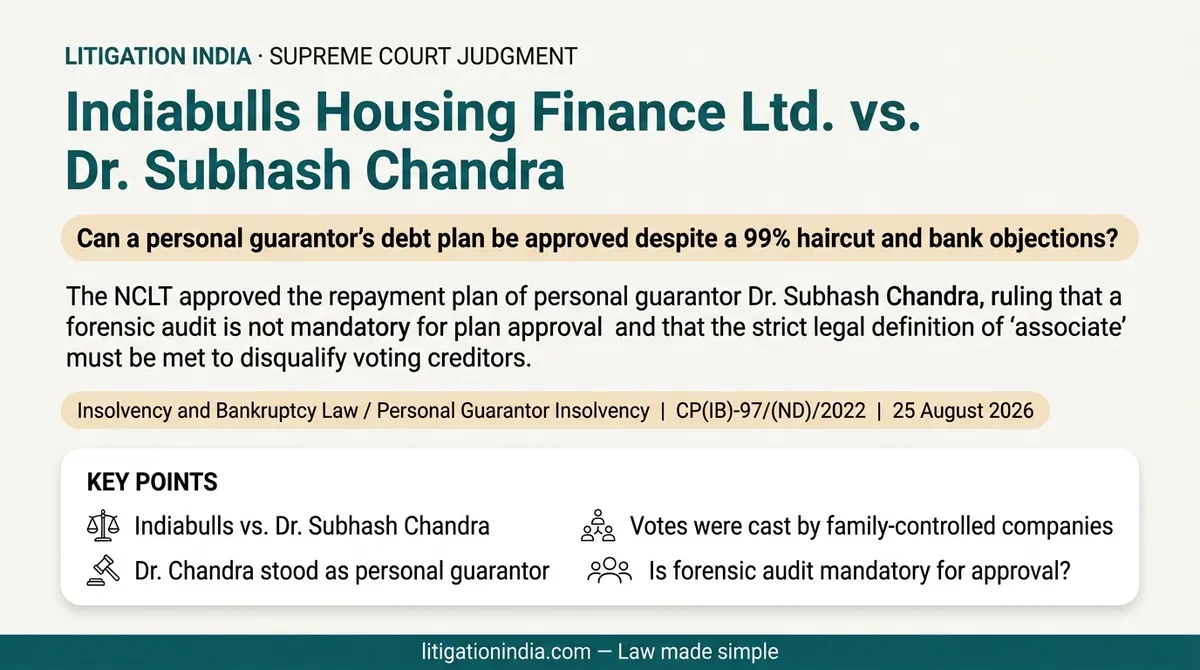
Indiabulls Housing Finance Ltd. vs. Dr. Subhash Chandra
The big legal question
Can a personal guarantor's debt plan be approved despite a 99% haircut and bank objections?
“The NCLT approved the repayment plan of personal guarantor Dr. Subhash Chandra, ruling that a forensic audit is not mandatory for plan approval and that the strict legal definition of 'associate' must be met to disqualify voting creditors.”
Story Slides
In short
This landmark decision by the National Company Law Tribunal (NCLT) New Delhi resolved a major tie-breaker regarding the personal insolvency of Dr. Subhash Chandra under the Insolvency and Bankruptcy Code (IBC). Dr. Chandra, acting as a personal guarantor for several corporate loans, faced insolvency proceedings after defaults. He proposed a repayment plan of Rs. 6.5 crores to settle massive debts totaling over Rs. 22,000 crores. Dissenting financial creditors, including Canara Bank and IndusInd Bank, vehemently opposed the plan. They argued that the plan offered a massive 99.9% haircut and was voted through by 'associates' (related companies controlled by Dr. Chandra's family) who held over 61% of the voting share and should have been disqualified under Section 109 of the IBC. They also demanded an independent forensic audit and asset-tracing, pointing out that Dr. Chandra's net worth had dropped from over Rs. 40,000 crores in 2018 to just Rs. 31 crores. The Third Member of the NCLT, Judicial Member Nilesh Sharma, rejected the banks' objections. The tribunal clarified that under Section 79(2)(g) of the IBC, the definition of an 'associate of the debtor' requires actual legal ownership (over 50% shares) or direct board control, not just family ties or business influence. Since Dr. Chandra did not hold shares in those voting companies, they could not be disqualified. Furthermore, the tribunal ruled that a forensic audit is not a mandatory prerequisite for approving a repayment plan. Such deep investigative powers are reserved for the bankruptcy stage under a Bankruptcy Trustee, not the earlier restructuring phase. While the tribunal excluded two undocumented claims (admitted erroneously without paperwork), it held that the overall repayment plan was validly approved by the statutory majority and is now fully binding on all creditors under Section 115.
Background
Dr. Subhash Chandra stood as a personal guarantor for massive corporate loans that defaulted, leading to insolvency proceedings against him. He proposed a repayment plan of Rs. 6.5 crores to settle over Rs. 22,000 crores in debts, which was approved by an 80.8% majority of creditors. Dissenting banks challenged this, claiming the voting majority consisted of family associates and that Dr. Chandra had hidden his multi-billion dollar assets.
The Decision
The NCLT approved Dr. Chandra's repayment plan, ruling that the voting companies did not legally qualify as 'associates' and their votes were valid. It held that a forensic audit is not a mandatory requirement for plan approval, and that the approved plan binds all creditors. However, it ordered the exclusion of two undocumented individual claims, directing that their share be redistributed among valid creditors.
Why it matters for you
This judgment confirms that courts will not delay debt settlement plans indefinitely based on mere suspicions or demands for forensic audits by a minority of creditors. It reinforces that once a repayment plan is approved by the legal majority of creditors, it becomes strictly binding on all creditors, preventing separate recovery attempts.
AI-assisted summary, reviewed and verified by our editorial team.
In the Court's words
“The Code does not make a forensic audit or asset-tracing exercise a mandatory precondition for approval of a repayment plan.”
“Accordingly, the approved Plan is binding on all creditors covered by it, whether assenting or dissenting.”
“The statutory test is therefore based on ownership and legal control, not merely on commercial influence or business proximity.”
Need help with your case?
Facing a similar legal challenge in the Supreme Court or High Court? Connect with our pro bono volunteer advocates today.
Related Supreme Court services