Full text of the judgment
Text extracted from In Re: Recent Rape Incidents in Delhi NCR. For the authoritative version refer to the Supreme Court of India's official website.
1 In the Supreme Court of India Inherent Jurisdiction Suo Moto Writ Petition (Criminal) No. 6/2026 IN RE: RECENT RAPE INCIDENTS IN DELHI NCR
ORDER 1. A series of deeply disturbing news reports over the past few weeks, detailing egregious crimes against minor girls and women across the National Capital Region (NCR) of Delhi, have raised serious concerns regarding safety and security of public spaces in and around the city. 2. The harrowing account given by the 17-year-old victim of the alleged gang rape at Aastha Kunj Park in Delhi, is a stark reminder of the persistent vulnerabilities faced by women and children in spaces that ought to be safe and accessible to all. The safety concerns emerging from this incident, however, cannot be viewed in isolation. This incident has also brought to light preexisting complaints of recurrent sexual harassment faced by students of Lady Shri Ram College for Women, situated in the immediate vicinity of Aastha Kunj Park. Regrettably, these prior grievances failed to serve as a wake-up call for the police or the Digitally signed by VISHAL ANAND Date: 2026.09.28 17:57:55 IST Reason: Signature Not Verified
2 local administration to rectify institutional security lapses through enhanced patrolling and vigilance before yet another victim fell prey to unscrupulous perpetrators. 3. We are equally distressed by the news reports regarding the alleged gang rape and murder of a teenage girl in the Swaroop Nagar area of Delhi, where the police reportedly recovered the victim’s decomposed body from a field, in a partially scavenged state. 4. Furthermore, we take serious note of the recently reported incident involving the alleged sexual assault of a minor girl inside a moving sleeper bus, which law enforcement agencies failed to intercept while it traversed a distance of over 47 Km from Greater Noida to Delhi. One cannot help but draw painful parallels to the 2012 Nirbhaya case, calling into question whether systemic law enforcement mechanisms have made any meaningful progress in the decade since then. 5. These incidents, considered alongside other recent reports of sexual offences across Delhi-NCR, starkly underline a systemic failure on the part of law enforcement and civil administrative authorities to guarantee basic public safety. The right to live with dignity, free from the fear of violence, is an intrinsic facet of the fundamental guarantee of life and personal liberty enshrined
3 under Article 21 of the Constitution. Public spaces, including parks, roads, buses, metro stations, subways, foot bridges, etc. cannot be permitted to become zones of high risk due to grossly inadequate illumination, poor surveillance, lax patrolling, or other preventable administrative deficiencies. 6. The statements made by public authorities and elected representatives expressing concern over these incidents are understandable. However, expressions of concern, devoid of accountability, fall short of answering the larger institutional question. Expressing solidarity is not the solution to this social evil. What is required is a measurable response, with responsibility and accountability fixed upon the authorities entrusted with prevention of crime, maintenance of public order and protection of vulnerable persons. 7. Furthermore, we must emphasize that public spaces suffering from inadequate illumination, deficient surveillance, or a lack of visible police patrolling and prompt interventional response mechanisms inevitably expose every citizen to heightened security risks. Where basic measures of public safety remain compromised, no individual, irrespective of age, gender, or sexual identity, can navigate public spaces with a sense of security. The
4 primary obligation of the State and its instrumentalities is to maintain public spaces that are safe, accessible, and secure for all, while remaining particularly attentive to the heightened risks faced by children, women and other sexual minorities. 8. We remain mindful that specific allegations of crime must be investigated strictly in accordance with law and that the guilt or innocence of individual accused persons can only be determined through due process and fair trial. Consequently, the scope of the present suo moto proceedings is not directed at assessing individual criminal culpability, but rather at examining the broader institutional failures that transcend any single case. The primary objective of the present proceedings is to evaluate whether effective systemic, preventive, and monitoring frameworks are currently in place to ensure safety in public spaces across Delhi-NCR. 9. In view of the concerned noted hereinabove, we consider it necessary to ascertain not merely the measures which have been announced or introduced by the authorities, but the extent to which such measures are actually operational on the ground and have translated into effective protection and timely response. The concerned authorities shall, accordingly, place before this Court, a comprehensive status report addressing, inter alia, the
5 following aspects. i. What are the measures presently undertaken to ensure adequate safety and security arrangements in public places, including parks, roads, public transport facilities, markets, educational institutions and other areas frequented by women and children? The report shall indicate whether such arrangement remain equally effective during peak hours, late evening hours and early morning hours, when public spaces may have reduced visibility and footfall. ii. What is the manner in which the National Database on Sexual Offenders (NDSO) is presently being utilised by the Delhi Police? We would require the authorities to indicate whether the database is being regularly accessed for antecedent verification and identification of repeat or habitual sexual offenders; the number of instances in which it has been utilised in investigations in Delhi during the preceding five years; and whether any system exists for translating information available through the database into lawful preventive measures. iii. Similarly, what is the manner in which the Ministry of Home Affairs is utilising the Investigation Tracking System for Sexual Offences (ITSSO) which was stated to have been
6 launched as an online analytical tool for monitoring and tracking time-bound investigation in sexual-offence cases. The authorities shall place on record the manner in which ITSSO is being utilised in Delhi, including the mechanism for monitoring investigations which are required to be completed within the statutory period, the officers responsible for such monitoring, the frequency with which cases are reviewed and the remedial steps taken where an investigation is delayed. The report shall also indicate whether senior officers receive alerts or periodic reports in cases where the prescribed timelines are not being adhered to. iv. What is the manner in which the Mission Shakti programme which was launched as an umbrella programme concerning the safety, security and empowerment of women is operational in Delhi. The concerned authorities shall place before this Court the components of the programme, the agencies responsible for their implementation, the services actually available to women and children, and the mechanism by which the effectiveness and accessibility of such services are evaluated. v. Furthermore, the Ministry of Women and Child
7 Development, Government of India, in its Report of June 2024 on the Implementation of Beijing Declaration and Platforms for Action had referred to a number of mechanisms intended to strengthen the safety and protection of women. The concerned authorities shall indicate the present status and actual functioning in Delhi of each such mechanism, including: (a) the Emergency Response Support System (ERSS) number 112, including its integration, wherever applicable, with police, fire, ambulance and other emergency-response services and the mechanism for computer-aided dispatch of field resources; (b) the Women Helpline number- 181, including its present availability in Delhi, the nature of assistance provided through it, the manner in which calls requiring immediate police intervention are escalated to ERSS number 112, and the mechanism for coordination with One Stop Centres and other support services; (c) the Safe City Project, including the present status of CCTV coverage, command-and-control infrastructure, smart lighting, emergency response mechanisms and other technology-enabled measures contemplated under the
8 project. The authorities shall specifically indicate the number of identified vulnerable locations covered by such measures and the mechanism for ensuring that installed equipment remains functional; (d) Women Help Desks in police stations, including the number presently functional in Delhi, the number headed by women police officers, their hours of operation, the training imparted to personnel posted there and the mechanism for monitoring their accessibility and effectiveness; and (e) the availability and functioning of One Stop Centres and other support mechanisms for women and children affected by sexual violence, including the manner in which police, medical, legal, counselling and rehabilitation services are coordinated. (vi) Whether proper publicity is being given to the ERSSs, the Women Helpline Number, the Women Helpdesk in Police Stations and the One Stop Centers so as to disseminate such information to the general public and enable them to access such systems in the event of a perceived threat. The Administration and the Police
9 within the NCT of Delhi should also formulate schemes by which regular information dissemination programs are formulated in schools, colleges, such other educational institutions, residential colonies and so on and so forth, making the citizen aware of the protective devices in place and the ready access to such devices.” 10. The reports submitted shall not be confined to a description of the schemes or infrastructure existing merely on paper. In respect of each mechanism, the authorities shall clearly set out the following: i. whether it is presently operational; ii. the geographical area and population covered; iii. the officer or authority responsible for itsimplementation; iv. the volume of complaints, calls, cases or interventions handled during the preceding three years; and v. the average response time, wherever measurable; 11. We reiterate that the purpose of calling for the aforesaid information is not to evaluate governmental schemes on paper. A mechanism intended to protect women and children can serve its purpose only if it is accessible, functional, adequately staffed, capable of responding promptly and subject to continuing institutional oversight.
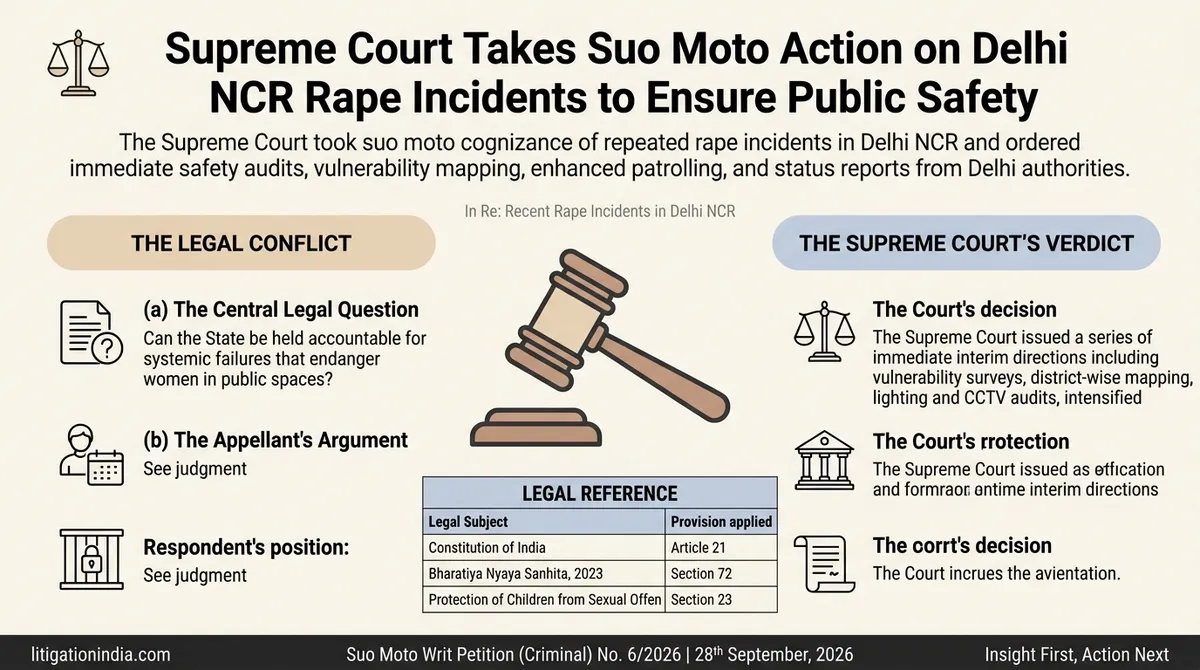
10 12. Pending consideration of the aforesaid status reports, and having regard to the gravity of the concerns, the following immediate interim measures shall be undertaken within a period of 4 weeks from today: i. The Commissioner of Police, Delhi, shall constitute dedicated police teams for each police district, headed by an officer not below the rank of Deputy Superintendent of Police, to conduct an immediate survey and inspection of vulnerable pockets within their respective jurisdictions, including the outskirts, isolated stretches, parks, transport hubs, markets, educational-institution zones and other public places. The audit shall be based upon NCRB data, local intelligence, past and present complaints received, previous incidents and other objective indicators to identify locations prone to such crimes. These teams shall identify locations where poor lighting, lack of surveillance, insufficient patrolling, abandoned structures, poor access control or other deficiencies may increase the risk of crime. ii. A district-wise vulnerability map shall be prepared and shared across adjoining police stations to ensure that information on recurring patterns of crime and habitual offenders is not confined to individual police-station
11 jurisdictions. iii. Appropriate patrolling and security arrangements shall be deployed at all identified public parks and vulnerable areas at all times, particularly during evening and early morning hours and/or such other periods as may emerge from the crime and vulnerability assessment. A designated officer shall be responsible for each such location, and the authorities shall prescribe a mechanism for periodic inspection. iv. An immediate lighting and CCTV audit shall be carried out across all public parks and vulnerable zones to eliminate blind spots. Non-functional CCTV cameras and lighting infrastructure shall be repaired or restored in an expeditious manner. Additional lights and CCTVs to be installed wherever inadequacy is sensed or reported by citizens. A similar audit shall be undertaken in respect of Metro stations, bus stops, bus terminals, railway stations and other major public-transport facilities, particularly those falling within or adjoining identified vulnerable zones. v. The concerned authorities shall utilise the existing citizen grievance-redressal mechanism, including the CM Jan Sunwai Portal, as an additional source of information for
12 identifying deficiencies in public-safety infrastructure. Citizens may report inadequate or non-functional lighting, insufficient CCTV coverage, dark or isolated stretches, unsafe access points and other vulnerabilities in public places. Each such report shall, wherever appropriate, be geo-tagged or otherwise location-specific, forwarded to the competent authority for verification, and acted upon within a prescribed time-frame. Where the deficiency is verified, the competent authority shall take appropriate remedial measures, including installation or augmentation of lighting and CCTV infrastructure, as the circumstances may require. The status of such complaints and the action taken thereon shall remain capable of being tracked by the complainant. vi. The Commissioner of Police, in coordination with the concerned civic authorities and other agencies responsible for public infrastructure, shall periodically analyse complaints received through the aforesaid mechanism and incorporate recurring or corroborated complaints into the vulnerability mapping exercise directed hereinabove. Thus, citizen complaints shall not be treated merely as isolated
13 grievances, but, where appropriate, as inputs into the identification of emerging public-safety vulnerabilities. vii. Furthermore, intensified police patrolling shall encompass mobile check-posts and vehicular inspections at regular intervals. Law enforcement authorities are directed to strictly enforce the safety protocols and directions laid down by this Court in Avishek Goenka v. Union of India & Anr. [Writ Petitioner (Civil) No. 265 of 2011] wherein it was expressly noted that the use of black, tinted, or solar-control films on vehicle windows facilitates the commission of heinous crimes by concealing activities within. The police shall ensure total compliance with the complete prohibition on aftermarket window films and take immediate measures to impound non-compliant vehicles, remove illegal window coatings, and prosecute offenders without further lapses. 13. We further direct that the Registrar General, High Court of Delhi shall place on record, by way of an affidavit, within 4 weeks, comprehensive information regarding the present status and functioning of the Fast Track Special Courts (FTSCs) and Exclusive POCSO Courts in Delhi, specifying: i. The total number of FTSCs and Exclusive POCSO Courts currently functional;
14 ii. The total number of cases pending before each such Court; iii. The annual disposal rates for the preceding three years; iv. The average time taken for final disposal of cases in these Special Courts. 14. Furthermore, the Delhi High Court in its Administrative side is directed to assign the above-mentioned cases to a designated Fast Track Special Court, and to ensure that the trials are concluded expeditiously, preferably within a period of one year from the commencement of trial. 15. The Registry is directed to register this matter and number the same as suo-moto writ petition (Criminal) in public interest. 16. Issue Notice to: i. The Chief Secretary, Government of NCT of Delhi ii. The Commissioner of Police, Delhi; and iii. The Registrar General, High Court of Delhi 17. Before concluding, we find it imperative to observe that media reporting on sexual offences carries a profound constitutional and ethical duty. Media outlets, journalists, and publishing platforms must remain deeply mindful of their solemn obligation to practice responsible, empathetic, and restrained journalism in such matters. Sensationalist headlines, graphic or lurid descriptions of sexual violence, and insensitive phraseology fail to serve any public interest and risk causing severe secondary
15 trauma to victims and their families. Furthermore, all print, electronic, and digital media organizations are reminded of the strict statutory mandate under Section 72 of the Bharatiya Nyaya Sanhita, 2023 as well as Section 23 of the POCSO Act, prohibiting the disclosure, whether direct or indirect, of the identity of any victim of sexual assault or minor child. Headlines and reportage must prioritize dignity, factual accuracy, and institutional accountability over sensationalism, ensuring that the discourse remains centered on justice and safety. 18. The District Administration should call for an immediate meeting with the Media Houses so as to provide a dedicated column in the newspapers and a dedicated time in the electronic media to provide information of the protective devices and the telephone numbers, which could be accessed for immediate assistance in the event of a perceived threat. We are sure that the print and electronic media would rise up to the
dedicated column/time, probono, including the phone numbers that could provide immediate assistance on such threats occurring.” 19. We appoint Ms. Liz Mathew, the learned Senior counsel to act as Amicus and assist this Court on this burning issue. Registry shall provide one copy of this order along with the newspaper
16 cuttings attached with it to the learned Amicus at the earliest. Registry shall also inform about this order to the learned Amicus at the earliest.
20. List the matter on 5-10-2026 for further directions and compliance. ............................. J. (J.B. Pardiwala) ............................. J. (K. Vinod Chandran) New Delhi; 28th September, 2026.
17 ITEM NO.805 COURT NO.6 SECTION PIL-W S U P R E M E C O U R T O F I N D I A RECORD OF PROCEEDINGS SUO MOTO WRIT PETITION(CRIMINAL) No.6/2026 IN RE: RECENT RAPE INCIDENTS IN DELHI NCR Petitioner(s) VERSUS Respondent(s)
Date : 28-09-2026 This petition was called on for hearing today. CORAM : HON'BLE MR. JUSTICE J.B. PARDIWALA HON'BLE MR. JUSTICE K. VINOD CHANDRAN For Petitioner(s) : For Respondent(s) : UPON hearing the counsel the Court made the following O R D E R 1. The Registry is directed to register this matter and number the same as suo-moto writ petition (Criminal) in public interest. 2. Issue Notice to: i. The Chief Secretary, Government of NCT of Delhi ii. The Commissioner of Police, Delhi; and iii. The Registrar General, High Court of Delhi 3. We appoint Ms. Liz Mathew, the learned Senior counsel to act as Amicus and assist this Court on this burning issue. Registry shall provide one copy of this order along with the newspaper cuttings attached with it to the learned Amicus at the earliest. Registry shall also inform about this order to the learned Amicus at the earliest.
4. List the matter on 5-10-2026 for further directions and compliance. (VISHAL ANAND) (POOJA SHARMA) DEPUTY REGISTRAR COURT MASTER (NSH) (Signed Order is placed on the file)