
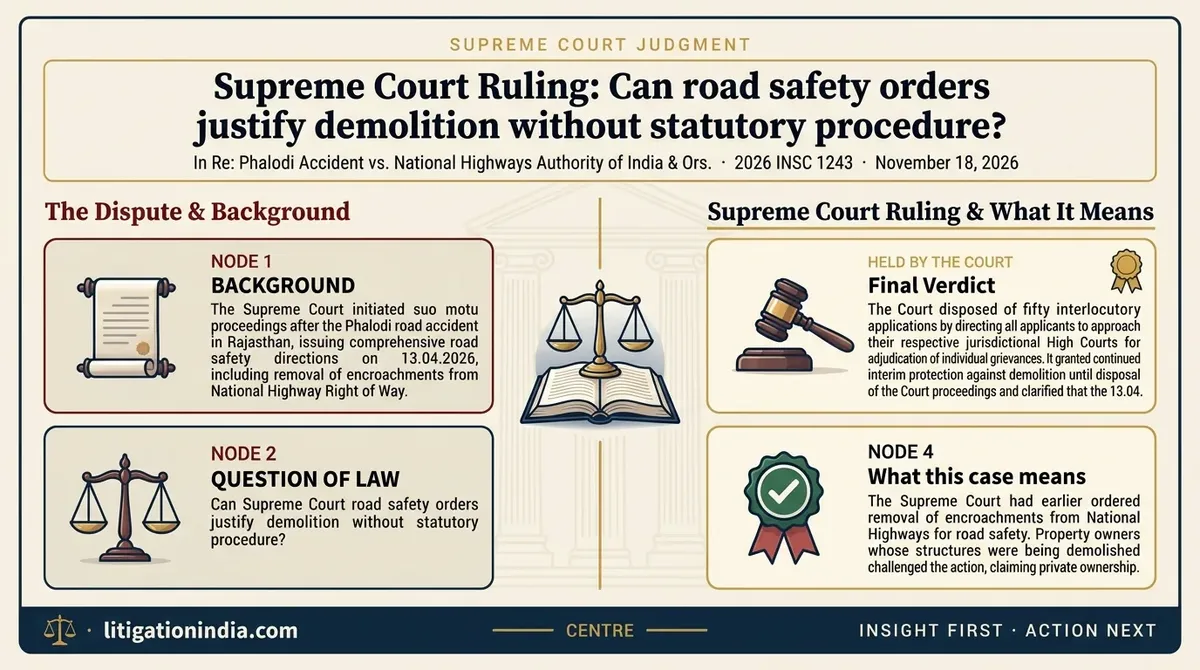
Full text of the judgment
Text extracted from In Re: Phalodi Accident vs. National Highways Authority of India & Ors.. For the authoritative version refer to the Supreme Court of India's official website.
2026 INSC 1243 SUO MOTO WRIT PETITION (CIVIL) NO. 9/2025 ETC. 1
REPORTABLE IN THE SUPREME COURT OF INDIA CIVIL ORIGINAL JURISDICTION
SUO MOTO WRIT PETITION (CIVIL) NO(s). 9/2025
IN RE: PHALODI ACCIDENT PETITIONER(S)
NATIONAL HIGHWAYS AUTHORITY OF INDIA & ORS.
RESPONDENT(S)
WRIT PETITION (C) NO. 1100/2025
WRIT PETITION (C) NO. 1272/2019
IA No. 308397/2026, IA No. 296745/2026, IA No. 316792/2025, IA No. 270466/2026, IA No. 270243/2026, IA No. 269086/2026, IA No. 308233/2026, IA No. 270722/2026, IA No. 242242/2026, IA No. 288848/2026, IA No. 293942/2026 , IA No. 288807/2026, IA No. 293929/2026, IA No. 288684/2026, Digitally signed by SONIA BHASIN Date: 2026.11.18 17:38:00 IST Reason: Signature Not Verified
SUO MOTO WRIT PETITION (CIVIL) NO. 9/2025 ETC. 2
IA No. 293900/2026, IA No. 293514/2026, IA No. 293363/2026, IA No. 289276/2026, IA No. 288920/2026, IA No. 288866/2026, IA No. 305733/2026, IA No. 242241/2026, IA No. 289277/2026, IA No. 288921/2026, IA No. 288867/2026, IA No. 288849/2026, IA No. 293943/2026, IA No. 288808/2026, IA No. 293931/2026, IA No. 288685/2026, IA No. 293901/2026, IA No. 269087/2026, IA No. 293515/2026, IA No. 293366/2026, IA No. 294494/2025, IA No. 269085/2026, IA No. 288916/2026, IA No. 308232/2026, IA No. 259477/2026, IA No. 288868/2026, IA No. 305732/2026, IA No. 335365/2025,
SUO MOTO WRIT PETITION (CIVIL) NO. 9/2025 ETC. 3
IA No. 288852/2026, IA No. 293939/2026, IA No. 288809/2026, IA No. 293919/2026, IA No. 288681/2026, IA No. 293896/2026, IA No. 270721/2026, IA No. 293510/2026, IA No. 270465/2026, IA No. 293361/2026, IA No. 270241/2026, IA No. 289273/2026, IA No. 308395/2026, IA No. 289275/2026, IA No. 288919/2026, IA No. 288865/2026, IA No. 288847/2026, IA No. 293941/2026, IA No. 288806/2026, IA No. 293928/2026, IA No. 288683/2026, IA No. 293899/2026, IA No. 293513/2026, IA No. 293364/2026, IA No. 308234/2026, IA No. 270723/2026, IA No. 270467/2026, IA No. 270244/2026
SUO MOTO WRIT PETITION (CIVIL) NO. 9/2025 ETC. 4
IN SUO MOTO WRIT PETITION(CIVIL) No(s). 9/2025
IA No. 152354/2026 IN W.P.(C) NO.1100/2025
AND IA No. 106150/2024, IA No. 280278/2025, IA No. 184634/2022, IA No. 255152/2025, IA No. 221232/2025, IA No. 20800/2021, IA No. 1096/2021, IA No. 3439/2021, IA No. 228114/2025, IA No. 230162/2024, IA No. 236406/2024, IA No. 135458/2019, IA No. 251974/2024, IA No. 41241/2024 IN W.P.(C) No. 1272/2019
J U D G M E N T VIKRAM NATH, J. 1. The present suo motu proceedings (Suo Moto Writ Petition No. 9 of 2025) arise out of the concerns relating to road safety on National Highways, following the unfortunate road accidents at Phalodi, Rajasthan, and other places. In the course of these proceedings, this Court has issued various directions aimed at improving road safety and
SUO MOTO WRIT PETITION (CIVIL) NO. 9/2025 ETC. 5
ensuring the removal of unauthorised encroachments from National Highways. 2. By order dated 13.04.2026, this Court issued various interim directions in the larger interest of road safety. For the purposes of the present applications, it would be appropriate to reproduce the relevant directions contained in paragraph 4 of the said order, which read as follows:
“b) Inspection, Survey and Citizen Grievance – The Highway Administration, NHAI, NHIDCL, and State PWDs shall, within 30 days, file before this Court a consolidated report on –
(i) Composition and schedule of dedicated inspection teams for each highway stretch;
(ii) State-wise encroachments identified, notices issued under Section 26 of the Control of National Highways (Land and Traffic) Act, 2002 – CNH Act and structures demolished, and
(iii) Status of compliance with the directions issued in Gyan Prakash vs. Union of India and others. NHAI shall simultaneously confirm full operationalisation of the Rajmargyatra encroachment complaint module (with geo-tagged uploads, grievance tracking, and appeal mechanism), activation of toll-free number 1033 for encroachment complaints, and dissemination of both across highway signage, toll plazas, and media. Drone-based aerial surveys (DRAMS Policy Circular, 05.09.2025) shall be conducted at least twice annually, with six-monthly reports filed before this Court.
c) Encroachment Prohibition and Removal – Construction/operation of any new dhaba, eatery, or commercial structure within the Right of Way
SUO MOTO WRIT PETITION (CIVIL) NO. 9/2025 ETC. 6
(ROW) of any National Highway is prohibited with immediate effect. District Magistrates shall enforce demolition/removal of all new or existing unauthorised structures within 60 days, in terms of the CNH Act procedure and SOP dated 07.08.2025.
e) District Highway Safety Task Force – In every district wherever the National Highway passes through, the concerned District Magistrate within 15 days of this order constitute a District Highway Safety Task Force in every district across India within 7 days of this order, comprising officers of the District Administration, Police, NHAI (or concerned land-owning agency), PWD, and local bodies. The District Collector and Commissioner of Police/Superintendent of Police shall bear joint responsibility for timely encroachment removal. The Task Force shall hold fortnightly review meetings and maintain minutes. State Governments shall further issue notifications within 60 days prohibiting change of land use within 40 metres (residential) and 75 metres (commercial) from the mid-point of any National Highway, consistent with IRC norms; MoRTH shall facilitate uniform notifications across all States within the same period.”
3. At this stage, we are concerned with a batch of interlocutory applications filed by persons who are aggrieved by the action initiated by the National Highways Authority of India (hereinafter referred to as “NHAI”) and other concerned authorities for removal of structures alleged to be encroachments upon the Right of Way of National Highways. The applicants have, inter alia, sought interim protection against demolition or other coercive action in respect of their properties. Since the grievances
SUO MOTO WRIT PETITION (CIVIL) NO. 9/2025 ETC. 7
raised in these applications are substantially similar, we propose to consider them together by this common order. 4. Pursuant to the aforesaid directions, NHAI and the concerned authorities initiated action for removal of structures alleged to be encroachments upon the Right of Way of National Highways. Aggrieved by such action, several persons have approached this Court seeking clarification of the earlier directions and interim protection against demolition or removal of their structures. Some of the applicants had also approached the jurisdictional High Courts and were granted liberty to seek clarification from this Court. During the pendency of these applications, this Court, by orders dated 08.09.2026, 22.09.2026 and 06.10.2026, directed maintenance of status quo in certain matters. 5. I.A. Nos. 269085 and 269086 of 2026 have been filed by Prakashbhai Manharlal Shah and Others, seeking impleadment and clarification of the order dated 13.04.2026. The applicants claim ownership of the disputed property on the basis of a registered sale deed dated 02.05.1988 and have challenged the proposed demolition of their structures by NHAI. Having initially approached the High Court of Gujarat, they were granted liberty to seek clarification from this Court as to whether their properties are covered by the directions issued on 13.04.2026. 6. Similarly, I.A. Nos. 270241, 270243 and 270244 of 2026 have been filed by Patel Nileshbhai Pravinbhai and Others,
SUO MOTO WRIT PETITION (CIVIL) NO. 9/2025 ETC. 8
who claim to be owners of land adjoining National Highway 48 in District Valsad, Gujarat. They are aggrieved by notices issued by the Highway Administrator proposing removal of structures situated on their land. I.A. Nos. 270465, 270466 and 270467 of 2026 have been filed by Ashokbhai Nanubhai Patel and Others, who contend that although no formal written notices have been served upon them, announcements concerning removal of structures have been made through Highway Patrol Vehicles, and notices have been issued to other adjoining landowners. Apprehending similar action against structures situated on their privately owned land, they have approached this Court seeking clarification of the earlier directions and interim protection against any coercive action. I.A. Nos. 270721, 270722 and 270723 of 2026, filed by Arihant Petroleum and Another, raise similar grievances concerning the proposed removal of structures situated on land claimed to be privately owned by the respective applicants. These applications also seek clarification of the earlier directions and interim protection against the proposed action. 7. A further set of applications has been filed by Sabbirali Jivabhai Sunsara, Sarabhai Virubhai Bharvad, Jivankumar Chandanmal Jain, Mukeshbhai Keshubhai Vora, Laljibhai Meghjibhai Vaghasiya and Tanujaben Nalinbhai Patel, through their Advocate-on-Record, Mr. T. Harish Kumar. These include I.A. Nos. 288681, 288809, 288852, 288868, 288916 and 289273 of 2026, together
SUO MOTO WRIT PETITION (CIVIL) NO. 9/2025 ETC. 9
with their respective connected applications for modification and interim stay. The applicants have challenged notices issued by the Highway Administration proposing removal of structures situated on properties claimed to be privately owned by them in Navsari, Gujarat. They contend that the proposed demolition is being undertaken without proper determination of their rights or compliance with the applicable statutory procedure. They have also sought protection against coercive action and, in the alternative, acquisition of their land and payment of compensation in accordance with law, if the same is required for highway widening or other public purposes. 8. Similar applications have been filed by Dahyabhai Mavjibhai Patel, Siddik Sumar Safiya, Prima Auto Cool, National Tyre Services and M/s GD Hotel, through the same Advocate-on-Record. These include I.A. Nos. 293361, 293510, 293896, 293919 and 293939 of 2026, along with their respective connected applications for modification and interim stay. The applicants claim that the structures proposed to be removed are situated on their privately owned properties and that the action initiated by NHAI is contrary to the procedure prescribed by law. They have sought clarification of the order dated 13.04.2026, protection against demolition and, wherever applicable, consideration of their entitlement to acquisition and compensation in accordance with law. 9. I.A. Nos. 305732 and 305733 of 2026 have been filed by Hatim Sirajbhai Lokhandwala, who claims to be the
SUO MOTO WRIT PETITION (CIVIL) NO. 9/2025 ETC. 10
registered owner of land situated in District Navsari, Gujarat, upon which a hotel is being operated. The applicant has challenged the notice dated 22.08.2026 issued by NHAI proposing removal of structures alleged to fall within the Right of Way of National Highway 48. The applicant disputes the demarcation undertaken by NHAI and claims that the structures are situated on privately owned land which has neither been acquired nor compensated for. Having approached the High Court of Gujarat, the applicant was permitted to seek clarification from this Court and has also sought interim protection against the proposed demolition. 10. I.A. Nos. 308232, 308233 and 308234 of 2026 have been filed by Ramanbhai Dhirubhai Patel, seeking impleadment, clarification and interim stay. The applicant is aggrieved by notices issued for removal of structures which he claims are situated on his privately owned land adjoining a National Highway. He has sought clarification of the directions dated 13.04.2026 and protection against the proposed removal of such structures pending adjudication of his grievance. 11. During the pendency of these applications, this Court, by order dated 08.09.2026, directed NHAI to file its response and ordered maintenance of status quo. By a subsequent order dated 22.09.2026, the interim protection was continued, and NHAI was granted an opportunity to respond to certain additional applications raising similar grievances. Thereafter, by order dated 06.10.2026, this
SUO MOTO WRIT PETITION (CIVIL) NO. 9/2025 ETC. 11
Court issued notice in I.A. Nos. 305732, 305733 and 308232 of 2026 and directed maintenance of status quo therein. The Office Report dated 12.10.2026 indicates that NHAI has filed its responses in several of the applications. Thus, while formal notice has been expressly issued in certain applications, NHAI has also participated in the proceedings and filed responses in several other applications where no express order issuing notice has been passed. 12. We have heard learned counsel appearing for the respective applicants, learned counsel appearing for NHAI and the learned Amicus Curiae, and have considered the material placed on record. The principal submission advanced on behalf of the applicants is that the structures sought to be removed are situated on land which they claim to be lawfully owned or occupied by them. It is contended that the authorities have proceeded to treat such structures as unauthorised encroachments without properly determining the extent of the Right of Way or affording the applicants an adequate opportunity to establish their respective claims. Several applicants have also disputed the measurements and demarcation undertaken by NHAI and have relied upon documents concerning ownership, acquisition and permissions granted by the competent authorities. It is further submitted that the directions issued by this Court on 13.04.2026 cannot be construed as authorising demolition of structures without following the procedure prescribed by law.
SUO MOTO WRIT PETITION (CIVIL) NO. 9/2025 ETC. 12
13. On the other hand, NHAI has sought to justify the action initiated by it on the ground that the removal of unauthorised encroachments is being undertaken in compliance with the directions issued by this Court on 13.04.2026, particularly directions 4(b), 4(c) and 4(e). It is submitted that the concerned authorities are under an obligation to ensure removal of encroachments from the Right of Way of National Highways in the interest of road safety. NHAI has further maintained, in its responses to certain applications, that notices have been issued under the provisions of the Control of National Highways (Land and Traffic) Act, 2002 (hereinafter referred to as “the 2002 Act”) and that the measurements undertaken by the authorities establish that the disputed structures fall within the Right of Way. It has also been contended that disputes concerning ownership, boundaries and the extent of the Right of Way involve questions of fact which ought to be adjudicated before the competent court. 14. Having considered the rival submissions, we find it necessary to clarify the scope and effect of the directions issued by this Court on 13.04.2026. There can be no dispute that the removal of unauthorised encroachments from National Highways is a matter of considerable public importance, particularly having regard to the serious consequences which such encroachments may have upon road safety. It was precisely in this context that the aforesaid directions were issued. However, those directions were intended to address the larger issue of highway safety
SUO MOTO WRIT PETITION (CIVIL) NO. 9/2025 ETC. 13
and the removal of unlawful encroachments. They did not involve an examination or determination of the individual rights of persons whose properties may subsequently be subjected to action by the concerned authorities. The question whether a particular structure constitutes an unauthorised encroachment was neither examined nor adjudicated upon by this Court. 15. It is in this context that the submission advanced on behalf of NHAI, that the proposed demolition is being undertaken pursuant to the directions of this Court, must be considered. The directions dated 13.04.2026 undoubtedly cast an obligation upon the concerned authorities to identify and remove unauthorised encroachments. However, such an obligation cannot be understood as dispensing with the requirement of determining whether the structure sought to be removed is, in fact, an unauthorised encroachment upon highway land. The distinction between a general direction to remove encroachments and the determination of whether a particular property constitutes an encroachment is of considerable significance. The former cannot, by itself, be treated as a conclusive adjudication of the latter. Indeed, direction 4(c) expressly requires that removal be undertaken in accordance with the procedure prescribed under the 2002 Act and the Standard Operating Procedure dated 07.08.2025. The earlier directions, therefore, cannot be construed as conferring upon the authorities any power
SUO MOTO WRIT PETITION (CIVIL) NO. 9/2025 ETC. 14
beyond that contemplated by the applicable statutory framework. 16. Section 26 of the 2002 Act provides the statutory mechanism for removal of unauthorised occupation of highway land. Subsections (2) to (6) contemplate issuance of notice identifying the highway land concerned, an opportunity to make a representation, and consideration of the cause shown by the person against whom action is proposed. The importance of adherence to this procedure has also been recognised by this Court in Gyan Prakash v. Union of India and Others, 2025 SCC OnLine SC 1189, wherein it was emphasised that the procedure prescribed under Section 26 is essential for compliance with the principles of natural justice. It is true that subsections (7) and (8) of Section 26 also contemplate removal of unauthorised occupation without prior notice in the circumstances specified therein. However, the availability of such powers must necessarily be examined with reference to the statutory conditions governing their exercise. The directions issued by this Court cannot be invoked as an independent justification for dispensing with the requirements of the statute. 17. In the present applications, several applicants have raised disputes concerning ownership of the land, the extent of the Right of Way, the correctness of the demarcation undertaken by NHAI and the acquisition of the land in question. These are matters which may require examination of revenue records, acquisition proceedings,
SUO MOTO WRIT PETITION (CIVIL) NO. 9/2025 ETC. 15
survey reports and other relevant documents. We are conscious that a mere assertion of ownership or lawful occupation cannot, by itself, prevent the authorities from exercising their statutory powers to remove unauthorised encroachments. Equally, the mere assertion by the authorities that a particular structure falls within the Right of Way cannot be treated as a substitute for the determination required under law, where the very basis of such assertion is disputed. The competing claims must be examined in accordance with the applicable statutory framework, and the persons affected must be afforded such opportunity of hearing and adjudication as the law requires. 18. We are, therefore, of the considered view that the individual grievances raised in these applications ought to be examined by the respective jurisdictional High Courts. The present suo motu proceedings are concerned with the larger and systemic issues relating to highway safety, and it would neither be appropriate nor practicable for this Court to undertake a factual examination of the ownership, boundaries and legal status of each disputed property. The jurisdictional High Courts would be better placed to consider the relevant records, examine the legality of the action initiated by the authorities and determine whether the procedure prescribed by law has been duly followed. They would also be at liberty to consider whether any disputed question requires determination by the competent statutory authority or other appropriate forum.
SUO MOTO WRIT PETITION (CIVIL) NO. 9/2025 ETC. 16
Such an approach would ensure that the directions issued by this Court for removal of unauthorised encroachments are implemented in accordance with law, without depriving the affected persons of an opportunity to establish their respective claims. 19. We accordingly consider it appropriate to relegate the applicants to the respective jurisdictional High Courts for adjudication of their grievances. We make it clear that we have not expressed any opinion on the merits of the claims advanced by the applicants or upon the correctness of the action initiated by NHAI and the other concerned authorities. Those questions shall remain open for independent consideration in accordance with law. At the same time, the directions issued by this Court on 13.04.2026 shall continue to operate in their entirety, subject to the clarification that their implementation must remain consistent with the applicable statutory provisions and the rights of affected persons to seek appropriate remedies in accordance with law. 20. Accordingly, we dispose of the present interlocutory applications by granting liberty to the respective applicants to approach the jurisdictional High Courts for adjudication of their grievances concerning the proposed demolition or removal of structures alleged to be encroachments upon the Right of Way of National Highways. Those who have already instituted proceedings before the High Courts shall be at liberty to pursue the same in accordance with law.
SUO MOTO WRIT PETITION (CIVIL) NO. 9/2025 ETC. 17
21. The interim protection already granted by this Court shall continue until disposal of the respective proceedings before the jurisdictional High Courts. In cases where no such protection has previously been granted, we direct that NHAI and the concerned authorities shall not undertake demolition, removal of the disputed structures or any other coercive action pursuant to the impugned notices until such disposal. 22. The jurisdictional High Courts shall adjudicate upon the respective grievances independently, after affording due opportunity of hearing to the parties and in accordance with law. All questions concerning ownership, demarcation of the Right of Way, acquisition of land and compliance with the statutory procedure shall remain open for consideration. The directions dated 13.04.2026 shall not be treated as having conclusively determined the rights of the parties or the legality of the disputed structures. We request the High Courts to dispose of such proceedings as expeditiously as possible. 23. It is made clear that the interim protection shall remain confined to the structures forming the subject matter of these applications and shall not create any equity in favour of the applicants or authorise any fresh construction or encroachment. The directions dated 13.04.2026 shall otherwise remain unaffected. 24. Accordingly, I.A. Nos. 269085, 269086, 270241, 270243, 270244, 270465, 270466, 270467, 270721, 270722, 270723, 288681, 288683, 288684, 288806, 288807,
SUO MOTO WRIT PETITION (CIVIL) NO. 9/2025 ETC. 18
288809, 288847, 288848, 288852, 288865, 288866, 288868, 288916, 288919, 288920, 289273, 289275, 289276, 293361, 293363, 293364, 293510, 293513, 293514, 293896, 293899, 293900, 293919, 293928, 293929, 293939, 293941, 293942, 305732, 305733, 308232, 308233 and 308234 of 2026 stand disposed of in the aforesaid terms. 25. The remaining interlocutory applications shall remain pending. List the main matter with the connected matters in due course.
…………………………………………..J. [VIKRAM NATH]
…………………………………………..J. [APARESH KUMAR SINGH] NEW DELHI; NOVEMBER 18, 2026