Full text of the judgment
Text extracted from Hemant D. Shah HUF & Anr. vs Chittaranjan D. Shah HUF & Ors.. For the authoritative version refer to the Supreme Court of India's official website.
2026 INSC 1111 CA@ SLP (C) No.26474 of 2026 Page 1 of 10
Non-Reportable
IN THE SUPREME COURT OF INDIA CIVIL APPELLATE JURISDICTION
CIVIL APPEAL NO. OF 2026 (Arising out of SLP (C) No.26474 of 2026)
Hemant D. Shah HUF & Anr.
...Appellant(s)
Chittaranjan D. Shah HUF & Ors. ...Respondent(s)
J U D G M E N T
K. VINOD CHANDRAN, J.
Leave granted. 2. ‘Veritable Party’ in a constituted arbitration is a vexing question that props up oftener than ever, which question has to be determined more on the facts; the multiple aspects arising therefrom, which cannot be put down in a strait jacket formula. 3. We have heard Sri Ashim Sood, learned Counsel for the appellants, Sri Sanjay Sarin, learned Counsel for the 1st and 2nd respondents and Sri Ritin Rai, learned Senior Counsel for the 3rd and 4th respondents. Digitally signed by CHANDRESH Date: 2026.10.12 15:51:36 IST Reason: Signature Not Verified
CA@ SLP (C) No.26474 of 2026 Page 2 of 10
4. The issue is with respect to whether the 2nd and 3rd respondents must be included in the arbitration; whom, if we find to be veritable parties on a prima facie consideration of the facts and circumstances, still the question would be open before the Arbitrator appointed. 5. The High Court, considering the application under Section 11 of the Arbitration and Conciliation Act, 19961, first considered the aspect of limitation, especially since there was an earlier Arbitral Award at the instance of the appellants themselves, which was set aside under Section 34 of the said Act. The question of limitation was found in favour of the appellants, which we need not engage with, especially since the issue of limitation is deemed to have been answered only as against 1st and 2nd respondents; and with respect to 3rd and 4th respondents, prayer to join them in the arbitration was declined. The rejection of such prayer was also on account of the finding that they are not signatories to the Arbitration Agreement and do not fall within the recognized exceptions as person/persons claiming through or under a signatory or covered under the Group of Companies doctrine.
1 Hereinafter referred to as ‘the Act’
CA@ SLP (C) No.26474 of 2026 Page 3 of 10
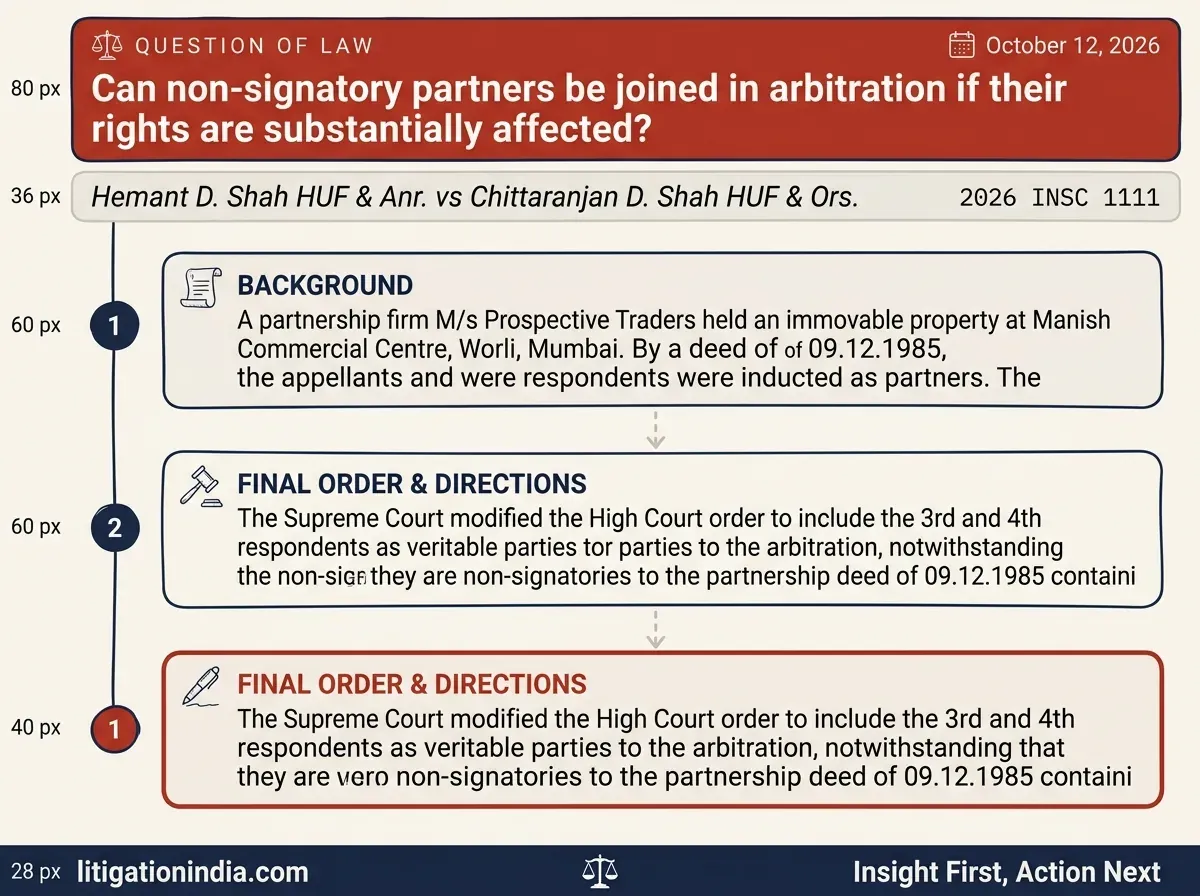
6. We would first look at the facts which led to the application before the High Court. The dispute specifically arises with respect to a property numbered as Unit No.2 admeasuring 3,500 sq. ft. in the ground floor of Manish Commercial Centre, 216-A, Dr. Annie Besant Road, Worli, Mumbai - 400 030, which is hereinafter termed as the ‘subject asset’. This originally belonged to a partnership firm called M/s Prospective Traders. The original deed of partnership was executed between three family trusts, respectively of V. U. Shah, N.U. Shah and C.U. Shah; who are referred to as the original partners, by a deed of partnership executed on 02.04.1977. The asset was acquired by the partnership on 03.10.1977. On 09.12.1985, the partnership was reconstituted by a deed, wherein the appellants; Hemant D. Shah HUF and the wife of Hemant D. Shah, the 1st and 2nd appellants as also Chittaranjan D. Shah HUF and the daughter in law of C.D. Shah, the 1st and 2nd respondents were inducted as partners. 7. Subsequently on 30.12.1987, by another deed of partnership; which is also disputed by the appellants, the partnership firm was reconstituted and the original partners retired. On 03.07.1995, by a deed of retirement, the appellants are asserted to have retired from the partnership
CA@ SLP (C) No.26474 of 2026 Page 4 of 10
firm, which document is alleged to be a forged one by the appellants. Later, on 01.07.2005, the 2nd respondent retired from the partnership firm, resulting in dissolution of the said partnership firm and it continued as a proprietorship with its assets vested with the 1st respondent. Again, by a deed of 30.09.2009, 3rd and 4th respondents were brought as partners into the proprietorship, constituting a new partnership. On retirement of the 1st respondent, by a deed of 04.11.2009, 3rd and 4th respondents continued as partners of the firm. 8. The 3rd and 4th respondents distanced themselves from the partnership agreement of 09.12.1985; which contains an arbitration clause and the 1st and 2nd respondents assert the dissolution of the firm on the retirement of 2nd respondent, subsequent to the retirement of the appellants. The appellants, on the other hand, assert that they never retired from the firm and the partnership continues even now, as also the assets belong to the original partnership. 9. Learned Single Judge has relied on Cox & Kings Limited v. SAP India Private Limited and Another2 and
2 (2024) 4 SCC 1
CA@ SLP (C) No.26474 of 2026 Page 5 of 10
Hindustan Petroleum Corporation Limited v. BCL Secure Premises Private Limited3. 10. Cox & Kings Limited2 elaborately considered the principle of ‘claiming through or under’ and the ‘doctrine of group companies’, which we are of the opinion, does not apply to the present proceedings. However, the principle stated therein would assist us in resolving the question raised herein, which has to be resolved on the facts arising in the present case. Holding arbitration law to be an autonomous legal field, there was a distinction drawn from the corporate law and contract law, insofar as the main purpose of the latter is imputation of substantive legal liability while the law of arbitration determines whether an Arbitration Tribunal has jurisdiction over the disputes arising between the parties to an arbitration agreement. A non-signatory, who has not put pen to paper, indicates an intention, not to assume rights or responsibilities under the agreement. But, it was held that the Courts and Tribunals cannot adopt a rigid approach to exclude all persons or entities, who through conduct and relationship with the signatories intended to be bound by the
3 (2026) 3 SCC 711
CA@ SLP (C) No.26474 of 2026 Page 6 of 10
underlying contract containing the arbitration clause (para 100). 11. It was held in paragraph 132 of Cox & Kings Limited 2 that ‘Looking at the factors holistically, it could be inferred that the non-signatories, by virtue of their relationship with the signatory parties and active involvement in the performance of commercial obligations which are intricately linked to the subject-matter, are not actually strangers to the dispute between the signatory parties.’(sic) 12. From the conclusion of Cox & Kings Ltd.2, we extract paragraphs 170.3, 170.12 and 170.13 as under: ‘170.3. The requirement of a written arbitration agreement under Section 7 does not exclude the possibility of binding non-signatory parties; xxx xxx xxx 170.12. At the referral stage, the referral court should leave it for the Arbitral Tribunal to decide whether the non-signatory is bound by the arbitration agreement; and 170.13. In the course of this judgment, any authoritative determination given by this Court pertaining to the Group of Companies doctrine should not be interpreted to exclude the application of other doctrines and principles for binding non-signatories to the arbitration agreement.’
13. Hindustan Petroleum Corporation Limited3 referred to Cox & Kings Limited2 and culled out the principle of a prima facie satisfaction being entered by the Referral Court,
CA@ SLP (C) No.26474 of 2026 Page 7 of 10
that there exists an Arbitration Agreement and the nonsignatory being a veritable party. It was found that despite such prima facie satisfaction entered, the jurisdiction of the Arbitral Tribunal to decide on it, on the basis of factual evidence and the application of legal doctrine, is preserved. However, it was held that the Referral Court under Section 11 of the Act is not deprived of its jurisdiction from examining whether the non-signatory, in the real sense, is a party to the agreement, the answer to which will depend on the facts and circumstances of each case. Therein the appellant Corporation floated a tender, the successful tenderer in which gave a sub-contract to the respondent. There was a civil suit and later an arbitration attempted by the subcontractor to settle the disputes with the original contractor. That having failed, the sub-contractor filed an application under Section 11 of the Act against the appellant Corporation, which stood allowed. In the factual scenario, it was found that there was not even a semblance of an intent to affect a legal relationship between the sub-contractor and the awarder or that such a third party was a veritable party. 14. Be that as it may, in the present case, the dispute revolves around the ‘subject asset’ which is an immovable
CA@ SLP (C) No.26474 of 2026 Page 8 of 10
property. Admittedly, the asset was acquired by the partnership firm, in which, later the appellants and the 1st and 2nd respondents were partners, along with the original partners. The original partners retired and though the said document is disputed by the appellants, the original partners do not raise any dispute on the said document. The retirement of the original partners also does not affect the rights of the appellants, if the deed of 09.12.1985 subsists. The bone of contention is the deed of retirement dated 03.07.1995, by which the appellants are said to have retired; which is alleged to be a forged document. 15. In fact, it is this retirement which led to the eventual constitution of another partnership by the 1st and 2nd respondents; subsequently with the retirement of 2nd respondent, the firm continued as a proprietorship with the 1st respondent, who inducted 3rd and 4th respondents and then retired from the firm. If the deed of retirement of 03.07.1995 is found to be invalid on the allegations raised, then necessarily the parties revert to the partnership of 09.12.1985. In which event, it would affect the rights of the 3rd and 4th respondents, who were inducted by the 1st respondent, as partners who obtained rights over the
CA@ SLP (C) No.26474 of 2026 Page 9 of 10
‘subject asset’ by that partnership deed, in which neither the appellants nor the 1st and 2nd respondents are partners. The dispute raised for arbitration revolves around the ownership of the ‘subject asset’; whether it be by virtue of the deed of 09.12.1985 or by the deed of 04.11.2009. 16. On the facts and circumstances of this case, we are of the opinion that 3rd and 4th respondents are veritable parties to the dispute, since it would substantially affect their rights also as per the partnership deed of 30.11.2009 which can be valid only if the deed of retirement of the appellants is valid. However, this is not to say that the questions of limitation raised by 3rd and 4th respondents and whether the appellants are estopped from including 3rd and 4th respondents, as they were not included in the earlier arbitration proceedings, despite knowledge of the retirement deed at that point of time, would not survive. These aspects are definitely left to be agitated before the Arbitral Tribunal. 17. The impugned order is modified only to the extent of finding the 3rd and 4th respondents to be veritable parties to the arbitration, despite the said respondents being not signatories to the partnership deed of 09.12.1985.
CA@ SLP (C) No.26474 of 2026 Page 10 of 10
18. We hasten to observe that our findings on 3rd and 4th respondents being veritable parties, is a prima facie finding, which would not govern the adjudication of the said issue or the issue of limitation or the ground raised of an estoppel against the appellants by 3rd and 4th respondents, which would be alive; left to be considered by the Arbitral Tribunal. 19. With the above observations and modification to the impugned order, the appeal stands disposed of. 20. Pending application(s), if any, shall stand rejected.
.......…….……………………. J.
(J. B. PARDIWALA)
....……….……………………. J.
(K. VINOD CHANDRAN)
NEW DELHI; OCTOBER 12, 2026.