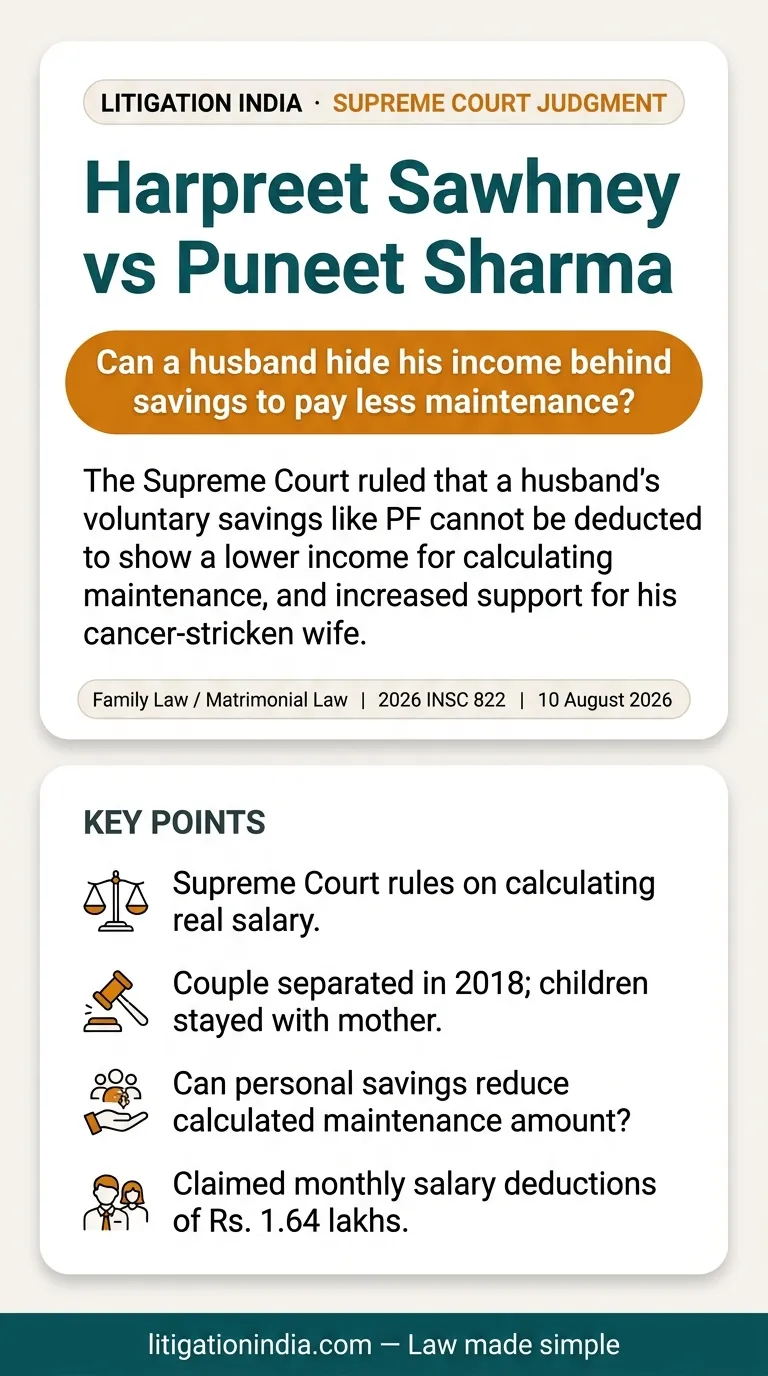
Harpreet Sawhney vs Puneet Sharma
The big legal question
Can a husband hide his income behind savings to pay less maintenance?
“The Supreme Court ruled that a husband's voluntary savings like PF cannot be deducted to show a lower income for calculating maintenance, and increased support for his cancer-stricken wife.”
Story Slides
In short
This judgment resolves a bitter dispute over maintenance between Harpreet Sawhney and Puneet Sharma. The wife, who is fighting aggressive breast cancer, is the sole caregiver for their two minor sons. While the High Court had fixed child maintenance at Rs. 1,25,000 per month, it failed to provide personal financial support to the wife for her ongoing cancer treatment. The husband argued that his net disposable income was much lower because of monthly salary deductions of around Rs. 1.64 lakhs. The Supreme Court rejected this excuse, clarifying that voluntary contributions like Provident Fund (PF) and Employee Stock Purchase Plans (ESPP) cannot be treated as compulsory deductions. Unlike income tax, these savings ultimately return to the husband and remain part of his wealth. Considering the wife's medical emergency and the children's needs, the Supreme Court enhanced child maintenance to Rs. 1,50,000 per month (Rs. 75,000 per child) and granted the wife an additional Rs. 30,000 per month for her cancer therapy. The husband has been ordered to clear all outstanding dues within three months.
Background
After the couple separated in 2018, the wife looked after their two children and later filed for divorce. While the legal battle was ongoing, she was diagnosed with aggressive breast cancer in 2024, leading to a massive increase in her medical and household expenses.
The Decision
The Supreme Court enhanced the children's maintenance to Rs. 1,50,000 per month and ordered the husband to pay Rs. 30,000 per month to the wife for cancer treatment. He must clear all dues within three months.
Why it matters for you
This ruling sets a vital precedent that spouses cannot artificially reduce their income using voluntary savings schemes to avoid paying fair maintenance. It also guarantees that courts will prioritize crucial medical emergencies, like cancer treatment, for dependent spouses.
AI-assisted summary, reviewed and verified by our editorial team.
Need help with your case?
Facing a similar legal challenge in the Supreme Court or High Court? Connect with our pro bono volunteer advocates today.
Related Supreme Court services