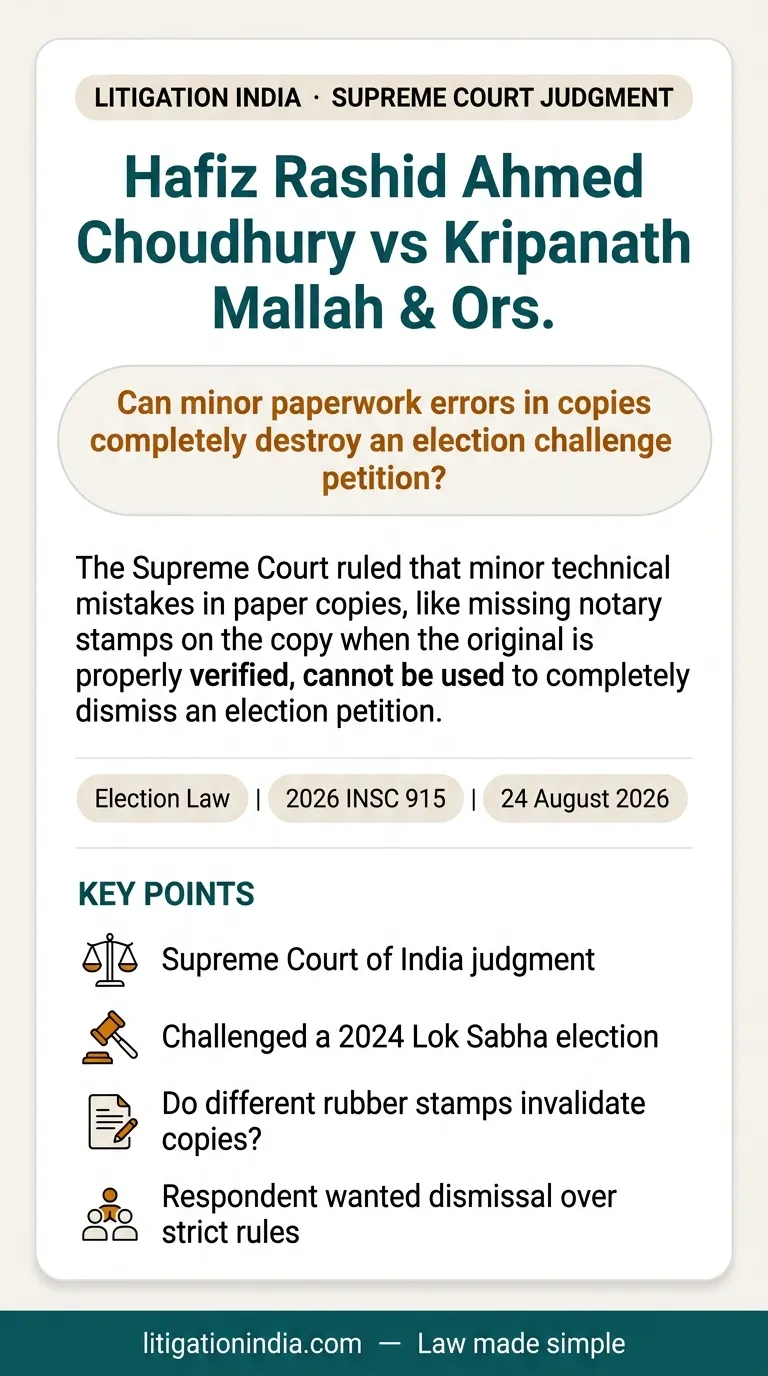
Hafiz Rashid Ahmed Choudhury vs Kripanath Mallah & Ors.
The big legal question
Can minor paperwork errors in copies completely destroy an election challenge petition?
“The Supreme Court ruled that minor technical mistakes in paper copies, like missing notary stamps on the copy when the original is properly verified, cannot be used to completely dismiss an election petition.”
Story Slides
In short
In this case, Hafiz Rashid Ahmed Choudhury challenged the 2024 Lok Sabha election victory of Kripanath Mallah from Karimganj, Assam. The High Court threw out his election petition without a full trial because of minor technical errors in the copies given to the winning candidate. Specifically, some pages were stamped 'certified true copy' instead of 'attested true copy,' and the copy of his affidavit (Form-25) did not show the notary's stamp, even though the original file submitted to the court was properly signed and stamped. The Supreme Court reversed the High Court's decision and restored the case. The Court explained that different stamps like 'certified true copy' and 'attested true copy' mean the same thing under the law as long as the petitioner signed them and took responsibility. Regarding the missing notary stamp on the candidate's copy, the Court ruled that if the original affidavit submitted to the court is properly notarized, the missing stamp on the copy is not a fatal mistake. It does not mislead the other side. The Supreme Court ordered the High Court to check the original papers. If the original is correct, the High Court must hear the entire case on its merits.
Background
The appellant challenged a Lok Sabha election result in Assam. The High Court rejected his petition early on because the paperwork copies given to the winning candidate had minor stamping errors and lacked visible notary marks.
The Decision
The Supreme Court allowed the appeal and restored the election petition. It directed the High Court to check if the original court documents were properly verified, and if so, hear the case on its merits.
Why it matters for you
This judgment protects litigants from losing their genuine court cases over minor printing or copying mistakes. It ensures that courts focus on actual justice and truth rather than throwing out cases on technical, administrative errors.
AI-assisted summary, reviewed and verified by our editorial team.
Need help with your case?
Facing a similar legal challenge in the Supreme Court or High Court? Connect with our pro bono volunteer advocates today.
Request Free Callback