
Can authorities charge homebuyers delay penalties caused by a bankrupt builder?
Granite Gate Properties (Lotus Panache) vs. NOIDA
Case: Granite Gate Properties (Lotus Panache) vs. NOIDACitation: 2026 INSC 952Decided on: 03 September 2026
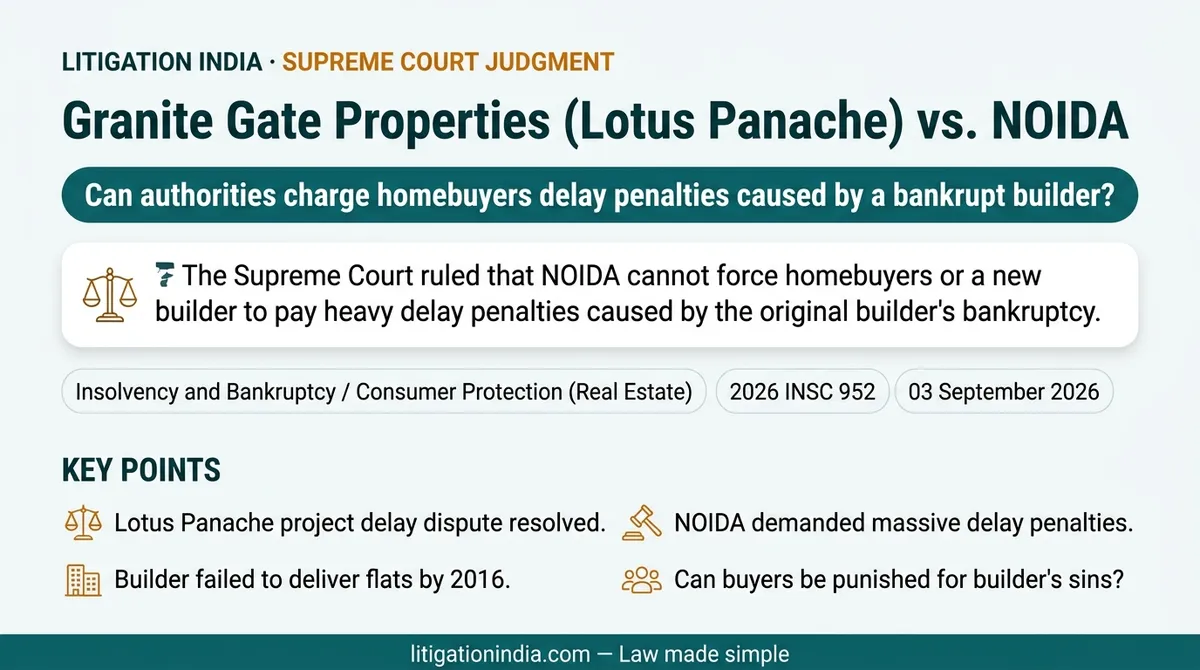
“The Supreme Court ruled that NOIDA cannot force homebuyers or a new builder to pay heavy delay penalties caused by the original builder's bankruptcy.”
Story Slides
In short
This landmark judgment comes as a huge relief to thousands of distressed homebuyers of the 'Lotus Panache' and 'Lotus Boulevard' projects in Noida. The original real estate developer, Granite Gate Properties Private Limited, went into insolvency (bankruptcy) after failing to deliver the project flats by 2016. Under the Insolvency and Bankruptcy Code (IBC), a Corporate Insolvency Resolution Process (CIRP) was initiated. The homebuyers pooled their own money and formed a Committee of Creditors (CoC) to keep the project alive, eventually approving a resolution plan with a new builder (Successful Resolution Applicant or SRA) to complete the construction. However, the local authority, New Okhla Industrial Development Authority (NOIDA), demanded massive 'time-extension charges' (delay penalties) under the lease deeds and office policies. NOIDA claimed these charges should be treated as priority expenses of the bankruptcy process (CIRP costs) and even sealed three residential towers to force payment. The National Company Law Appellate Tribunal (NCLAT) had ordered that these charges be treated as bankruptcy costs for up to three years. On appeal, the Supreme Court of India set aside this direction. The Court held that time-extension charges are penal in nature, designed only to punish defaulting developers. Since the bankrupt builder is out of the picture, forcing innocent homebuyers or the new builder to pay for the old builder's defaults is highly unjust. The Court ordered NOIDA to completely waive these delay penalties and dismissed NOIDA's appeal to charge fees beyond three years, ensuring the stalled project can finally be completed without unfair financial burdens on flat buyers.
Need clarity on a similar legal issue?
Request free pro bono guidance from a Supreme Court Advocate.
Background
A builder leased land from NOIDA to build large housing projects but went bankrupt before completion. To save their flats, homebuyers pooled their money and brought in a new builder, but NOIDA blocked progress by demanding crores in delay penalties and sealing towers.
The Decision
The Supreme Court allowed the homebuyers' appeal, ruled that NOIDA cannot impose any delay penalties on the homebuyers or the new builder, and ordered NOIDA to waive these charges completely.
Why it matters for you
This judgment protects flat buyers from being unfairly penalized for the financial failures and delays of bankrupt builders. It ensures that government authorities cannot stall construction or seal buildings over old dues, helping homebuyers get their homes.
AI-assisted summary, reviewed and verified by our editorial team.
In the Court's words
“The homebuyers and the SRA are sought to be penalised for past sins of the Corporate Debtor, which cannot be allowed...”
“...it is only proper that NOIDA waives the penalty charges since it is neither the default of the homebuyers nor the default of the SRA, which led to the delay.”
Need help with your case?
Facing a similar legal challenge in the Supreme Court or High Court? Connect with our pro bono volunteer advocates today.
Related Supreme Court services