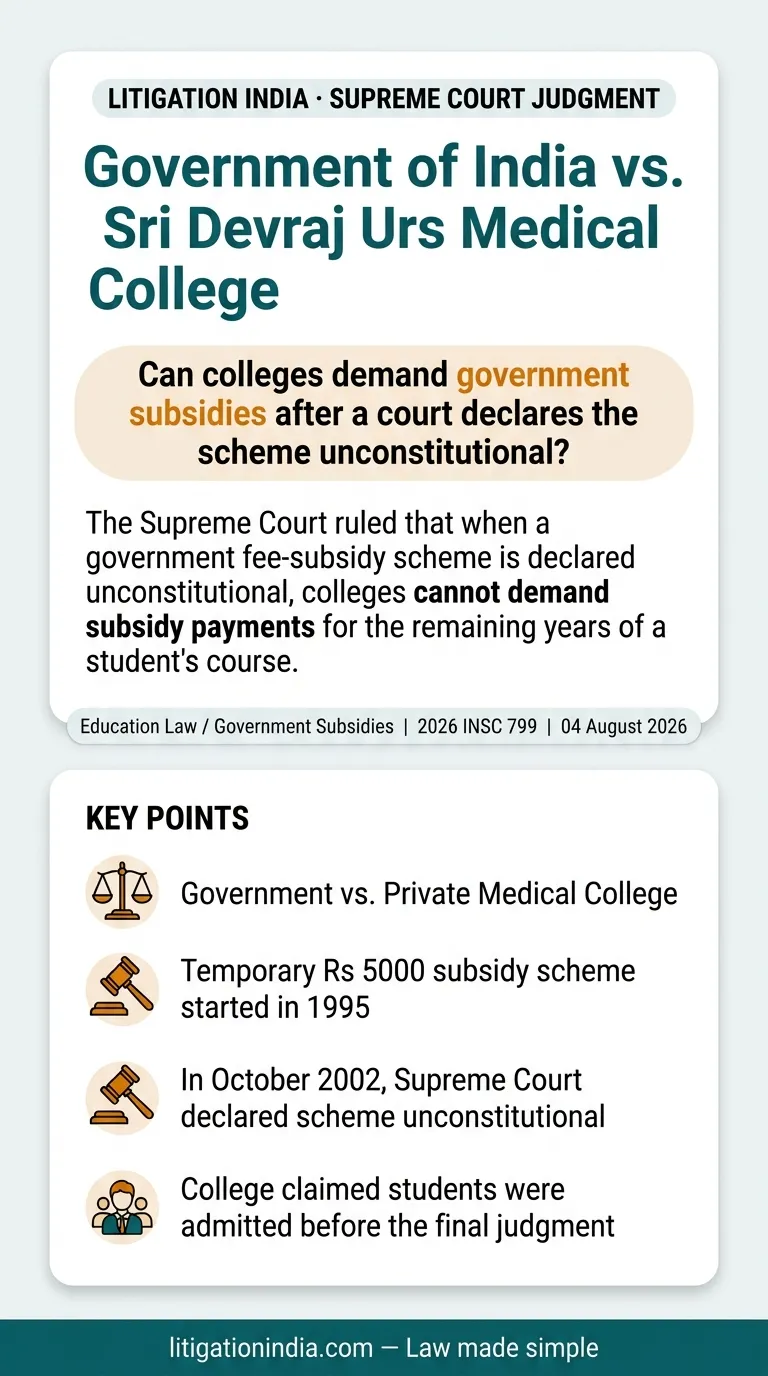
Government of India vs. Sri Devraj Urs Medical College
The big legal question
Can colleges demand government subsidies after a court declares the scheme unconstitutional?
“The Supreme Court ruled that when a government fee-subsidy scheme is declared unconstitutional, colleges cannot demand subsidy payments for the remaining years of a student's course.”
Story Slides
In short
This case decided whether a private medical college has a legal right to receive government financial aid (called subvention) after the scheme supporting it was declared unconstitutional. In 1995, the Supreme Court created a temporary scheme where the government paid Rs. 5,000 yearly per student to private professional colleges to keep student fees low and stop colleges from overcharging. However, this scheme was subject to a final decision. In October 2002, an 11-judge bench of the Supreme Court in the famous 'TMA Pai' case declared the underlying fee-regulation scheme unconstitutional. Consequently, the government stopped paying this subsidy from the academic year 2002-03. Sri Devraj Urs Medical College went to the Karnataka High Court, which ordered the government to pay the subsidy for the full five years of the course for all students admitted up to 2002-03. The government appealed to the Supreme Court. The Supreme Court partly allowed the government's appeal. It clarified that Supreme Court judgments are retrospective (effective from the past) unless specified otherwise. The subsidy scheme naturally ended on October 31, 2002. Since the subsidy was an annual payment and not a one-time lump sum, the government was not required to pay it for the remaining years of the course once the scheme was declared unconstitutional. Additionally, the college failed to show any financial proof of losses to justify demanding the money.
Background
In 1995, the Supreme Court started a temporary scheme where the government paid a Rs. 5,000 annual subsidy per student to private colleges. In October 2002, the Court's major judgment declared this underlying fee system unconstitutional. Sri Devraj Urs Medical College then sued the government when the subsidy payments were stopped for students admitted in the 2002-03 academic year.
The Decision
The Supreme Court ruled that the government does not have to pay the subsidy for the remaining years of the course for students admitted in 2002-03. Since the subsidy was paid annually and the scheme itself was declared unconstitutional in late 2002, the college had no legal right to claim it. The High Court's order directing payment for the full 5-year course was set aside.
Why it matters for you
This judgment makes it clear that if a court declares a government scheme or policy unconstitutional, citizens or organizations cannot demand ongoing benefits from it. It also establishes that Supreme Court decisions apply retrospectively unless the court specifically says otherwise.
AI-assisted summary, reviewed and verified by our editorial team.
Need help with your case?
Facing a similar legal challenge in the Supreme Court or High Court? Connect with our pro bono volunteer advocates today.
Related Supreme Court services