Fisherman Care v. The Government of India, Department of Animal Husbandry, Dairying and Fisheries & Ors. (with Gnanasekar & Ors. v. Union of India & Ors.)
The big legal question
Can a State government restrict or block fishermen from transiting through its territorial waters to engage in purse seine fishing in the Exclusive Economic Zone (EEZ)?
“The Supreme Court directed Tamil Nadu to designate a specified transit channel and ensure timely processing of applications for fishermen to access the Exclusive Economic Zone (EEZ) for purse seine fishing under the EEZ Rules 2025, upholding the principle of cooperative federalism.”
Story Slides
In short
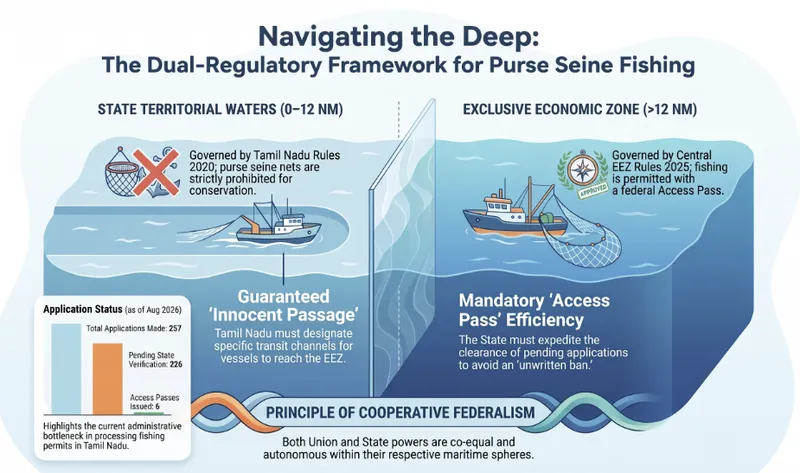
The Supreme Court disposed of interlocutory applications, holding that there is no conflict between the Union's Sustainable Harnessing of Fisheries in the Exclusive Economic Zone Rules, 2025 and Tamil Nadu's Marine Fishing Regulation Rules, 2020. While the State has autonomous powers to regulate or ban purse seine fishing within its territorial waters (up to 12 nautical miles) for marine conservation, it cannot impose an unwritten ban on fishing in the EEZ by delaying the verification of "Access Pass" applications. The Court directed Tamil Nadu to efficiently clear pending applications and frame rules designating a specified transit channel for vessels to pass from territorial waters to the EEZ.
Background
In 2000, Tamil Nadu banned purse seine fishing within its territorial waters to conserve juvenile fish stocks under the Tamil Nadu Marine Fishing Regulation Act, 1983. Under the Marine Fishing Regulation Rules, 2020, even carrying purse seine nets in territorial waters was considered a violation, effectively preventing fishermen from transiting to fish in the Exclusive Economic Zone (EEZ) beyond 12 nautical miles. Fisherman Care and other associations challenged this ban. In 2022, the Supreme Court ordered an Expert Committee to examine the issue. Based on the committee's findings, the Union government notified the Sustainable Harnessing of Fisheries in the Exclusive Economic Zone Rules, 2025, which established an "Access Pass" system for purse seine fishing in the EEZ. However, the State of Tamil Nadu delayed the physical verification of these applications, leaving 226 out of 257 applications pending as of August 2026. The court observed that this administrative delay virtually amounted to an unwritten ban, violating the rule of law and fishermen's right to carry out trade.
The Decision
The Supreme Court disposed of the interlocutory applications with the following key directions based on cooperative federalism and co-equal regulatory powers: Jurisdictional Co-Equality: Declared that the Union's EEZ Rules, 2025 (operating under Entry 57 of List I) and the State's Marine Fishing Regulation Rules, 2020 (operating under Entry 21 of List II) are co-equal and autonomous in their respective spheres, and do not conflict with each other. Mandate for Timely Verification: Directed the State of Tamil Nadu to ensure effective, efficient, and timely clearance and verification of the pending Access Pass applications on the ReALCRaft Portal, noting that delaying verification virtually amounts to an impermissible unwritten ban. Establishment of a Transit Channel: Directed the Tamil Nadu Government to frame rules/regulations under Rules 15(5) and (6) of its 2020 Rules to designate a specified transit channel for vessels to pass from territorial waters to the EEZ for fishing using purse seine nets. These regulations must incorporate the final recommendations of the Expert Committee. Governing Framework: Declared that the rights and liabilities of the parties will be governed by the relevant laws, EEZ Rules, 2025, and the Tamil Nadu Marine Fishing Regulation Rules, 2020.
Why it matters for you
This judgment is a landmark ruling on cooperative federalism and the right to livelihood under Article 19(1)(g) of the Constitution. It establishes that while states have the sovereign right to conserve marine resources within their territorial waters, they cannot use administrative inertia or delays to block economic activities in central jurisdictions (the EEZ) where fishermen have a fundamental right to operate. By demanding a coordinated effort between the Union and State agencies, the Court reinforces that sustainable environmental conservation and livelihood rights must be balanced through joint regulatory mechanisms rather than unilateral prohibitions.
Photos
Need help with your case?
Facing a similar legal challenge in the Supreme Court or High Court? Connect with our pro bono volunteer advocates today.
Related Supreme Court services