
Full text of the judgment
Text extracted from Elaine Info Solutions Pvt. Ltd. vs M/s. J & A Avenues India Private Limited and Ors.. For the authoritative version refer to the Supreme Court of India's official website.
2026 INSC 1228 Reportable IN THE SUPREME COURT OF INDIA CIVIL APPELLATE JURISDICTION C I V I L A P P E A L N O . 2 8 2 1 O F 2 0 2 0 ELAINE INFO SOLUTIONS PVT. LTD. .….APPELLANT (S) VERSUS M/S. J & A AVENUES INDIA PRIVATE LIMITED AND ORS. ..…RESPONDENT(S) With C I V I L A P P E A L N O . 6 2 5 0 O F 2 0 2 1 J U D G M E N T SANJEEV SACHDEVA,
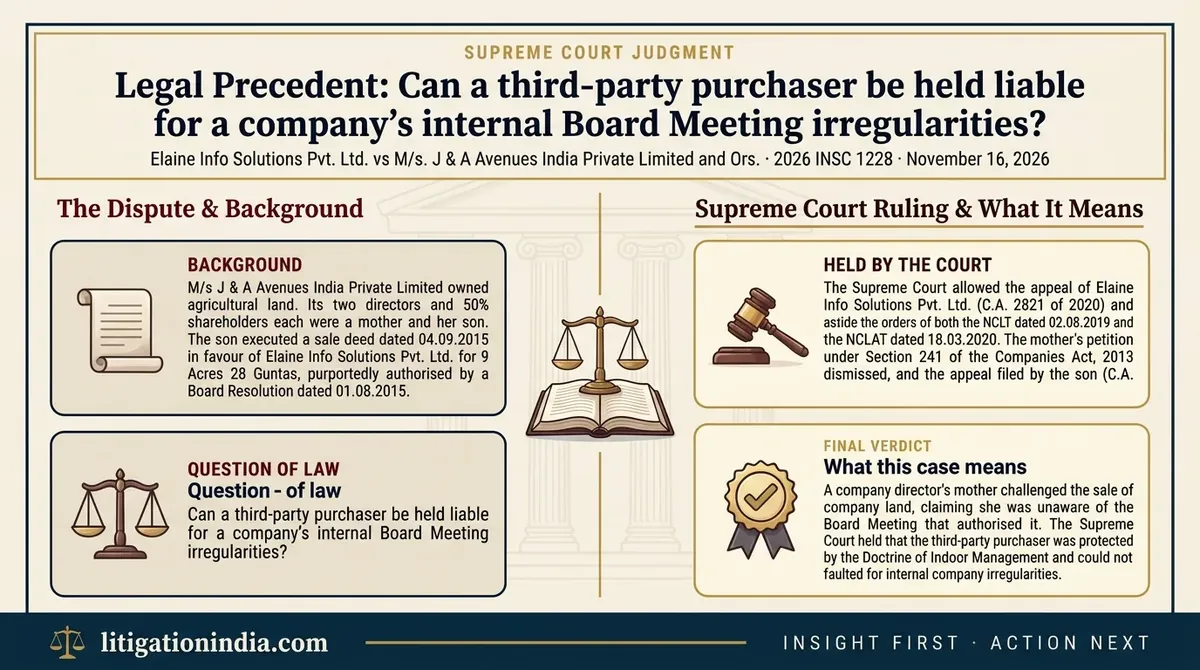
J. 1. M/s Elaine Info Solutions Pvt. Ltd.1, Appellant in C.A. 2821 of 2020 impugns judgment dated 18.03.2020 of the National Company Law Appellate Tribunal2 in Company Appeal (AT) 210 of 2019 whereby the 1 Hereinafter referred to as the Appellant. 2 NCLAT for short 1 Digitally signed by Deepak Guglani Date: 2026.11.16 18:24:47 IST Reason: Signature Not Verified
NCLAT has dismissed the appeal of the Appellant against order dated 02.08.2019 of the National Company Law Tribunal3. By order dated 02.08.2019 the NCLT, (on a petition filed by Mrs. Vishnumolaka Govardhanmma4 (the mother) under Section 241 of the Companies Act, 20135) had declared the Board Resolution of the Board Meeting dated 01.08.2015 and the registration of documents for land measuring 09 Acres and 28 Guntas with the Sub-Registrar as null and void and directed the Sub- Registrar to cancel the registered document dated 04.09.2015 and further directed restoration of the name of the property in the name of M/s J & A Avenues India Private Limited6 and the said Company to return the sum of Rs. 4,36,50,000/- with interest @ 8 % per annum from the date of receipt of the amount till repayment of the same. 2. Direction was also issued by order dated 02.08.2019 that as Mr. V. Lakshmi Chenuchu Venkata Siva Prasad Satya7 (the son) had received a sum of Rs. 7,91,00,000/- from Mr. Y. Naga Satish as part of the sale consideration of the subject property and said amount had been utilised for the Company, the son and the Company were directed to return the same to Mr. Y. Naga 3 NCLT for short 4 Hereinafter referred to as the mother 5 The Act for short 6 The Company for short 7 Hereinafter referred to as the son 2
Satish with interest @ 8% per annum from the date of receipt for the said amount within a period of 60 days. The son was also declared as an unfit person to hold the post of Director of the Company and was barred from the Directorship of the said Company for a period of 5 years from the date of the said order and the Company was directed to convene an extraordinary general meeting within a period of 60 days to give effect to the direction issued by the said order and also to appoint a new Director in place of the son in accordance with the provisions of Companies Act. The Second Appeal (C.A. No. 6250 of 2021) has been filed by the son impugning the above orders in so far as they relate to him. 3. These proceedings emanate from a Petition filed by the mother under section 241 of the Companies Act, whereby she had challenged the sale of the subject land owned by the Company contending that though she was the Director of the Company, the son was taking care of the day-to-day affairs of the Company. 4. It was contended by the mother that the Company had purchased 18 Acres 18 Guntas of land vide sale deed dated 26.03.2013 and she was surprised to learn that the son, in collusion with the Appellant had transferred a part of the said land, i.e., 9 Acres 28 Guntas, by way of a sale 3
deed dated 04.09.2015. It was contended that as per the sale deed, the son was authorised to execute the sale deed by the Board of Directors in a meeting held on 01.08.2015. It was contended that on the said date there were only two directors of the said Company, i.e., the mother and the son, and she was neither aware of any Board Meeting held on 01.08.2015 and nor did she receive any notice for meeting from the Board of Directors. It is contended that the shares of the Company were owned by her and her son in the ratio of 50% each and both of them were Directors of the Company. 5. The son, in his counter-affidavit filed before the NCLT contended that Mr. Naga Satish, Director of the Appellant, was a family friend and both Mr. Naga Satish and his mother were in the business of moneylending and Mr. Naga Satish had paid to the Company to purchase of lands on different dates and that the total money paid by Mr. Naga Satish and his mother was Rs. 1,65,00,000/-. It was further alleged that the Company had agreed to sell the subject land admeasuring, 9 Acres 28 Guntas, to Mr. Naga Satish for a total consideration of Rs. 12,27,50,000/-, treating the loan amount of Rs. 1,65,00,000/- as an advance payment. 6. It was contended that after adjusting the advance amount of Rs. 1,65,00,000/-, Mr. Naga Satish was required to pay the balance amount of 4
Rs. 10,62,50,000/-. Out of the balance consideration an amount of Rs. 7,91,00,000/- was paid to the son and Rs. 4,36,50,000/- was paid to the account of the Company. All the cheques, except one, were issued by Mr. Naga Satish. Further, the amount of Rs. 7,91,00,000/-, although received by the son, was utilized for the purposes of the Company and its shareholders. It was further contended that Mr. Naga Satish prepared the sale deed in respect of the subject land for Rs. 4,36,50,000/- instead of Rs. 12,27,50,000/-. It was contended that Mr. Naga Satish also purchased 34 Guntas of land belonging to Mr. S. Goverdhan Reddy and Mr. S. Venkataram Reddy. Although the actual sale consideration was Rs. 1,07,10,000/-, an amount of Rs. 38,25,000/- was shown as the sale consideration in the sale deed. 7. It was further submitted in the counter-affidavit by the son, that Mr. Naga Satish had filed a case against the son on the basis of an agreement to sell dated 16.02.2015, for purchase of agricultural land admeasuring 29 Acres 30.08 Guntas, owned by the son. The agreement reflected a balance consideration of Rs. 7,91,00,000/- towards the purchase of the said land. 8. In the counter-affidavit filed on behalf of the Appellant, it was contended that son had provided a Board Resolution dated 01.08.2015, 5
which was duly recorded in the sale deed executed on 04.09.2015. Mr. Naga Satish, being a Director of the Appellant made the payment of Rs. 4,36,50,000/- towards the sale consideration of the subject land and had signed the sale deed on behalf of the Company. He contended that the balance sheet of the Company as on 31.03.2016 disclosed that the Company had received the advance amount of Rs. 12,73,50,000/- towards the sale of land. It was further contended that, in case the Company had failed to record the Board Meeting held on 01.08.2015, such failure could not be attributed to the Appellant, which was a bona fide purchaser and non-recording of the Board Meeting was an internal matter of the Company, and the Appellant could not be attributed for the failure of recording the same. 9. It was further contended that the Appellant was protected under the provisions of Section 41 of the Transfer of Property Act, 1882, and the sale could not be invalidated, merely because the son did not have the authority to execute the sale deed. It was further contended that the Appellant being the landowner based on the said sale deed, had further executed an Agreement of Sale dated 11.06.2018 with M/s. Anirudh Agro Farms Limited and M/s. VBS Builders and Developers and had received a substantial amount as advance consideration. 6
10. In respect of the contention raised by the son, the Appellant contended that the total sale consideration was only Rs. 4,36,50,000/-, and the same was paid by Mr. Naga Satish on behalf of the Appellant, and the land was registered in the name of the Appellant, in which Mr. Naga Satish later acquired a substantial share. 11. It was further contended that the son had agreed to sell his own land at Kollur, for which Mr. Naga Satish had paid an amount of Rs. 1,65,00,000/-. The said sale transaction was subsequently cancelled. Thereafter, the son agreed to sell his own land, admeasuring 30 Acres and odd to Mr. Naga Satish for a total consideration of Rs. 12,00,00,000/- and an agreement to sell dated 16.02.2015 was entered into. Said amount of Rs. 1,65,00,000/was treated as an advance and, subsequently, Mr. Naga Satish paid a total amount of Rs. 7,91,00,000/- out of the sale consideration of Rs. 12,00,00,000/-. The transaction between Mr. Naga Satish and the Company was independent and as the Company failed to execute the sale deed, a suit for specific performance was filed by Mr. Naga Satish, which is pending. 12. It was further contended that subject petition was filed by the mother in collusion with her son in order to settle the dispute between the Company 7
and Mr. Naga Satish, which was subject matter of the Suit for Specific Performance. 13. By the order dated 02.08.2019, the NCLT held that as there were only two shareholders and two directors, i.e., the mother and the son, the question of conducting any valid Board Meeting in the Company did not arise without participation of either the mother or the son. It further held that neither the son nor the Appellant produced the notice of the impugned Board Meeting at which the resolution dated 01.08.2015 was signed. As no Board Meeting had been conducted, the son did not have the authority to transact the sale of the property and, thus, held that the sale deed was void ab initio and non est in the eyes of law. 14. The NCLT held that the Appellant’s contention that they had bonafidely purchased the property for valuable consideration being unaware of the internal affairs of the Company and were protected by law based on the principal of ‘Doctrine of Indoor Management’, was no tenable. The NCLT held that as only a colour photocopy of the alleged original resolution was produced, Appellant failed to do due diligence and it could not claim to be a bona fide purchaser of the property of the Company. NCLT had noted that there was an ongoing dispute between the son and Mr. Naga Satish, 8
Director of the Appellant Company. NCLT noted that the impugned sale deed dated 04.09.2015 was not only in respect of the subject property of the Company, but also properties of two other third party individuals, hence the three properties were put together and registered under a common sale deed. NCLT held that the actions of the son amounted to an act of oppression against the interests of the mother and the Company in general and there was a mismanagement on the part of the son and, consequently, the NCLT declared the sale deed as null and void and, inter alia, directed the cancellation of the registered sale deed dated 04.09.2015. 15. The order passed by the NCLT was impugned by both the Appellant as well as the son before the NCLAT by filing their respective appeals. The mother also filed an appeal against the order passed by the NCLT, challenging it to the limited extent of the direction requiring her to return the amount of Rs. 4,36,50,000/-, along with interest @ 8%, and further the direction to return the amount of Rs. 7,91,00,000/- by Mr. Naga Satish, along with interest @ 8%. 16. The NCLAT disposed of all the appeals, holding that the Appellant had failed to adduce any evidence relating to presence of the mother at the Board Meeting allegedly held on 01.08.2015. It was observed that the Audit 9
Report and the relevant financial statement were not reflecting the sale of the said land and no Board Meeting dated 01.08.2015 was held as per Annual Return of 2015-16 of the Company. It was held that the original Board Resolution had not been shown to the Appellant and that Appellant had purchased the land on basis of a certified copy of the Board Resolution. It opined that the impugned property was in mother’s control. 17. NCLAT further held that no profit or loss was reflected in the profit and loss account for the Financial Year 2015-16, in respect of sale of the land. The NCLAT ultimately held that the sale was executed only on the basis of the Board Resolution dated 01.08.2015, which could not be relied upon. Therefore, the sale of the land seemed to have been executed without proper authorisation from the Board. Consequently, the order of NCLT was upheld and the appeals were disposed of. 18. It may be noted that the Appellant is a third-party to the affairs of the Company. The Board Resolution dated 01.08.2015 is alleged to have been passed in a meeting held on the same date 01.08.2015. Though the sale deed dated 04.09.2015 refers to a resolution of the Board Meeting dated 01.08.2015, Appellant cannot be attributed to have any knowledge of the same as the holding of the meeting and passing of the said resolution would 10
be within the personal knowledge of the Directors/shareholders of the Company. 19. The only two shareholders of the Company are the mother and the son. Appellant, being an unrelated third party would have no knowledge of the meeting, therefore, the finding of the NCLT that Appellant has failed to prove that mother had notice or participated in any alleged meeting is erroneous for the reason that it was for the shareholders and the directors of the Company to prove the said meeting. Appellant being an unrelated thirdparty, cannot be made liable for proving the holding of the meeting and passing of a resolution in the said meeting. A third-party purchaser can only act bona fidely when one of the two directors, being a 50% shareholder produces a resolution of the Board of Directors. 20. The Doctrine of Indoor Management would clearly come to apply in the present case. Both NCLT and NCLAT have primarily acted by holding that the resolution of the Board of Directors had not been passed and the sale deed executed based thereon was invalid. Appellant, being an unrelated third-party would have no knowledge of the indoor affairs of the Company. 11
21. Admittedly the sale consideration had been received by the Company and duly reflected in the books of accounts of the Company which were duly audited. The audited accounts were signed by both the mother and the son. In the notes attached to the accounts, there is a clear mention of the sale of the subject land. Sale consideration was received in the accounts of the Company. Sale consideration of Rs. 4,36,50,000/-, which was received in the accounts of the Company, were duly utilized by the Company. The accounts were audited and signed by the mother. 22. We may also note that copy of the resolution of the Board of Directors referred to in the Sale Deed contains the signature of the mother attesting the same as true copy. Though the signature has been denied by the mother as not hers, no complaint has been filed against the son for allegedly forging her signatures on the certified copy of the resolution of Board of Directors. No criminal proceedings have been initiated by the mother against her own son. 23. In the books of accounts for the Assessment Year 2016-17, corresponding to the Financial Year in which the subject transaction has taken place, the amount received has been duly reflected and was also utilized by the Company for its business transactions. The books of the 12
accounts were signed by the mother on 02.09.2016 and there is no denial to the same. We may also refer to the ‘Significant Accounting Policies and Notes to the Financial Statements’ appended to the Audited Accounts and particularly Note 14 thereof, which reads as under: “During the year, the company had executed a Sale Deed for sale of Ac. 9-28 Gts Agricultural Land. The Purchaser disputed the consideration amount, setting up a false and fabricated agreement and filed a suit vide O.S. No. 15/2016 with First Additional District Judge, Sangareddy, which is pending. Therefore, the matter is sub-judice. The sale will be completed/cancelled Subject to the outcome of the suit 24. The Notes to the Financial Statements specifically mentions about the execution of the subject Sale Deed and that the Company had executed a sale deed for sale of 9 Acres 28 Guntas of agriculture land. Though it records that the purchasers (i.e. the Appellant Company) had disputed the consideration amount and there is that reference to the Suit for specific performance filed by the Appellant, the note acknowledges the execution of the Sale Deed. The Account Books including the Notes to the Financial Statements are duly certified by the Chartered Accountant i.e. the Statutory Auditors and have also been signed by the mother and the son. At no point in time has any challenge been raised to the veracity of books of accounts by the mother or to the reference in the Notes to the Financial Statements to the 13
factum of the sale deed having been executed for 9 Acres and 28 Guntas of land. 25. There is no dispute that Note 14 refers to Sale Deed in question, particularly because the note refers to the suit number filed by Mr. Naga Satish. It further records that the sale would be completed/cancelled subject to the outcome of the suit. The Mother, being the signatory to the books of accounts, would have been aware of the entries reflecting the sale of the account subject and the appropriation and utilization of the sale consideration for the affairs of the Company. She cannot, therefore, be permitted to deny the said transaction or claim the ignorance to such a transaction. 26. It may be noted that the mother filed the subject petition before the NCLT on 08.10.2018, contending that she was not aware of the transaction and claimed that the petition filed by her was within the period of limitation. Such a contention cannot be permitted to be raised on behalf of the mother for the reason that on 02.09.2016, she has herself signed the balance sheet and the Notes to the Financial Statements containing a disclosure about the sale of the subject land to the Appellant. Clearly, the petition was filed 14
before the NCLT challenging a registered sale deed dated 04.09.2015 after the expiry of a period of three years. 27. It is thus evident that a challenge to the Board Resolution dated 01.08.2015 and the sale deed dated 04.09.2015 has been made to counter the claim of Mr. Naga Satish in the suit for specific performance filed by him. 28. We may also note that the Income Tax Returns of the Company have not been placed before any forum, which would have shown the treatment given to the Capital Gains made on the sale of the said land. There is no denial by the son of the execution of the sale deed; only denial is to the sale consideration. Nonetheless, it was obligatory on behalf of the Company to reflect the transaction in its Income Tax Returns. Filing of the Income Tax Return was necessary to demonstrate the manner in which the sale consideration had been treated in a claim towards capital gains. Since the Income Tax Returns have not been placed before this Court, an adverse inference needs to be drawn against the Company. 29. Clearly, the NCLT by its order dated 02.08.2019 has erred in declaring the Board Resolution of the Board Meeting dated 01.08.2015 and the Sale Deed dated 04.09.2015 for land measuring 09 Acres and 28 Guntas as null 15
and void and has further erred in directing the Sub-Registrar to cancel the registered document and directing restoration of the title of the property in the name of M/s J & A Avenues India Private Limited and in directing the return of the sum of Rs. 4,36,50,000/- with interest. The NCLAT by its order dated 18.03.2020 has erred in compounding the error by confirming the order of the NCLT. We may only note for the purpose of record and completeness that by order dated 02.08.2019 the son was barred from the Directorship of the Company (M/s J & A Avenues India Private Limited ) for a period of 5 years. Said debarment has worked itself out as the period has already elapsed. 30. In view of the above, the appeal (C.A. 2821 of 2020) filed by the Appellant (Elaine Info Solutions Pvt. Ltd.) is allowed and the appeal (C.A. 6250 of 2021) filed by the son (Mr. V. Lakshmi Chenuchu Venkata Siva Prasad Satya) is dismissed as infructuous. Order dated 02.08.2019 of the NCLT and the order dated 18.03.2020 of the NCLAT are set aside. The petition filed by the mother (Mrs. Vishnumolaka Govardhanmma) under under Section 241 of the Companies Act, 2013 is dismissed. It is clarified that we have neither examined nor commented upon the merits of the allegations of either party in respect of the Suit for Specific Performance 16
(O.S. No. 15/2016) pending in the court of First Additional District Judge, Sangareddy. Said Suit shall be decided on its own merits without being influenced by anything stated in this Judgment. …………………………….J. [SANJAY KUMAR] …………………………….J. [SANJEEV SACHDEVA] New Delhi; November 16, 2026 17