Edelweiss Custodial Services Limited vs. NSE Clearing Ltd. & Anr.
The big legal question
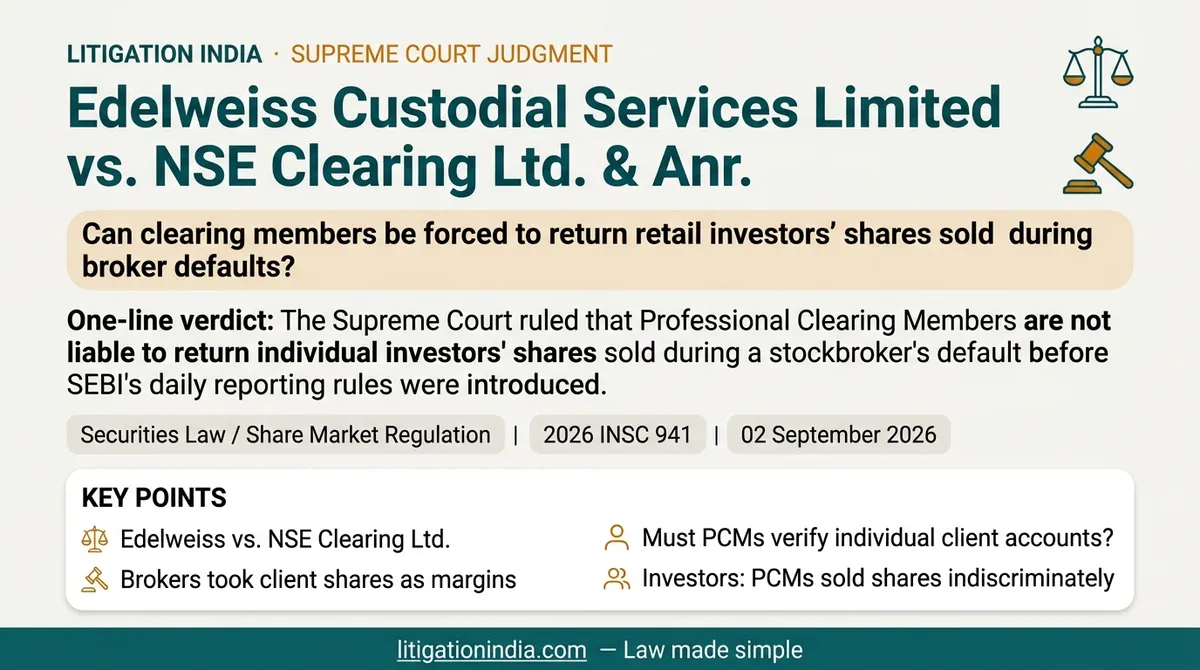
Can clearing members be forced to return retail investors' shares sold during broker defaults?
“The Supreme Court ruled that Professional Clearing Members are not liable to return individual investors' shares sold during a stockbroker's default before SEBI's daily reporting rules were introduced.”
Story Slides
In short
This case involves a major dispute in the Futures & Options (F&O) segment of the stock market. Share brokers, technically called Trading Members (TMs), like Anugrah Stock & Broking, took share securities as collateral from retail investors. These brokers then deposited the shares with Professional Clearing Members (PCMs), such as Edelweiss Custodial Services, to secure their trading limits. However, some brokers ran illegal high-yield schemes promising fixed returns and misused client shares. When these brokers suffered massive trading losses and defaulted, the PCMs sold the deposited collateral shares in the open market to recover their dues. Many retail investors who had no outstanding dues lost their shares because the PCMs liquidated the pooled accounts. The National Stock Exchange Clearing Corporation (NCL) and the Securities Appellate Tribunal (SAT) ordered the PCMs to return (restitute) these shares or pay equivalent money to the affected investors. The PCMs challenged this before the Supreme Court. The Supreme Court allowed the PCMs' appeals and set aside the restitution orders. The Court ruled that prior to SEBI's daily reporting circular of July 2021, PCMs had no real-time visibility or legal duty to check the debit/credit positions of individual clients before liquidating pooled collaterals. There was no direct contract between the PCM and the broker’s clients. Furthermore, the Court held that the NCL's disciplinary committee lacked the statutory power to order restitution or cash payouts under Section 9(3)(b) of the Securities Contracts (Regulation) Act, 1956, which strictly bars monetary penalties by exchanges. Such recovery powers rest solely with SEBI. Finally, the Court observed that F&O trading is highly speculative, and investors who knowingly risked their shares in illegal schemes for high fixed returns cannot claim innocence or demand compensation from the clearing members.
Background
Trading members (brokers) took shares from retail investors as margin money and pledged them with clearing members to guarantee trades. When the brokers defaulted due to massive losses, the clearing members sold these shares, leaving even non-defaulting retail investors empty-handed.
The Decision
The Supreme Court set aside the orders of the NCL and SAT that forced clearing members to return the sold shares. It held that clearing members had no way of knowing individual client positions at that time, and the exchange committee had no legal power to order money returns or share restitution.
Why it matters for you
This judgment clarifies that stock exchange committees cannot act like courts to order monetary recovery or asset returns. It also warns retail investors that participating in high-risk derivative trading and illegal fixed-return schemes offered by brokers carries immense risks where they cannot expect bailout protection.
AI-assisted summary, reviewed and verified by our editorial team.
In the Court's words
“there was no statutory obligation on the PCM to find that out. At that point of time, there were weekly settlements which made the verification impossible”
“The power of disgorgement, hence, was specifically conferred on the SEBI and intentionally not permitted to be conferred, in the byelaws made under Section 9 of the Securities Act.”
“there can be no claim laid against the PCM for the default committed by the TM, especially in the context of the TM having indulged in illegal schemes and the investors having participated with open eyes”
Need help with your case?
Facing a similar legal challenge in the Supreme Court or High Court? Connect with our pro bono volunteer advocates today.
Related Supreme Court services