
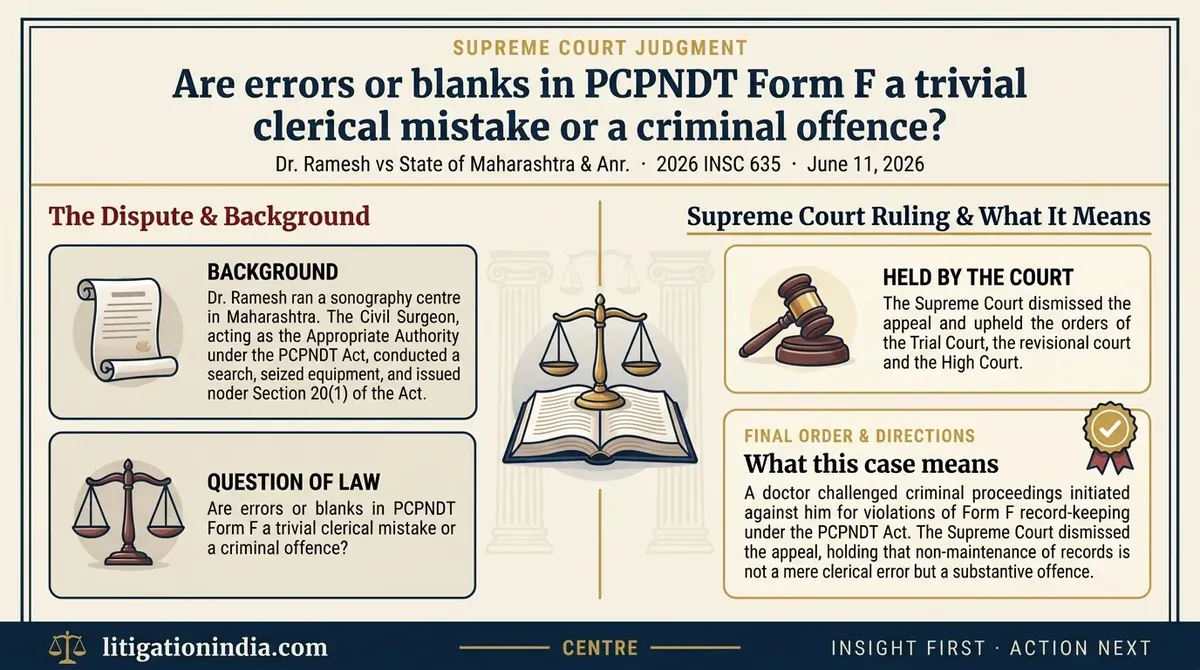
Full text of the judgment
Text extracted from Dr. Ramesh vs State of Maharashtra & Anr.. For the authoritative version refer to the Supreme Court of India's official website.
2026 INSC 635 Crl.A…/2026 @ SLP (CRL) No. 9574 of 2018 Page 1 of 20
IN THE SUPREME COURT OF INDIA CRIMINAL APPELLATE JURISDICTION
CRIMINAL APPEAL NO OF 2026 (Arising out of Special Leave Petition (Criminal) No.9574 of 2018)
…APPELLANT(S)
STATE OF MAHARASHTRA & ANR. …RESPONDENT(S)
J U D G M E N T
SANJAY KAROL J. Leave granted.
2. In the larger context of this appeal, we are reminded of the words of Subhadra Kumari Chauhan in the poem ‘Balika ka parichay’. It powerfully describes the beautiful joy of a mother upon the birth of her daughter: “यह मेरी गोदी की शोभा, सुख सोहाग की है लाली शाही शान भभखारन की है, मनोकामना मतवाली
दीप-भशखा है अँधेरे की, घनी घटा की उभियाली उषा है यह काल-भ ृंग की, है पतझर की हररयाली
सुधाधार यह नीरस भदल की, मस्ती मगन तपस्वी की. िीभवत ज्योभत नष्ट नयनोृं की, सच्ची लगन मनस्वी की. Digitally signed by MINI Date: 2026.06.11 13:48:27 IST Reason: Signature Not Verified
Crl.A…/2026 @ SLP (CRL) No. 9574 of 2018 Page 2 of 20
बीते हुए बालपन की यह, क्रीडापूर्ण वाभटका है . वही मचलना, वही भकलकना,हँसती हुई नाभटका है .
मेरा मृंभदर,मेरी मसभिद, काबा काशी यह मेरी . पूिा पाठ,ध्यान,िप,तप,है घट-घट वासी यह मेरी.
क ष्णचन्द्र की क्रीडाओृं को अपने आृंगन में देखो . कौशल्या के मात -मोद को, अपने ही मन में देखो.
प्रभु ईसा की क्षमाशीलता, नबी मुहम्मद का भवश्वास. िीव-दया भिनवर गौतम की,आओ देखो इसके पास .
पररचय पूछ रहे हो मुझसे, कैसे पररचय दूँ इसका . वही िान सकता है इसको, माता का भदल है भिसका ”
Well, to our mind the objective of the Pre-Natal Diagnostic Techniques (Prohibition of Sex Selection) Act, 19941 is to enable a woman to feel the joy that has been described above. From our own scriptures, the once much cherished, but now largely forgotten value is also worth reminding ourselves of:
3. This appeal challenges the judgment and order of the High Court of Judicature at Bombay, Aurangabad Bench in CrWP No. 1363 of 2017, whereby the challenge to the order taking cognizance dated 9th June 2016 in RCC No.16 of 2016 passed by the Judicial Magistrate First Class, Ardhapur3 was rejected.
4. The Trial Court has directed the issuance of process under Section 204 of the Code of Criminal Procedure4 for the offences punishable under Section 23 of the
1 PCPNDT 2 [‘Yatra naryastu pujyante ramante tatra dewatah’] (where woman is worshipped, there is abode of God). 3 Trial Court 4 CrPC
Crl.A…/2026 @ SLP (CRL) No. 9574 of 2018 Page 3 of 20
Pre-Conception and Pre-Natal Diagnostic Techniques (Prohibition of Sex Selection) Act, 19945 for violation of Sections 4(3), 5, 6 and 29 of the Act and Rules 9, 8(5) and 18(9). Also under challenge was the order dated 21st August 2017 which dismissed the Criminal Revision No. 82 of 2016 preferred by the appellant against the issuance of process.
5. In short, an Authority (delegation of power to whom is in fact, a point of challenge raised before us) conducted a search and seized the equipment belonging to the appellant and issued notice to him under Section 20(1) of the PCPNDT, calling upon him to offer an explanation. Pursuant to letter dated 18th March 2016 issued by such Authority, he also appeared before the Advisory Committee, constituted under the Act on 22nd March 2016. Having heard him, it was concluded that prima facie material existed in so far as the violations under PCPNDT were concerned. The suspension of the sonography center and seizure of the sonography machine was ordered by communication dated 23rd March 2016. Here itself, it may be noted that this seizure of machine was challenged as per law, and as on date it stands released in favour of the appellant as also registration thereof restored. The same is, therefore, a non- issue before us. Proceedings before the Trial Court, as already noted, were initiated on 28th April 2016. The order under challenge was issued on 9th June 2016.
6. A Revision Petition was preferred against this Order which was disposed of by judgment dated 21st August 2017. Both grounds raised, i.e., the competence of the Civil Surgeon, as the appropriate Authority and, the maintenance and updating of records being the responsibility of the hospital staff and not the responsibility of
Crl.A…/2026 @ SLP (CRL) No. 9574 of 2018 Page 4 of 20
the appellant herein were rejected.
7. In the judgment impugned before us, the grounds of challenge raised by the appellant were two –fold. One, that Civil Surgeon was not the appropriate Authority under the Act and as such, the cognizance taken by the Magistrate was without basis; Two, it was urged that the errors or blanks in Form ‘F’ were technical errors and inadvertent. They were not errors backed by intention. Regarding the first contention, notification dated 15th May 2015 was taken note of which made the District Civil Surgeon, the appropriate Authority under the Act, and as such, the instant proceedings were in accordance with law. About the second contention, it was concluded by the Court that the errors in maintaining the records were not a trivial matter and compromises in maintaining the record apart from being a substantive offence under the proviso to Section 4(3), would also be offensive to the scope of the Act. The extent and manner of violations in maintaining the record is a question of trial and had to be determined in such proceedings. The order of the Magistrate suffered from no error.
8. The appellant, therefore, has carried the matter in appeal before this Court. We have heard the learned counsel for the parties and perused the record. The short question to be considered is whether the Magistrate was correct in taking cognizance.
9. At the outset, we may profitably refer to the observations in Voluntary Health Assn. of Punjab v. Union of India6, wherein this court observed: “14. Female foeticide has its roots in the social thinking which is fundamentally based on certain erroneous notions, egocentric traditions, perverted perception of societal norms and obsession with ideas which are totally individualistic sans the
6 (2013) 4 SCC 1
Crl.A…/2026 @ SLP (CRL) No. 9574 of 2018 Page 5 of 20
collective good. All involved in female foeticide deliberately forget to realise that when the foetus of a girl child is destroyed, a woman of the future is crucified. To put it differently, the present generation invites the sufferings on its own and also sows the seeds of suffering for the future generation, as in the ultimate eventuate, the sex ratio gets affected and leads to manifold social problems. I may hasten to add that no awareness campaign can ever be complete unless there is real focus on the prowess of women and the need for women empowerment.”
Even after more than a decade our sentiment is similar.
10. The relevant provisions of the PCPNDT Act are as follows: 2. Definitions.- In this Act, unless the context otherwise requires,— (a) “Appropriate Authority” means the Appropriate Authority appointed under section 17 “pre-natal diagnostic procedures” means all gynaecological or obstetrical or medical procedures such as ultrasonography, foetoscopy, taking or removing samples of amniotic fluid, chorionic villi, blood or any other tissue or fluid of a man, or of a woman for being sent to a Genetic Laboratory or Genetic Clinic for conducting any type of analysis or pre-natal diagnostic tests for selection of sex before or after conception; (j) “pre-natal diagnostic techniques” includes all prenatal diagnostic procedures and pre-natal diagnostic tests;
CHAPTER III REGULATION OF PRE-NATAL DIAGNOSTIC TECHNIQUES
4. Regulation of pre-natal diagnostic techniques.- On and from the commencement of this Act,— 1. no place including a registered Genetic Counselling Centre or Genetic Laboratory or Genetic Clinic shall be used or caused to be used by any person for conducting pre-natal diagnostic techniques except for the purposes specified in clause (2) and after satisfying any of the conditions specified in clause (3); 2. no pre-natal diagnostic techniques shall be conducted except for the purposes of detection of any of the following abnormalities, namely:— … 3. no pre-natal diagnostic techniques shall be used or conducted unless the person qualified to do so is satisfied for reasons to be recorded in writing that any of the following conditions are fulfilled, namely:— (i) age of the pregnant woman is above thirty-five years; … Provided that the person conducting ultrasonography on a pregnant woman shall keep complete record thereof in the clinic in such manner, as may be prescribed, and any deficiency or inaccuracy found therein shall amount to contravention of provisions of section 5 or section 6 unless contrary is proved by the person conducting such ultrasonography;
Crl.A…/2026 @ SLP (CRL) No. 9574 of 2018 Page 6 of 20
4. … 5. … “
“5. Written consent of pregnant woman and prohibition of communicating the sex of foetus. 1. No person referred to in clause (2) of section 3 shall conduct the pre-natal diagnostic procedures unless— (a) he has explained all known side and after effects of such procedures to the pregnant woman concerned; (b) he has obtained in the prescribed form her written consent to undergo such procedures in the language which she understands; and (c) a copy of her written consent obtained under clause (b) is given to the pregnant woman. 2. No person including the person conducting pre-natal diagnostic procedures shall communicate to the pregnant woman concerned or her relatives or any other person the sex of the foetus by words, signs or in any other manner. 6. Determination of sex prohibited.- On and from the commencement of this Act,— (a) no Genetic Counselling Centre or Genetic Laboratory or Genetic Clinic shall conduct or cause to be conducted in its Centre, Laboratory or Clinic, pre-natal diagnostic techniques including ultrasonography, for the purpose of determining the sex of a foetus; (b) no person shall conduct or cause to be conducted any pre-natal diagnostic techniques including ultrasonography for the purpose of determining the sex of a foetus; (c) no person shall, by whatever means, cause or allow to be caused selection of sex before or after conception.” (emphasis supplied)
23. Offences and penalties.- (1) Any medical geneticist, gynaecologist, registered medical practitioner or any person who owns a Genetic Counselling Centre, a Genetic Laboratory or a Genetic Clinic or is employed in such a Centre, Laboratory or Clinic and renders his professional or technical services to or at such a Centre, Laboratory or Clinic, whether on an honorary basis or otherwise, and who contravenes any of the provisions of this Act or rules made thereunder shall be punishable with imprisonment for a term which may extend to three years and with fine which may extend to ten thousand rupees and on any subsequent conviction, with imprisonment which may extend to five years and with fine which may extend to fifty thousand rupees. 2. The name of the registered medical practitioner shall be reported by the Appropriate Authority to the State Medical Council concerned for taking necessary action including suspension of the registration if the charges are framed by the court and till the case is disposed of and on conviction for removal of his name from the register of the Council for a period of five years for the first offence and permanently for the subsequent offence.
Crl.A…/2026 @ SLP (CRL) No. 9574 of 2018 Page 7 of 20
3. Any person who seeks the aid of a Genetic Counselling Centre, Genetic Laboratory, Genetic Clinic or ultrasound clinic or imaging clinic or of a medical geneticist, gynaecologist, sonologist or imaging specialist or registered medical practitioner or any other person for sex selection or for conducting pre- natal diagnostic techniques on any pregnant women for the purposes other than those specified in sub-section (2) of section 4, he shall, be punishable with imprisonment for a term which may extend to three years and with fine which may extend to fifty thousand rupees for the first offence and for any subsequent offence with imprisonment which may extend to five years and with fine which may extend to one lakh rupees. 4. For the removal of doubts, it is hereby provided, that the provisions of subsection (3) shall not apply to the woman who was compelled to undergo such diagnostic techniques or such selection.
(emphasis supplied) …
28. Cognizance of offences. 1. No court shall take cognizance of an offence under this Act except on a complaint made by— (a) the Appropriate Authority concerned, or any officer authorised in this behalf by the Central Government or State Government, as the case may be, or the Appropriate Authority; or (b) a person who has given notice of not less than fifteen days in the manner prescribed, to the Appropriate Authority, of the alleged offence and of his intention to make a complaint to the court. Explanation.—For the purpose of this clause, “person” includes a social organisation. 2. No court other than that of a Metropolitan Magistrate or a Judicial Magistrate of the first class shall try any offence punishable under this Act. 3. Where a complaint has been made under clause (b) of subsection (1), the court may, on demand by such person, direct the Appropriate Authority to make available copies of the relevant records in its possession to such person.” (emphasis supplied)
11. Section 32 of the Act, although not reproduced supra, provides the rulemaking power. Under this Authority, the Central Government has framed the Pre- Conception and Pre-Natal Diagnostic Techniques (Prohibition of Sex Selection) Rules, 1996. The Scheme thereof was discussed in a recent judgment of this Court speaking through Bhuyan J., in Naresh Kumar Garg (Dr.) v. State of Haryana7.
7 2026 SCC OnLine SC 295
Crl.A…/2026 @ SLP (CRL) No. 9574 of 2018 Page 8 of 20
12. For our purposes, since the errors or blanks in Form ‘F’ is at ‘front and centre’ it would be apposite to reproduce the same as prescribed under the Rules: “Form F [See Proviso to Section 4(3), Rule 9(4) and Rule 10(1-A)] FORM FOR MAINTENANCE OF RECORD IN CASE OF PRE-NATAL DIAGNOSTIC TEST/PROCEDURE BY GENETIC CLINIC/ULTRASOUND CLINIC/IMAGING CENTRE Section A: To be filled in for all Diagnostic Procedures/Tests 1. Name and complete address of Genetic Clinic/Ultrasound Clinic/Imaging centre:……………………… 2. Registration No. (Under PC & PNDT Act, 1994) …………………………………………….. 3. Patient's name……………………….Age………… 4. Total Number of living children: …………………….. (a) Number of living sons with age of each living son (in years or months):……………………………………… (b) Number of living daughters with age of each living daughter(in years or months):………………………………… 5. Husband's/Wife's/Father's/Mother's Name: ………………………………………….. 6. Full postal address of the patient with Contact Number, if any………………………… 7.(a) Referred by (Full name and address of Doctor(s)/Genetic Counseling Centre):……………… (Referral slips to be preserved carefully with Form F) (b) Self-Referral by Gynaecologist/Radiologist/Registered Medical Practitioner conducting the diagnostic procedures:……………………………… (Referral note with indications and case papers of the patient to be preserved with Form F) Self-referral does not mean a client coming to a clinic and requesting for the test or the relative/s requesting for the test of a pregnant woman ……………………………………….. 8. Last menstrual period or weeks of pregnancy: …………………………………………. Section B : To be filled in for performing non-invasive diagnostic Procedures/Tests only 9. Name of the doctor performing the procedure/s:
Crl.A…/2026 @ SLP (CRL) No. 9574 of 2018 Page 9 of 20
…………………………………………. 10. Indication/s for diagnosis procedure ……………… (specify with reference to the request made in the referral slip or in a self-referral note) (Ultrasonography prenatal diagnosis during pregnancy should only be performed when indicated. The following is the representative list of indications for ultrasound during pregnancy. (Put a “Tick” against the appropriate indication/s for ultrasound) i. To diagnose intra-uterine and/or ectopic pregnancy and confirm viability. ii. Estimation of gestational age (dating). iii. Detection of number of fetuses and their chorionicity. iv. Suspected pregnancy with IUCD in-situ or suspected pregnancy following contraceptive failure/MTP failure. v. Vaginal bleeding/leaking. vi. Follow-up of cases of abortion. vii. Assessment of cervical canal and diameter of internal os. viii. Discrepancy between uterine size and period of amenorrhea. ix. Any suspected adenexal or uterine pathology/abnormality. x. Detection of chromosomal abnormalities, fetal structural defects and other abnormalities and their follow-up. xi. To evaluate fetal presentation and position. xii. Assessment of liquor amnii. xiii. Preterm labor/preterm premature rupture of membranes. xiv. Evaluation of placental position, thickness, grading and abnormalities (placenta praevia, retro-placental hemorrhage, abnormal adherence, etc.). xv. Evaluation of umbilical cord-presentation, insertion, nuchal encirclement, number of vessels and presence of true knot. xvi. Evaluation of previous Caesarean Section scars. xvii. Evaluation of fetal growth parameters, fetal weight and fetal well being. xviii. Color flow mapping and duplex Doppler studies. xix. Ultrasound guided procedures such as medical termination of pregnancy, external cephalic version, etc. and their follow-up. xx. Adjunct to diagnostic and therapeutic invasive interventions such as chorionic villus sampling (CVS), amniocenteses, fetal blood sampling, fetal skin biopsy, amnio-infusion, intrauterine infusion, placement of shunts, etc. xxi. Observation of intra-partum events. xxii. Medical/surgical conditions complicating pregnancy. xxiii. Research/scientific studies in recognised institutions. 11. Procedures carried out (Non-Invasive) (Put a “Tick” on the appropriate procedure)
Crl.A…/2026 @ SLP (CRL) No. 9574 of 2018 Page 10 of 20
i. Ultrasound (Important Note : Ultrasound is not indicated/advised/performed to determine the sex of fetus except for diagnosis of sex-linked diseases such as Duchene Muscular Dystrophy, Hemophilia A & B etc.) ii. Any other (specify) ……… 12. Date on which declaration of pregnant woman/person was obtained:…………………… 13. Date on which procedures carried out: ………… 14. Result of the non-invasive procedure carried out (report in brief of the test including ultrasound carried out)………………………………………………………….. 15. The result of pre-natal diagnostic procedures was conveyed to…………on………… 16. Any indication for MTP as per the abnormality detected in the diagnostic procedures/tests………… Date:(………………………………………….) Place:Name, Signature and Registration Number with Seal of the Gynaecologist/Radiologist/Registered Medical Practitioner performing Diagnostic Procedure/s Section C: To be filled for performing invasive Procedures/Tests only 17. Name of the doctor/s performing the procedure/s: ……………………………………… 18. History of genetic/medical disease in the family (specify):……………………… Basis of diagnosis (“Tick” on appropriate basis of diagnosis): (a) Clinical (b) Bio-chemical (c) Cytogenetic (d) other (e.g. radiological, ultrasonography, etc. specify) 19. Indication/s for the diagnosis procedure (“Tick” on appropriate indication/s): A. Previous child/children with: (i) Chromosomal disorders (ii) Metabolic disorders (iii) Congenital anomaly (iv) Mental Disability (v) Haemoglobinopathy (vi) Sex-linked disorders (vii) Single gene disorder (viii) Any other (specify) B. Advanced maternal age (35 years) C. Mother/father/sibling has genetic disease (specify) D. Other (specify) ………………………………………… 20. Date on which consent of pregnant woman/person was obtained in Form G prescribed in PC & PNDT Act, 1994:………………………………………………… 21. Invasive procedures carried out (“Tick” on appropriate indication/s) i. Amniocentesis ii. Chorionic Villi aspiration
Crl.A…/2026 @ SLP (CRL) No. 9574 of 2018 Page 11 of 20
iii. Fetal biopsy iv. Cordocentesis v. Any other (specify) 22. Any complication/s of invasive procedure (specify)… 23. Additional tests recommended (Please mention if applicable) (i) Chromosomal studies (ii) Biochemical studies (iii) Molecular studies (iv) Pre-implantation gender diagnosis (v) Any other (specify) 24. Result of the Procedures/Tests carried out (report in brief of the invasive tests/procedures carried out)………………….. 25. Date on which procedures carried out:………………… 26. The result of pre-natal diagnostic procedures was conveyed to …………on………… 27. Any indication for MTP as per the abnormality detected in the diagnostic procedures/tests………………………………………… (………………………………………….) Date: Name, Signature and Registration Place: Number with Seal of the Gynaecologist/Radiologist/Registered Medical Practitioner performing Diagnostic Procedure/s
Section D: Declaration DECLARATION OF THE PERSON UNDERGOING PRE-NATAL DIAGNOSTIC TEST/PROCEDURE I, Mrs./Mr…………………………. declare that by undergoing ……………………… Prenatal Diagnostic Test/Procedure. I do not want to know the sex of my foetus. (…………………………………………….) Date: Signature/Thump impression of the person undergoing the Prenatal Diagnostic Test/Procedure In Case of thumb Impression: Identified by (Name) ……………………Age:……Sex:…… Relation (if any):……….Address & Contact No.:………….. Signature of a person attesting thumb impression:……… Date:………… DECLARATION OF DOCTOR/PERSON CONDUCTING PRE-NATAL DIAGNOSTIC PROCEDURE/TEST I, ……………… (name of the person conducting ultrasonography/image scanning) declare that while conducting ultrasonography/image scanning on Ms./Mr. ……………… (name of the pregnant woman or the person undergoing pre-natal
Crl.A…/2026 @ SLP (CRL) No. 9574 of 2018 Page 12 of 20
diagnostic procedure/test), I have neither detected nor disclosed the sex of her fetus to anybody in any manner. Signature:……………………… Date:………… (…………………………………….) Name in Capitals, Registration Number with Seal of the Gynaecologist/Radiologist/Registered Medical Practitioner Conducting Diagnostic procedure
13. The importance and essentiality of the form to the proper functioning of the Act is no longer up for debate. The position stands settled in Federation of Obstetrics & Gynaecological Societies of India v. Union of India8. It was held as follows: “97. In light of the nature of offences which necessitated the enactment of the Act and the grave consequences that would ensue otherwise, suspension of registration under Section 23(2) of the Act serves as a deterrent. … 98. Non-maintenance of record is springboard for commission of offence of foeticide, not just a clerical error. In order to effectively implement the various provisions of the Act, the detailed forms in which records have to be maintained have been provided for by the Rules. These Rules are necessary for the implementation of the Act and improper maintenance of such record amounts to violation of provisions of Sections 5 and 6 of the Act, by virtue of proviso to Section 4(3) of the Act. In addition, any breach of the provisions of the Act or its Rules would attract cancellation or suspension of registration of Genetic Counselling Centre, Genetic Laboratory or Genetic Clinic, by the appropriate authority as provided under Section 20 of the Act. 99. There is no substance in the submission that provision of Section 4(3) be read down. By virtue of the proviso to Section 4(3), a person conducting ultrasonography on a pregnant woman, is required to keep complete record of the same in the prescribed manner and any deficiency or inaccuracy in the same amounts to contravention of Section 5 or Section 6 of the Act, unless the contrary is proved by the person conducting the said ultrasonography. The aforementioned proviso to Section 4(3) reflects the importance of records in such cases, as they are often the only source to ensure that an establishment is not engaged in sex determination. 100. Section 23 of the Act, which provides for penalties of offences, acts in aid of the other sections of the Act is quite reasonable. It provides for punishment for
8 (2019) 6 SCC 283
Crl.A…/2026 @ SLP (CRL) No. 9574 of 2018 Page 13 of 20
any medical geneticist, gynaecologist, registered medical practitioner or a person who owns a Genetic Counselling Centre, a Genetic Clinic or a Genetic Laboratory, and renders his professional or technical services to or at the said place, whether on honorarium basis or otherwise and contravenes any provisions of the Act, or the Rules under it. 101. Therefore, dilution of the provisions of the Act or the Rules would only defeat the purpose of the Act to prevent female foeticide, and relegate the right to life of the girl child under Article 21 of the Constitution, to a mere formality. 102. In view of the above, no case is made out for striking down the proviso to Section 4(3), provisions of Sections 23(1), 23(2) or to read down Section 20 or 30 of the Act. Complete contents of Form F are held to be mandatory. Thus, the writ petition is dismissed. No costs.”
(Emphasis supplied)
We notice that prior to the position having been authoritatively stated as above, High Courts also echoed similar positions, inter alia, the Gujarat High Court in Suo Motu v. State of Gujarat9, and the Bombay High Court in Sai v. State of Maharashtra10. 14. The provisions reproduced above and also the judicial interpretation thereof leave no room for doubt. The keeping of records is essential to the Act and its avowed purpose. It is true that in general terms, the declining sex ratio issue is better and has shown considerable improvement but, however, diluting the provisions of law, or letting infractions thereof slide cannot be countenanced. According to official Government of India data, the country’s sex ratio has shown clear signs of improvement in recent years, though the story is not entirely straightforward. The National Family Health Survey-5 (2019–21)11, conducted under the Ministry of Health and Family Welfare, records the sex ratio to be 1,020 females per 1,000 males, compared to 991 in NFHS-4 (2015–16).12. At the same time, the sex ratio at
9 2008 SCC OnLine Guj 294 10 2016 SCC OnLine Bom 8812 11 https://dhsprogram.com/pubs/pdf/FR375/FR375.pdf 12 https://sansad.in/getFile/loksabhaquestions/annex/1714/AU926.pdf?source=pqals
Crl.A…/2026 @ SLP (CRL) No. 9574 of 2018 Page 14 of 20
birth, which reflects the number of girls born relative to boys in the five years preceding the survey, stood at 929 females per 1,000 males. As per Census Commissioner’s report13, the position is as follows:
Although this represents some improvement compared to previous reports, it remains below the biologically expected level of around 950 or higher.14 On a global level though, unfortunately, the data does not present a positive outlook. The World Economic Forum’s Global Gender Gap Report 202515 records a drop in our ranking in terms of overall gender parity score from the previous year to 131 out of 148, from 129 the previous year. 15. Turning back the page of history confirms this assessment. Census data shows that the national child sex ratio declined from 945 in 1991 to 927 in 2001 and further to 919 in 2011, reflecting the severity of the imbalance that prompted stringent implementation of the PCPNDT Act. The recovery to 929 at birth signals a partial course correction, but yet, not a path of true equality and acceptability. Differences across State drive whom this point. For example, Haryana and Punjab, which
13 Sample Registration System Statistical Report 2021 and Sample Registration System Statistical Report 2024 released by Office Of The Registrar General & Census Commissioner, India Ministry Of Home Affairs, Government Of India; 14 Chakravarty N, Dabla V, Sagar M, Neogi S, Markan M, Segan M, Agnani S, Kapahi P, Neogi S. Cultural and Social Bias Leading to Prenatal Sex Selection: India Perspective. Front Glob Womens Health. 2022 Accessssible at: https://pmc.ncbi.nlm.nih.gov/articles/PMC9234277/ 15 https://www.weforum.org/publications/global-gender-gap-report-2025/ CATEGORY 2015-17 2016-18 2017-19 2018-20 2019-21 2022-24 RURAL 898 900 904 907 912
914 URBAN 890 897 906 910 918
928 TOTAL 896 899 904 907 913
Crl.A…/2026 @ SLP (CRL) No. 9574 of 2018 Page 15 of 20
recorded child sex ratios below 900 in the years immediately after the turn of the century have demonstrated improvement in subsequent surveys showing the success of the regulations as enforced and the awareness measures being implemented. Nonetheless, several states still do report sex ratios at birth below the national average. This shows the continuing presence of deep-seated patriarchal preferences towards a male child and the ‘behind the curtains’ prevalence of sex selection practices16. The following extract is from Statistics of India based on the Civil Registration System 2023:
16 Vital Statistics of India Based on the Civil Registration System 2023 as on 10.10.2025 https://dc.crsorgi.gov.in/assets/download/Annual-Reports/crs/2023.pdf
Crl.A…/2026 @ SLP (CRL) No. 9574 of 2018 Page 16 of 20
The current scenario, good, or not so good, with scope of improvement, as it may be, is a result of continued efforts by Central and State Governments. We may only observe that more than seventy-five years after we have set out to chart our own path, even today seeing posters for education and upliftment, including financial security, of a girl child is not a sight out of the ordinary, in any town or city, including Delhi, where it is most often visible on the buses of the Delhi Transport Corporation. The various schemes brought in over the years are inter-alia as follows: NAME OF THE SCHEME IMPLEMENTED BY AIMS OF THE SCHEME SCHEME WITH EMPHASIS TO CURB FEMALE FOETICIDE Beti Bachao Beti Padhao 17 Central Government This scheme was launched on 22nd January, 2015 (addresses the declining child sex ratio and promotes the survival, protection, and education of the girl child. Janani Suraksha Yojana 18 Central Government It is a safe motherhood intervention under the National Health Mission. It is being implemented with the objective of reducing maternal and neonatal mortality by promoting institutional delivery among poor pregnant women. The scheme, launched on 12 April 2005 by the Hon’ble Prime Minister, is under implementation in all states and Union Territories (UTs), with a special focus on Low Performing States (LPS). Aapki Beti Hamari Beti 19 Haryana Government scheme by the Haryana government provides financial support to empower girls, offering ₹2,500 per year for five years to registered beneficiaries, regardless of caste or income. The
17 https://www.pmindia.gov.in/en/government_tr_rec/beti-bachao-beti-padhao-caring-for-the-girl-child/ 18 https://nhm.gov.in/index1.php%3Flang%3D1%26level%3D3%26lid%3D309%26sublinkid%3D841 19 https://wcdhry.gov.in/schemes-for-children/abhb/
Crl.A…/2026 @ SLP (CRL) No. 9574 of 2018 Page 17 of 20
scheme aims to improve the child sex ratio, promoting the birth and education of girls. It applies to firstborn girls in SC/BPL families and all second-born girls. Cradle Baby Scheme20 Tamil Nadu Government Programme that allows mothers to safely surrender unwanted girl children. Chief Minister’s Girl Child Protection Scheme-I21 Tamil Nadu Government Social Welfare and Women Empowerment Department, Government of Tamil Nadu. The scheme aims to provide financial assistance to girl children of poor families as well as to promote girl child education, small family norms, increase the child sex ratio, discourage the preference for male child & eradicate female infanticide. Chief Minister Kanya Utthan Yojana22 Bihar Government This is a scheme to stop female feticide, encourage girl birth, encourage birth registration, complete vaccination of 02-year-old girls, increase the gender ratio, reduce girl child mortality rate, promote girl education, Curb child marriage, reduce the total fertility rate and bring girls into the mainstream of society by making them self-reliant, as a result of which girls will contribute significantly to the development of family and society. Nirbhaya Kadhi, Mo Gelha Jiya, Kalpana Avijan, Odisha Government Schemes launched for adolescent girls to prevent child marriages, to combat
20https://www.google.com/url?sa=t&source=web&rct=j&opi=89978449&url=https://www.tnsocialwelfare.tn.gov.in/ en/specilisationschild-welfare/cradle-babyscheme&ved=2ahUKEwj5z8vd9OqUAxXSTWcHHRXuPIoQFnoECBwQAQ&usg=AOvVaw3RyZQHt28CJ3Ssieg 1lNwD 21 https://www.tnsocialwelfare.tn.gov.in/en/specilisationschild-welfare/chief-ministers-girl-child-protection-scheme 22 https://www.myscheme.gov.in/schemes/cmkuy
Crl.A…/2026 @ SLP (CRL) No. 9574 of 2018 Page 18 of 20
Swarna Kalika and Veerangana Yojana under BBBP Scheme23
sex selection and female foeticide, and to boost Self-Esteem and Confidence
SCHEMES WITH EMPHASIS TO IMPROVE CONDITION OF WOMEN IN SOCIETY Vigyan Jyoti Scheme24 Central Government Implemented by the Department of Science & Technology to encourage meritorious girls to pursue careers in STEM (Science, Technology, Engineering, and Math) fields. Bal Vivah Mukt Bharat25 Central Government Campaign aimed at eradicating child marriage through strict enforcement of the Prohibition of Child Marriage Act, 2006. Pradhan Mantri Matru Vandana Yojana26
Central Government Under Mission Shakti, this maternity benefit scheme provides financial assistance for the first living child. It was revamped to offer ₹6,000 for the second child if it is a girl, encouraging families to embrace a second daughter. The Sukanya Samriddhi Account27 Central Government Small savings scheme under the 'Beti Bachao, Beti Padhao' campaign designed for the girl child, offering a high-interest rate (currently 8.2%) and tax benefits. Parents can open this account for a girl under 10, with a minimum yearly deposit of ₹250 and a maximum of ₹1.5 lakh until 15 years, maturing in 21 years. Balika Samriddhi Yojana28 Central Government Initiative supporting girl children born on or after August 15, 1997, to belowpoverty-line (BPL) families. It
23 https://www.pib.gov.in/PressReleaseIframePage.aspx?PRID=2100589®=3&lang=2 24 https://www.pib.gov.in/PressReleseDetailm.aspx?PRID=2220196®=3&lang=2 25 https://www.pib.gov.in/PressReleasePage.aspx?PRID=2212352®=3&lang=2 26 https://wcd.delhi.gov.in/wcd/pradhan-mantri-matru-vandana-yojana-pmmvy 27 https://www.nsiindia.gov.in/(S(vfuo55454y3hkhuyhkb3pry0))/InternalPage.aspx?Id_Pk=89 28 https://socialwelfare.mn.gov.in/en/rules-regulations/balika-samridhi-yojna-bys/
Crl.A…/2026 @ SLP (CRL) No. 9574 of 2018 Page 19 of 20
provides a ₹500 post-birth grant and annual education scholarships (₹300- ₹1,000) through a dedicated interestbearing account, aimed at promoting education and delaying marriage. Ladli Lakshmi Yojana29 Madhya Pradesh/ Delhi/Goa Government Scheme provides financial deposits that mature into a lump sum of ₹1 lakh when the girl turns 21. Mukhyamantri Kanya Sumangala Yojana30 Uttar Pradesh Government Scheme provides financial assistance up to ₹25,000 in six instalments. Kanyashree Prakalpa 31 West Bengal Government Scheme provides annual scholarships and a one-time grant for unmarried girls between 13-18 years. Informer reward scheme under PC & PNDT Act, 199432 Delhi Government The government provides cash rewards to expose illegal sexdetermination centres and practices. Informers who provide actionable tips receive up to ₹50,000, while pregnant women who act as decoy patients during stings are eligible for up to ₹1,50,000. Delhi Lakhpati Bitiya Yojana33
Delhi Government A revamped version of the former Ladli scheme. It provides a phased financial support, to girl child of families having annual income not more than Rs.1,20,000 (One Lakh Twenty Thousand).
16. These schemes are indicative of continued efforts to eradicate the systemic bias suffered by the girl child in an inherently patriarchal system. Much progress has been made, and yet, much is left to be desired. In sum, while the situation is markedly better than it was in the mid-1990s, the data does not support complacency. The
29 https://betul.nic.in/en/scheme/ladli-laxmi-yojna/ 30 https://www.myscheme.gov.in/schemes/ksy 31 https://wbkanyashree.gov.in/kp_scheme.php 32 https://health.delhi.gov.in/sites/default/files/Health/covid-19/PC_PNDT_Act/IS+DFW.pdf 33 https://wcd.delhi.gov.in/wcd/delhi-ladli-scheme-2008
Crl.A…/2026 @ SLP (CRL) No. 9574 of 2018 Page 20 of 20
statistics referred to above show that the progress made is incomplete and uneven. Consequently, the integrity and strict enforcement of welfare-oriented legislation such as the PCPNDT Act remain essential along with efforts continued and earnest, till the time there is a widespread change in mentality and what till now, is perceived as the ‘inherent weakness’ of the woman, is replaced by true equality, when there will dawn a realization that efforts such as these are no longer required. This is not to say that the laws protecting women within legislation such as IPC/BNS will no longer be required but at least, there will no longer be a question on whether a girl child deserves to be born. 17. The appeal, in view of the cumulative assessment above, is bereft of merit and is accordingly dismissed. Pending applications (if any) shall be disposed of.
…………………………………………..J. (SANJAY KAROL)
……….…………………………………..J. (PRASHANT KUMAR MISHRA )
New Delhi June 11, 2026