Updates
Criminal Law / Family Law
1 views

Dr. Lokesh B.H. vs State of Karnataka

The big legal question

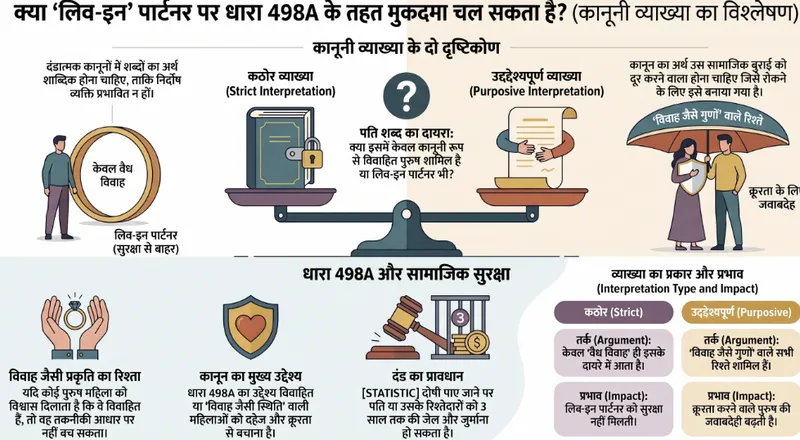
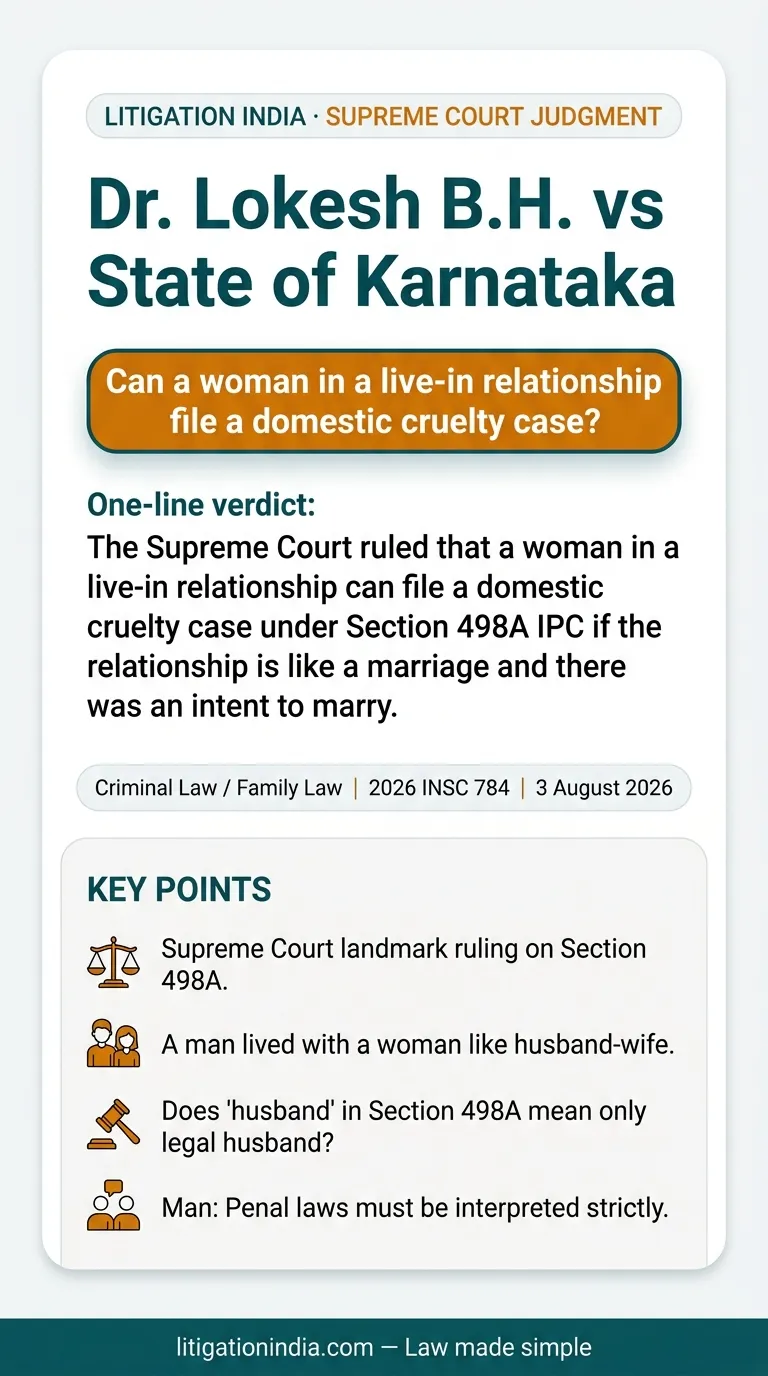
Can a woman in a live-in relationship file a domestic cruelty case?

“The Supreme Court ruled that a woman in a live-in relationship can file a domestic cruelty case under Section 498A IPC if the relationship is like a marriage and there was an intent to marry.”

Story Slides
1 / 7

Cruelty Case in Live-In Relationships

  • Supreme Court landmark ruling on Section 498A.
  • Protects women in serious live-in relationships.
  • Prevents abusers from escaping the law.
Dr. Lokesh B.H. vs State of Karnataka3 August 2026
2 / 7

The Dispute

  • A man lived with a woman like husband-wife.
  • He allegedly hid his first marriage from her.
  • She filed a cruelty case for dowry harassment.
  • He claimed no legal marriage, so no case.
Dr. Lokesh B.H. vs State of Karnataka3 August 2026
3 / 7

The Big Question

  • Does 'husband' in Section 498A mean only legal husband?
  • Can a live-in partner be prosecuted for cruelty?
Dr. Lokesh B.H. vs State of Karnataka3 August 2026
4 / 7

The Conflicting Arguments

  • Man: Penal laws must be interpreted strictly.
  • Woman: Abusers shouldn't exploit technical loopholes.
Dr. Lokesh B.H. vs State of Karnataka3 August 2026
5 / 7

The Court's Decision

  • Law must adapt to changing social realities.
  • Section 498A applies if there is intent to marry.
  • The word 'husband' covers such live-in partners.
  • Case against the partner will not be cancelled.
Dr. Lokesh B.H. vs State of Karnataka3 August 2026
6 / 7

Important Safeguards Imposed

  • Woman must prove initial intent to marry.
  • No automatic or routine police arrests.
  • Arnesh Kumar arrest guidelines must be strictly followed.
Dr. Lokesh B.H. vs State of Karnataka3 August 2026
7 / 7

Why It Matters for You

  • Protects modern relationships from domestic abuse.
  • Balances women's safety with protection from false cases.
Dr. Lokesh B.H. vs State of Karnataka3 August 2026

At a glance (infographic)

Dr. Lokesh B.H. vs State of Karnataka — infographic summary
Download infographic

In short

In this landmark judgment, the Supreme Court addressed whether a man in a live-in relationship can be prosecuted for domestic cruelty under Section 498A of the Indian Penal Code (IPC). A woman had filed a complaint against her partner, alleging he hid his first marriage, lived with her as a husband, and subjected her to cruelty and dowry demands. The man argued that since they were not legally married, Section 498A (which applies to a 'husband' or his relatives) could not be used against him. Disagreeing with this argument, the Supreme Court ruled that a strict, literal interpretation of the word 'husband' would allow wrongdoers to escape punishment simply because the marriage was not legally valid. The Court held that Section 498A protects women in live-in relationships that qualify as 'relationships in the nature of marriage,' provided there was a clear intention to marry. However, to prevent misuse, the Court established strict safeguards. The woman must initially prove the intent to marry, and the police cannot make routine arrests without a proper preliminary inquiry as laid down in the Arnesh Kumar case. Since there were serious allegations of physical abuse and hiding a prior marriage in this case, the Court refused to throw out the criminal proceedings, directing the trial to continue.

Background

A woman filed criminal complaints of cruelty, dowry harassment, and physical abuse against her partner, who lived with her but allegedly hid his earlier marriage. The partner asked the High Court and then the Supreme Court to cancel the case, arguing that because they were never legally married, he could not be prosecuted under Section 498A as a 'husband.'

The Decision

The Supreme Court refused to cancel the criminal case against the man. It held that Section 498A IPC applies to live-in relationships that are like marriages with an intent to marry, meaning the trial against the man must go on.

Why it matters for you

This judgment ensures that men cannot escape criminal liability for abusing their partner simply by claiming they were not legally married. It expands safety nets for women in serious live-in relationships while also putting clear safeguards to prevent false complaints.

Photos
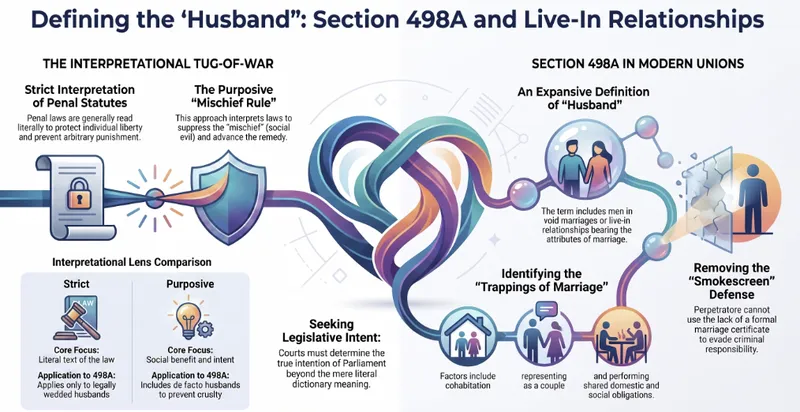
The Supreme Court of India ruled that Section 498A of the IPC applies to live-in relationships that qualify as "relationships in the nature of marriage," provided there is an established intent to marry

AI-assisted summary, reviewed by our editors.

Litigation India

A public-service initiative to make justice understandable for every Indian.

contact@litigationindia.com

+91 9956486585

New Delhi, India

Quick Links

Our Mission

To make every important Supreme Court of India judgment understandable to ordinary citizens in simple English and Hindi, and to connect litigants and junior lawyers with experienced Supreme Court advocates — so that no one suffers injustice merely for lack of correct guidance.

Disclaimer: Summaries are for general public understanding only and are not legal advice. Always consult a qualified lawyer for your specific case.

© 2026 Litigation India. All rights reserved.