Cruise ships qualify for simplified lower tax rates like other passenger shipping businesses
Director of Income Tax vs M/s Star Cruises (India) P. Ltd.
What this case means
This case was about whether luxury cruise ships should pay a higher tax as entertainment businesses or a lower simplified tax as shipping businesses. The Supreme Court decided that offering food and entertainment on a cruise does not stop it from being a shipping transport business. This decision ensures that the tax department cannot use overly strict definitions to deny simplified tax benefits to businesses.
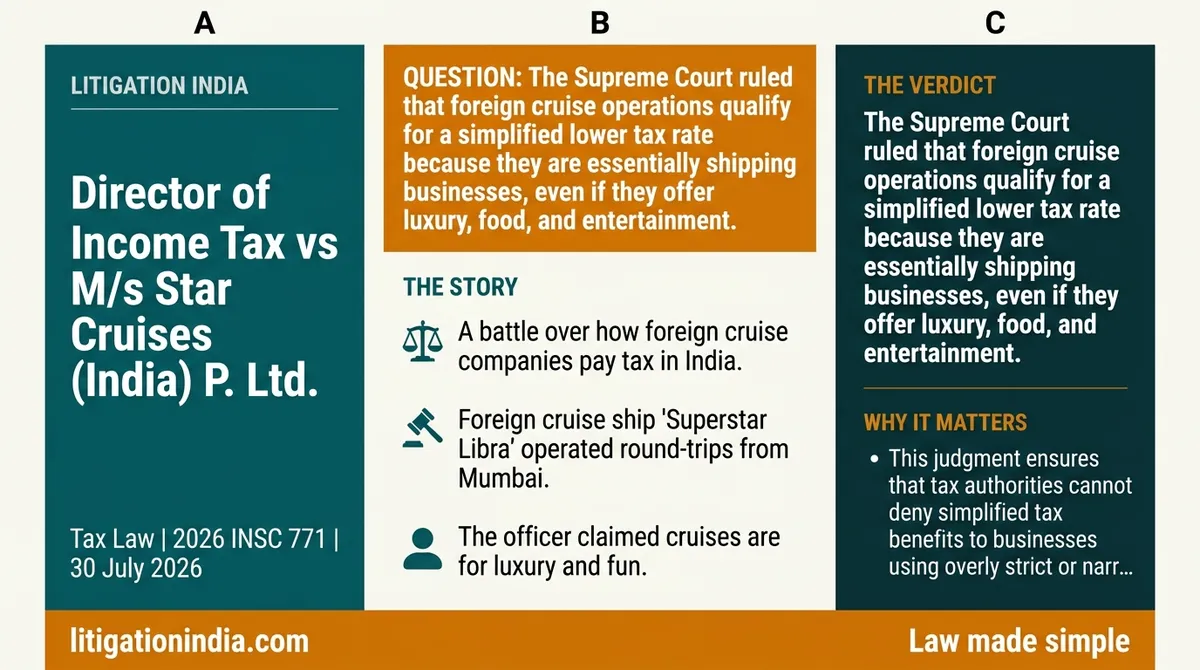
“The Supreme Court ruled that foreign cruise operations qualify for a simplified lower tax rate because they are essentially shipping businesses, even if they offer luxury, food, and entertainment.”
Story Slides
In short
This case decided how tax should be calculated for foreign cruise companies operating in India. A foreign company, Superstar Libra Ltd, ran cruise trips in India through its local agent, Star Cruises (India) Pvt Ltd. The agent argued that since it is a shipping business, its tax should be calculated under a special simplified rule (Section 44B of the Income Tax Act). This rule states that only 7.5% of the total ticket collections will be treated as profit for tax purposes. However, the Income Tax Department argued that a cruise is not just simple passenger transport from one place to another. They claimed it is an entertainment and luxury holiday service, and thus wanted to tax them on a much higher profit estimate of 25%. The Supreme Court rejected the tax department's narrow definition. The Court ruled that offering extra facilities like entertainment, food, or comfortable cabins during a voyage does not change the primary nature of the business, which is carrying passengers by ship. A round-trip journey is still a form of transport. Therefore, the cruise company is entitled to use the simplified 7.5% tax calculation rate. This ruling ensures that tax rules designed to simplify business for foreign shipping companies are applied fairly without being blocked by overly strict interpretations of transport services.
Background
A foreign cruise ship ran round-trips from Mumbai, offering passengers cabins, food, and entertainment. The operator wanted to pay income tax under a simplified tax law meant for shipping companies, but the tax department claimed it was an entertainment business and demanded a much higher tax rate.
The Decision
The Supreme Court dismissed the tax department's appeals, confirming that providing extra services on a voyage does not disqualify a cruise from being classified as a transport and shipping business under the law. The cruise operator was allowed to use the simplified 7.5% tax rate.
Why it matters for you
This judgment ensures that tax authorities cannot deny simplified tax benefits to businesses using overly strict or narrow definitions. It protects international shipping and tourism operators by recognizing that customer hospitality is a normal part of passenger transport.
Relevant Legal Provisions
Key Acts and sections cited or relied upon in this judgment
“This law provides a simplified way of taxing non-resident shipping companies, stating that only 7.5 percent of their total earnings from carrying passengers or cargo is considered taxable profit. The Supreme Court ruled that cruise ships are shipping businesses under this section, meaning they cannot be forced to pay tax on a higher profit estimate.”
“This law defines who can be treated as an agent in India for a foreign taxpayer who does not live in the country. In this case, the court recognized the Indian company as the representative agent for the foreign cruise operator to handle its tax matters.”
“This law outlines what types of income are subject to Indian tax, specifically covering income that is received or earned within India. The case applied this to determine how the earnings from ticket sales for cruise trips starting in Indian ports should be taxed.”
AI-assisted summary, reviewed and verified by our editorial team.
Need help with your case?
Facing a similar legal challenge in the Supreme Court or High Court? Connect with our pro bono volunteer advocates today.
Related Supreme Court services