
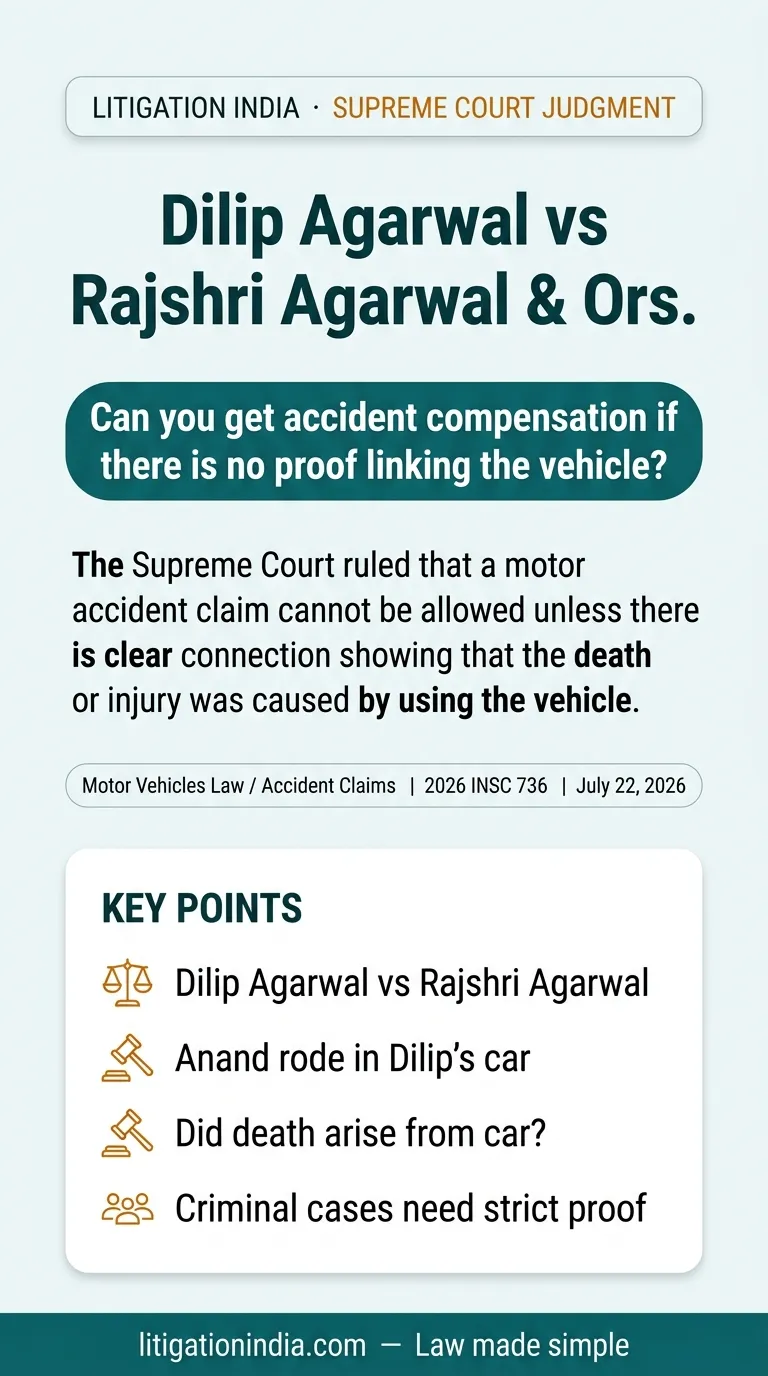
Can you get accident compensation if there is no proof linking the vehicle?
Dilip Agarwal vs Rajshri Agarwal & Ors.
Case: Dilip Agarwal vs Rajshri Agarwal & Ors.Citation: 2026 INSC 736Decided on: July 22, 2026
“The Supreme Court ruled that a motor accident claim cannot be allowed unless there is a clear connection showing that the death or injury was caused by using the vehicle.”
Story Slides
In short
This case deals with whether a family can get accident compensation under the Motor Vehicles Act when a person is murdered, but there is no proof connecting the vehicle to the death. A man named Anand went with his friend Dilip in his car and was found dead three days later. While the High Court acquitted Dilip of the murder charges due to lack of evidence, the accident claims Tribunal and the High Court still ordered Dilip to pay compensation. They assumed the death happened inside the car. The Supreme Court overturned these orders. The Court explained that even though civil cases are decided based on what is 'more likely to have happened' (preponderance of probabilities) rather than proof 'beyond reasonable doubt', there must still be a clear link between the vehicle and the death. In this case, there was no forensic evidence like blood, hair, or skin cells found in the car, nor was there any road accident. Merely because a car was present in the chain of events does not make it a motor accident. Thus, the Court ruled that Dilip and his insurance company are not liable to pay compensation under the Motor Vehicles Act, though any amount already paid to the family will not be taken back.
Need clarity on a similar legal issue?
Request free pro bono guidance from a Supreme Court Advocate.
Background
Anand went with his friend Dilip in a car and was found dead three days later. His family filed a murder case and also claimed accident compensation, alleging that he was killed inside Dilip's car.
The Decision
The Supreme Court set aside the compensation orders because there was no forensic or physical proof linking Dilip's car to Anand's death. However, the Court directed that any money already paid to the family should not be recovered.
Why it matters for you
This judgment clarifies that to claim insurance or compensation under the Motor Vehicles Act, you must prove a direct link between the vehicle's use and the injury. You cannot get compensation based on mere assumptions or guess work without proof.
AI-assisted summary, reviewed and verified by our editorial team.
Need help with your case?
Need help securing compensation under the Motor Vehicles Act? Our accident claims advocates can guide you.
Related Supreme Court services