
Updates

Can administrative delay and change of counsel justify condonation of delay?

Supreme Court condones DDA's 95-day delay in filing consumer revision petition

Case: Delhi Development Authority vs Sudarshan Manjhi & Ors.Citation: 2026 INSC 1254Decided on: November 20, 2026

What this case means

DDA's revision petition against a consumer forum order was dismissed by the National Commission for a 95-day delay after excluding COVID-19 limitation. The Supreme Court set aside those orders, condoning the delay by applying a liberal, justice-oriented approach. It held that cumulative circumstances, not isolated factors, must guide courts in deciding condonation of delay.

“The Supreme Court condoned DDA's 95-day delay in filing a consumer revision petition, holding that cumulative circumstances disclosed sufficient cause and that the matter should be decided on merits.”

Share:

Story Slides

Case at a glance1 / 5

Supreme Court of India

DDA's Consumer Revision Delay Condoned by Supreme Court

Delhi Development Authority vs Sudarshan Manjhi & Ors. | 2026 INSC 1254

Court: Supreme Court of India | Date: November 20, 2026Bench: Justice Vikram Nath and Justice Aparesh Kumar SinghArea of Law: Consumer Law / Limitation / Condonation of Delay95-day residual delay (after COVID-19 exclusion) condoned; revision petition restored to National Commission
Delhi Development Authority vs Sudarshan Manjhi & Ors. · 2026 INSC 1254November 20, 2026
The legal question2 / 5

Was the 95-day delay sufficient cause to dismiss DDA's revision petition?

Core legal question before the Supreme Court

  • Appellant: 95-day delay arose from administrative approval, engaging counsel and procuring certified copy, not deliberate.
  • Appellant: COVID-19 exclusion reduced 512-day delay to 95 days; cumulative circumstances justify condonation.
  • Respondent: DDA failed to act with due diligence; change of counsel and internal procedures are insufficient grounds.
  • Respondent: National Commission and High Court correctly found no sufficient cause for the remaining delay.
Delhi Development Authority vs Sudarshan Manjhi & Ors. · 2026 INSC 1254November 20, 2026
The Court's reasoning3 / 5

How the Supreme Court Reasoned to Condone the Delay

Step-by-step reasoning of the Court

  1. 1Step 1: Apply settled law — 'sufficient cause' must be interpreted liberally to advance substantial justice (Mst. Katiji, 1987).
  2. 2Step 2: Length of delay is not decisive; acceptability of explanation is what matters (N. Balakrishnan, 1998).
  3. 3Step 3: Exclude COVID-19 period (15.03.2020 to 28.02.2022) per Supreme Court's suo motu order; residual delay is only 95 days.
  4. 4Step 4: Examine 95-day delay cumulatively — administrative approval, change of counsel, certified copy procurement — no deliberate intent.
  5. 5Step 5: Conflicting findings of District Forum and State Commission make merits examination necessary; threshold dismissal unjust.
Cumulative circumstances, not isolated factors, must guide courts on delay condonation.
Delhi Development Authority vs Sudarshan Manjhi & Ors. · 2026 INSC 1254November 20, 2026
The verdict4 / 5

Supreme Court's Final Decision

What was decided and what happens next

  • The Fact: DDA filed its revision petition 95 days late (after COVID exclusion); National Commission and High Court refused condonation.
  • The Law: 'Sufficient cause' must be construed liberally; cumulative circumstances disclosed no deliberate delay by DDA.
  • The Result: Appeal allowed; High Court and National Commission orders set aside; revision petition restored for merits hearing.
Delay condoned; Revision Petition No. 1621 of 2022 restored to National Commission for hearing on merits.
Delhi Development Authority vs Sudarshan Manjhi & Ors. · 2026 INSC 1254November 20, 2026
Why it matters5 / 5

What This Means for You

Practical significance of this judgment

  • Courts must assess delay condonation by looking at all circumstances together, not cherry-picking individual weak points.
  • COVID-19 Supreme Court orders excluding limitation periods protect litigants from being penalised for pandemic-era delays.
  • A government body or institution is not automatically barred for delay if administrative processes genuinely caused it.
  • When lower forums disagree on merits, higher courts should prefer hearing the case on facts over dismissing on procedure.
Delay condonation should advance justice, not shut out parties on technicalities when genuine steps were taken.
Delhi Development Authority vs Sudarshan Manjhi & Ors. · 2026 INSC 1254November 20, 2026

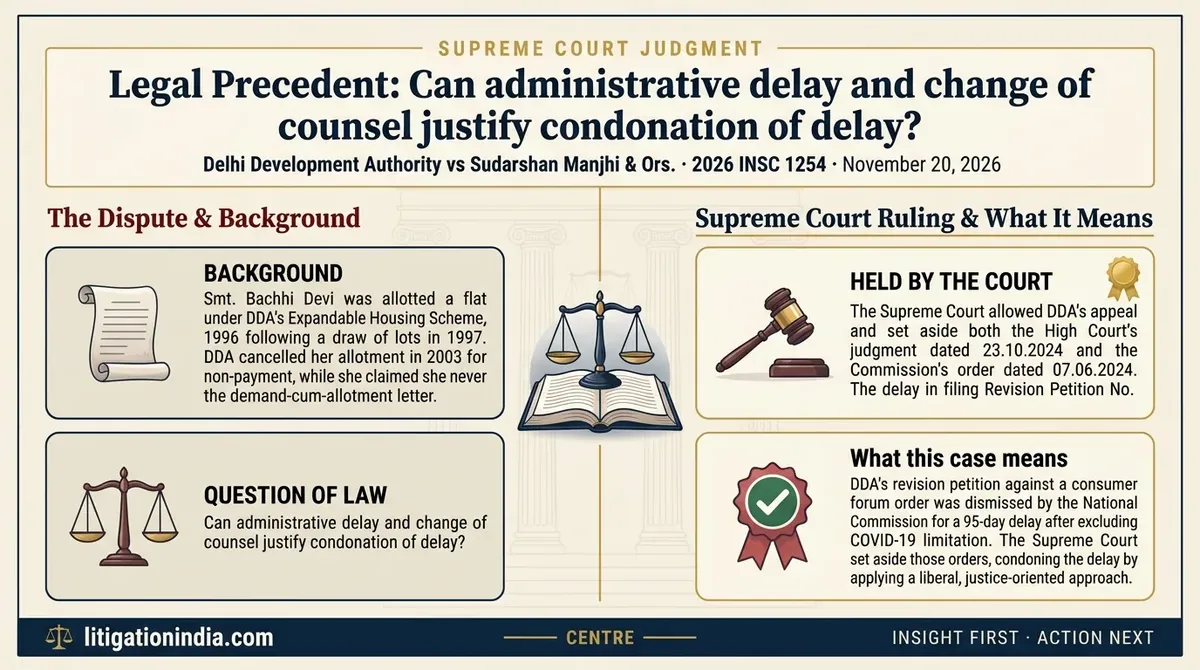
At a glance (infographic)

Delhi Development Authority vs Sudarshan Manjhi & Ors. — infographic summary
Download infographic

In short

This case arose from a dispute between the Delhi Development Authority (DDA) and the legal heirs of Smt. Bachhi Devi, who had been allotted a flat under the Expandable Housing Scheme, 1996. DDA cancelled the allotment in 2003 on account of non-payment, claiming the demand-cum-allotment letter had been duly sent, while the allottee denied having received it. The District Consumer Forum dismissed her complaint in 2015, but the State Consumer Commission reversed the finding in 2021, directing DDA to allot an alternative flat at original rates. DDA filed a revision petition before the National Consumer Disputes Redressal Commission with a delay of 512 days. After excluding the COVID-19 pandemic limitation exclusion period (15.03.2020 to 28.02.2022) as directed by the Supreme Court in In Re: Cognizance for Extension of Limitation, Suo Motu Writ Petition (Civil) No. 3 of 2020, the residual delay was 95 days. DDA attributed this to obtaining administrative approval, engaging panel counsel, and procuring a certified copy. The National Commission refused to condone the delay, finding the explanation insufficient. The High Court of Delhi upheld this decision under Article 227 of the Constitution, holding DDA lacked due diligence. The Supreme Court allowed DDA's appeal, applying the principles from Collector, Land Acquisition, Anantnag v. Mst. Katiji (1987) and N. Balakrishnan v. M. Krishnamurthy (1998). The Court held that the National Commission adopted an unduly restrictive approach and the High Court failed to weigh the cumulative circumstances. Setting aside both orders, the Court condoned the delay, restored the revision petition to the National Commission for consideration on merits, and kept all contentions of the parties open.

Need clarity on a similar legal issue?

Request free pro bono guidance from a Supreme Court Advocate.

Request Guidance

Background

Smt. Bachhi Devi was allotted a flat under DDA's Expandable Housing Scheme, 1996 following a draw of lots in 1997. DDA cancelled her allotment in 2003 for non-payment, while she claimed she never received the demand-cum-allotment letter. After the State Consumer Commission in 2021 directed DDA to allot an alternative flat at original rates, DDA filed a delayed revision petition before the National Commission, which refused to condone the 95-day residual delay (after COVID-19 exclusion) and dismissed the petition.

The Decision

The Supreme Court allowed DDA's appeal and set aside both the High Court's judgment dated 23.10.2024 and the National Commission's order dated 07.06.2024. The delay in filing Revision Petition No. 1621 of 2022 was condoned, and the revision petition was restored to the National Commission for hearing and disposal on merits with an opportunity of hearing to both parties. No opinion was expressed on the merits of the dispute.

Why it matters for you

This judgment reinforces that government bodies should not be shut out from courts merely on technicalities of delay when reasonable steps were taken to pursue the remedy. It reminds tribunals and courts to assess delay condonation with a cumulative, justice-oriented view. For ordinary citizens, it means that when the other side has a genuine explanation, courts must be open to hearing the case on its facts rather than on procedural grounds alone.

Relevant Legal Provisions

Key Acts and sections cited or relied upon in this judgment

“Article 227 grants High Courts supervisory jurisdiction over subordinate courts and tribunals; DDA invoked this article before the High Court to challenge the National Commission's order refusing condonation of delay.”

Full text of the judgment

Text extracted from Delhi Development Authority vs Sudarshan Manjhi & Ors.. For the authoritative version refer to the Supreme Court of India's official website.

2026 INSC 1254 C.A. NO………/2026@SLP(C) NO. 9105 OF 2025 Page 1 of 7

REPORTABLE IN THE SUPREME COURT OF INDIA CIVIL APPELLATE JURISDICTION CIVIL APPEAL NO………………………….OF 2026 (@ SLP (CIVIL) NO.9105 OF 2025)

DELHI DEVELOPMENT AUTHORITY

…APPELLANT(S) VERSUS SUDARSHAN MANJHI & ORS. …RESPONDENT(S)

J U D G M E N T VIKRAM NATH, J.

1. Leave granted. 2. The present appeal arises from the judgment and order dated 23.10.2024 passed by the High Court of Delhi at New Delhi (hereinafter referred to as the “High Court”) in CM(M) No. 3690 of 2024, whereby the High Court dismissed the petition filed by the appellant, Delhi Development Authority (hereinafter referred to as the “DDA”), challenging the order dated 07.06.2024 passed by the National Consumer Disputes Redressal Commission (hereinafter referred to as the “National Commission”) in Revision Petition No. 1621 of 2022. By the said order, the National Commission declined to condone the delay in filing the revision petition against the order dated 09.04.2021 passed by the State Digitally signed by SONIA BHASIN Date: 2026.11.20 16:36:50 IST Reason: Signature Not Verified

C.A. NO………/2026@SLP(C) NO. 9105 OF 2025 Page 2 of 7

Consumer Disputes Redressal Commission, Delhi (hereinafter referred to as the “State Commission”), and consequently dismissed the revision petition on the ground of limitation. 3. The facts giving rise to the present appeal are as follows: 3.1. Smt. Bachhi Devi, the predecessor-in-interest of the respondents, applied for allotment of a residential flat under the Expandable Housing Scheme, 1996, floated by DDA. Pursuant to a draw of lots held on 21.03.1997, she was allotted Flat No. 286, Sector B-4, Pocket 6, Narela, Delhi. DDA thereafter issued a demand-cum-allotment letters dated 12.01.2000 to 20.01.2000, requiring payment of the prescribed amount within the stipulated period. 3.2. According to DDA, the demand-cum-allotment letter was sent to the correspondence address furnished by the allottee, whereas she denied having received it. Upon non-payment, DDA issued a show cause notice dated 09.08.2001 proposing cancellation of the allotment. Despite her representations seeking issuance of a proper demand letter, DDA informed her on 20.10.2003 that the allotment had been cancelled. 3.3. Aggrieved thereby, the allottee instituted Consumer Complaint No. 36 of 2009 before the District Consumer Disputes Redressal Forum-II, New Delhi (hereinafter referred to as the “District Forum”), alleging deficiency

C.A. NO………/2026@SLP(C) NO. 9105 OF 2025 Page 3 of 7

in service. By order dated 11.08.2015, the District Forum dismissed the complaint, holding that the demand-cum-allotment letter had been sent to the correspondence address furnished by the allottee and that the cancellation was justified. 3.4. The allottee challenged the said order before the State Commission in First Appeal No. 462 of 2015. By order dated 09.04.2021, the State Commission allowed the appeal, holding that the demand-cum-allotment letter had not been duly served upon the allottee. Consequently, DDA was directed to allot an alternative flat at the rates prevailing at the time of the original allotment. 3.5. DDA challenged the aforesaid order before the National Commission by filing Revision Petition No. 1621 of 2022 on 02.12.2022, along with an application for condonation of delay. The revision petition was reported to have been filed with a delay of 512 days. DDA sought exclusion of the period covered by the orders of this Court extending limitation during the COVID-19 pandemic and attributed the remaining delay of 95 days to administrative procedures, change of counsel and procurement of the certified copy. 3.6. By order dated 07.06.2024, the National Commission dismissed the application for condonation of delay and consequently the revision petition, holding that DDA

C.A. NO………/2026@SLP(C) NO. 9105 OF 2025 Page 4 of 7

had failed to establish sufficient cause for the remaining delay of 95 days. 3.7. DDA thereafter approached the High Court under Article 227 of the Constitution of India. By the impugned judgment dated 23.10.2024, the High Court dismissed the petition, holding that DDA had failed to act with due diligence and that no ground for interference with the order of the National Commission was made out. 4. Being aggrieved by the impugned judgment, the appellant has preferred the present appeal. 5. The limited question that arises for our consideration is whether the National Commission was justified in declining to condone the delay in filing the revision petition and whether the High Court erred in affirming the said decision. 6. We have heard learned counsel for the parties and have carefully perused the material placed on record. The principles governing condonation of delay are well settled by this Court. In Collector, Land Acquisition, Anantnag and Another v. Mst. Katiji and Others1, this Court held that the expression “sufficient cause” must receive a liberal interpretation so as to advance substantial justice. Similarly, in N. Balakrishnan v. M. Krishnamurthy2, this Court observed that the length of delay is not decisive and

1 (1987) 2 SCC 107 2 (1998) 7 SCC 123

C.A. NO………/2026@SLP(C) NO. 9105 OF 2025 Page 5 of 7

that the acceptability of the explanation furnished is the relevant consideration. The approach must therefore be pragmatic and justice-oriented, while ensuring that the requirement of sufficient cause is not rendered meaningless. 7. In the present case, the National Commission recorded that the revision petition had been filed with a delay of 512 days. However, a substantial part of this period stood excluded pursuant to the orders passed by this Court in In Re: Cognizance for Extension of Limitation, Suo Motu Writ Petition (Civil) No. 3 of 2020, whereby the period from 15.03.2020 to 28.02.2022 was directed to be excluded for computing limitation. The National Commission itself acknowledged the applicability of this exclusion and proceeded to examine the explanation furnished by DDA for the remaining delay of 95 days. 8. The material on record indicates that the delay occurred during the process of obtaining administrative approval, engaging panel counsel and procuring the certified copy of the order sought to be challenged. It is true that DDA ought to have acted with greater diligence and that change of counsel or internal administrative procedures cannot, by themselves, justify every delay. Nevertheless, these circumstances must be considered cumulatively rather than in isolation. The explanation furnished discloses the steps undertaken in pursuing the remedy, and there is

C.A. NO………/2026@SLP(C) NO. 9105 OF 2025 Page 6 of 7

nothing on record to suggest that the delay was deliberate or intended to secure any undue advantage. The fact that the District Forum and the State Commission had arrived at different conclusions also makes it appropriate that the challenge be examined on merits, without expressing any opinion on the correctness of either decision. 9. In our considered view, the National Commission adopted an unduly restrictive approach in assessing the explanation furnished by DDA. The High Court, while affirming that decision, also failed to give sufficient weight to the cumulative circumstances in which the delay had occurred. Having regard to the principles laid down by this Court and the particular facts of the present case, we are satisfied that sufficient cause has been made out for condonation of delay. While we do not approve of the lack of diligence exhibited by DDA, we are of the view that the interests of justice would be better served by permitting the revision petition to be considered on merits rather than terminating the proceedings at the threshold. 10. Accordingly, the appeal is allowed. The impugned judgment and order dated 23.10.2024 passed by the High Court in CM(M) No. 3690 of 2024 and the order dated 07.06.2024 passed by the National Commission in Revision Petition No. 1621 of 2022 are hereby set aside. 11. Consequently, the delay in filing Revision Petition No. 1621 of 2022 stands condoned. The revision petition is

C.A. NO………/2026@SLP(C) NO. 9105 OF 2025 Page 7 of 7

restored to the file of the National Commission for consideration and disposal on merits, in accordance with law, after affording an opportunity of hearing to the parties. It is clarified that we have not expressed any opinion on the merits of the dispute, and all contentions of the parties are left open. 12. Pending applications, if any, stand disposed of.

………………………………………J. [VIKRAM NATH]

………………………………………J. [APARESH KUMAR SINGH] NEW DELHI; NOVEMBER 20, 2026

AI-assisted summary, reviewed and verified by our editorial team.

In the Court's words

“The expression 'sufficient cause' must receive a liberal interpretation so as to advance substantial justice.”
“The length of delay is not decisive and that the acceptability of the explanation furnished is the relevant consideration.”
“The explanation furnished discloses the steps undertaken in pursuing the remedy, and there is nothing on record to suggest that the delay was deliberate or intended to secure any undue advantage.”
“The interests of justice would be better served by permitting the revision petition to be considered on merits rather than terminating the proceedings at the threshold.”

Need help with your case?

Facing a similar legal challenge in the Supreme Court or High Court? Connect with our pro bono volunteer advocates today.

Request Free Callback