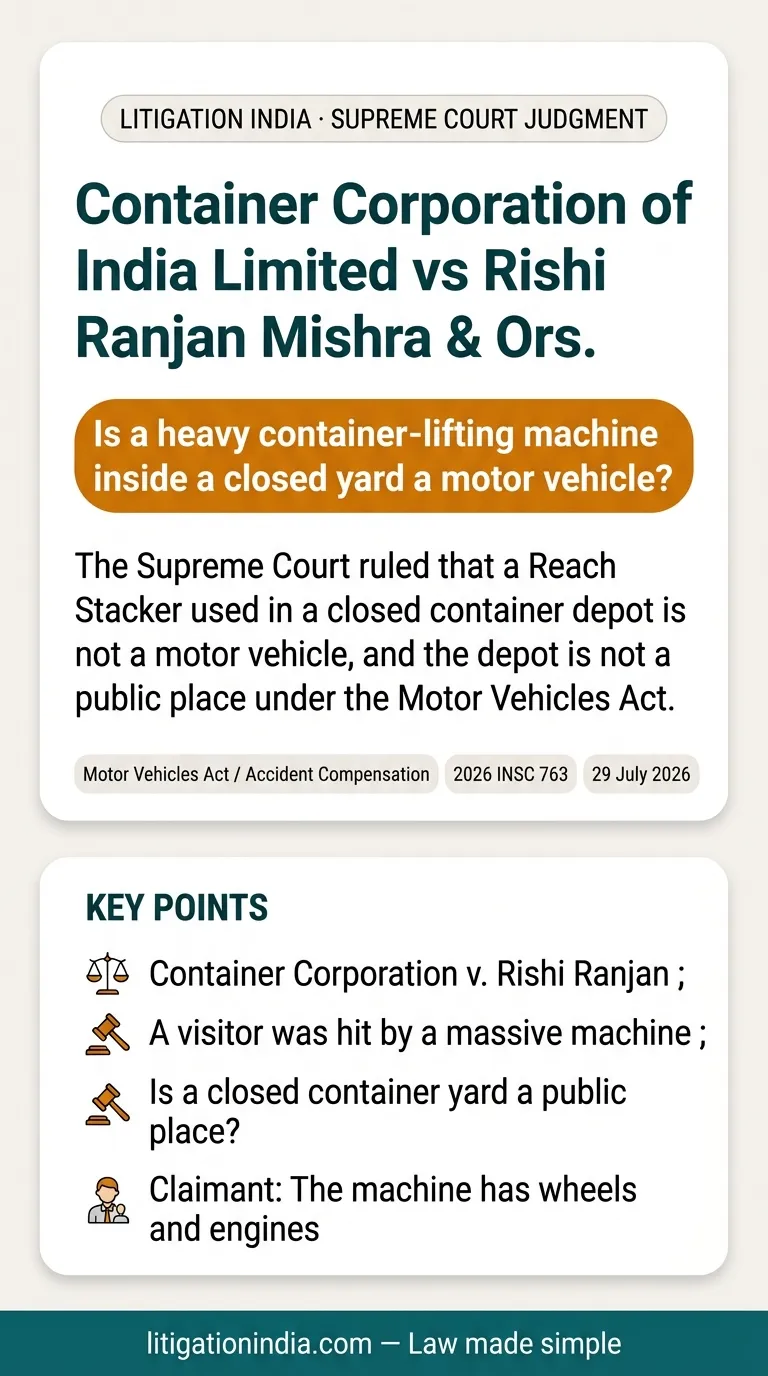
Container Corporation of India Limited vs Rishi Ranjan Mishra & Ors.
The big legal question
Is a heavy container-lifting machine inside a closed yard a motor vehicle?
“The Supreme Court ruled that a Reach Stacker used in a closed container depot is not a motor vehicle, and the depot is not a public place under the Motor Vehicles Act.”
Story Slides
In short
This case arose from a tragic accident at the Tughlakabad Inland Container Depot (ICD) in New Delhi. A visitor, Rishi Ranjan Mishra, was hit by a massive 'Reach Stacker'—a heavy wheeled machine weighing up to 102 tonnes used to lift and stack shipping containers. The accident resulted in the amputation of his right leg. He filed a claim for Rs. 75 lakhs before the Motor Accident Claims Tribunal (MACT). The main dispute was whether a Reach Stacker qualifies as a 'motor vehicle' and whether the secure ICD area is a 'public place' under the Motor Vehicles Act, 1988. The Tribunal dismissed the claim, but the Delhi High Court allowed it. On appeal, the Supreme Court restored the Tribunal's decision. The Court held that the ICD is a highly restricted, custom-bonded area, so its internal roads are not a 'public place' where the general public has a right to enter. Furthermore, the Reach Stacker is an exceptionally heavy, specialized machine designed solely for enclosed industrial spaces. It lacks standard road safety features, exceeds legal road weight limits, and can only be moved on public roads in a dismantled state. Therefore, it falls under the specific exclusion of the law and is not a 'motor vehicle'. However, the Court directed that any compensation already paid to the victim will not be recovered.
Background
A visitor at a secured container depot was run over by a massive container-lifting machine (Reach Stacker), leading to his leg being amputated. He filed an accident compensation claim, sparking a dispute over whether this machine is a motor vehicle and if the depot is a public place.
The Decision
The Supreme Court ruled that the container depot is a restricted customs area, not a public place, and the specialized machine is not a motor vehicle under the law. It dismissed the claim under the Motor Vehicles Act but protected the victim from returning any money already paid to him.
Why it matters for you
This judgment clarifies that highly specialized industrial machinery operating strictly inside restricted, private, or secure government premises cannot be treated as regular motor vehicles for insurance and road-accident claims. Victims of accidents involving such machinery must seek remedies through other civil laws rather than the Motor Vehicles Act.
AI-assisted summary, reviewed and verified by our editorial team.
Need help with your case?
Need help securing compensation under the Motor Vehicles Act? Our accident claims advocates can guide you.
Related Supreme Court services