
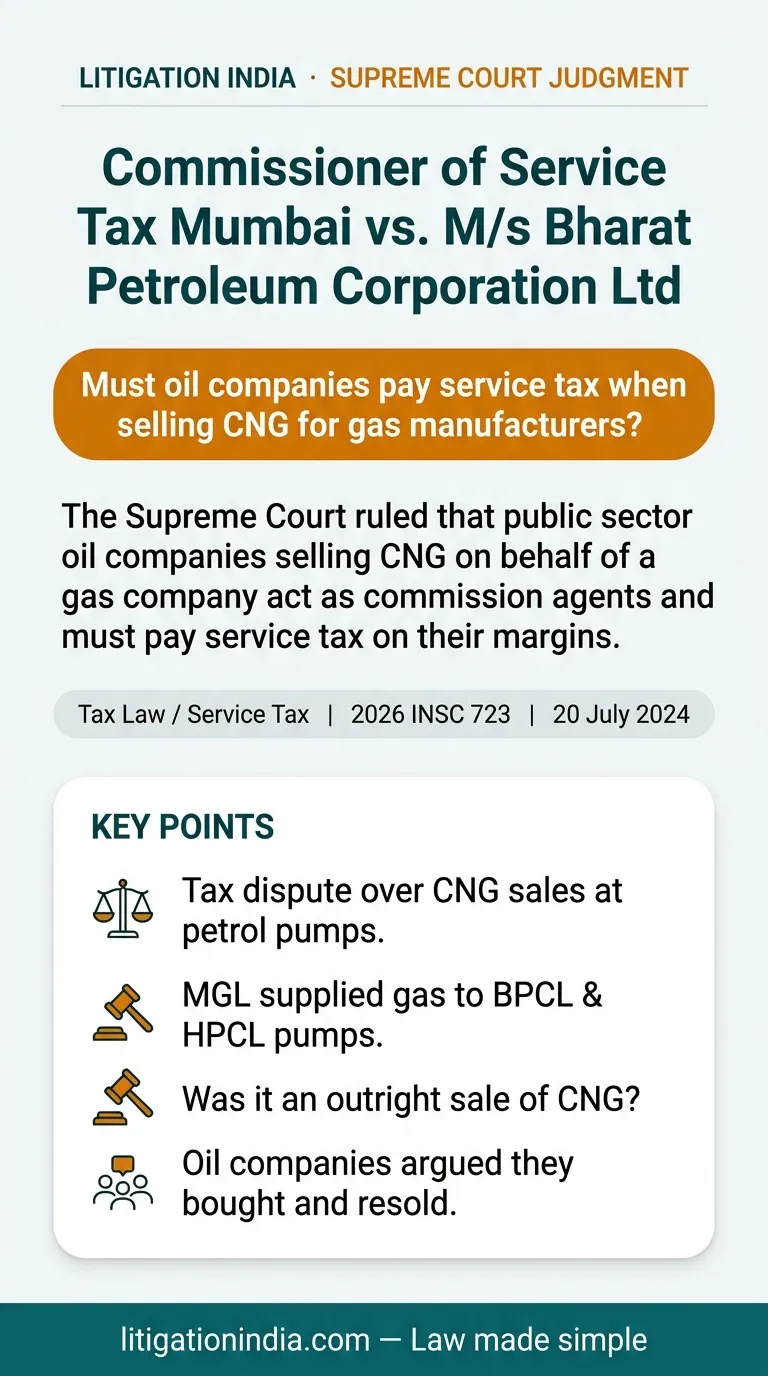
Must oil companies pay service tax when selling CNG for gas manufacturers?
Commissioner of Service Tax Mumbai vs. M/s Bharat Petroleum Corporation Ltd.
Case: Commissioner of Service Tax Mumbai vs. M/s Bharat Petroleum Corporation Ltd.Citation: 2026 INSC 723Decided on: 20 July 2024
“The Supreme Court ruled that public sector oil companies selling CNG on behalf of a gas company act as commission agents and must pay service tax on their margins.”
Story Slides
In short
The Supreme Court of India decided whether public sector oil companies, Bharat Petroleum Corporation Ltd. (BPCL) and Hindustan Petroleum Corporation Ltd. (HPCL), are liable to pay service tax on the margins they earn from selling Compressed Natural Gas (CNG) supplied by Mahanagar Gas Limited (MGL). MGL set up its compression and dispensing equipment at the retail petrol pumps of BPCL and HPCL to sell CNG to vehicle owners. The tax department argued that BPCL and HPCL were providing a 'Business Auxiliary Service' as commission agents for MGL, making them liable to pay service tax. Conversely, the oil companies argued that they were buying CNG from MGL and reselling it to customers on a 'Principal-to-Principal' basis, which is a pure sale of goods and not a taxable service. The Supreme Court analyzed the agreements and ruled in favor of the tax department. The Court held that the transactions did not constitute an outright sale because ownership and risk of the gas never transferred to the oil companies. Upon termination of the contract, all unsold CNG had to be returned to MGL. Furthermore, the oil companies could only sell the CNG at retail prices fixed by MGL and received a fixed commission per kilogram. Thus, they acted as facilitators and commission agents, making their earnings taxable under the Finance Act.
Need clarity on a similar legal issue?
Request free pro bono guidance from a Supreme Court Advocate.
Background
Mahanagar Gas Limited (MGL) supplied natural gas to BPCL and HPCL petrol pumps, where it was compressed and sold as CNG to vehicle owners. The tax department demanded service tax on the profit margins earned by the oil companies, claiming they were acting as agents providing services to MGL.
The Decision
The Supreme Court allowed the tax department's appeals and restored the orders demanding service tax. It held that the oil companies were commission agents providing marketing and facilitation services, not independent buyers of CNG.
Why it matters for you
This judgment clarifies that the real substance of an agreement determines tax liability, not just the labels used by parties. It sets a clear boundary between a genuine 'sale of goods' and an 'agency service' for tax purposes.
AI-assisted summary, reviewed and verified by our editorial team.
Need help with your case?
Facing a similar legal challenge in the Supreme Court or High Court? Connect with our pro bono volunteer advocates today.
Related Supreme Court services