Commissioner of Service Tax, Chennai vs. M/s Diebold Systems (P) Ltd.
The big legal question
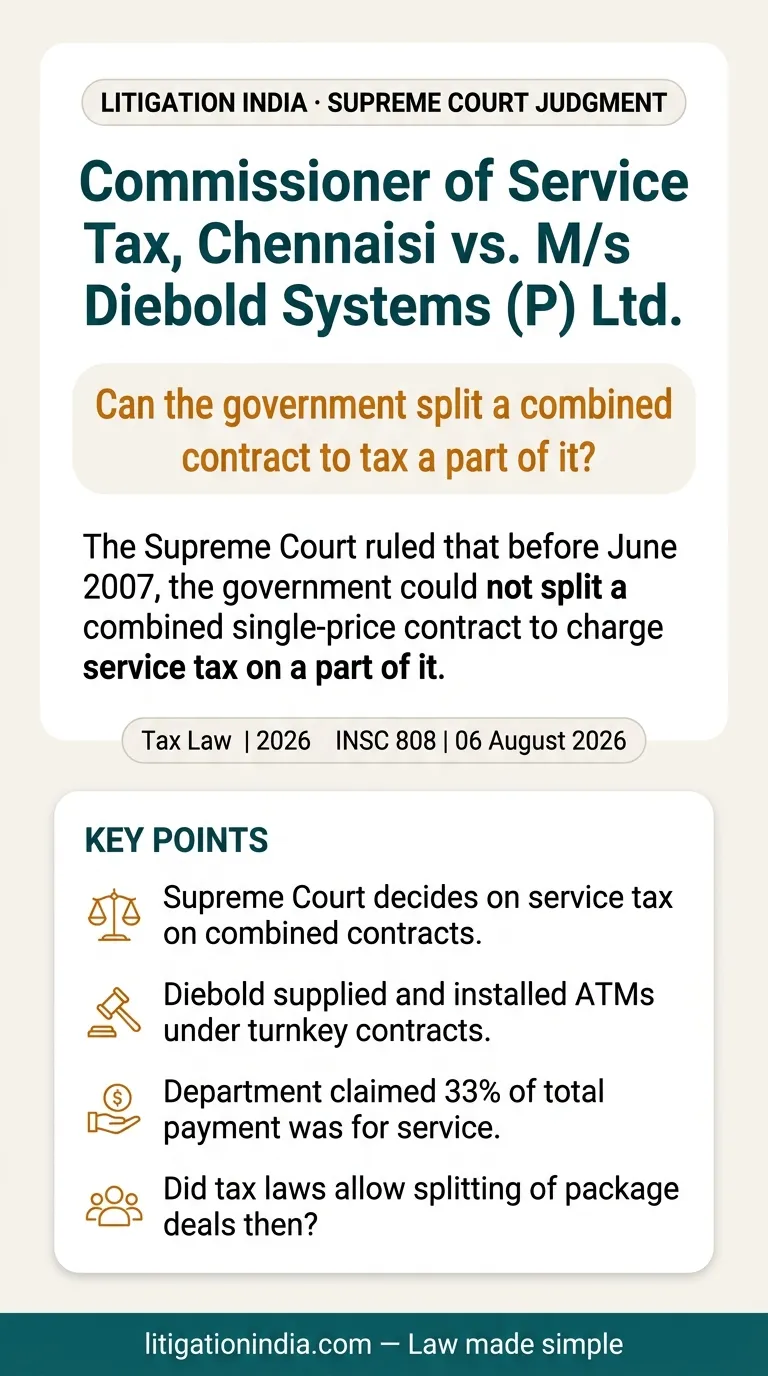
Can the government split a combined contract to tax a part of it?
“The Supreme Court ruled that before June 2007, the government could not split a combined single-price contract to charge service tax on a part of it.”
Story Slides
In short
This case resolves a dispute between the Service Tax Department and a company, Diebold Systems, which supplied and installed Automated Teller Machines (ATMs) for various banks. The company signed 'turnkey' contracts, meaning they charged a single, combined price for both supplying the machines and installing them. The Tax Department tried to tax 33% of this total amount, claiming it represented the value of 'installation services.' The Supreme Court had to decide if the tax department could artificially split a combined, single-price contract to tax the service part of it. The Court noted that during the period of dispute (July 2003 to April 2006), the tax law did not have any rule allowing the government to split such composite contracts. It was only on June 1, 2007, that a new 'works contract' rule was introduced to tax such combined services. The Court held that tax liability must come clearly from the written law. Without specific legal power, the tax department cannot make up a formula (like taxing 33%) to split a combined contract. Therefore, the court ruled in favor of the company and dismissed the government's appeals, confirming that no service tax could be levied on these ATM installation contracts.
Background
Diebold Systems supplied and installed ATMs for banks under single-price combined contracts. The tax department wanted to levy service tax on 33% of the contract value, claiming it was for installation services.
The Decision
The Supreme Court dismissed the tax department's appeals. It ruled that before June 2007, the law did not allow the government to split combined contracts to charge service tax.
Why it matters for you
This judgment protects businesses from arbitrary tax demands. It clarifies that the government cannot invent rules or split single-price packages to tax them unless the written law explicitly allows it.
AI-assisted summary, reviewed and verified by our editorial team.
Need help with your case?
Facing a similar legal challenge in the Supreme Court or High Court? Connect with our pro bono volunteer advocates today.
Related Supreme Court services