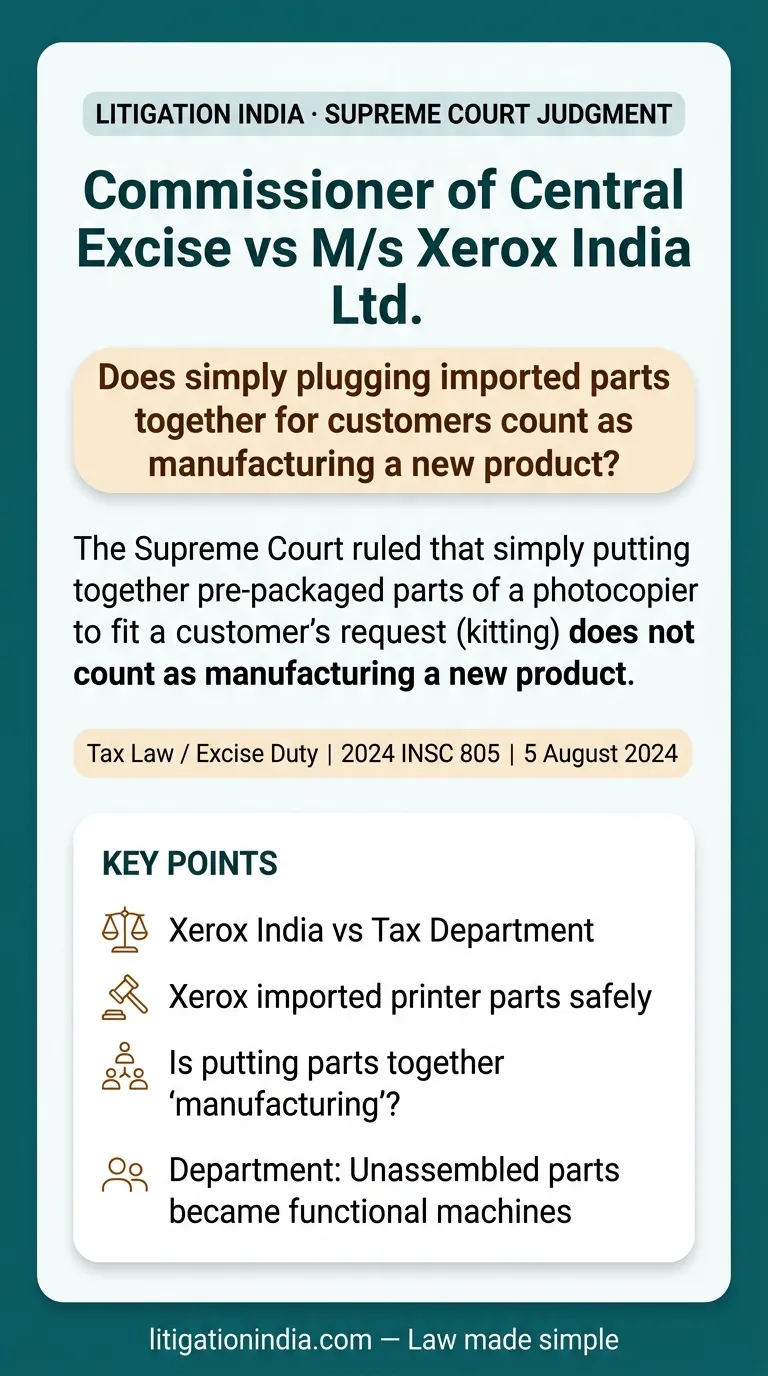
Commissioner of Central Excise vs M/s Xerox India Ltd.
The big legal question
Does simply plugging imported parts together for customers count as manufacturing a new product?
“The Supreme Court ruled that simply putting together pre-packaged parts of a photocopier to fit a customer's request (kitting) does not count as manufacturing a new product.”
Story Slides
In short
This case decides whether putting together imported modules of photocopiers at a warehouse to meet specific customer demands (a process called 'kitting') amounts to 'manufacture' under the Central Excise Act. Xerox India imported photocopier parts in a semi-knocked down or completely knocked down condition. They paid customs duty on them as complete machines. At their warehouses, they simply unpacked, grouped, and pinned these modules together according to what the customer ordered. The Tax Department argued this was 'manufacturing' and demanded over Rs. 17 crore in excise duty. Xerox argued that no new product was created, as the machines were already imported as complete units for ease of transport. The Supreme Court agreed with Xerox and dismissed the government's appeals. The Court explained that for 'manufacture' to happen, a completely new and distinct commercial product must emerge. Simply unpacking, plugging, or pinning parts together does not change the identity of the imported items. The Court also criticized the Tax Department for not physically inspecting the warehouse and for trying to treat the same goods as complete machines for customs duty, but as incomplete parts for excise duty.
Background
Xerox India imported photocopier parts and modules in knocked-down conditions to safely transport them. They paid customs duty on them as complete machines. The Tax Department claimed that assembling these parts at warehouses to match customer orders was 'manufacturing' and demanded excise duty.
The Decision
The Supreme Court dismissed the Tax Department's appeals and ruled in favor of Xerox India. The Court held that simply unpacking and plugging parts together (kitting) does not create a new commercial product and therefore does not attract excise duty.
Why it matters for you
This judgment protects businesses from double and unfair taxation. It clarifies that tax authorities cannot treat goods as complete machines for import duties but as incomplete parts to demand excise duties. It sets a clear limit on what activities legally count as manufacturing.
AI-assisted summary, reviewed and verified by our editorial team.
Need help with your case?
Facing a similar legal challenge in the Supreme Court or High Court? Connect with our pro bono volunteer advocates today.
Related Supreme Court services