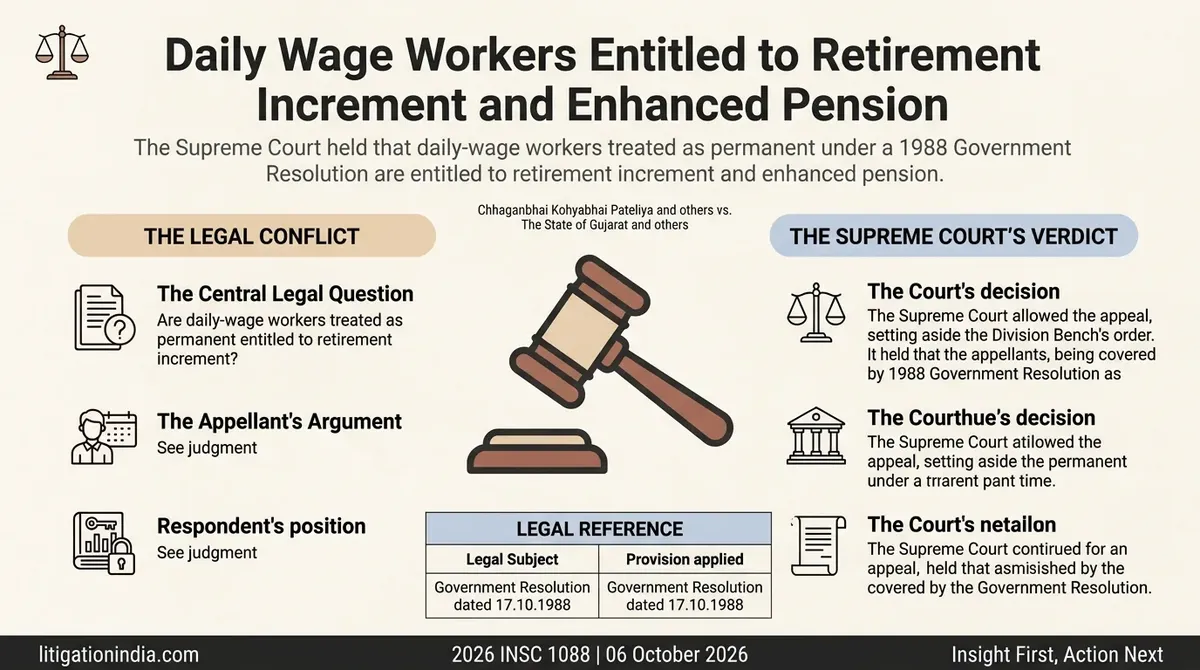
Full text of the judgment
Text extracted from Chhaganbhai Kohyabhai Pateliya and others vs. The State of Gujarat and others. For the authoritative version refer to the Supreme Court of India's official website.
2026 INSC 1088 Reportable IN THE SUPREME COURT OF INDIA CIVIL APPELLATE JURISDICTION
CIVIL APPEAL NO. ........................ OF 2026 (@ SLP (C) NO. 26129 OF 2025)
Chhaganbhai Kohyabhai Pateliya and others
….. Appellants
The State of Gujarat and others
….. Respondents
J U D G M E N T
SANJAY KUMAR, J
1. Leave granted. 2. Successful before a learned Judge of the Gujarat High Court, the appellants met with failure before a Division Bench of that Court, when the appeal filed by the respondents was allowed, vide oral order dated 09.01.2025. Assailing the said order, they are before this Court. 3. The grievance of the appellants before the learned Judge was that they had retired on the 30th of June of various years but were denied the benefit of the increment which fell due on the 1st of July of those years. By order dated 26.09.2023, the learned Judge accepted the appellants’ claim as the issue was no longer res integra in view of the judgment of this Court in Director (Administration and Human Resources), KPTCL, and Digitally signed by Deepak Guglani Date: 2026.10.06 13:28:06 IST Reason: Signature Not Verified
others vs. C.P. Mundinamani and others1, decided on 11.04.2023. However, it was contended by the respondents, the State and its authorities, that the appellants would not be entitled to arrears upon grant of the increment. Thereupon, the learned Judge noted that, in Pravinbhai Khemabhai Patel vs. State of Gujarat2, in a similar situation, a Co-ordinate Bench had directed payment of benefits along with arrears. This decision stood confirmed in appeal by a Division Bench on 07.08.2023. Reference was also made by the learned Judge to other precedents and it was held that, as the right to be paid an increment was the legitimate right of an employee upon successful completion of a year of employment, the contention to the contrary could not be countenanced and the authorities would be required to pay arrears also. 4. However, as the learned Judge was dealing with a batch of cases, involving several employees, appropriate directions were issued for the purpose of verification. The petitioners therein were directed to make applications for grant of the increment, which had accrued in their favour on the day after their retirement, within a timeframe and upon receipt of such applications, the authorities were directed to verify their details and then pay the increment due. The authorities were also directed to revise the pension and disburse other retiral benefits, including consequential
1 (2023) 14 SCC 411 2 Special Civil Application. No. 13489 of 2022, decided on 20.07.2022
benefits and arrears. This exercise was to be completed in a timeframe, failing which the petitioners in those cases were held entitled to interest @ 6% from the date the amount fell due till the date of payment. 5. The order dated 26.09.2023 was subjected to appeal in LPA No. 100 of 2025 by the State and its authorities, insofar as it pertained to Special Civil Application No. 20921 of 2022 filed by Chhaganbhai Kohyabhai Pateliya and 18 others. Strangely, before the Division Bench, a new ground was urged by the State and its authorities. They contended that the respondents in the appeal were daily wagers and were not entitled to claim the benefit of an increment on the basis of the decision of this Court in C.P. Mundinamani (supra). The Division Bench accepted this plea and held, by its oral order dated 09.01.2025, that the respondents in the appeal, being daily wagers, were not entitled to the benefit of an increment, which would be extended to regular employees. The order of the learned Judge holding to the contrary was, accordingly, quashed. The validity of this oral order is called in question before us by Chhaganbhai Kohyabhai Pateliya and 11 others. 6. It is an admitted fact that all the appellants rendered service in the Irrigation Department of the State of Gujarat in excess of 30 years. In this regard, Government Resolution dated 17.10.1988 assumes importance. By the said Resolution, the Government decided to accept the recommendations made by the Committee chaired by the Minister of the
Roads and Buildings Department and resolved to grant pay and facilities to daily-wage skilled workers serving in different departments of the State Government. For the purposes of this case, we may note that one of the reliefs granted under the said Resolution to those daily-wage skilled workers who had completed 10 years of service or more as on 01.10.1988, was that such workers were to be considered permanent. Those workers were to be kept in the running payscale of the cadre concerned and the salary, dearness allowance, house rent allowance and local compensatory allowance were to be paid to them. They were also held entitled to retiral benefits, gratuity, employees provident fund, etc., in terms of the prevalent rules. The age of superannuation for such workers was fixed at 60 years and the time period spent by them in permanent employment was to be considered pensionable. 7. The learned Additional Solicitor General, appearing for the State and its authorities, does not dispute the fact that all the petitioners in the writ petition fell in the aforestated category of daily-wage skilled workers. If that be so, as they were treated as permanent employees for the purpose of payscale and allowances, pension, retirement benefits, etc., the contention advanced before the Division Bench of the High Court that they were not entitled to grant of the increment only on the ground that they were daily wagers cannot be countenanced. This argument seems to have been made, ignoring the Government Resolution dated
17.10.1988 and the benefits that flowed therefrom. In effect, the argument before the Bench that the decision of this Court in C.P. Mundinamani (supra) had no application to them was also without merit. 8. While so, we may note that the ratio laid down in C.P. Mundinamani (supra) was applied by this Court in its later decision in Union of India and another vs. M. Siddaraj3. Miscellaneous applications came to be filed in this appeal, after its disposal, raising certain issues. By interim order dated 06.09.2024 passed in those applications, this Court directed that the judgment dated 11.04.2023 would be given effect to in case of third parties from the date of the judgment, that is, the pension by taking into account one increment would be payable on or after 01.05.2023 and enhanced pension for the period prior to 31.04.2023 would not be paid; for persons who had filed writ petitions and succeeded, the directions given in the said judgment were to operate as res judicata and enhanced pension by taking one increment into account would have to be paid; however, this direction would not apply where the judgment had not attained finality and cases where appeals had been preferred, or if filed, were entertained by the appellate court; and in case any retired employee had filed any application for intervention/impleadment in Civil Appeal No. 3933 of 2023 or any other writ petition and a beneficial order had been
3 Civil Appeal No. 3933 of 2023, decided on 19.05.2023
passed, the enhanced pension by including one increment would be payable from the month in which the application for intervention/ impleadment was filed. 9. Thereafter, on 20.02.2005, this Court disposed of the miscellaneous applications, directing that clauses (a), (b) and (c) of the order dated 06.09.2024 would be treated as final directions. For the purpose of clarity, clauses (a), (b) and (c) are extracted hereunder: ‘(a) The judgment dated 11.04.2023 will be given effect to in case of third parties from the date of the judgment, that is, the pension by taking into account one increment will be payable on and after 01.05.2023. Enhanced pension for the period prior to 31.04.2023 will not be paid. (b) For persons who have filed writ petitions and succeeded, the directions given in the said judgment will operate as res judicata, and accordingly, an enhanced pension by taking one increment would have to be paid. (c) The direction in (b) will not apply, where the judgment has not attained finality, and cases where an appeal has been preferred, or if filed, is entertained by the appellate court.’ However as regards clause (d) thereof, it was observed that it required modification and it was directed to read as under:- (d) In case any retired employee has filed an application for intervention/impleadment/writ petition/original application before the Central Administrative Tribunal/High Courts/this Court, the enhanced pension by including one increment will be payable for the period of three years prior to the month in which the application for intervention/impleadment/writ petition/original application was filed.”
10. Further, it was directed that clause (d) would not apply to a retired Government employee who filed a writ petition/original application or an application for intervention before the Central Administrative Tribunal/High Courts/this Court after the judgment in Union of India and another vs.
M. Siddaraj (supra), as in such cases, clause (a) will apply. It was also directed that in case any excess payment had already been made, including arrears, the amount paid will not be recovered. Therefore, as matters stand, the ratio of C.P. Mundinamani (supra) and M. Siddaraj (supra) would be conditioned by the above order dated 20.02.2025. 11. As it is an admitted fact that the appellants filed their writ petition in the year 2022 itself, they would be covered by the modified clause (d), which provided that enhanced pension, by including one increment, would be payable for the period of 3 years prior to the month in which the writ petition was filed. Therefore, the appellants would be entitled to the benefit of the increment and the pension payable, taking into account the said increment, in terms of the modified clause (d). We may note that the other petitioners in Special Civil Application No. 20921 of 2022, who did not choose to join the appellants in this appeal, were arrayed as proforma respondent Nos. 5 to 11 herein. However, as the benefit of the order dated 20.02.2025 of this Court would be applicable to all who come within the ambit thereof, the benefits of this order shall also be extended to the said proforma respondents. We may, however, note that no interest was granted by this Court in the order dated 20.02.2025 on the arrears payable and this aspect was settled by this Court in its later order in Madhya Pradesh Purv Kshetra Vidyut Vitran Company Ltd. vs. Vidyut Mandal
Pension Samaj and others4, holding that no interest would be payable on the arrears. However, this would make it incumbent upon the authorities concerned to abide by the time stipulations, as per the Court’s/Tribunal’s orders, for disbursing the arrears due and payable. Failure to do so would entail payment of interest from the date of default. 12. As we do not propose to go into the individual fact situation applicable to each of the appellants/proforma respondents, we leave it to the authorities to examine each of their cases in the context of the date of the retirement of each of them; work out the amounts payable to them, in the light of modified clause (d) of the order dated 20.02.2025; and release the amounts due within 30 days from today, failing which interest thereon @ 6% p.a. shall be paid for the period thereafter till the date of payment. The appeal is allowed in the aforestated terms. Pending applications, if any, shall stand disposed of. Parties shall bear their own costs.
..............................., J SANJAY KUMAR
..............................., J. SANJEEV SACHDEVA October 06, 2026 New Delhi.
4 C.A. 15097 of 2025, decided on 19.12.2025