
Are printers used with medical machines classified as medical diagnostic equipment for tax?
Carestream Health India vs. Commissioner of Customs
Case: Carestream Health India vs. Commissioner of CustomsCitation: 2026 INSC 837Decided on: 12 August 2026
“The Supreme Court ruled that imported laser printers used to print medical films are general accessories, not medical diagnostic machines, and must pay higher general customs duty.”
Story Slides
In short
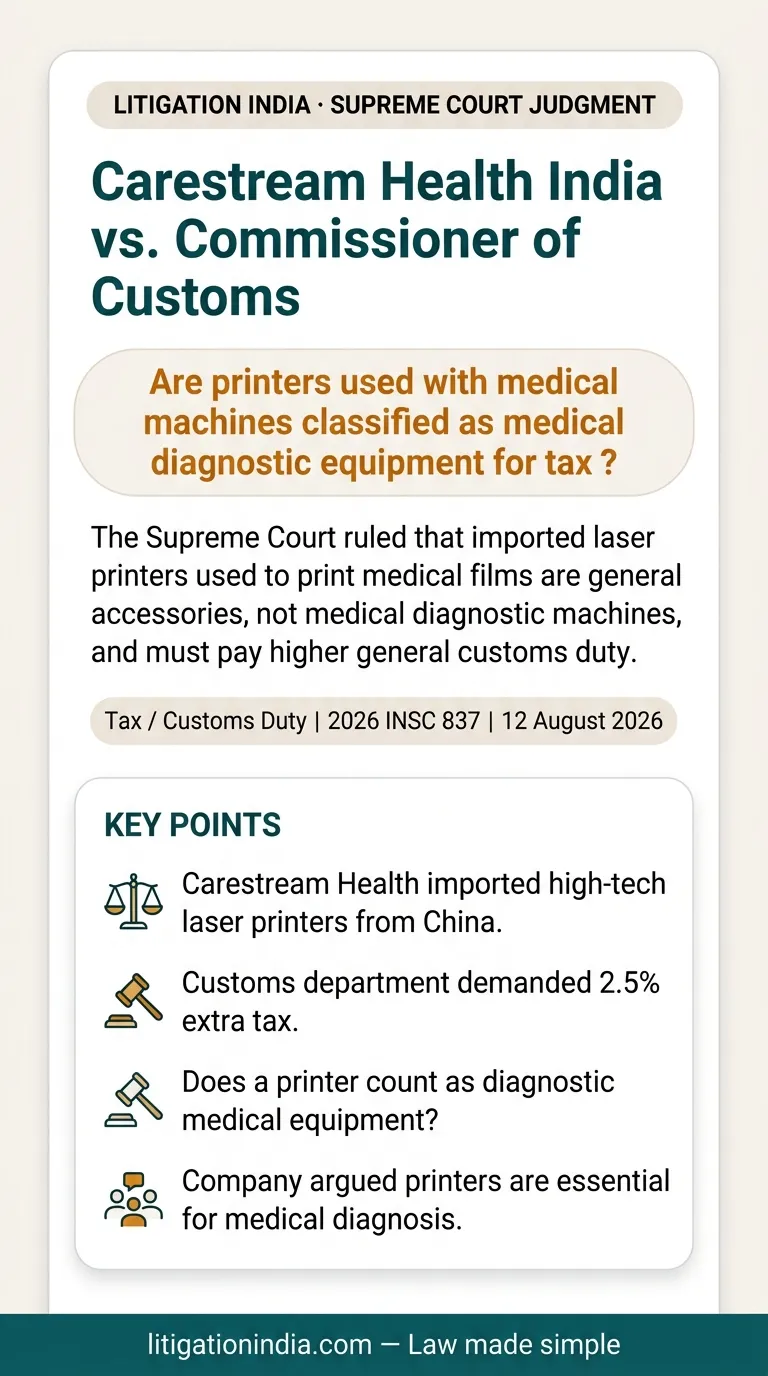
This case is about how imported goods are taxed in India. A company named Carestream Health India imported high-tech laser printers, known as laser imagers, from China. These printers are used in hospitals to print medical images like X-rays and MRI scans onto film. The company argued that these printers should be classified as "diagnostic medical equipment" because they are used alongside medical machines. This classification would allow them to pay a lower customs duty tax. However, the Customs Department argued that these printers do not diagnose any diseases on their own; they simply print data. Furthermore, because these printers can connect to different types of medical machines, like CT scanners and X-ray generators, which are taxed at different rates, they cannot belong to a single medical category. The Supreme Court agreed with the Customs Department. The Court explained that since the printer has no independent diagnostic ability, it is only an accessory. Under the tax rules, if an accessory can be used with multiple machines falling under different tax categories, it must be classified under a general "catch-all" category for parts and accessories, which has a higher tax rate. The Court dismissed the company's appeal, ruling that they must pay the higher tax.
Need clarity on a similar legal issue?
Request free pro bono guidance from a Supreme Court Advocate.
Background
A company imported special laser printers from China to print medical images like X-rays and MRIs. They wanted to pay lower import tax by calling them medical equipment, but the tax department classified them as general accessories with a higher tax rate.
The Decision
The Supreme Court dismissed the company's appeal, holding that printers are not diagnostic tools because they cannot diagnose diseases on their own. Since they work with different kinds of medical machines, they must be taxed under the general accessories category.
Why it matters for you
This judgment clarifies that tax categories for imports depend on what an item actually does by itself, not just what it is connected to. It prevents businesses from claiming lower tax rates on general accessories by linking them to specialized medical machines.
AI-assisted summary, reviewed and verified by our editorial team.
Need help with your case?
Facing a similar legal challenge in the Supreme Court or High Court? Connect with our pro bono volunteer advocates today.
Related Supreme Court services