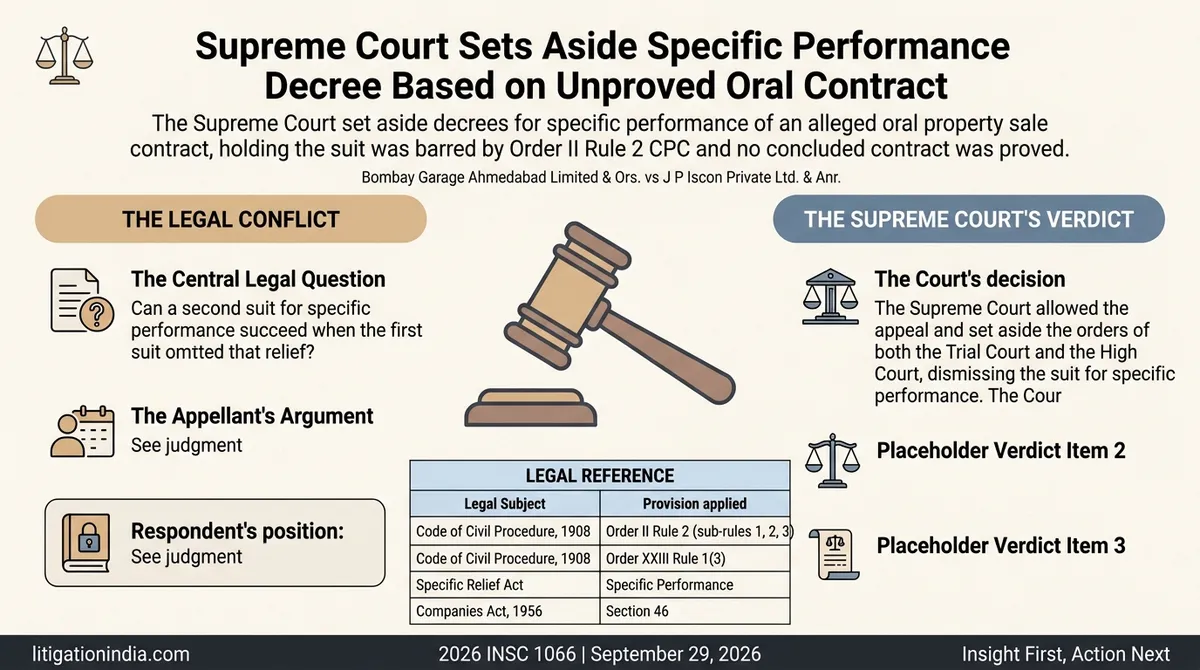
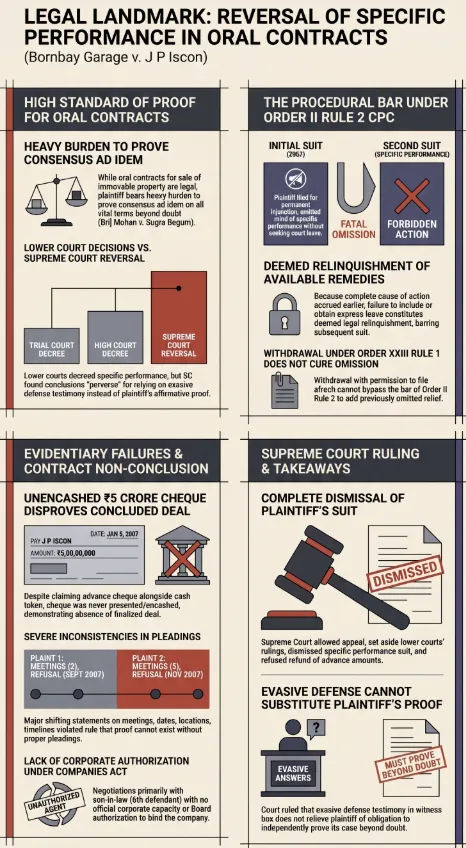
Full text of the judgment
Text extracted from Bombay Garage Ahmedabad Limited & Ors. vs J P Iscon Private Ltd. & Anr.. For the authoritative version refer to the Supreme Court of India's official website.
2026 INSC 1066 Page 1 of 31 CA@SLP(C) No.25909 of 2024 Reportable
IN THE SUPREME COURT OF INDIA CIVIL APPELLATE JURISDICTION
Civil Appeal No………….of 2026 (@Special Leave Petition (C) No.25909 of 2024)
Bombay Garage Ahmedabad Limited & Ors.
…. Appellants
Versus J P Iscon Private Ltd. & Anr.
…. Respondents
J U D G M E N T
K. VINOD CHANDRAN, J.
Leave granted.
2. A suit for specific performance, based on an oral agreement, was decreed concurrently, impugned in the present appeal. That a suit for specific performance can be based on an oral agreement is beyond cavil, as held in Brij Mohan and Ors. v. Smt. Sugra Begum and Ors.1 and K. Nanjappa (Dead) by Legal Representatives v. R.A. Hameed @ Ameersab (Dead) by Legal Representatives and Another2. In fact, what was stated in paragraph 20 of the decision in Brij Mohan1 was reiterated in
1 (1990) 4 SCC 147 2 (2016) 1 SCC 762 Digitally signed by CHANDRESH Date: 2026.09.29 16:33:40 IST Reason: Signature Not Verified
Page 2 of 31 CA@SLP(C) No.25909 of 2024 paragraph 22 of K. Nanjappa2. We extract from paragraph 20 of the former decision, which reads as under: - 20……We agree with the contention of the learned counsel for the appellants to the extent that there is no requirement of law that an agreement or contract of sale of immovable property should only be in writing. However, in a case where the plaintiffs come forward to seek a decree for specific performance of contract of sale of immovable property on the basis of an oral agreement alone, heavy burden lies on the plaintiffs to prove that there was consensus ad idem between the parties for a concluded oral agreement for sale of immovable property. Whether there was such a concluded oral contract or not would be a question of fact to be determined in the facts and circumstances of each individual case. It has to be established by the plaintiffs that vital and fundamental terms for sale of immovable property were concluded between the parties orally and a written agreement if any to be executed subsequently would only be a formal agreement incorporating such terms which had already been settled and concluded in the oral agreement. [emphasis supplied by us]
3. In Brij Mohan1, on facts, as stated in paragraph Nos.21 and 22 it was found that there was no proof of a concluded contract arrived at and there were many lacunae which would commend the Court to find otherwise. In K. Nanjappa2, this Court found the reliance on an agreement written in a quarter sheet of paper, merely for the reason of it having been produced before the
Page 3 of 31 CA@SLP(C) No.25909 of 2024 Magistrate’s Court in a criminal proceeding, to be improper, especially when an earlier agreement referred to therein was not produced. Hence, though reliance could be on an oral agreement, there should be proof beyond doubt of a concluded contract between the parties; strict proof being the norm and a mere inference impermissible. 4. In the present case, however, there were other contentions addressed against the suit, by Mr. Mihir Thakore, learned Senior Counsel appearing for the appellants, on facts and on the maintainability of the suit itself. On maintainability, it is submitted that there was a suit filed for injunction simpliciter earlier, which was withdrawn by the plaintiff, seeking leave to file a fresh suit. Then the fresh suit was filed with a prayer for specific performance, which is deemed to have been relinquished, as per the rigor of Order II Rule 2 of the Code of Civil Procedure, 1908 (CPC). The plaint in the earlier case was on record and was admitted in the plaint filed in the present suit; the subsequent one. The cause of action for a claim of specific performance had arisen at the earlier instance, even as per the pleadings then, which however was not sought for. There was no leave taken at the time of filing of the suit for injunction simpliciter, which would have
Page 4 of 31 CA@SLP(C) No.25909 of 2024 enabled a fresh suit with a prayer for specific performance. The suit hence, has to be found not maintainable as filed at the second instance. 5. Further, on the contract itself, it is argued that there was no concluded contract. The Courts relied only on the oral testimonies of the witnesses wherein there were gross inconsistencies. The very plaint had inconsistent pleadings and amendments were made to the suit filed in 2007, far later in the year 2011. The letter relied on by both the Trial Court, and the High Court does not bring out a concluded contract but merely indicates communication of certain documents. There is a discrepancy insofar as the advance amounts pleaded, which also have not been substantiated. The entire negotiations were alleged to be with the son-in-law of the person-in-charge of the 1st defendantcompany; who had no authorization from the company. Even the 9th respondent, the person-in-charge, who was later impleaded, who is said to have agreed to the sale, is not shown to have an authority to act on behalf of the Company and enter into an agreement for sale of its assets. Section 46 of the Companies Act, 1956 is pressed into service to urge that if the oral agreement is
Page 5 of 31 CA@SLP(C) No.25909 of 2024 proved, it is not with the consent of the Board of Directors of the Company. 6. Mr. Deven Parikh, learned Senior Counsel appearing for the plaintiff-respondents, however, points out that there can be no bar under Order II Rule 2 CPC, ferreted out in this case, on facts. The plaintiff in its pursis filed in the first suit clearly sought liberty to file a fresh suit. Though liberty has not been expressly stated in the order, since the withdrawal has been ordered on the basis of the pursis, liberty has to be inferred. It is not Order II Rule 2 that applies and in the present case what would be significant is Order 23 Rule 1(3). In fact, the second suit was filed immediately, within the limitation period and when the plaintiff could have very well sought an amendment in the first suit, incorporating the relief of specific performance, a fresh suit cannot be barred. 7. Insofar as the facts are concerned, it has been clearly brought out that an amount of Rs.5,11,000/- was paid as advance in cash and Rs.5 crores was paid by way of a cheque. The oral testimony clearly indicates a concluded contract and the defendant No.2 and 9, who mounted the box gave evasive answers and feigned ignorance of many aspects, which itself would enable the Court to draw an adverse inference in favour of
Page 6 of 31 CA@SLP(C) No.25909 of 2024 the plaintiff. Admittedly, the sale price was agreed and on the insistence of the defendants the same was increased, which was also spoken of by the witnesses. The appeal has to be dismissed, is the contention of the learned Senior Counsel. 8. On maintainability, decisions have been placed before us by both parties which have to be looked into, to put the law in the correct perspective. We would first look at a decision of the Constitution Bench of this Court in Gurbux Singh v. Bhooralal3. Therein the plaintiff who was the respondent before this Court, filed a suit for mesne profits, asserting absolute ownership over the property and alleging wrongful possession by the defendant. In the plaint itself, the earlier suit was admitted as filed, along with his mother, wherein a claim had been made against the defendant for recovery of mesne profits for the period ending on 10.02.1950. The defendant disputed the maintainability of the second suit in its written statement. The Constitution Bench, looking at Order II Rule 2(3) of the CPC, succinctly laid down three aspects which are to be proved to non-suit the plaintiff on the basis of an earlier suit, under Order II Rule 2(3); which were :- “(1) that the second suit was in respect of the same cause of action as that on which the previous suit was
3 1964 SCC OnLine SC 101
Page 7 of 31 CA@SLP(C) No.25909 of 2024 based; (2) that in respect of that cause of action the plaintiff was entitled to more than one relief; (3) that being thus entitled to more than one relief the plaintiff, without leave obtained from the Court omitted to sue for the relief for which the second suit had been filed.”
9. It was held that unless there is an identity between the cause of action on which the earlier suit was filed and that on which the claim in the later suit is based, there would be no scope for application of the bar. In the cited decision, the plea raised was held to be of a technical bar, which had to be ‘established satisfactorily and cannot be presumed merely on the basis of inferential reasoning’. It was found that the earlier plaint was not produced in evidence by the defendant. Merely on the admission of the plaintiff in the plaint that the previous suit was filed for mesne profits, which normally can be claimed only from a trespasser in wrongful possession, the plea under Order II Rule 2 cannot be raised to find identity of cause of action. The facts which the plaintiff had alleged to support the right to the relief he claimed were important and hence without looking into the plaint filed in the earlier suit, ‘the defendant cannot invite the Court to speculate or infer by a process of deduction what those facts might be with reference to the reliefs which were then claimed’ (sic para 7), was the finding.
Page 8 of 31 CA@SLP(C) No.25909 of 2024 10. We have to immediately notice that in the present case, the plaint is produced by the plaintiff itself, and it cannot be a proposition that if only the defendant produces it, the Court could look into the same. But before we look into the plaint itself, we would look at the other decisions placed before us. 11. Gurinderpal v. Jagmittar Singh4 was a case in which there was a contract to sell a plot of land, the specific performance of which was declined when the High Court dismissed the suit as barred by Order II Rule 2 of the CPC. The bar was invoked since the plaintiff had filed an earlier suit for permanent injunction, restraining the defendant from alienating the suit property. The first suit was sought to be withdrawn with liberty to file a fresh suit and the withdrawal sought for was allowed. This Court found that though there was no express liberty granted in the order, the suit was dismissed as withdrawn in view of the statement of the plaintiff, which clearly suggests that the plaintiff wanted to file a fresh suit. It was held, ‘obviously the plaintiff wanted to seek a decree of specific performance and not confine it to a mere injunction, which was the reason for the withdrawal’ (sic). With due respect we are afraid this is an inference by the learned
4 (2004) 11 SCC 219
Page 9 of 31 CA@SLP(C) No.25909 of 2024 Judges, impermissible and running contrary to the Constitution Bench decision. Gurinderpal4 being a three Judge Bench, we bow down to the proposition as laid down in the Constitution Bench which was followed in Vurimi Pullarao v. Vemari Vyankata Radharani5. 12. Vimlesh Kumari Kulshrestha v. Sambhajirao and Another6 was in the context of Order XXIII Rule 1 (3) (b). The same has absolutely no application even if we find Order XXIII applicable in the present case. Therein while a suit was pending for specific performance, another suit was filed for the same relief, especially since in the earlier suit an objection was taken by the defendant that proper court fee was not paid. The withdrawal of the earlier suit was sought, specifically on the second suit being filed, which was allowed. The second suit having been filed before withdrawing the first suit, wherein the defendant had taken an objection with respect to the court fees, it was found that Order XXIII Rule 1 was not applicable. 13. Now, we come to the decision of this Court in Cuddalore Powergen Corporation Ltd. v. M/s. Chemplast Cuddalore
5 (2020) 14 SCC 110 6 (2008) 5 SCC 58
Page 10 of 31 CA@SLP(C) No.25909 of 2024 Vinyls Limited and Anr.7 in which this Court (authored by one of us, J.B.Pardiwala, J.) has elaborately dealt with the application of the principles underlining Order II Rule 2, CPC, to the institution of a suit for specific performance when the relief of permanent injunction was sought in a previous suit. We will first refer to the decisions relied on therein. 14. Virgo Industries (Eng.) Private Limited v. Venturetech Solutions Private Limited8 and Vurimi Pullarao5 were cases in which this Court found the bar under Order II Rule 2 having rendered the second suit faulty at its very inception. In Virgo Industries (Eng.) Private Limited8, first, two suits were filed for permanent injunction against alienation of and creation of encumbrance on the suit scheduled properties and later two more suits were filed seeking specific performance, the subject properties being the very same. The foundation for the relief of permanent injunction as sought in the initial two suits, it was held, ‘furnished a complete cause of action to also sue for the relief of specific performance’. Since no leave was sought from the Court to confine the relief to one of permanent injunction, in the earlier
7 2025 INSC 73 8 (2013) 1 SCC 625
Page 11 of 31 CA@SLP(C) No.25909 of 2024 suit, the bar operated under Order II Rule 2 with respect to the two subsequent suits. 15. Therein the defendant after execution of the agreement to sell, returned the advance amounts received, and communicated the inability to honour the agreement since the Central Excise Department was contemplating attachment of the property against revenue demand. This Court found that the averments in the plaint in the first suit alleged that the defendants were merely finding an excuse to cancel the sale agreement to sell it to a third party and the attempt is to frustrate the agreement entered into with the plaintiff. It was held that clearly the plaintiff was entitled to avail the relief of specific performance at the time of filing of the earlier suit itself. 16. Vurimi Pullarao5 also was a case in which the earlier suit for permanent injunction was instituted on a date, after the time for completion of the sale as reserved in the agreement and after notice seeking performance was issued, responded to by the defendant with a stout denial. It was held that on receipt of the response refusing performance; as sought for in the notice, the cause of action for specific performance arose. It was found that there was a complete identity of cause of action between the
Page 12 of 31 CA@SLP(C) No.25909 of 2024 earlier suit for injunction simpliciter and the subsequent one filed for specific performance. The plaintiff being entitled to sue for specific performance at the first instance and having omitted the claim, without leave of the Court; the bar under Order II Rule 2(3) would stand attracted, was the finding, relying on Gurbux Singh3. 17. Inbasagaran v. S. Natarajan9 and Rathnavati v. Kavita Ganashamdas10 were decisions in which the bar under Order II Rule 2 was found to be not applicable. In Inbasagaran9 the defendant was allotted the suit property by the Housing Board on condition of the sale deed being executed, only after a building is constructed. The plaintiff entered into an agreement with the respondent for construction of the building and sale of the property. The building was constructed and on the allegation of an attempt to forcefully take possession of the building, a suit was filed for injunction simpliciter against the defendant. The defendant also filed a suit for permanent injunction, restraining the plaintiff in the other suit from interfering with the possession and enjoyment of the property. It was in the suit for injunction filed by the plaintiff that the execution of a sale deed in favour of the
9 (2015) 11 SCC 12 10 2015) 5 SCC 223
Page 13 of 31 CA@SLP(C) No.25909 of 2024 defendant by the Housing Board was first disclosed; which alone gave rise to a cause of action for seeking the relief of specific performance. This led to the second suit for specific performance which, on facts was found to be maintainable. 18. Likewise, in Rathnavati10 based on an agreement of sale, the plaintiff filed a suit for injunction against defendant No.2 who along with defendant No.1 visited the premises and threatened dispossession. In the injunction suit filed, the 2nd defendant filed a written statement asserting sale of the property to defendant No.1. This led to the second suit filed for specific performance, in which a prayer was added for cancellation of the sale deed also. This Court held that the rigour of Order II Rule 2 was not attracted on facts. 19. Sucha Singh Sodhi (Dead) through LRs v. Baldev Raj Walia11 was a case in which this Court reversed the order of the Trial Court, affirmed by the High Court, dismissing a suit under Order VII Rule 11 of the CPC, relying on Order II Rule 2. The plaintiff entered into an agreement for sale with the 1st defendantowner based on which he was also given possession. Later, before the sale deed was executed, the 1st defendant attempted
11 (2018) 6 SCC 733
Page 14 of 31 CA@SLP(C) No.25909 of 2024 to dispossess the plaintiff by a suit for permanent injunction, in which by a written statement, the 1st defendant asserted that he had sold the property to the 2nd defendant. On noticing such averment, the plaintiff sought withdrawal of the suit for injunction to file a suit for specific performance which was allowed. Order II Rule 2 and the liberty therein were discussed in paragraphs 24 and 25 which are extracted herein along with paragraph 26 which was the exception drawn: - 24. It is clear from the reading of Order 2 Rule 2(1) of the Code that whenever the plaintiff files a suit on the basis of a cause of action pleaded in the plaint, he is under a legal obligation to include and claim all the reliefs against the defendant, which have accrued to him on the cause of action pleaded by him in his plaint. In other words, if on the basis of cause of action pleaded by the plaintiff in the plaint, he is entitled to claim two reliefs, namely, ‘A’ and ‘B’ against the defendant(s), then he is under an obligation to claim both ‘A’ and ‘B’ reliefs together in the suit. Order 2 Rule 2(1) of the Code enables the plaintiff to relinquish any portion of his relief with a view to bring the suit within the jurisdiction of any court. 25. Order 2 Rule 2(2) of the Code, however, provides that where a plaintiff omits to sue or intentionally relinquishes, any portion of his claim/relief in his suit,
Page 15 of 31 CA@SLP(C) No.25909 of 2024 then in such event, he shall not be allowed afterwards to sue in respect of the claim/relief so omitted or/and relinquished by him in his suit. In other words Rule 2(2) does not permit the plaintiff to file second suit to claim the omitted or/and relinquished relief. 26. In our opinion, the sine qua non for invoking Order 2 Rule 2(2) against the plaintiff by the defendant is that the relief which the plaintiff has claimed in the second suit was also available to the plaintiff for being claimed in the previous suit on the causes of action pleaded in the previous suit against the defendant and yet not claimed by the plaintiff.
20. Therein at the time of filing of the suit for permanent injunction, the plaintiff was concerned with his possession, based on the sale agreement and only when the written statement was filed asserting sale to a third party, the plaintiff was confronted with a denial to comply with the terms of the agreement. 21. In Cuddalore Powergen Corporation Ltd.7 the factual scenario was that the 1st respondent entered into a sale agreement with the 2nd respondent and on payment of the entire sale consideration, was put in possession and a power of attorney was executed by the 2nd respondent in favour of the 1st respondent to facilitate the sale; in pursuance of which the sale agreement was got registered. Later, the 2nd respondent issued a letter cancelling
Page 16 of 31 CA@SLP(C) No.25909 of 2024 the power of attorney and returned the amount paid for the property, on a false pretext of return of a loan availed. The 1st respondent’s attempts to get the sale registered were thwarted since the registration authorities failed to accept the same due to a moratorium on sale deed registrations in that village brought in by a Government Order, against which a writ petition was filed. There was also a PIL filed against the G.O. The 1st respondent came to know of a sale deed executed by the 2nd respondent in the name of the appellant. When they together, attempted to interfere with his possession, the 1st respondent filed a suit for injunction and after the G.O was quashed in the PIL, a suit for specific performance was filed; wherein the appellant and the 2nd respondent took a plea under Order II Rule 2. 22. It was found that normally, the revocation of the power of attorney, the return of the entire sale consideration, the knowledge of a sale deed executed to a third party, combined with the lack of response to a notice to bring the agreement to fruition would have been sufficient for the 1st respondent, as a reasonable person, to infer that the 2nd respondent did not intend to perform her part of the contract. But despite these overwhelming facts giving rise to a cause of action, it was found
Page 17 of 31 CA@SLP(C) No.25909 of 2024 that the Trial Court failed to address the key aspect i.e., the relief for specific performance being unavailable to the 1st Respondent by reason of a ban imposed on the registration of sale deeds at Thiyagavalli Village, within which the suit property was situated. The notification issued by the Government of Tamil Nadu imposed an absolute prohibition of conveyance of any properties coming within the two villages to any person other than M/s. Cuddalore Power Company Limited. It was held that though the 1st respondent on the facts disclosed in the first suit was entitled to the relief of specific performance, it was not available to him at that point of time, due to the ban imposed on registration of conveyances. It was held, ‘in such a scenario Courts must give such an interpretation to the principles under Order II Rule 2 that it is not bogged down by technicalities’ (sic-para74). 23. The aforesaid decisions would clearly indicate that the application of Order II Rule 2 would be on facts. We would also extract from the Cuddalore Powergen Corporation Ltd.7 one paragraph which succinctly stated what a cause of action is particularly vis-à-vis Order II Rule 2: - “44. Therefore, the phrase “cause of action” for the purposes of Order II Rule 2 would mean the cause of action which gives an occasion for and forms the
Page 18 of 31 CA@SLP(C) No.25909 of 2024 foundation of the suit. If that cause enables a person to ask for a larger and wider relief than that to which he limits his claim, he cannot be permitted to recover the balance reliefs through independent proceedings afterwards, especially when the leave of the court has not been obtained.”
24. Earlier suit admitted in the plaint and produced along with the documents, is produced in the records as Annexure P19. The suit was filed at Mirazapur and the plaintiff is identical and the defendants, more or less are the same. The cause of action as alleged in the first suit were three meetings, one held at the residence of the plaintiff. Thereafter another, in the presence of the parties and the Solicitor, and then when the price was enhanced and the plaintiff gave a cheque of Rs.5 crores to the defendants on 11.01.2007. Then the revenue and ownership documents of the suit property were provided by letter dated 25.11.2006 and later on 08.05.2007, when the defendant No.1 refused to honour the agreement. The relief sought was only a permanent injunction restraining defendant No.1 and their agents, persons, servants, contractors etc. from alienating the property in any manner or changing the nature of the property and also from constructing on the same. Admittedly, at that point there was a clear refusal and a challenge to the plaintiff that the
Page 19 of 31 CA@SLP(C) No.25909 of 2024 property would be sold for a higher price and that the plaintiff could do whatever they wanted. The claim for specific performance on the contract pleaded was entitled and available at that point of time. Neither was the same claimed in the suit nor was leave sought from the Court at the time of the filing of the suit. 25. Order II Rule 2 reads as under: - ORDER II 2. Suit to include the whole claim. — (1) Every suit shall include the whole of the claim which the plaintiff is entitled to make in respect of the cause of action; but a plaintiff may relinquish and portion of his claim in order to bring the suit within the jurisdiction of any Court.
(2) Relinquishment of part of claim. —Where a plaintiff omits to sue in respect of, or intentionally relinquishes, any portion of his claim, he shall not afterwards sue in respect of the portion so omitted or relinquished.
Sub-rule (3) though couched in the negative enables a person who is entitled to seek more than one relief in respect of the same cause of action, but confines it to one or some of the reliefs; if he does so with the leave of the Court, to sue for the reliefs reserved, subsequently. No leave was sought at the time of filing of the suit and the liberty sought at the time of withdrawal does not cure the defect of leave to be obtained at the time of institution of the suit. The withdrawal pursis is produced as
Page 20 of 31 CA@SLP(C) No.25909 of 2024 Annexure P22 which definitely indicates a prayer to file the suit afresh which though not expressly granted in the order produced along with the suit, definitely it can be inferred. But this does not cure the malady which befell the defendant by his own negligence in not praying for both the reliefs or at least obtaining leave insofar as the relief of specific performance. 26. There is no application of Order XXIII Rule 1(3), since the second suit has been filed adding the relief of specific performance which the plaintiff had omitted in the first suit which on the terms of Order II Rule 2 is deemed to be a relinquishment of that claim. The second suit clearly attracts the bar under Order II Rule 2. Order II Rule 2 applies when a prior suit is filed and withdrawn to file a fresh suit, when in the prior suit the entire reliefs entitled and available to the plaintiff are not sought; in which event, the second suit would be maintainable only if at the time of filing of the suit, the plaintiff had obtained leave of the Court to agitate the reliefs not claimed at the appropriate time. Order XXIII Rule 1(3) applies when a suit has been filed and the plaintiff for whatever reason seeks withdrawal of the same to file a fresh suit when the suit has to be withdrawn with leave of the Court. Leave is granted on the Court’s satisfaction that sufficient
Page 21 of 31 CA@SLP(C) No.25909 of 2024 grounds exist to allow the plaintiff to institute a fresh suit for the subject-matter of a suit or part of the claim and not a new relief. 27. In the present case, obviously there was no leave taken when the first suit was instituted; but the relief of specific performance was entitled and available at that point of time. The suit was withdrawn on the ground of running settlement talks, with demand to file a fresh suit. Order XXIII Rule 3 only enables the plaintiff to file a fresh suit with the prayer for injunction and not with the additional prayer for specific performance. We also take note of the submission of the respondent that the fresh suit was filed when an amendment could have been sought in the first suit; but the fact remains that was not done and hence, is in the teeth of the rigour of Order II Rule 2. 28. For completeness, we will also look at the facts to ascertain whether there is a concluded oral contract. In this context, we first look at the earlier suit filed, which is also on the very same oral contract. There are three meetings asserted along with letter dated 25.11.2006, which is said to have brought about a concluded contract. The pleadings in the plaint and the cause of action asserted are to be read together. The first meeting, with no date specified, was with the 6th respondent and the other
Page 22 of 31 CA@SLP(C) No.25909 of 2024 administrators of the 1st respondent Company, at the end of which Rs.18,51,000/- was fixed as the total consideration, from which Rs.11,000/- was paid as a token advance. Then a meeting was held in the presence of the parties and the Solicitor to ‘prepare the title and the sale deed’ (sic.). A further meeting was held between the plaintiff and the 1st and 9th defendants, in which a higher price was demanded, and it was agreed that Rs.20,50,00,000/- would be paid. A token amount of Rs.5,00,000/- was given in cash and a cheque of Rs.5,00,00,000/- handed over to the defendants on 11.01.2007. Pursuant to which, the 1st defendant by communication dated 25.11.2006 sent the original documents from Bombay to the 9th defendant, so as to hand it over to the plaintiff. On 08.05.2007, when the plaintiff insisted on executing the sale deed, the defendant is said to have responded with a refusal and a challenge to contest it. 29. In the present suit, it was stated that the 1st defendant company and the 6th defendant, under the authority of the administrator of 1st defendant, contracted to sell to the plaintiff their property for Rs.18,51,00,000/-, to which end an advance of Rs.11,000/- was paid. Subsequently, a meeting is said to have been held between the plaintiff and the 1st and 6th defendants,
Page 23 of 31 CA@SLP(C) No.25909 of 2024 where, after deliberations the total consideration was increased to Rs.20,50,00,000/-, with a further payment of Rs.5,000/- in cash and cheque dated 11.01.2007 of Rs.5,00,00,000/- was handed over. Defendant No.1 is the Company and there is no clarity as to who represented the Company in the meeting, when the 6th defendant had no official role in the Company. Paragraph 3(A) & (B) only spoke of two meetings. 30. Subsequently by amendment paragraph 3(b1) was incorporated which speaks of a meeting having occurred in August 2006, at the residence of the person representing the plaintiff company between the 6th & 9th respondents and two persons representing the plaintiffs, where a decision for enhancing the total consideration to Rs.20,50,00,000/- was agreed. The 9th defendant is said to have received Rs.11,000/- in cash from and on behalf of the plaintiff in that meeting, on conclusion of the oral contract. Thereafter on 20.11.2006 in a meeting, cash of Rs.5,00,000/- was accepted by the 9th defendant as also a cheque for Rs. 5,00,00,000/-. Then the communication dated 25.11.2006 transmitted the relevant documents of the subject property. On various occasions, plaintiff has contacted the administrator of the 1st defendant and 6th defendant, who refused
Page 24 of 31 CA@SLP(C) No.25909 of 2024 to abide by the terms agreed between the parties which led to the filing of the suit; the second one. 31. In the plaint filed in the second suit, there is no specific date stated as to the refusal having been communicated by the defendants, contrary to the date specifically mentioned as 08.05.2007 in the earlier suit. The earlier suit was allegedly withdrawn, on grounds of amicable settlement being underway. There is nothing stated as to the settlement talks carried out after the withdrawal of the first suit and a fresh cause of action having arisen by way of a refusal, so as to file the second suit. There are many inconsistencies in the description of how the talks proceeded and it was concluded, not only in the averments in the two plaints, but also discernible from the statements in paragraphs 3(A) & (B) from that made in paragraph 3(1b). 32. We will not resort merely to nit picking to discredit the story set up; but it is these small discrepancies in pleadings that assume massive proportions in a civil suit especially when it is an oral contract that is attempted to be established. Trite is the principle that there can be no proof offered without pleadings. In the first suit, while the three meetings were asserted, in the second suit, initially only two meetings were pleaded. While by an
Page 25 of 31 CA@SLP(C) No.25909 of 2024 amendment, three meetings were spoken of which was again digressed from in paragraph 3(b1) of the second suit. While the evidence is to the effect that the first meeting was held at the official residence of PW2, such a pleading is not seen anywhere in the two plaints filed at different points of time. 33. More importantly, the plaint does not indicate a specific date on which the sale agreement was to be executed after payment of the entire consideration. It is also pertinent that despite a cheque of Rs.5,00,00,000/- having been handed over, there is nothing stated as to its presentation in the bank on which it was drawn. The cheque is alleged to have been dated 05.01.2007 and the first refusal, as per the earlier plaint, was on 08.05.2007, within which period, obviously, the cheque had not been presented. The second plaint also does not indicate the presentation of the cheque, which itself goes against the plea of a concluded contract. The contention itself is that the cheque of Rs.5,00,00,000/- was given as an advance, in addition to Rs.5,11,000/- given as a token advance, in cash. When the cheque of Rs.5,00,00,000/- given as an advance, had not been encashed, it is a clear indication that there is no concluded contract.
Page 26 of 31 CA@SLP(C) No.25909 of 2024 34. Again, the oral contract is attempted to be proved through three witnesses. PW1 who represents the plaintiff company, PW2, one Vajubhai Vala and PW3, Jatin Madanlal Gupta, a Director of the 1st plaintiff company. The oral testimony of PW1, is an interested testimony and without corroboration, there cannot be found sufficient proof. PW2 is projected as a man of considerable repute having been the Minister of the State and later, a Governor in one of the States, in whose presence and at whose residence, the first meeting is said to have taken place. It is pertinent that there is no pleading to that effect and the witness has been introduced without any pleadings. Further, it is the case of the plaintiff that there was no argument reduced to writing since the contract was entered into in the presence of a man of PW2’s stature. Immediately, we have to observe that in the first plaint the clear averment was that the 2nd meeting in the presence of a solicitor was ‘to prepare the title and sale deed’; despite the presence of PW2 was asserted in the first meeting. The written deed or argument was never prepared even according to the plaintiff. 35. Further, PW2’s evidence is to the effect that the contract was concluded in his presence by the 6th defendant who has no
Page 27 of 31 CA@SLP(C) No.25909 of 2024 authority insofar as the 1st defendant company’s assets are concerned. His evidence is also to the effect that the 6th defendant talked to the 9th defendant in his presence who concurred and accepted the contract, over telephone. The said assertion of PW2 is a mere hearsay, since there is nothing to indicate as to how PW2 knew for sure that the person on the other side of the telephone was the 9th defendant. There is also an argument addressed about the ‘evidentiary significance’(sic) of PW2, asserted by the respondents on the ground of his status as the Finance Minister at the time of the first meeting and then at the time of the deposition, as the Governor of the State of Karnataka. The status of the witness has no relevance insofar the oral testimony is concerned, since there is no presumption that a person having some political status would only speak truth before Court. PW2, though stated to be an independent witness, the plaintiff does not plead his presence at the meetings, nor does the pleadings indicate as to why the presence of such a high functionary was required in a land deal. The argument raised by the respondents that no formal agreement was entered into since the contract was entered into in the presence of PW2, is only to be rejected for lack of pleadings and absence of any legal sanctity.
Page 28 of 31 CA@SLP(C) No.25909 of 2024 36. Insofar as PW3 is concerned, he does not have any direct knowledge of what happened and his deposition is to the effect that the meeting conducted thereon and the oral agreement arrived at, was informed to him by PW1, the person representing the 1st plaintiff company. The Trial Court, in fact, relied more on the evasive answers of the 9th defendant and 2nd defendant, who were examined as DW1 and DW2 respectively. However recalcitrant, the conduct of DW1 and DW2 were in the box, that cannot lead to an inference of a concluded contract entered into by the parties, since the proof of the same has to be furnished by the plaintiff and established unequivocally. Merely because the testimony of the defence witnesses were inconsistent or were evasive, would not, as a corollary, lead to a finding in favour of the plaintiff. The defendants, from the very inception, opposed the contract having been entered into and in the box, the defence witnesses feigned ignorance, of the various aspects put to them in cross-examination. We have already found that the plaintiff’s evidence could not prove unequivocally that the claim was established. 37. As far as the letter dated 25.11.2006, it is issued by the 1st defendant company to the 9th defendant, enclosing various
Page 29 of 31 CA@SLP(C) No.25909 of 2024 documents with respect to the property and with a caution that if the documents are passed on to the plaintiff, then copies may be kept in the office of the 9th defendant. The mere transmission of some documents with respect to the property would not lead to a finding of conclusion of a contract. Yet again, the witnesses to that communication were D7 and D8, who were impleaded as defendants, without any relief claimed against them. In fact, the plaintiff should have examined them to prove the contract, if at all it could be and at this point of time, they are said to be no more. The Trial Court also relied on the affidavit filed by the 5th defendant, who was not examined in Court. 38. Significantly, the 6th respondent is said to have been involved in the negotiations and though he is said to have been authorized by the 1st defendant, there is no such authority put forth before Court. Even, the 6th respondent’s affidavit, relied on, does not speak of a concluded contract, since he only spoke of having coordinated between the person who represented the plaintiff and the 9th respondent which, however, did not materialise into a deal, as stated in the affidavit itself. The 6th respondent is the sonin-law of the 9th respondent, married to the 2nd defendant, which does not by that relationship alone give him any authority to deal
Page 30 of 31 CA@SLP(C) No.25909 of 2024 with the assets of the 1st defendant company. The 6th defendant has no official capacity in the Company and can, at best, be a go between in the land deal, who cannot promise or contract with a third party with regard to the assets of the 1st defendant company. If the plaintiff trusted the 6th defendant and went by his promises, based only on his matrimonial relationship, that is to the peril of the plaintiff. 39. We are of the opinion that the plaintiff has failed to establish a concluded contract and the Trial Court, and the First Appellate Court have egregiously erred in granting specific relief, which findings borders on perversity. We are not convinced that the meetings occurred, as pleaded by the plaintiff, and in that circumstance, we are unable to find even the token advance of Rs.5,11,000/- having been paid to the defendants and, hence, there is no question of refund of any advance amounts, especially, since the cheque alleged to have been handed over of Rs.5,00,00,000/-, is not presented to the bank on which it is drawn. We are not dealing with the authority of the 9th respondent to deal with the assets of the Company since it is no longer necessary, the suit having been found to be not maintainable and the contract having failed to be established as a concluded contract. The
Page 31 of 31 CA@SLP(C) No.25909 of 2024 concurrent findings of the Trial Court and the High Court, according to us are perverse. The plaintiff could not establish a concluded contact and emphasis in the impugned judgments, were more on the dishonest and evasive stance of the defendants who mounted the box, which cannot lead to any adverse inference against them. The defendants have stoutly denied the claim of the successive meetings and that of a concluded contract for sale of the land and the plaintiff miserably failed to prove any one of the points urged by them. 40. We allow the appeal and set aside the orders of the Trial Court and the impugned order of the High Court, and as a consequence, dismiss the suit filed for specific performance. The parties shall suffer their respective costs. 41. Pending application(s), if any, shall stand rejected.
.……………………………... J. (J. B. PARDIWALA)
..………….…………………. J. (K. VINOD CHANDRAN)
NEW DELHI; SEPTEMBER 29, 2026.