Bharat Petroleum Corporation Limited vs. The District Revenue Officer (Stamps) & Anr.
The big legal question
Does a property deal need fraudulent intent to trigger stamp duty undervaluation inquiry?
“The Supreme Court referred the question of whether 'fraudulent intent' is necessary to initiate undervaluation proceedings under Section 47-A of the Stamp Act to a larger bench.”
Story Slides
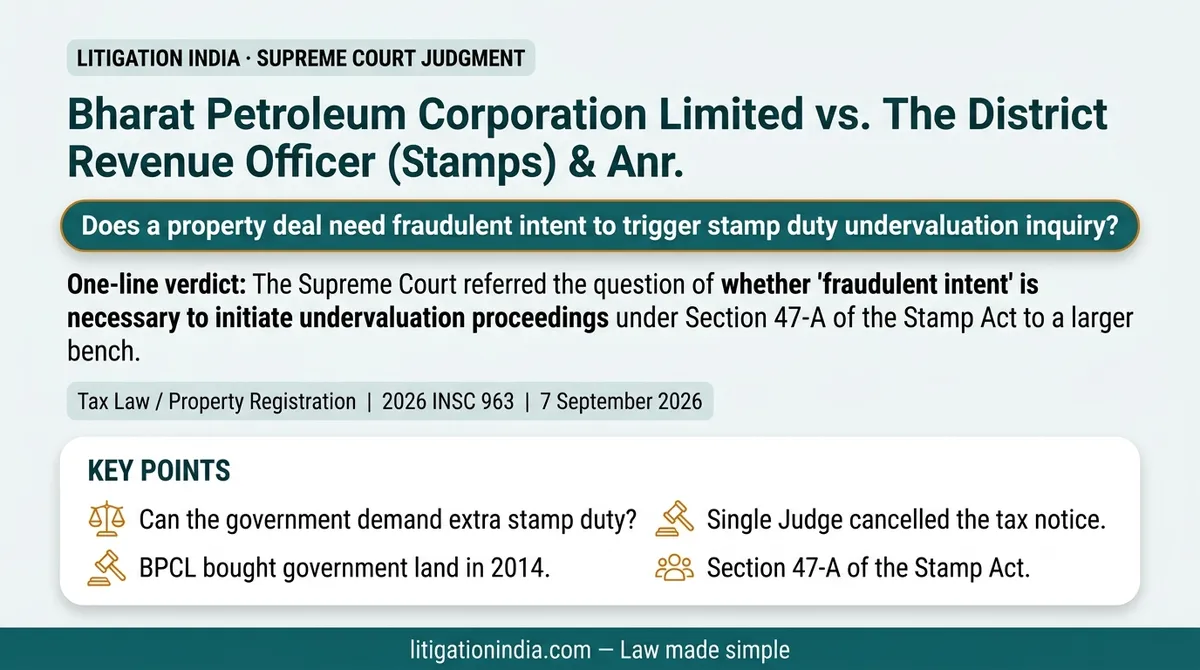
In short
This case addresses a vital question regarding property registration and stamp duty in India. Bharat Petroleum Corporation Limited (BPCL) purchased land from the Government of India for a fixed price and paid stamp duty based on this actual sale value. However, the registering authority paused the registration and referred the matter to the District Revenue Officer under Section 47-A of the Indian Stamp Act, 1899, demanding additional stamp duty because the official guideline value (circle rate) of the area was higher than the actual purchase price. BPCL challenged this show cause notice in the Madras High Court. A Single Judge cancelled the notice, ruling that Section 47-A can only be used if there is a 'fraudulent intent' to hide the real value and evade taxes, relying on a previous Supreme Court decision in V.N. Devadoss. A Division Bench later reversed this, saying BPCL should have first responded to the official notice instead of directly approaching the High Court. When the matter reached the Supreme Court, the two-judge bench expressed strong doubts about the earlier V.N. Devadoss judgment. The judges observed that tax laws must be read strictly by their plain words, and Section 47-A does not mention the word 'fraud' or 'wilful intent.' Requiring proof of fraud makes it extremely difficult for the government to protect its revenue and converts a simple property valuation dispute into a complex, character-damaging investigation. Since the previous ruling was by a larger three-judge bench, the Supreme Court referred the case to a larger bench to officially decide whether a 'culpable mindset' or 'fraudulent intent' is truly a must-have condition for the government to query undervalued property deals.
Background
BPCL purchased government land in 2014 and registered the deed in 2016, paying stamp duty on the actual sale price. The sub-registrar refused to release the registered deed, claiming the property was undervalued compared to the official circle rate, and referred the case for recovery of deficit stamp duty.
The Decision
The Supreme Court doubted the correctness of its own earlier judgment which required 'fraudulent intent' to investigate property undervaluation. Since that earlier decision was by a three-judge bench, the Court referred the issue to a larger bench for a final decision.
Why it matters for you
This judgment will clarify whether ordinary homebuyers can be investigated for paying stamp duty below the circle rate even when they bought the property honestly, or if the government must prove fraud before demanding extra tax.
AI-assisted summary, reviewed and verified by our editorial team.
In the Court's words
“the basis for exercise of power under Section 47-A of the Act is wilful undervaluation of the subject of transfer with fraudulent intention to evade payment of proper stamp duty.”
“On its own terms, Section 47-A does not require the registering authority to issue notice having “reason to believe” of a culpable mindset being the motive behind the transaction”
Need help with your case?
Facing a property, eviction, or landlord-tenant dispute? Consult our property lawyers for a free initial review.
Related Supreme Court services