
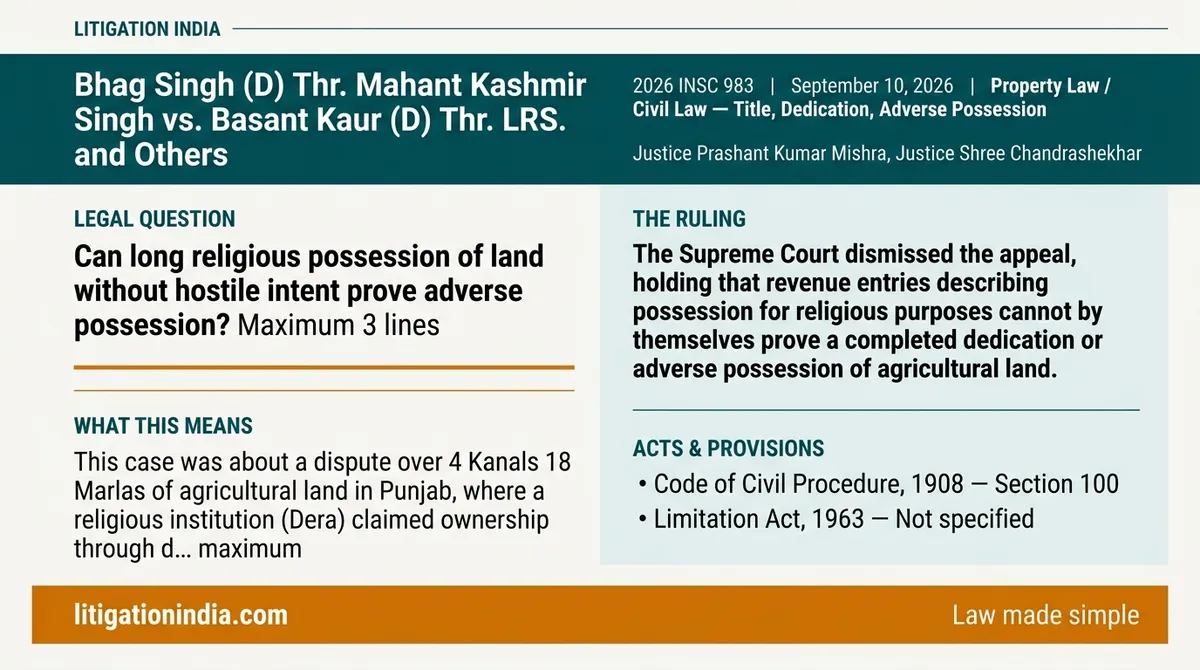
Can long religious possession of land without hostile intent prove adverse possession?
Court upholds plaintiffs' title over land claimed by religious institution through adverse possession
Case: Bhag Singh (D) Thr. Mahant Kashmir Singh vs. Basant Kaur (D) Thr. LRS. and OthersCitation: 2026 INSC 983Decided on: September 10, 2026
What this case means
This case was about a dispute over 4 Kanals 18 Marlas of agricultural land in Punjab, where a religious institution (Dera) claimed ownership through dedication and adverse possession against plaintiffs who held a registered sale deed. The Supreme Court dismissed the appeal, affirming that long possession without proven hostile intent does not amount to adverse possession. The ruling clarifies that revenue entries alone cannot prove title or completed dedication of property to a religious institution.
“The Supreme Court dismissed the appeal, holding that revenue entries describing possession for religious purposes cannot by themselves prove a completed dedication or adverse possession of agricultural land.”
Story Slides
In short
This case arose from a title dispute over 4 Kanals 18 Marlas of agricultural land in Muktsar, Punjab. The plaintiffs claimed ownership through a registered sale deed dated 13 May 1965, while the defendants, representing Dera Bhai Mastan Singh, claimed the property had been irrevocably dedicated for religious purposes (Dharam-Arth) well before that sale, and that successive Mahants had possessed it continuously, thereby perfecting title by adverse possession. The Trial Court and the First Appellate Court both dismissed the plaintiffs' suit, relying primarily on revenue entries describing possession as 'gair marusi bila lagan bawaja Dharam Arth' and concluding that dedication and adverse possession had been established. The High Court reversed these concurrent findings, holding that the revenue entries were insufficient to prove a completed dedication or adverse possession, and decreed the suit in favour of the plaintiffs. The Supreme Court affirmed the High Court's judgment. It held that revenue records are evidence of possession only and cannot by themselves establish title or dedication. The Court further held that the two defences of dedication and adverse possession were internally inconsistent, since adverse possession assumes title initially vested in another party. On adverse possession specifically, the Court found that the appellants had never pleaded or proved the date from which their possession became hostile to the true owners, nor demonstrated any overt act of repudiation. The Court clarified that long, uninterrupted possession without hostile animus cannot constitute adverse possession. The High Court's interference under Section 100 of the CPC was held proper since the lower courts had misapplied settled legal principles rather than merely recording different factual findings. However, the Court also noted that dismissal of the appellants' claim did not automatically validate the respondents' title to the entire property, as the sale deed covered only the vendors' share.
Need clarity on a similar legal issue?
Request free pro bono guidance from a Supreme Court Advocate.
Background
The plaintiffs filed Civil Suit No. 183-A of 1981 claiming title and possession over 4 Kanals 18 Marlas of land in Muktsar, Punjab, relying on a registered sale deed dated 13 May 1965 executed by Gajjan Singh and Baggu Singh. The defendants, representing Dera Bhai Mastan Singh, claimed the property had been dedicated for religious purposes (Dharam-Arth) before the sale, with possession held by successive Mahants, and that the Dera had perfected title by adverse possession. Both the Trial Court and the First Appellate Court dismissed the suit, but the High Court reversed those findings in 2011 and decreed the suit in favour of the plaintiffs.
The Decision
The Supreme Court dismissed the appeal and affirmed the High Court's judgment dated 22 March 2011. It held that the appellants failed to establish either a valid dedication of the suit property to Dera Bhai Mastan Singh or title by adverse possession, as no hostile animus or date of commencement of hostile possession was pleaded or proved. The Court further clarified that the High Court was justified in interfering under Section 100 of the CPC since the lower courts had misapplied settled legal principles, not merely reached a different factual conclusion.
Why it matters for you
This judgment reaffirms that a religious institution cannot claim ownership of private land merely by showing long possession or revenue entries describing religious use, without proving clear hostile intent against the true owner. It also clarifies that a party cannot simultaneously rely on both dedication and adverse possession as these are legally contradictory claims. Ordinary landowners can take comfort that their title through a registered sale deed cannot be defeated by vague claims of religious dedication unsupported by clear evidence.
Relevant Legal Provisions
Key Acts and sections cited or relied upon in this judgment
“This provision governs the jurisdiction of the High Court in second appeals; the Court held that the High Court was justified in interfering with concurrent findings of the lower courts because those findings were based on erroneous application of legal principles on dedication and adverse possession, not merely a reappreciation of facts.”
“This Act prescribes the statutory period for adverse possession to run; the Court held that unless the commencement of hostile possession is pleaded and proved, the statutory period under this Act cannot even begin to run, and the appellants had failed to establish this foundational requirement.”
AI-assisted summary, reviewed and verified by our editorial team.
In the Court's words
“Revenue records, including Jamabandis and Khasra Girdawaris, are undoubtedly relevant pieces of evidence for determining the nature and continuity of possession. They neither create nor extinguish title, nor can they, by themselves, constitute conclusive evidence of ownership.”
“The burden of establishing such dedication squarely rests upon the party asserting it. The Court must be satisfied that the owner had manifested a clear and unequivocal intention to divest himself permanently of ownership and to vest the property in the religious institution.”
“Possession founded upon such an assertion cannot, without more, simultaneously be characterised as hostile possession so as to attract the doctrine of adverse possession.”
“The doctrine of adverse possession does not reward longevity of occupation alone. It protects only such possession as is accompanied by a conscious and hostile assertion of ownership in denial of the rights of the true owner.”
Need help with your case?
Facing a property, eviction, or landlord-tenant dispute? Consult our property lawyers for a free initial review.
Related Supreme Court services