
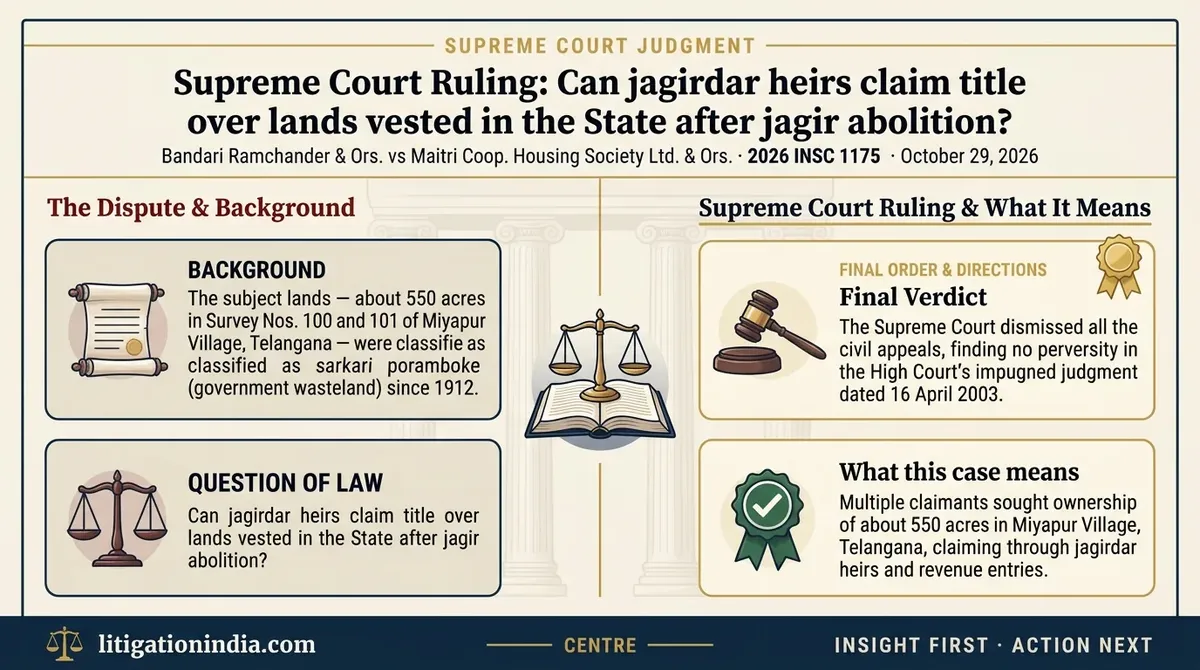
Full text of the judgment
Text extracted from Bandari Ramchander & Ors. vs Maitri Coop. Housing Society Ltd. & Ors.. For the authoritative version refer to the Supreme Court of India's official website.
2026 INSC 1175 Civil Appeal No. 10699/2013 & Connected Matters Page 1 of 44 REPORTABLE IN THE SUPREME COURT OF INDIA CIVIL APPELLATE JURISDICTION CIVIL APPEAL NO. 10699 of 2013
BANDARI RAMCHANDER & ORS.
… APPELLANTS VERSUS MAITRI COOP. HOUSING SOCIETY LTD. & ORS. … RESPONDENTS WITH CIVIL APPEAL NO. 10701/2013 CIVIL APPEAL NO. 10685/2013 CIVIL APPEAL NO. 10700/2013 CIVIL APPEAL NO. 10682/2013 CIVIL APPEAL NO. 10683/2013 CIVIL APPEAL NO. 10684/2013 CIVIL APPEAL NO. 10686/2013 CIVIL APPEAL NO 10698/2013 Digitally signed by SWETA BALODI Date: 2026.10.29 16:43:23 IST Reason: Signature Not Verified
Civil Appeal No. 10699/2013 & Connected Matters Page 2 of 44 CIVIL APPEAL NO. 10681/2013 CIVIL APPEAL NO. 10695/2013 CIVIL APPEAL NO. 10696/2013 CIVIL APPEAL NO. 10697/2013 CIVIL APPEAL NO. 10706/2013 CIVIL APPEAL NOS. 10702-10704/2013 CIVIL APPEAL NO. 10705/2013 CIVIL APPEAL NO.10707/2013 CIVIL APPEAL NO. 10708/2013
J U D G M E N T M. M. Sundresh, J. 1. The appellants before us have challenged the common impugned judgment dated 16.04.2003 passed by the High Court of Andhra Pradesh at Hyderabad in Writ Petition Nos. 889/1998, 1976/1998, 2260/1998, 2267/1998, 4156/2000, 13650/2000, 3062/1998, 6240/1995, 3120/1998 and 8008/1992.
Civil Appeal No. 10699/2013 & Connected Matters Page 3 of 44 2. Before we proceed to deal with the matter, we deem it appropriate to place on record the fact that, on one of the earlier occasions, while hearing the present batch of matters, we had heard all the learned Senior Counsel and the learned counsel appearing for the appellants and the respondents, at length. However, on a request made for making further submissions, we had adjourned the matter. Subsequently, new Senior Counsel have been engaged and arguments were made once again, which we permitted. 3. A strange plea was made on the day of reserving this batch of matters that the matters shall not be proceeded with by this Bench. Though, the only possible entity that could have raised an objection to proceed with determination of the present appeals would be the respondent - State of Telangana, however, such a plea was raised on behalf of one of the appellants. Thereafter, wisdom having dawned upon, the said objection was withdrawn, and arguments have been made, once again, through the newly engaged Senior Counsel. Accordingly, we have elaborately heard the arguments made by the learned Senior Counsel and the learned Counsel appearing for the respective parties and perused the documents, as well as the written submissions.
Civil Appeal No. 10699/2013 & Connected Matters Page 4 of 44 BACKGROUND OF THE PROCEEDINGS 4. The lands involved in the present appeals are situated in Survey Nos. 100 and 101 of Village Miyapur, Serilingamapally Mandal, Ranga Reddy District, Telangana. These properties have their own chequered history. Thus, it is not a surprise that the same position is sought to be extended even before us. 5. It is a peculiar case where multiple individuals and societies claim their title and possession through three different sources, by way of inheritance and various conveyance deeds. The Special Court constituted under the Andhra Pradesh Land Grabbing (Prohibition) Act, 1982 (for short, ‘1982 Act’) in a set of Land Grabbing Cases (for short, ‘LGCs’) bearing LGC Nos. 21 and 22 of 1994, declared the respondents therein as land grabbers of the schedule land in Survey No. 100, of Village Miyapur, Serilingamapally Mandal, Ranga Reddy District, Telangana. In these LGCs, the erstwhile unified State of Andhra Pradesh was not made a party. Another set of land grabbing cases in LGC Nos. 110/1994, 131/1995 and 136/1995 were filed, wherein, the State was duly impleaded as a party. The
Civil Appeal No. 10699/2013 & Connected Matters Page 5 of 44 same were dismissed, holding that the disputed lands were “poramboke lands” and belonged to the State. 6. Aggrieved by the findings rendered by the Special Court, the appellants approached the High Court of Andhra Pradesh in Writ Petition Nos. 889, 1976, 2260, 2267 of 1998 and Writ Petition Nos. 4156 and 13650 of 2000 challenging the judgment dated 31.12.1997 rendered in LGC Nos. 131/1995 and 136/1995. Further, Writ Petition Nos. 3062/1998 and 3120/1998 were preferred challenging the judgment dated 31.12.1997 rendered in LGC No. 110/1994, and Writ Petition No. 6240/1995 was preferred challenging the judgment dated 06.02.1995, rendered in LGC Nos. 21 and 22 of 1994. 7. The Division Bench of the High Court of Andhra Pradesh in the impugned judgment upheld the findings rendered by the Special Court in LGC Nos. 131 and 136 of 1995 and LGC No. 110/1994, and set aside the final judgment in LGC Nos. 21 and 22 of 1994. The applicants and the private respondents therein were declared as land grabbers, and it was held that the title of the disputed lands vested in the State.
Civil Appeal No. 10699/2013 & Connected Matters Page 6 of 44 8. Both the Special Court and High Court have dealt with the issues in extenso, which are sought to be assailed before us. It is apposite to mention that some of the appellant(s) have filed the present appeals, despite not being parties before the Special Court and the High Court. FACTUAL MATRIX 9. The chequered history qua the subject properties, in Survey Nos. 100 and 101 of Miyapur Village, spanning over an extent of 550 acres and 39 guntas, begins from the year 1912 onwards. After completion of the survey of Miyapur Village in the year 1912, an extent of Ac. 277-05 in Survey No. 100 and Ac. 273-34 in Survey No. 101 situated in Miyapur village were duly classified as Sarkari poramboke. The same is reflected in the classer register and Sethwar. 10. The Nizam of Hyderabad constituted a Paigah Commission headed by Justice Reilly to inquire into the settlement of paigah estates and the inter se claims. A Report was submitted by this Commission on 30.04.1927 recommending four villages, including Miyapur village, to be restored in favour of one Rafi-un-nisa Begum, daughter of Kadiri Begum @ Quadri Begum.
Civil Appeal No. 10699/2013 & Connected Matters Page 7 of 44 “REPORT OF THE PAIGAH COMMISSION OF 1345H
INTRODUCTION
xxx Claims of descendants of Rashiduddin Khan's daughter. 42….The case of Rafi-un-nisa Begum is a little different. She claims 4 villages, which are now in the possession of the Sadr-ul-Moham of the Paigahs as part of the Vikar-ul-Umarahi. Paigah. Ex. XLVIII, shows that two of these villages were granted to Kadiri Begum, mother of Rafi-un-nisa Begum, by Fakhruddin Khan in 1278 H., and Ex. XLVIII, that the other two were granted to her by her father, Rashiduddin Khan, in 1297. It is now represented before us for Rafi-un-nisa Begum that, if these 4 villages are restored to her with mesne profits from 1316 H., when she lost possession of them she will not claim any other share of the Paigah property or income. Exs. LXXIV, LXXIV- A and LXXIV-B, however show that the claim of Rafi-un-nisa Begum to these 4 villages was considered by His Exalted Highness in 1333 H., and it was then ordered that her claim to the two villages granted in 1278 H., could not be admitted on the ground that the other two villages, Bahadurpalli and Miyapur, were granted in 1297 H., in their stead. Rafi-un-nisa Begum has submitted to that order till now and has drawn Rs. 200 a month under it in lieu of the income of Bahadurpalli and Miyapur. In our opinion we cannot now reopen her claim to the other two villages. But we recommend that Bahadurpalli and Miyapur be restored to her as their income is considerably more than the Rs. 200 a month which she has been receiving on account of them, though in the circumstances we do not think that she can properly claim any mesne profits on account of these villages….” xxx
(emphasis supplied) 11. Following the aforesaid report, H.E.H. Mir Osman Ali Khan, the VIth Nizam of Hyderabad, issued Firman Isfandar 1338 Fasli for the settlement of paighas. As a result, the jagirs given to the heirs of the daughters of Rashid-ud-Din Khan, including Rafi-un-nisa Begum, shall be given to
Civil Appeal No. 10699/2013 & Connected Matters Page 8 of 44 their present heirs. It would be pertinent to observe that the Reilly Commission noted that the village Miyapur was part of the jagir granted to Rafi-un-nisa Begum by her father Rashid-ud-Din Khan. “Extra Ordinary Gazette Vol. 60 Hyderabad – 15th Isfandar 1338 F., Corresponding to 5th Shaban 1347 H., Thursday No. 2
ORDER II-Co-SHARES OF THE PAIGAH AND THEIR SHARES
(5) The heirs of the daughters of Rashi-ud-Din Khan Shams-ul-Umra IV (i.e., the sisters of Khurshid Jah) are at present Bahadur Dil Jung, Qutb-un-Nisa Begum and Rafi-un-Nisa Begum. They will not be given any share from the Paigah income, but the Jagirs given away to the said sisters by their father and grandfather, should be given to the present heirs with Wasilat or mesne profits.” xxx
xxx 12. The firman issued in 1929 had its own strings attached in the form of certain conditions, which were to the effect that the immovable properties of the paigahs shall not be sold, mortgaged or gifted without the sanction of the Nizam. “Extra Ordinary Gazette Vol. 60 Hyderabad – 15th Isfandar 1338 F., Corresponding to 5th Shaban 1347 H., Thursday No. 2
For the preservation of the Paigah Estates and perpetuation of the Paigah family, the following general orders are also issued:-
Civil Appeal No. 10699/2013 & Connected Matters Page 9 of 44 1. The division of the Jagirs and immovable property of the Paigah into three portions as pr awards of Salar Jung I and Mr. Ridsdale, regarding which no one at present has any objection, will continue as at present; and in accordance with my Firman dated the 10th Rajjab 1337 Hijri, the Jagirs of the three Paigahs, and also the immovable properties connected therewith, shall not be further divided either now or in future, nor shall their sale or purchase, mortgage or gift be ever effected without my sanction. The annual income of the said Jagirs and estates will however be divisible in such a manner as is detailed in the accompanying orders.
2. In accordance with the opinion of the Egerton Commission what ever property has hitherto been acquired, or article purchased or building constructed out of the income of the Paigahs, will be considered the property of the Paigahs and not that of any individual, and it will not be liable to division like an inheritance.
4. If at any time the Government of Hyderabad should abolish the Paigah forces, along with other Jagir forces, and levy cash contribution in lieu thereof, the Sarf-I-Khans shall, in accordance with the finding of the Reilly Commission, be entitled to a third part of that compensation. This right and title of the Sarf-I-Khans is reserved.”
(emphasis supplied) 13. Twenty years down the line, the Andhra Pradesh (Telangana Area) (Abolition of Jagirs) Regulation 1358-Fasli (for short, “A.P. Abolition of Jagirs Regulation”) was introduced with effect from 15.08.1949, abolishing all the jagirs. Consequently, a notification was issued on 07.09.1949 transferring the jagirs, including those where the subject properties are situated, to the administration of the State of Hyderabad with
Civil Appeal No. 10699/2013 & Connected Matters Page 10 of 44 effect from 15.09.1949. Subsequently, the Hyderabad Atiyat Inquiries Act, 1952 (for short, the ‘Atiyat Inquiries Act’) was also enacted with an object to amend and consolidate the laws pertaining to Atiyat grants in respect of Atiyat inquiries, with respect to the claims of succession to any right, title or interest therein. 14. When the matter stood crystallised, as mentioned above, a strange occurrence happened. In the pahanies of the years 1950-51, 1951-52 and 1952-53, the name of one ‘Raheemunissa Begum’, without referring to her husband’s name, was found to be inserted as pattedar in Column No. 14. This was done despite the entry in Column No. 11 as Poramboke and Sarkari in Column No. 12.
15. The story did not end there. In 1955, under the proceedings initiated as per the Atiyat Inquiries Act, Nawab Mohammad Khaisaruddin Khan, son of one Rafi-un-nisa Begum, had applied for the grant of Muntakhab/Muntakhib for four paigah villages, including Miyapur village, that were settled in favour of the heirs of Rafi-un-nisa Begum under Firman Isfandar 1338 Fasli.
Civil Appeal No. 10699/2013 & Connected Matters Page 11 of 44 16. During the pendency of the said proceedings, the Jagir Administrator, Hyderabad, under the Andhra Pradesh Telangana Area (Jagir Commutation) Rules, 1950 (for short, ‘A.P. Jagirs Commutation Rules’), issued a provisional and revised commutation award to Nawab Mohammad Khaisaruddin Khan, son of Rafi-un-nisa Begum, on 08.05.1957 and 08.04.1958, respectively.
Office of the Jagir Administrator Government of Andhra Pradesh, Hyderabad Deccan
REVISED COMMUTATION AWARD (Provisional)
NAME OF THE JAGIRDAR
Qaisaruddin Khan
NAME OF THE JAGIR
Kesarjawlga etc. (4 villages)
Tq. Bhalki & Tq. West, Dists. Bidir & Hyderabad (Mixed regions)
KHATA NO. 505
VERIFICATION SLIP No. (1495/R) DATE 14-3-1958
In exercise of the power conferred by section 5 of the Hyderabad Jagirs (Commutation) Regulation of 1359 F, the commutation sum in respect of the above Jagir is determined provisionally as Rs. 1,20,303-12-5 as under:
C) Commutation Sum
Rs. 1,20,303-19-5
Civil Appeal No. 10699/2013 & Connected Matters Page 12 of 44
There is neither Hissedar nor any Guzaredar in this jagir. The entire commutation sum of Rs. 1,20,303-19-5 is payable to the jagirdar as under:
NB:- This cancels the award No. 1419 dated 08.05.1957
Sd/- Supdt.
Examiner of A/cs Jagir Administrator
No. 1419/R-635 Dt. 8.4.58
(emphasis supplied)
17. Without any reference to the aforesaid proceedings, the Tahsildar granted permission under Sections 47 and 48 of the Hyderabad Tenancy and Agricultural Land Act, 1950 (for short, ‘Hyderabad Tenancy Act’) to one Raheemunnisa Begum, wife of Abdul Salam, to alienate 140 acres of land in Survey No. 100 of Miyapur Village, on strength of the entry of her name in the pahanies of 1950-53. 18. Coming back to the Muntakhab/Muntakhib proceedings initiated by the Nawab Mohammad Khaisaruddin Khan before the Nazim Atiyat, an order was passed on 28.10.1968, issuing Muntakhib to Nawab Mohammad Khaisaruddin Khan, granting him the Muntakhib for two villages.
Civil Appeal No. 10699/2013 & Connected Matters Page 13 of 44 xxx
xxx “….From the succession statement of Rafiunnisa Begum prepared by the Board of Trust, Paigah Sir Vicarul Umra, it is evident that the four Villages of Kaiser-Jawalga, Wakulgaon, Mianpur and Bahadurpalli belonging to Rafiunnisa Begum were confirmed in the name of her son Kaisaruddin Khan with the clarification that the status of Kaiseruddin Khan over these Villages would be the same as that of Rafiunnisa Begum. This succession was sanctioned through Firman Mubarak dated 10th Ramzan 1368 H.
“Out of the four Villages claimed by the Petitioner Mianpur and Bahadurpalli are neither found in the claim of the Paigah nor are they included in the list of Subgrants made by the Paigah, and as such these Villages cannot be confirmed as sub-grants. The claim for two plan Maqtas Madinaguda and Mahboobpet also falls as they are under the Village Mianpur”.”
19. Aggrieved, an appeal was preferred by Nawab Mohammad Khaisaruddin Khan before the Board of Revenue, which came to be allowed on 29.12.1976 and Muntakhib was granted for four villages, including Miyapur village. “Judgement in File No. NA2/78/1969 of Board of Revenue, dated 29.12.1976
ORDER: Arguments of the appellant and Asst. Govt. Pleaders were heard. It is argued by the Advocate for the appellant that the Reilly Commission recommended confirmation of all the four Villages in Para 42 of its report, that the Firman of HEH, dt. 15-4-1338 F. confirmed this recommendation (Order III Para 5) and that the Nazim Atiyat has erred in confirming only two Villages leaving out the other two. The record shows that the Nazim Atiyat had not confirmed the 2 Villages on the ground that the Paigah had not included them in its claim. The Firman has been perused and it is seen therefrom that in Order III, Para 5 the Villages given to the appellant's predecessors in title are expressly confirmed. The Paigah had also sanctioned succession in
Civil Appeal No. 10699/2013 & Connected Matters Page 14 of 44 respect of these Villages. In these circumstances the Order passed by the Nazim Atiyat is set aside and the appeal is allowed.”
(emphasis supplied)
20. Before proceeding to the filing of the land grabbing cases before the Special Court, it would be pertinent to mention here that one Rawoof- Uddin Khan, claiming to be the son of Khaisaruddin Khan, initiated proceedings before the Commissioner, Survey Settlement and Land Records, seeking release of the four jagir villages, including Miyapur village. The same was rejected vide an order dated 30.03.1995. xxx
“In continuation of this office reference 2nd cited. The Collector, Ranga Reddy District is informed that (4) Villages namely Kesarjawalge, Wakalgaon, Miyapur and Bahdurpalli were confirmed to be Jagir Villages as Sub-grants of Paigah Sir Vicar-Ul-Umrah given to Mohammed Khaisaruddin Khan as per the Judgement of the Nazim Atiyat dated 28-10-68 in file No. 4/56/58 and the Judgement of the Board of Revenue dated 29-12-1976 in file No. NA2/78/69.
After the commencement of the Andhra Pradesh (Telangana Area) Abolition of Jagirs Regulation 1358F and according to Section 6 of the said Regulation, all the Jagirs in erstwhile Hyderabad state were taken over by the Government and transferred to Diwani. From the date of transfer of Jagirs to the Government the powers, rights and liabilities of the Jagirdars in to their Jagirs were lapsed in favour of the Jagir Administrator.
As seen from the records of the Jagir Administrator, Hyderabad the commutation sum in respect of the above (4) Jagir Villages were determined provisionally as Rs. 1.20.363-12 in favour of the Jagirdar. Khaisaruddin Khan and as per the letter of the Nazim Atiyat bearing No. 1148, dated 25.10.57 the payment of commutation amount to the Jagirdar Khaisaruddin Khan was
Civil Appeal No. 10699/2013 & Connected Matters Page 15 of 44 continued pending Inam inquiry in the above said 4 villages by issuing an award No. 1495 dated 08.04.1958 to that effect.
In view of the above facts, it is clear that after the commencement of the Andhra Pradesh (T.A.) Abolition of Jagir Regulation 1358 F and according to the Section 6 thereof all the Jagirs in Hyderabad State were taken over by the Government and transferred to Diwani. In this case the commutation sum was also paid to the Jagirdar. Hence the discontents of deceased Jagirdar cannot claim for release of the above said villages and change of entries in the Revenue Records since after the commencement of the Abolition of Jagirs Regulation, the question of appointing or recognizing any person to be as a Jagirdar whether in succession to a deceased Jagirdar or otherwise does not arise.”
xxx (emphasis supplied)
21. The narrative further unfolds, as certain appellants trace their title to Raheemunnisa Begum, wife of Nawab Moin-ud-Dowla Bahadur. According to their case, Miyapur village formed part of the Paigah estate, and Survey Nos. 100 and 101 had been granted to her. They relied upon historical documents relating to the Paigah estate, including the 1929 Firman (Ex. B-11) and the Book of Proceedings (Ex. B-37), as marked before the Special Court, contending that the lands in question were the personal properties of Raheemunnisa Begum, wife of Nawab Moin-ud- Dowla Bahadur, rather than Jagir lands vesting in the Government upon the abolition of Jagirs in 1949. Following her death on 13.03.1970, the
Civil Appeal No. 10699/2013 & Connected Matters Page 16 of 44 property devolved upon her legal heirs, who subsequently executed a registered General Power of Attorney (GPA) in favour of one Bandari Ramachander, leading to agreements of sale being executed for portions of the land, including 40 acres in favour of one party and 100 acres in favour of another party. 22. While the matter stood thus, the appellants, claiming through Raheemunnisa Begum, wife of Abdul Salam, filed LGC Nos. 21 and 22 of 1994, against the heirs of Khaiseruddin Khan with respect to land in Survey No. 100, Miyapur. The said case was allowed in favour of the appellants, claiming through Raheemunnisa Begum, wife of Abdul Salam, vide order dated 06.02.1995, without making the State a party to the said proceedings, though it was observed that the lands stood transferred to the Diwani under the A.P. Abolition of Jagirs Regulations, 1358 Fasli. 23. Other appellants claiming through the same Raheemunnisa Begum, wife of Abdul Salam, filed LGCs against the appellants, claiming through Raheemunnisa Begum, wife of Nawab Moinuddowla Bahadur, in LGC No. 110/1994 with respect to 145 acres and 25 guntas of land in Survey No. 101, Miyapur, LGC No. 131/1995 with respect to 40 acres in Survey
Civil Appeal No. 10699/2013 & Connected Matters Page 17 of 44 No. 100, Miyapur and LGC No. 136/1995 with respect to 30 acres in Survey No. 100, Miyapur. In the said cases, the State was impleaded as a party. Both the applicants and private respondents therein, were declared to be land grabbers, and the State was declared to be the rightful owner of the property. 24. The High Court of Andhra Pradesh at Hyderabad, vide impugned judgment dated 16.04.2003, confirmed the view of the Special Court in LGC No. 110 of 1994, LGC Nos. 131 and 136 of 1995, while setting aside the view taken in LGC Nos. 21 and 22 of 1994, and declared the State to be the rightful owner of the property. LEGAL ANALYSIS 25. It is apposite to discuss the relevant expressions and regulations under the A.P. Abolition of Jagirs Regulations and the Atiyat Inquiries Act. Certain relevant terminologies are being extracted from paragraph 93 of the judgment of this Court in Trinity Infraventures Ltd. v. M.S. Murthy, 2023 SCC OnLine SC 738, for the said purpose.
Civil Appeal No. 10699/2013 & Connected Matters Page 18 of 44 Relevant Terminologies “93…. (i) Matruka: The property, both movable as well as immovable left by a deceased muslim is called Matruka.
(ii) Paigah: It is a Persian (or Farsi) word which is used to denote pomp and rank. The word is also translated to mean “right- hand man” or “footstool”.
(iii) Paigah Grant: It is an estate granted for the maintenance of the Army.
(v) Jagir: 1. Literally, the place of taking. An assignment to an individual of the government share of the produce of a portion of the land. There were two species of jaghires; one, personal, for the use of the grantee; another, in trust for some public service, most commonly the maintenance of troops. [Whart.] 2. Annual allowance ordered by the Ruler of an erstwhile State to be paid to the junior members of his family is not ‘jagir’. 3. Both in its popular sense and legislative practice, the word “jagir” is used as connoting State grants which conferred on the grantees rights “in respect of land revenue”. But the word “Jagir” is defined in Regulation 2(f) of the Andhra Pradesh (Telangana Area) (Abolition of Jagirs) Regulations, 1358 Fasli to include a Paigah, Samsthan part of a jagir, village Mukhta, village Agrahar, Umli and Mukasa, whether granted by a Ruler or a Jagirdar, and as respects the period commencing on the date appointed for a jagir under Section 5, means the estate there-to-fore constituting a jagir;” xxx
26. In this regard, we would like to clarify that the grant of paigah, would mean an estate granted for the maintenance of the army. A jagir would mean a grant of the estate qua the right in respect of land revenue.
Civil Appeal No. 10699/2013 & Connected Matters Page 19 of 44 Therefore, a grant of jagir is not to be misconstrued as one of title over the property. The Andhra Pradesh (Telangana Area)(Abolition of Jagirs) Regulation, 1358 F.
“Regulation 2. Definitions- In this Regulation unless there is anything repugnant in the subject or context:-
(h) “Jagirdar” means the person who immediately before the date appointed under section 5 was the holder (qabiz) of a jagir and includes the Amir of a Paigah and the Vali of a Samasthan;”
27. Therefore, a jagirdar has been explained under Regulation 2(h) of the A.P. Abolition of Jagirs Regulation, as a person who was the holder (qabiz) of a jagir, immediately before the date appointed under Regulation 5. “Regulation - 3. Appointment of Jagir Administrator:-
(1) The Government shall appoint a Jagir Administrator and as many Assistant Jagir Administrators as he considers necessary for the due administration of this Regulation.
(2) Any power conferred or duty imposed by this Regulation on the Jagir Administrator may, save as otherwise provided in rules made thereunder, be exercised or discharged by an Assistant Jagir Administrator appointed under sub-section (1).”
Civil Appeal No. 10699/2013 & Connected Matters Page 20 of 44 “Regulation - 4. Appointment of Jagirdars to cease:-
After the commencement of this Regulation, no person shall be appointed to be, or be recognised as, a Jagirdar whether in succession to a deceased Jagirdar or otherwise.”
28. Regulations 3 and 4 of the A.P. Abolition of Jagirs Regulation pertain to the appointment of a jagir administrator and the impact of the regulation, after its commencement, on the erstwhile jagirdars. Such an administrator has been appointed for the purpose of administration of the aforesaid regulation. Thus, once the regulation comes into effect, all the jagirdars, who were previously appointed, would cease to hold the said position, and this applies to anyone who seeks succession to a deceased jagirdar. 29. It is thus clear from a perusal of the aforesaid regulations, that a jagirdar is not a title holder, however, he enjoys the said position as per the wishes of the Nizam. Further, as per Regulation 4 of the A.P. Abolition of Jagirs Regulation, succession to a deceased jagirdar would not be automatic, as the status of a jagirdar has been completely removed by the A.P. Abolition of Jagirs Regulation, from the date of its commencement.
Civil Appeal No. 10699/2013 & Connected Matters Page 21 of 44 “Regulation - 5. Appointment of dates for transfer of administration:-
(1) As soon as may be after the commencement of this Regulation, the Government shall appoint a date for the transfer to Government of the administration of jagirs and may appoint different dates for different jagirs.
(2) On the date so appointed for any Jagir (hereinafter referred to as the appointed day) the Jagirdar shall make over the management of the Jagir to the Jagir Administrator and shall furnish him with an account of the revenue received and expenditure incurred on account of the Jagir in the current or, if the Jagir Administrator so requires, in the immediately preceding year of account, in so far as such revenue and expenditure are attributable to that year.
(3) If the Jagirdar fails to comply with the provisions of sub-section (2) to the satisfaction of the Jagir Administrator, or obstructs the access of the Jagir Administrator to any lands or buildings belonging to the Jagir, or fails to furnish the Jagir Administrator with any documents relating to the administration of the jagir, the Jagir Administrator may use or cause to be used such force as may be necessary for the purpose of entering upon any such lands or buildings of or securing possession of any such documents.
(4) If any Jagir, a jagirdar is not in existence on the appointed day, the Jagir Administrator shall require the duties imposed upon the jagirdar by subsection (2) to be discharged by such one of the Hissedars as he may designate for the purpose and references in sub-sections (2) and (3) of this section and in sub-section (4) of Section 13 to the Jagirdar shall be read as referring to the Hissedar so designated.”
“Regulation - 6. Powers, rights and liabilities as from the appointed day:-
As from appointed day- (1) The jagir shall be included in the Diwani and unless and until included in a district constituted under the Andhra Pradesh (Telangana Area) Land Revenue Act, 1317 F., shall be administered by the Jagir Administrator;
Civil Appeal No. 10699/2013 & Connected Matters Page 22 of 44 (2) The powers, rights and liabilities of the Jagirdar in relation to the jagir shall cease to be exercisable and enforceable by or against the Jagirdar, and shall be exercisable and enforceable by or against the Jagir Administrator:
Provided that where the Jagirdar has on or after the 1st October, 1948, entered into a contract in relation to a jagir the performance of which has not been completed before the appointed day, the Jagir Administrator may repudiate the contract if in his opinion it was not entered into in the normal course of management of the jagir, and where the Jagir Administrator so repudiates such contract any damages recoverable in respect of the repudiation shall be recoverable from the Jagirdar alone;
Provided further that where the Jagirdar has on or after the 1st January, 1949, effected a mortgage, lease or other transfer of property included in the jagir and the Jagir Administrator is of opinion that the mortgage, lease or other transfer was effected not in the normal course of management of the jagir but in anticipation of legislation for the abolition of jagirs, the Jagir Administrator may cancel the mortgage, lease, or other transfer and any damages recoverable in respect of the cancellation shall be recoverable from the jagirdar alone;
(3) all expenditure incurred by the Jagir Administrator on the administration of a jagir shall be defrayed from the revenue of the State;
(4) no Jagirdar shall recover or receive any customary or other dues from any tenant or resident of the Jagir;
(5) no Jagirdar shall in his capacity as such be required to pay the educational cess, or the cess for the maintenance of the Jagirdars' College, or any other cess imposed by Government;
(6) no Peshkash, Haq-e-Malikana or pan shall be payable by a Jagirdar in respect of the Fasli year 1359 or any subsequent year;
(7) the share of a Jagirdar or Hissedar in the net income of a Jagir, and the maintenance allowance of a Guzarayab, shall be inalienable save with the previous sanction of Government; not more than one half of such share or allowance shall be liable to attachment and sale in any one year of account in execution of a decree and no part thereof shall be so liable, save with the previous sanction of Government;
Civil Appeal No. 10699/2013 & Connected Matters Page 23 of 44 (8) if a Jagirdar or Hissedar dies, his share in the net income of the Jagir, including his share in the Haq-e-Intazam, shall devolve in accordance with his personal law:
Provided that in the case of a Muslim Jagirdar or Hissedar the principal of Hijb Hirman shall not apply and that in the case of a male Hindu Jagirdar his share shall be deemed to be his separate property;
(9) If a Jagirdar or Hissedar dies and leaves no heir entitled to inherit, his share, in the case of a jagir granted by a ruler, shall lapse to Government, and in the case of a Jagir granted by a Jagirdar shall be added to the gross revenue of the Jagir of the grantor.” (emphasis supplied)
30. Regulation 5 of the A.P. Abolition of Jagirs Regulation facilitates a specified date for transfer of administration. Under Regulation 6 of the A.P. Abolition of Jagirs Regulation, such a jagir shall be included in the diwani, meaning thereby, that if a Jagirdar or Hissedar dies, leaving no heir entitled to inherit his share in the case of a jagir granted by a ruler, the same shall lapse to the Government and, therefore, would become property of the State. Further, in a case where a jagir is granted by a jagirdar, the same would be added to the gross revenue of the jagir of such grantor. “Regulation - 17. Home farms:-
(1) Nothing in this Regulation shall affect the home farm (seri Khudkasht) of a Jagirdar or Hissedar which, subject to any law for the time being in force, he shall continue to hold- (a) where the village in which the farm is situated has been brought under survey and settlement whether before or after the appointed day,
Civil Appeal No. 10699/2013 & Connected Matters Page 24 of 44 in accordance with the terms recorded at the time of such survey and settlement; (b) for so long as the village has not been brought under survey and settlement in accordance with the terms and conditions prevailing immediately before the appointed day.
(2) For the purposes of sub-section (1) the extent and boundaries of the home farm of a Jagirdar or Hissedar shall be such as the Jagir Administrator may by order determine:
Provided that no forest or waste land shall be included in any home farm.”
(emphasis supplied)
“Regulation - 18. Personal property and liabilities not affected:- Nothing in this Regulation shall affect:-
(a) the personal property of Jagirdar or Hissedar or any property other than the jagir held by a Jagirdar on behalf of the Hissedars, or (b) any liability of a Jagirdar or Hissedar in respect of any loan taken from Government.” (emphasis supplied) 31. The exception to Regulations 5 and 6 is found within Regulation 17 of the A.P. Abolition of Jagirs Regulation, with respect to home farms and in Regulation 18, with respect to personal properties of a Jagirdar or Hissedar which, subject to any law for the time being in force, he shall continue to hold. The onus to prove that the property is a home farm or a personal property lies on the person who asserts the same, as the said regulation is only an exception. This is a limited right conferred with the
Civil Appeal No. 10699/2013 & Connected Matters Page 25 of 44 sole aim of permitting a jagirdar to continue the enjoyment of his personal properties and home farms, as it is presumed that such properties would be in the physical control and enjoyment of the Jagirdar. Therefore, Regulations 17 and 18 of the A.P. Abolition of Jagirs Regulation, carve out an exception for a village which forms part of a jagir estate, brought under the survey and settlement to a specified extent of land, that is proved as a home farm or a personal property. “Regulation - 20. Appeal and Revision:-
(1) A party aggrieved by any order passed by the Jagir Administrator under this Regulation may appeal against the order to Government or to such authority as Government may appoint in this behalf.
(2) An appeal under sub-section (2) shall be filed within 60 days of the date on which the aggrieved party is informed of the order against which he appeals:
Provided that the appellate authority may for sufficient cause entertain an appeal filed after the expiration of the said 60 days.
(3) Government or such authority as Government may appoint in this behalf may revise any order passed by the Jagir Administrator. Provided that no order adversely affecting any person shall be passed in revision without giving that person an opportunity of being heard.”
(emphasis supplied) “Regulation - 21. Judicial proceedings:-
(1) Save with the previous sanction of Government, no civil or criminal proceedings shall be instituted against the Jagir Administrator or any other public servant in respect of anything done or purporting to have been done under this Regulation.
Civil Appeal No. 10699/2013 & Connected Matters Page 26 of 44 (2) All claims relating to a jagir or to any share in the income thereof, whether arising under this Regulation or otherwise, shall, subject to this Regulation but notwithstanding any existing law, be filed in, and decided by, the appropriate civil court: Provided that any proceeding pending at the commencement of this Regulation before an Atiyat Court or, before a Commission or any other authority shall be completed in accordance with the existing law as if this Regulation had not been enacted.” (emphasis supplied)
32. Regulation 20 of the A.P. Abolition of Jagirs Regulation provides the mechanism for appeal and revision, while Regulation 21 bars independent civil or criminal proceedings, except with the prior sanction of the Government. 33. This Court in Trinity Infraventures Ltd. (supra), on the understanding of the A.P. Abolition of Jagirs Regulation, was pleased to hold the following: “30. Twenty years after this report, the political atmosphere changed and the Jagirs and the Paigahs were abolished by means of the Jagir Abolition Regulations (Hyderabad Regulation No. 69 of 1358 F) with effect from 15.08.1949. The Jagirs and the properties connected with the Jagirs were taken over by the Jagir Administrator and the Jagirdars were declared entitled only to the commutation amount. The other properties and estates unconnected with the Jagirs, however, were allowed to remain with the Jagirdars.” (emphasis supplied)
Civil Appeal No. 10699/2013 & Connected Matters Page 27 of 44 34. A similar view was earlier taken while interpreting Regulations 4, 5, 9, 10, 11, 14 and 21 of the A.P. Abolition of Jagirs Regulation in Ahmad-Un- Nissa Begum v. State, AIR 1952 Hyderabad 163, by the Full Bench of the High Court of Andhra Pradesh at Hyderabad, as it was at the relevant point of time. “15. During this period, two important Regulations were passed. By the Regulation No. XLI(41) of 1358 Fasli, the estate of the Ruler known as ‘Sarf-e-Khas’ was merged in the ‘Diwani’ on 5-2-1949. Then by another Regulation No. LXIX(69) of 1358 Fasli which is called the Hyderabad (Abolition of Jagirs) Regulation and came into force from the date of its publication in the Jarida on Meher 15, 1358 Fasli (15-8-1949) all jagir tenures were incorporated into State lands. No person under S. 4 of this Regulation could after its commencement be appointed or recognised as a Jagirdar whether in succession or otherwise. Section 5 directed a date to be notified for the transfer to the Government of the administration of the jagirs and on the date the jagirdars were to make over their managements to the Jagir Administrator. Such a date was notified.
Section 6 lays down that the jagirs shall be included in the ‘Diwani’ and unless and until included in a district shall be administered by the Jagir Administrator and the powers, rights and liabilities in relation to such estates shall cease to be exercisable by the jagirdar and shall be exercisable by the Administrator. By sub-s. (7) of the Section, the share of a Jagirdar or Hissedar in the net income of his jagir is inalienable save with the previous sanction of the Government and one half of such shares or allowances is liable to attachment in execution of decrees. Then sub-s. (8) makes the shares in the net income heritable according to the personal law of the persons entitled and according to sub-s. (9) in the absence of any heir, they are to lapse to the Government in case of grants by the Ruler.
The Regulation after providing for the deduction of certain percentage of the gross revenue to the Government for the administration expenses allows in ss. 10 and 11 distribution of the balance among the persons entitled. By s. 14, such payments are called interim maintenance allowances which would be payable until the commutation for the jagirs is determined. Under sub-s. (2) of
Civil Appeal No. 10699/2013 & Connected Matters Page 28 of 44 s. 21, all claims relating to a jagir or to any shares in the income notwithstanding any existing law are made justiciable by the Civil Court; but the proviso saves pending succession proceedings. As it is important, I shall quote it in extenso: “Provided that any proceeding pending at the commencement of this Regulation before an Atiyat Court or before a Commission or any authority shall be completed in accordance with the existing law as if this Regulation had not been enacted.”
12. The effects of these Regulations are that all existing Jagir tenures in the State were merged in the State lands and the State alone became the ultimate landlord, and the rights to receive allowances became statutory, heritable and justiciable. Had it not been for the proviso to sub-s. (2) of S. 21, it could have been argued with some justification that the rights to receive interim allowances and compensation required no special sanctions by acceptance of the recommendations of the tribunals in pending succession cases; for under sub-s. (3) of S. 9, the heirs of the deceased jagirdars are declared to be entitled to their shares in the income after the deduction of expenses.” (emphasis supplied) Provisions under the Andhra Pradesh (Telangana Area) Atiyat Enquiries Act, 1952:
“Section 2 – Definitions:- (1) In this Act unless there is anything repugnant in the subject or context-
xxx (b)“Atiyat grants” means- (i) in the case of jagirs abolished under the Andhra Pradesh (Telangana Area) (Abolition of Jagirs) Regulation, 1358 F (LXIX of 1358 F) the commutation sums payable in respect thereof under the Andhra Pradesh (Telangana Area) Jagirs (Commutation) Regulations, 1359 F (XXV of 1359 Fasli);
(ii) inams to which the Andhra Pradesh (Telangana Area) Abolition of Inams Act, 1955 (VII of 1955) is not applicable;
Civil Appeal No. 10699/2013 & Connected Matters Page 29 of 44 (iii) in the case of inams abolished under the The Andhra Pradesh (Telangana Area) Abolition of Inams Act, 1955 (VIII of 1955) the compensation payable under that Act;
(iv) cash grants to which the Hyderabad Abolition of Cash Grants Act, 1952 (XXXIII of 1952) is not applicable;
(v) cash grants temporarily continued under the Hyderabad Abolition of Cash Grants Act, 1952 (XXXIII of 1952);
(vi) in the case of cash grants abolished under the Hyderabad Abolition of Cash Grants Act, 1952 (XXXIII of 1952), subject to payment of compensation, the compensation payable in respect thereof;.
(c)“Muntakhabs and Vasikas” means documents issued by competent authorities as a result of inam or succession enquiries held under the Dastoor ul Amal Inams or other Government orders on the subject and issued by way of continuance or confirmation of Atiyat grants;”
35. Section 2(1)(b) of the Atiyat Inquiries Act defines ‘Atiyat grant’, being the commutation sums payable in respect of jagirs. This Act is to be read in consonance with the A.P. Abolition of Jagirs Regulation, along with the A.P. Jagirs Commutation Rules. In other words, this enactment has been made to facilitate the payment of commutation sum to the erstwhile jagirdars. 36. ‘Muntakhabs’ and ‘Vasiqas’ have been defined under Section 2(1)(c) of the Atiyat Inquiries Act. These are documents issued by the competent authorities, pursuant to the inam or succession inquiries made for the purpose of continuation and confirmation of Atiyat grants. In other words,
Civil Appeal No. 10699/2013 & Connected Matters Page 30 of 44 this is a document which enables a successor to get the Atiyat grant under the Atiyat Inquiries Act. 37. A conjoint reading of the A.P. Abolition of Jagirs Regulation and the A.P. Jagirs Commutation Rules along with the Atiyat Inquiries Act, would clearly reiterate the fact that the entitlement of an erstwhile Jagirdar or the muntakhabs, would be confined only to the payment of the amount of commutation. To put it differently, a holder of the Atiyat grant either on the basis of a muntakhab or otherwise, by way of an order of the competent authority, would be entitled to receive the payment, so computed. Thus, it is a commutation sum payable as a one-time payment in the nature of compensation, for abolition of such jagirdari rights which, by their own nature, are both restrictive and limited. SUBMISSIONS OF THE PARTIES 38. Learned Senior Counsel appearing on behalf of the appellants, claiming through Nawab Mohammad Khaisaruddin Khan, made the following submissions. The fact that the village in question was a paigah village is admitted by the State, as is also the status of their predecessor-in-title, as the jagirdar. Once such status is not in dispute, the entitlement would
Civil Appeal No. 10699/2013 & Connected Matters Page 31 of 44 follow. Their entitlement is based upon an oral gift executed in their favour by the Nawab Mohammad Khaisaruddin Khan himself. The Special Court could not have passed the judgment without impleading them as parties. The House Committee appointed by the Andhra Pradesh Legislative Assembly submitted a Report, wherein, it was observed that Government interest is not involved in the dispute between various parties. The said Report of the House Committee was placed on record before the High Court, however, the same has not been considered. 39. Learned Senior Counsel appearing on behalf of the appellants, claiming through Raheemunissa Begum, wife of Abdul Salam, submitted that the pahanies along with the official revenue records would enure to the benefit of the appellants. The State, having recognised the claim of the appellants through subsequent conduct in granting permission to alienate the land under the Hyderabad Tenancy Act, land acquisition proceedings, ceiling proceedings, etc., acts as an estoppel against them. In the proceedings initiated under the Atiyat Inquiries Act by Nawab Mohammad Khaisaruddin Khan, they were not parties, and they continued to be in possession. Another submission, which had never been raised before the
Civil Appeal No. 10699/2013 & Connected Matters Page 32 of 44 Special Court and the High Court, has been made before us to the effect that the lands in question were purchased in an auction and were conveyed to Raheemunissa Begum, wife of Abdul Salam, by way of a will. Both the Courts erred in rejecting the documents relied upon by them. In any case, on the plea of adverse possession, they are entitled to relief. 40. Learned Senior Counsel appearing for the appellants, claiming through Raheemunissa Begum, wife of Nawab Moinuddowla Bahadur, submitted that Raheemunissa Begum, wife of Nawab Moinuddowla Bahadur, is the rightful pattedar over the land in question and the revenue entries are with respect to her and not Raheemuissa Begum, wife of Abdul Salam. The Civil Court has held that the land in question belongs to Asman Jahi Paigah and the character of right is heritable Matruka in nature. Therefore, the grant in their favour under the Firman 15 Isfandar 1338F and subsequent events clearly support the claim of the appellants. 41. Learned Senior Counsel appearing for the respondent - State of Telangana submits that none of the appellants has any right over the land in question. Admittedly, the commencement of the A.P. Abolition of Jagirs Regulation is not in doubt and, therefore, in tune with Regulation 5 of the said
Civil Appeal No. 10699/2013 & Connected Matters Page 33 of 44 regulation, vesting has, in fact, taken place. It is nobody’s case that the vesting has not been done. Even otherwise, the grant by the Nizam being conditional, followed by the abolition under the said regulation, the appellants, claiming through Khaisaruddin Khan, have absolutely no right. He is estopped from raising any right to title that is not even available under the grant of jagir. Having received the commutation amount, any contrary stand would be an abuse of the process of law. 42. Insofar as the appellants claiming through Raheemunissa Begum, wife of Abdul Salam, are concerned, it is submitted by the learned Senior Counsel appearing for the respondent - State of Telangana that they would also not have any right, as both the Courts have concurrently rejected the reliance placed on pahanies and other revenue documents. It is rather strange how a lady could be termed as a pattedar, that too, over a large extent of land, which is not only classified as government land, but also statutorily stood vested in the State. A plea of adverse possession would also not be available in view of Exhibit A-36, placed before the Special Court. Such a plea also cannot be raised when relief is sought based on the title. There is no specific reference to any date qua animus possidendi. In any case, there
Civil Appeal No. 10699/2013 & Connected Matters Page 34 of 44 is no question of adverse possession, when proceedings have already been concluded under the jagir abolition regulation. The contention that the said property was purchased in auction and, later on, bequeathed to Raheemunissa Begum, wife of Abdul Salam, by way of a will cannot be gone into, as it was never raised before the Courts below. 43. Qua the appellants, claiming through Raheemunissa Begum, wife of Nawab Moinuddowla Bahadur, it is submitted by the learned Senior Counsel appearing for the respondent - State of Telangana that they have no right over the subject lands, as they have raised contradicting claims before the Courts below. The firman being relied upon by them gives no right of title, and the High Court was right in rejecting the plea of Zat Jagir as misfounded and, in view of the fact that it was never raised before the Special Court. In addition to the aforesaid submissions, the learned Senior Counsel submits that all the pleas and material that were not placed before the Special Court and have been placed on record for the first time before this Court cannot be taken into consideration.
Civil Appeal No. 10699/2013 & Connected Matters Page 35 of 44 FACTUAL ANALYSIS 44. The facts, as narrated, indicate a sorry state of affairs. Clearly, an attempt is being made by the appellants to usurp the lands vested in the State of Telangana by claiming that the subject lands belong to them. The fact that the lands in Miyapur Village were declared as sarkari poramboke, much earlier in the year 1912 itself, is not in dispute. Similarly, there cannot be any challenge to the Report of the Reilly Commission and the Firman Isfandar, 1338. While the firman itself restricts the rights vested in a jagirdar, the nature of the grant is also restrictive. Hence, there cannot be any claim to the title on that basis. 45. Even the said limited rights, transferred by the firman, have been statutorily removed, duly, by introduction of the A.P. Abolition of Jagirs Regulation dated 15.08.1949. A Notification No. 8 dated 07.09.1949 was also issued by the Revenue Department transferring the administration of paigah lands to the Hyderabad State (Jagir Administrator) with effect from 15.09.1949. It is only thereafter, that the pahanies and other revenue records have been interpolated, as rightly noted by both the Special Court and the High Court.
Civil Appeal No. 10699/2013 & Connected Matters Page 36 of 44 46. In this background, the appellants claiming through Nawab Mohammad Khaisaruddin Khan are estopped and barred from raising any plea towards title over the subject lands, in view of the concluded proceedings which were initiated at his instance before the Nazim Atiyat and, further, in the appeal preferred by him before the Board of Revenue. The determination and receipt of the commutation amount disentitles Nawab Mohammad Khaisaruddin Khan or his successors from claiming any sort of title or interest over the subject lands. The final nail in the coffin is the unchallenged dismissal of the application preferred by the son of Nawab Khaisaruddin Khan, seeking restoration of the subject lands. 47. The inclusion of the name of Raheemunissa Begum, wife of Abdul Salam, as a pattedar, notwithstanding the finding with respect to the nature of the land recorded as “dongala gutta kancha poramboke” in the khasra pahanies of 1954 - 55, appears to be quite strange. At this juncture, we may state that not only the revenue entries, but also the proceedings before the Special Court in LGC Nos. 21 and 22 of 1994, were in total ignorance of the A.P. Abolition of Jagirs Regulation, followed by the consequential Atiyat Inquiries Act.
Civil Appeal No. 10699/2013 & Connected Matters Page 37 of 44 48. In other words, these inclusions in the revenue records were done after the subject lands were vested in the State, without the knowledge of the administrator under the A.P. Abolition of Jagirs Regulation. These suspicious circumstances are well established by the inherent discrepancies in the pahanies themselves, coupled with the evidence of the Mandal Revenue Officer, who was examined as RW-8 in LGC No. 131/1995, before the Special Court. 49. The mystery gets compounded further by the absence of any order of transfer or mutation, facilitating such an entry in favour of Raheemunissa Begum, wife of Abdul Salam. There is no corresponding entry regarding transfer of the land or change of mutation from the Government in the faisal patti and pucca book for Survey Nos. 100 and 101, a practice which is mandatory, as per the evidence available through the statement of the Mandal Revenue Officer, who was examined as RW-8 in LGC No. 131/1995, before the Special Court. These entries have been made without any authority or jurisdiction. They constitute an act of nullity. There is no formal order facilitating the said entries in the revenue records. The officials, who allegedly made the revenue entries, had no authority to
Civil Appeal No. 10699/2013 & Connected Matters Page 38 of 44 undertake the said exercise, particularly, in the teeth of the A.P. Abolition of Jagirs Regulation, followed by the transfer of lands in favour of the State. 50. We find it quite surprising, as to how a woman could have been given such a vast extent of land as a pattedar, at the relevant point in time, that too, after vesting had already taken place in favour of the State. It is to be noted that the subsequent inspection dated 19.10.1995 made by the Mandal Revenue Officer, Serilingamapally, clearly stated that the land was found to be a wasteland and covered by boulders, and there was an absence of any visible agricultural operations or possession in favour of any party, including that of the said Raheemunissa Begum. 51. In view of the same, we find that the revenue entries in her favour are bogus and not genuine, as it is a case of fraud orchestrated by persons in collusion with the revenue officials. We find no perversity in the findings recorded by both, the Special Court in LGC Nos. 110/1994, 131/1995 and 136/1995, and the High Court on this aspect. 52. There is absolutely no power to record the name of an individual as a pattedar, through a mere entry, sans any proceedings. Therefore, looking
Civil Appeal No. 10699/2013 & Connected Matters Page 39 of 44 from any perspective, there is absolutely no right in favour of Raheemunnissa Begum, wife of Abdul Salam, who has also not proved any factum of adverse possession though, the said plea itself is not otherwise available. 53. The permission granted by the Tehsildar to Raheemunnissa Begum, wife of Abdul Salam, to alienate the said property cannot be considered as valid in the eyes of law, as there is absolutely no reference, either to the A.P. Abolition of Jagirs Regulation, or to the Atiyat proceedings. Admittedly, the Administrator and Nawab Mohammad Khaisaruddin Khan have not been heard and, in any case, it is nothing but a nullity, being without jurisdiction. The acquisition proceedings, treating it as a private property belonging to Raheemunnisa Begum, wife of Abdul Salam, that were later on quashed by the High Court, will not estop the State, as the title of the landowner was neither disputed nor determined therein. The Report of the House Committee does not create any right nor convey any benefit. It is of no consequence in the light of the discussion made on merits. 54. For the very first time before this Court, the appellants claiming through Raheemunissa Begum, wife of Abdul Salam, are raising a plea that the
Civil Appeal No. 10699/2013 & Connected Matters Page 40 of 44 property in question was purchased in an auction by one Basith Khan in the year 1918, and was later bequeathed to one Raheemunissa Begum, wife of Abdul Salam, by way of a Will between the years 1943-44. The said issue was neither raised before the Special Court nor the High Court. We are of the opinion that the veracity of the said document itself is in doubt, as no such reference to the same has been made in the Report of the Reilly Commission. Merely because the documents have been produced, it would, ipso facto, not mean that they are genuine. We are dealing with proceedings emanating from the designated Special Court. These documents have not gone through the process of admissibility, relevancy and proof. Thus, we find it rather strange that there is absolutely no reference to the alleged auction or the will in any one of the earlier proceedings, including the Report of the Reilley Commission, and even thereafter. We further hold that the proceedings starting from the year 1912 are public in nature and, therefore, there is no dispute over them. In such view of the matter, reliance cannot be placed upon any of these documents, which are contrary to the State’s documents spanning over a century.
Civil Appeal No. 10699/2013 & Connected Matters Page 41 of 44 55. Insofar as appellants claiming through Raheemunissa Begum, wife of Nawab Moinuddowla are concerned, we are again of the opinion that there is absolutely no case which has been made out in favour of the appellants. Even assuming that the land was settled in favour of their predecessor-ininterest in Firman Isfandar 1338 Fasli, it would be of no avail to them, as no title was transferred by the firman and any interest that stood transferred was also extinguished by virtue of the operation of A.P. Abolition of Jagirs Regulation. Any subsequent proceeding or order in their favour would be of no use to them, in view of the findings given above. Our observations made earlier with respect to Khaisaruddin Khan, would also equally apply to the case of the appellants claiming through Raheemunnisa Begum, wife of Moinuddowla. 56. When the said claimant herself did not have a valid title, as her claim itself was based upon the firman, the lands could not have been alienated by her in favour of the appellants claiming through her. Zat Jagir means property that is personally granted to an individual. It is different from home-farms or personal property, as found in Regulations 17 and 18 of the A.P. Abolition of Jagirs Regulation. The contention that the lands are Zat Jagir
Civil Appeal No. 10699/2013 & Connected Matters Page 42 of 44 and, therefore, would be unaffected by the A.P. Abolition of Jagirs Regulation was rightly rejected by the High Court, as such a plea was neither taken, nor was any evidence led by the parties before the Special Court. Although this was sufficient to dismiss the contention, the High Court additionally examined the said submission on merits and found no substance in it, as what could be granted is only the revenue of lands. In any case, this issue is a question of fact, which has not been proved. 57. The documents relied upon by the learned Senior Counsel appearing for the respondent – State of Telangana, i.e., starting from the year 1912 onwards, would clearly disentitle any relief in favour of the appellants claiming through Raheemunnisa Begum, wife of Moinuddowla. 58. An act of fraud vitiates all solemn acts. These appeals depict a clear case of fraud committed to usurp the lands vested in the State. As the title of the State is clearly established and also in light of the submissions made on that issue, any incidental submission would be of no consequence and, therefore, not relevant. 59. At the cost of repetition, we hold that the Special Court and the High Court have considered all the submissions made and documents relied upon in
Civil Appeal No. 10699/2013 & Connected Matters Page 43 of 44 extenso. The scope of the Special Court is rather wide and extensive, and it has taken into consideration the relevant materials, except in the first set of Land Grabbing Cases where the State had not been made a party, a mistake which has been subsequently rectified by the High Court, in the impugned judgment. In fact, the said mistake was rectified by the Special Court itself, in the second set of Land Grabbing Cases. 60. Suffice it to state that no grounds have been made out to allow these appeals. As we do not find any perversity in the impugned judgment of the High Court, warranting any interference, we are inclined to dismiss all the appeals. 61. While dismissing the appeals, we also take note of the further development with respect to lands being transferred in favour of Hyderabad Urban Development Authority (‘HUDA’). Incidentally, we are not going into the inter se dispute within the claims. 62. We do clarify that the State was not made a party in LGC Nos. 21/1994 and 22/1994. Hence, the decision made by the Land Grabbing Court will not have any bearing. In any case, the High Court, having considered all the cases together, no technical plea can be raised on that ground as well.
Civil Appeal No. 10699/2013 & Connected Matters Page 44 of 44 63. We also do not find any reason to invoke equities in favour of the parties. As discussed above, it is a clear-cut case of attempts being made to grab valuable lands vested in the State. As the very title of the appellants itself is lacking, there is no question of granting any equitable reliefs. 64. Accordingly, the appeals are dismissed in the aforesaid terms. 65. No order as to costs. 66. Consequently, all the applications for impleadment/intervention stand dismissed. 67. Pending application(s), if any, shall stand disposed of.
…………………………………. J. (M. M. SUNDRESH)
……….…………………………. J. (SATISH CHANDRA SHARMA) NEW DELHI; OCTOBER 29, 2026