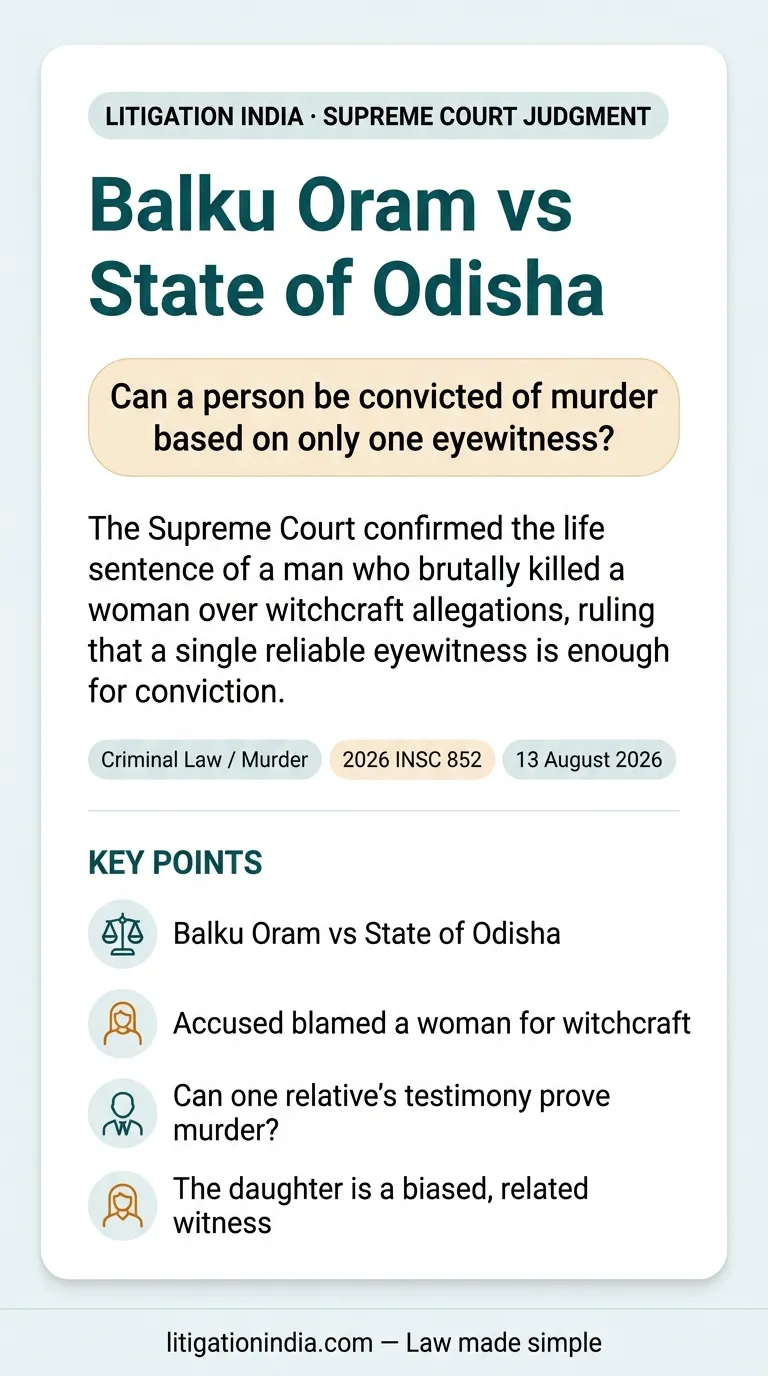
Balku Oram vs State of Odisha
The big legal question
Can a person be convicted of murder based on only one eyewitness?
“The Supreme Court confirmed the life sentence of a man who brutally killed a woman over witchcraft allegations, ruling that a single reliable eyewitness is enough for conviction.”
Story Slides
In short
The Supreme Court dismissed the appeal of Balku Oram, who was sentenced to life imprisonment for the brutal murder of Puni Naik in Odisha in 1998. The accused and his brother dragged the victim out of her house and beat her to death with sticks, blaming her of causing a young girl's death through witchcraft. The entire incident was witnessed by the victim's 15-year-old daughter. The appellant challenged his conviction arguing that the daughter was a related, and thus biased, witness, and that there was a delay in lodging the police report (FIR). Rejecting these arguments, the Supreme Court ruled that a court can convict a person based on the sole testimony of a single reliable witness, as the quality of evidence matters more than the quantity of witnesses. The Court clarified that being a relative does not make a witness biased; indeed, a close relative is a natural witness who would want the real culprit punished. The Court also accepted the delay in filing the FIR, noting that a teenager who just saw her mother murdered would naturally be in shock and fear. Finally, the Court strongly condemned the social evil of witch-hunting, calling it a direct attack on human dignity.
Background
In February 1998, Balku Oram and his brother dragged a woman named Puni Naik out of her home in Odisha and beat her to death with a stick. They blamed her of practicing witchcraft and causing a neighbor's daughter's death. The victim's 15-year-old daughter witnessed the entire brutal attack and reported it to the police the next day.
The Decision
The Supreme Court dismissed the appeal and confirmed the life imprisonment of the accused. The Court held that the daughter's eyewitness testimony was completely reliable, and minor inconsistencies did not affect the case. It ruled that superstition cannot justify violence and that justice must prevail over blind faith.
Why it matters for you
This judgment clarifies that a criminal can be convicted based on a single reliable eyewitness, even if they are related to the victim. It also sends a strong social and legal message against the practice of witch-hunting, protecting women from violence driven by superstition.
AI-assisted summary, reviewed and verified by our editorial team.
Need help with your case?
Facing a similar legal challenge in the Supreme Court or High Court? Connect with our pro bono volunteer advocates today.
Related Supreme Court services