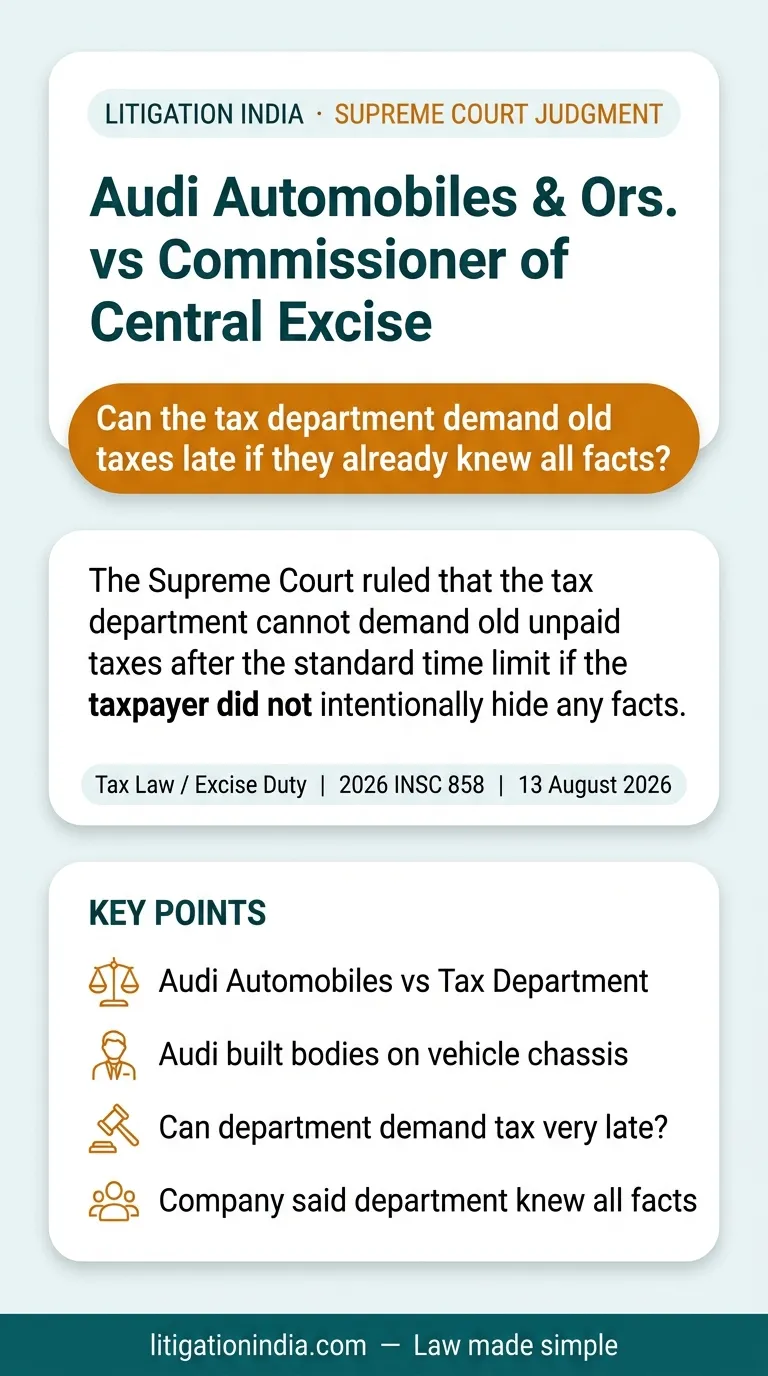
Audi Automobiles & Ors. vs Commissioner of Central Excise
The big legal question
Can the tax department demand old taxes late if they already knew all facts?
“The Supreme Court ruled that the tax department cannot demand old unpaid taxes after the standard time limit if the taxpayer did not intentionally hide any facts.”
Story Slides
In short
The case involves Audi Automobiles, a business that builds bodies on vehicle frames (chassis) supplied by manufacturers. In this business, the manufacturer first pays excise tax on the chassis value (which includes a 10% extra cost). When the body builder finishes the vehicle and returns it, they must calculate and pay excise tax on the total final value. Audi Automobiles calculated this final tax using the basic cost of the chassis, without adding the extra 10% cost. The tax department argued that the 10% should have been included. On this point of calculation, the Supreme Court agreed with the department. However, the department had raised this tax demand very late—well beyond the standard one-year time limit. Under the law, the department can only ask for taxes up to five years late if the taxpayer intentionally hid or lied about the facts to avoid paying tax. The Supreme Court decided that because the department already knew all the facts—specifically, how the chassis value was originally cleared—there was no intentional hiding (wilful suppression) of facts by Audi. Therefore, the department could not use the special extended time limit to demand the tax. Since the department missed the regular deadline, the entire tax demand was canceled, and the business was saved from paying the late penalty and tax.
Background
Audi Automobiles built bodies on vehicle frames (chassis) sent by manufacturers. When calculating final excise tax, they did not include a 10% extra cost that was part of the original chassis value. The tax department sent them a notice demanding unpaid tax after the standard one-year deadline had expired.
The Decision
The Supreme Court ruled that although the 10% should have been included, the tax demand was illegal because it was made too late. The Court held that since the tax department already knew all the facts, the company did not intentionally hide anything. Therefore, the department was not allowed to use the special extended deadline, and the tax demand was canceled.
Why it matters for you
This judgment protects honest businesses from facing sudden tax demands and penalties years later if there was no fraud. It clarifies that if the tax department already has all the information, they must act quickly within the standard time limit and cannot blame the taxpayer for hiding facts.
AI-assisted summary, reviewed and verified by our editorial team.
Need help with your case?
Facing a similar legal challenge in the Supreme Court or High Court? Connect with our pro bono volunteer advocates today.
Related Supreme Court services