
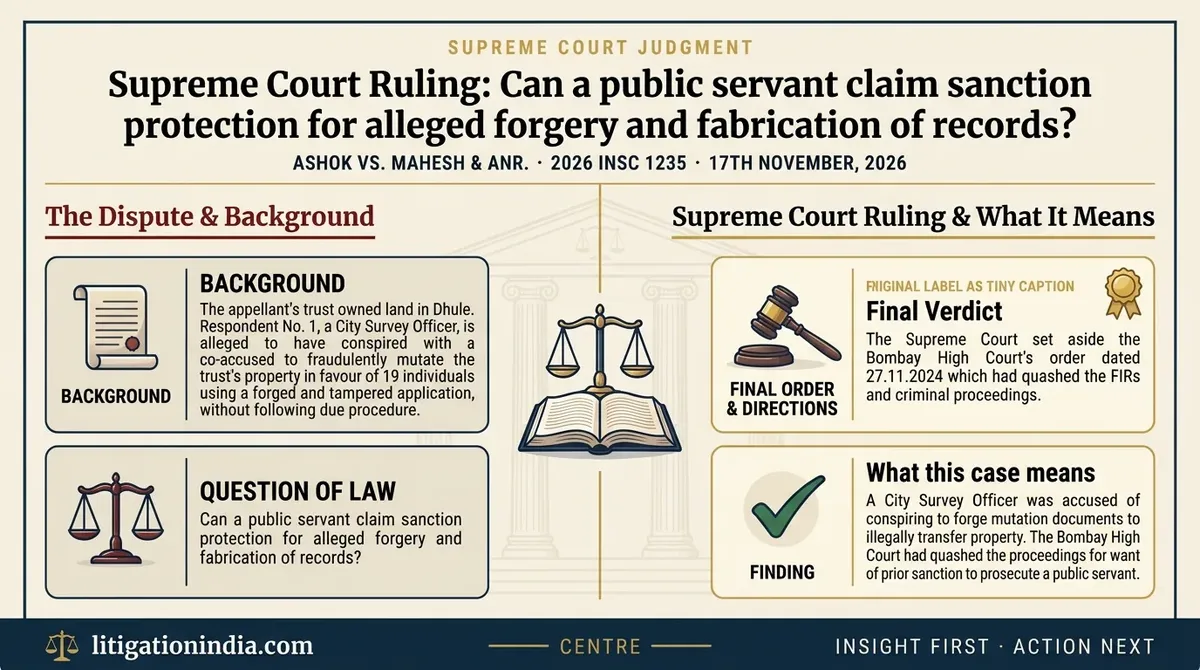
Full text of the judgment
Text extracted from Ashok vs. Mahesh & Anr.. For the authoritative version refer to the Supreme Court of India's official website.
2026 INSC 1235 1
REPORTABLE IN THE SUPREME COURT OF INDIA CRIMINAL APPELLATE JURISDICTION CRIMINAL APPEAL NOS. 5370-5371 OF 2026 [@ Special Leave Petition (Crl.) Nos. 7056-7057 of 2025]
..….Appellant(s)
Versus Mahesh & Anr.
……. Respondent(s) J U D G M E N T K. V. Viswanathan, J. 1) Leave granted. 2) The present appeals call in question the correctness of the order dated 27.11.2024 in Criminal Application Nos. 1371 of 2020 and 3235 of 2021 passed by the High Court of Judicature at Bombay, Bench at Aurangabad. By the said order, the High Court allowed the applications filed by Respondent No. 1 and quashed the proceedings pending against him in RCC No. 1020 of 2023 and RCC No. 119 of 2024 before the Chief Judicial Digitally signed by HARPREET KAUR Date: 2026.11.17 18:33:20 IST Reason: Signature Not Verified
Magistrate, Dhule. In RCC No. 1020 of 2023, chargesheet was filed for offences under Sections 465, 466, 468, 471, 474, 420, 120B and 34 of the Indian Penal Code, 1860 (for short ‘the IPC’) and in RCC No. 119 of 2024, chargesheet was filed for offences under Sections 465, 466, 468, 471, 474, 420,120B and 34 of the IPC. 3) The short ground on which the proceedings were quashed was that under the Maharashtra Amendment Act XXXIII of 2016 to Section 156(3) of the Code of Criminal Procedure, 1973, (for short ‘the Cr.P.C.’), even for ordering a Section 156(3) investigation against a public servant in respect of acts done by such public servant while acting or purporting to act in the discharge of his official duty, sanction under Section 197 of the Cr.P.C. was required. Further, it was held that for the proviso to the said amendment to apply, providing for application of the principle of deemed sanction, the application had to be made to the competent authority. In the present case, applications were made to Settlement
Commissioner and Director of Land Records (Maharashtra State) and in another case to the Settlement Commissioner, which authorities, according to the High Court, were not the competent authorities. 4) Under the circumstances, the High Court, by the impugned order, recorded the following findings: - “11. …….Therefore, it ought to have been considered by the learned Magistrate, as to whether the Settlement Commissioner, who is certainly the superior officer of the applicant, had the power to appoint and remove the applicant or not. The learned Advocate for the applicant is making available the photocopy of promotion order passed by the Government of Maharashtra on 17th September 2007, wherein the present applicant was promoted from Class-III post to Class-II post and therefore, it is not in dispute that the State Government is the removing authority. The hierarchy in the office is not relevant for according sanction to prosecute, but it depends upon the power to appoint and remove from service. Therefore, when respondent No.2 had made application to the wrong authority and the wrong authority / the authority who was not competent, had not taken any action on the application filed by respondent No.2 for more than 90 days, the same will not give the deeming effect. In other words, inaction of an authority who is not competent to accord sanction, will not give advantage to respondent No.2 to take advantage of the deeming provision in Section 156(3) of the Code of Criminal Procedure. Here, in the present case, there was no sanction at all to prosecute
the applicant nor there was a deemed sanction. The learned Magistrate could not have passed the order directing the investigation to be made under Section 156(3) of the Code of Criminal Procedure. The First Information Reports based on the said orders cannot be allowed to sustain as there is inherent defect, and therefore, even the proceedings will not be allowed to proceed further. It would be unjust to ask the applicant to face the trial on the basis of such inherent defect. Therefore, this is a fit case where we should exercise our powers under Section 482 of the Code of Criminal Procedure.” 5) The said order is assailed by the complainant-the appellant herein before us on the ground that the authority approached by the complainant was the competent authority and, in any event, the acts done could not be said to be in discharge of or in purported discharge of official duties, thereby obviating the need for prior sanction. 6) The brief facts essential for the disposal of the present matters are as follows. On 18.09.1992, the Appellant, as a trustee of the Priyadarshini Charitable Trust, received land parcel admeasuring 21,000 sq.ft. (City Survey No. 1888) as gift from its owners Avdhut Anant Adavadkar and others, through Gopal Anant Adavadkar holding General Power of Attorney. Eversince, the Trust was in ownership and possession of the
said land. Appropriate mutation was made in favour of the Trust. When matters stood thus, a Special Civil Suit No. 53 of 2003 came to be filed by the original owners of some portion of the land situated in Devpur, Dhule, being Survey Nos. 42/2 and 44/7, before the Civil Judge, Senior Division, Dhule seeking partition and separate possession, with declarations that the sale deeds are void and not binding on them, including the sale deed dated 20.06.1992 by which Shri Swami Samarth Co-op Housing Society Limited, Devpur, Dhule purchased 1,05,100 sq.ft. land from Gopal Anant Adavadkar holding General Power of Attorney. 7) The Appellant alleged that the suit land did not concern the land owned and possessed by Priyadarshini Charitable Trust, which was received pursuant to the gift deed of 18.09.1992. It appears that on 01.08.2018, the Civil Judge, decreed the suit and declared the deeds void and not binding on the shares of the plaintiffs, including the sale deed of 20.06.1992.
8) It is alleged that on the same day, Dinkar Anantrao Adavadkar (Accused No. 1), made an application to the City Survey Officer and sought mutation in his name in respect of his share of the property as per the decree of the Civil Judge, Senior Division. It is alleged by the Appellant that the said application was not even signed. It is alleged that an office noting mentioning that the area involved in the cancelled sale deed in the civil suit and the gift deed to Priyadarshini Charitable Trust were one and the same was made, and on that basis illegal mutation entry was done in favour of the decree holders by Respondent No. 1, when the property of Priyadarshini Charitable Trust was not concerned in the suit. 9) It also appears that the decree passed by the Civil Judge, Senior Division, in Special Civil Suit No. 53 of 2003 dated 01.08.2018, was stayed by the Appellate Court on 22.11.2018. 10) The Appellant, on 19.12.2018, coming to know about the illegal mutation, sent a notice to Respondent No. 1-Mahesh Fulpagare (Accused No. 2) and Madhukar More (Accused No.
3) and apprised them of the different nature of the properties. Collusion and conspiracy were also alleged. It was also alleged that no notice was given to Priyadarshini Charitable Trust in whose name the mutation stood. 11) By a reply of 29.12.2018, Respondent No. 1-Mahesh Fulpagare (Accused No. 2) and Madhukar More (Accused No. 3) stated that in view of the civil suit decree no notice was required to be issued to Priyadarshini Charitable Trust. 12) On 02.01.2019, the Appellant tried to lodge a First Information Report. Since the First Information Report was not registered, a complaint was made to the Superintendent of Police, and on the Superintendent of Police not taking action, a private complaint on behalf of the Trust under Section 156(3) of the Cr.P.C. seeking directions for the filing of First Information Report against Accused Nos. 1, 2, 3 was filed in Criminal Misc. Application No. 323 of 2019. This Complaint was filed in the name of the Appellant as trustee of Priyadarshini Charitable Trust. Another complaint in Criminal
Misc. Application No. 421 of 2019 was filed by the Appellant before the CJM, Dhule as Secretary of the Shri Swami Samarth Co-op Housing Society Limited, Dhule. 13) On 11.07.2019, the Appellant made an application to the Settlement Commissioner and Director of Land Records (Maharashtra State) to accord sanctions to prosecute City Survey Officer-Accused No. 2 (Respondent No. 1) and Examination Surveyor-Accused No. 3. 14) In the meantime, on 30.11.2019, the District Superintendent of Land Records, Dhule, allowed Appeal No. 214 of 2019, and directed Mutation Entry No. 7062 to be cancelled. 15) On 17.03.2020, in Criminal Misc. Application No. 323 of 2019, the JMFC, Dhule directed investigation under Section 156(3) of the Cr.P.C. and recorded the following findings:- “5. …..It is alleged that the respondent no.l in connivance with the respondent nos.2 and 3 have fraudulently mutated his name along with other persons in the City Survey No.1888. The judgment and decree of the Civil Judge, Senior Division, Dhule in
Spl.C.S.No.53/2003, dated 01/01/2018 declared that the sale deed dated 20/06/1992 is not binding on the plaintiffs and defendant nos. 5 to 12. The respondent no.l is plaintiff no.2 in the said suit. The sale deed dated 20/06/1992 was in respect of 1,05,100 sq. ft area, in respect of which, based on the Civil Court's decree, the respondent no.l by following due procedure should have mutated his name. But instead of that he got mutated his name on Survey No. 1888, which is having an area of 21000 sq ft. Prima facie, it shows that the application dated 01/08/2018 only shows two documents annexed with it and the City Survey officer had taken into consideration four more documents which were not annexed with the application of the respondent no.l. I find that prima facie case for investigation for the offences punishable under Sections 465, 466, 468, 471, 474, 420, 120-B r/w Section 34 of I.P.C. is made out. Considering this fact, the matter requires investigation…..”
16) Subsequently, on 20.03.2020, FIR No. 79 of 2020 came to be registered at Dhule City Police Station, and Respondent No. 1 and Accused No. 3 were arrested on the same day. 17) There is also a document on record which shows that on 05.08.2020, the Settlement Commissioner and Director of Land Records (Maharashtra State) suspended Respondent No. 1 after noticing the registration of FIR No. 79 of 2020 and the custody period of the Respondent No. 1 from 20.03.2020, 1:08 am to 23.03.2020 which was for a period exceeding 48 hours.
18) On 13.08.2020, Respondent No. 1 filed Criminal Application No. 1371 of 2020 before the High Court seeking quashment of FIR No. 79 of 2020. 19) On 04.03.2021, the JMFC, Dhule, in Criminal Misc. Application No. 421 of 2019 directed investigation under Section 156(3) of the Cr.P.C. by recording the following findings:- “5. In this case, it is alleged that the accused no.l has made an application to mutate his name on the property bearing City Survey Nos. 1889, 4460 and 4496 on the basis of preliminary decree of Hon'ble Civil Court Senior Division, Dhule, without annexing necessary documents and the accused nos. 2 and 3 in connivance with the accused no.l have entered the name of the accused no.l and others on the said properties, without following due procedure of law. The said preliminary decree was challenged and is in executable unless and until it is finalized. It is alleged that the application made by the accused no.l dated 01/08/2018 only mentions the sale deed. It does not mention the documents as shown by the accused no.2 in his noting and the accused no.3 has passed the order approving to enter the said names of the accused no.l and others on the property bearing City Survey Nos. 1889, 4460 and 4496. The complainant had sought for information regarding the application of the accused no. l dated 01/08/2018 through Right of Information from the Office of City Survey and the Public Information Officer, City Survey Office, Dhule has replied that the documents as mentioned in noting of the accused no.3 were not annexed with the application
dated 01.08.2018 of the accused no. l. The said reply further shows that the application of the accused no. l was incomplete, illegal and made without following rules. The said noting and entry made and approved by accused nos. 2 and 3 is cancelled in Appeal SR 2148/2019, Dhule by District Superintendent of Land Record, Dhule on 30.11.2019, on the ground that the said entry was taken without following due procedure of law. 6. In the circumstances, prima facie, a case for investigation under Section 156(3) of the Code of Criminal Procedure is made out against the accused nos. l to 3…..”
On 06.03.2021, FIR No. 62 of 2021 came to be registered by Dhule City Police Station against the Accused Nos. 1, 2, 3 of which Respondent No. 1 was Accused no. 2. 20) On 17.12.2021, Respondent No. 1 filed Criminal Application No. 3235 of 2021 before the High Court of Judicature at Bombay, Bench at Aurangabad, seeking quashment of FIR No. 62 of 2021. 21) On 21.12.2023, a charge sheet was filed in case arising out of FIR No. 79 of 2020. 3 accused were arrayed and Respondent No.1 was arrayed as Accused No. 2. Crucial allegations in the charge sheet were as under: -
“ ……Upon receiving the requested documents, it was revealed that Accused No. 1's original application dated 01/08/2018 had been tampered with. The following irregularities were found: Alterations (erasures and overwriting) were made in the original application, A photograph of Accused No. 1 was pasted later on the application, A small signature was placed at the designated signature spot, which was not present in the original application, Below the subject, a handwritten note was added stating 'as per the court order', despite no such mention in the original application. Additionally, a formal letter was submitted to the City Survey Office, requesting information regarding this matter. Upon receiving a response, copies of all three versions of the application were obtained. From these documents, it was evident that Accused No. 1 had not submitted any supporting documents along with the application dated 01/08/2018. Furthermore, Accused No. 1 had mentioned 'List No. 2' as an attachment in the submitted documents. However, when Nilesh Rambhau Patil requested a copy of List No. 2 from the Sub-Registrar Office No. 1, it was revealed that: 'List No. 2' was destroyed in a fire that occurred at the Sub-Registrar Office on 23/06/2011, The Sub-Registrar Office No. 1 officially confirmed this in a written statement. From the above findings, it is evident that Accused No. 1's application submitted to the City Survey Office for mutation entry was not in the prescribed format and was not accompanied by any valid supporting documents. Furthermore, after the complainant pointed out the discrepancies in the application, modifications and alterations were made twice even after Mutation Entry No. 7062 was approved. This forged and tampered application was then falsely presented as a genuine document and was officially placed in the City Survey Office records. From this, it is evident that the accused have created forged documents. Subsequently, Accused No. 2 and
Accused No. 3, without conducting a hearing on Accused No. 1 's application, without verifying the documents, and without ensuring that the documents mentioned in the application were actually submitted, issued an order based on the said application. As a result, Mutation Entry No. 7062 was approved on 16/11/2018, removing the name of Priyadarshini Charitable Trust, Dhule, and instead, recording the names of Accused No. 1, other Adavadkar family members, and their heirs, totaling 19 individuals, in the property register. In connection with the said property, the complainant filed an appeal (SR 2148/2019) before the Hon'ble Superintendent of Land Records, requesting the cancellation of Mutation Entry No. 7062, which was approved by Accused No. 2. After conducting a hearing, the Hon'ble Superintendent of Land Records issued a decision on 30/11/2019, stating that Mutation Entry No. 7062 was found to be incorrect and, therefore, it was canceled. As per the findings of the investigation, Accused No. 1, in collusion with Accused No. 2 and Accused No. 3, conspired to commit a criminal offense by preparing forged documents and falsely presenting them as genuine. These fraudulent documents were submitted to the City Survey Office and officially recorded, leading to the approval of Mutation Entry No. 7062. This resulted in the wrongful removal of the property ownership of Priyadarshini Charitable Trust, Dhule, where the complainant is a trustee, with the intention of fraudulently transferring the property to Accused No. 1 and 18 other individuals. Therefore, it has been established that Accused No. 1, 2, and 3 have committed the said offences, and criminal charges have been registered against them under Sections 465, 468, 471, 474, 420, and 120B of the Indian Penal Code (IPC).” [Emphasis supplied]
22) Similarly, on 12.02.2024, chargesheet was filed in case arising out of FIR No. 62 of 2021 registered at Dhule City Police Station. Crucial allegations in the charge sheet were as under:- “ …..In this case, the property located at Survey No. 42/2 + 44/7 in Devpur Shivaar, Taluka & District Dhule, specifically Plot No. 2, measuring 1,05,100 sq. ft., has been recorded in the City Land Survey Office, Dhule, under Property Nos. 1889, 4460, and 4496. As per the property records, the registered owner and possessor of the said property is the Chairman of Shri Swami Samarth Cooperative Housing Society Ltd., Dhule. The said property was permanently purchased by Shri Swami Samarth Cooperative Housing Society through a registered sale deed (Document No. 1725) dated 20/06/1992 at the office of the Sub-Registrar, Dhule. Since then, the property has been in the possession and enjoyment of the Society and its members. The property was permanently sold to Shri Swami Samarth Cooperative Housing Society by Yopal Anant Adavadkar (sic), acting as the General Power of Attorney holder on behalf of the eight brothers of Dinkar Anant Adavadkar. Although Gopal Anant Adavadkar was not given a General Power of Attorney, he sold the said property to Shri Swami Samarth Cooperative Housing Society, thereby defrauding his other brothers. However, from 20/06/1992 till the present date, for approximately 32 years, none of the Adavadkar brothers or their legal heirs have filed any complaint against Gopal Anant Adavadkar in any police station or court. However, a Special Civil Suit No. 53/2003 was filed regarding the said property in the Civil Court, Dhule, and the judgment was delivered
on 01/08/2018. An appeal (Regular Civil Appeal No. 125/2018) was subsequently filed before the District Court, Dhule, challenging this decision. The Hon'ble District Court has granted a stay on the judgment dated 01/08/2018 of the lower court until the final decision of the appeal. Despite the absence of any written orders from the Hon'ble Court or higher authorities, Accused Nos. 1, 2, and 3 fraudulently created false and forged documents and misrepresented them as genuine with the intent to illegally transfer the property belonging to the members of Shri Swami Samarth Cooperative Housing Society. Accused Nos. 2 and 3, abusing their official positions, manipulated the property records (Survey Nos. 1889, 4460, and 4496) and, through fraudulent Mutation Entry No. 7062 dated 16/11/2018, wrongfully altered the ownership details. Consequently, the Secretary of the Society, Complainant Ashok Shravan Patkar, filed a criminal application before the Hon'ble Chief Judicial Magistrate, Dhule. After carefully reviewing and verifying the submitted documents, the Hon'ble Court directed the registration of an FIR under relevant sections of the IPC, leading to the registration of FIR No. 62/2021 at Dhule City Police Station. The charge against the accused in this case is that Accused No. 1, in collusion with Accused Nos. 2 and 3, conspired to commit a criminal offense by fraudulently preparing forged documents and misrepresenting them as genuine. Using these fabricated documents, they illegally manipulated property records at the City Land Survey Office, Dhule, and executed Mutation Entry No. 7062 to fraudulently alter the ownership details of Survey Nos. 1889, 4460, and 4496, which legally belong to the members of Shri Swami Samarth Cooperative Housing Society. Their intent was to cheat and wrongfully transfer ownership of this property to Accused No. 1 and 18 others. Since substantial and credible evidence has been gathered against
Accused Nos. 1, 2, and 3, a charge sheet has been prepared under Sections 465, 468, 471, 474, 420, and 120(B) of the IPC and has been submitted before the Hon'ble Court for judicial proceedings.” [Emphasis supplied]
23) Respondent No.1 carried out the amendments to the quash petition and challenged the proceedings themselves in RCC Nos. 1020 of 2023 and 119 of 2024 pending before the Learned CJM, Dhule. It is in the said proceedings that the impugned order has come to be passed. 24) We have heard Mr. Sagar Pahune Patil, Learned Counsel for the Appellant, Mr. Raman Yadav, Learned Counsel for the State, and Mr. Siddharth S. Chapalgaonkar with Ms. Sneha Sanjay Botwe, as Learned Counsels for the first Respondent- Accused. 25) Learned Counsel for the Appellant vehemently contended that the offences committed by Respondent No. 1 cannot be said to be in discharge of official duties or in purported discharge thereof. That it was no part of the duty of Respondent No. 1 to commit forgery and/or to use a forged
document. Learned Counsel submitted that Section 156 (3) of the Cr.P.C., as amended in Maharashtra, would have no application since the protection in the amendment applies only to acts committed in discharge of official duty. It was further argued that even assuming it was part of the discharge of official duty, an application for sanction was made to the competent authority and only on the basis of an oral statement of the Counsel for Respondent No. 1, the High Court has assumed the Settlement Commissioner and Director of Land Records (Maharashtra State) to not be the competent authorities. It was, however, argued that the authority to whom sanction was applied was the competent authority. Learned Counsel prayed for setting aside of the High Court order and for permitting the trial to proceed. 26) Mr. Raman Yadav, Learned Counsel for the State of Maharashtra submitted that Section 197 of the Cr.P.C. would be attracted and, in turn, the Maharashtra Amendment to Section 156(3) of the Cr.P.C. would have applied only where
the act complained of bears a reasonable nexus with the discharge of the public servant of his official duties. Learned Counsel argued that acts involving fabrication of records or creation of false documents can never form part of discharge of the official powers, and therefore, the protection under the relevant Sections were not attracted. Learned Counsel referring to the allegations in the charge sheets contended that Respondent No. 1 misused his official position to facilitate the fabrication of the mutation application, and subsequently, altered the revenue records. 27) Mr. Siddharth S. Chapalgaonkar, Learned Counsel for Respondent No. 1, submitted that an application was duly received for mutation and it was only after obtaining the opinion of the District Government Pleader that the mutation was effected. 28) It must be pointed out herein that in the written submissions of the State of Maharashtra, it is stated that the District Government Pleader had opined that the decree was
in appeal and any appropriate action regarding revenue entry should await the outcome of the appeal. It was also pointed out that status quo was ordered by the Appellate Court on 22.11.2018 with the direction that status quo existing prior to 01.08.2018 should be maintained. 29) Reverting to the argument of the Learned Counsel for Respondent No. 1, Learned Counsel contended that the acts were clearly done in official capacity, and done with proper due diligence. Merely because the order is erroneous, no criminality can be attributed. Learned Counsel relied on the fact that there was no sanction obtained under Section 156(3) of the Maharashtra Amendment read with Section 197 of the Cr.P.C. 30) The Maharashtra Amendment to Section 156(3) reads as under: - “156. Police officer's power to investigate cognizable case.—(1) Any officer in charge of a police station may, without the order of a Magistrate, investigate any cognizable case which a Court having jurisdiction over the local area within the
limits of such station would have power to inquire into or try under the provisions of Chapter XIII. (2) No proceeding of a police officer in any such case shall at any stage be called in question on the ground that the case was one which such officer was not empowered under this section to investigate. (3) Any Magistrate empowered under section 190 may order such an investigation as abovementioned. STATE AMENDMENT Maharashtra Amendment of section 156.—In section 156 of the Code of Criminal Procedure, 1973, (2 of 1974) in its application to the State of Maharashtra (Hereinafter referred to as "the said Code"), after sub-section (3), the following provisos shall be added, namely: — "Provided that, no Magistrate shall order an investigation under this section against a person who is or was a public servant as defined under any other law for the time being in force, in respect of the act done by such public servant while acting or purporting to act in the discharge of his official duties, except with the previous sanction under section 197 of the Code of Criminal Procedure, 1973 (2 of 1974) or under any law for the time being in force: Provided further that, the sanctioning authority shall take a decision within a period of ninety days from the date of the receipt of the proposal for sanction and in case the sanctioning authority fails to take the decision within the said stipulated period of ninety days, the sanction shall be deemed to have been accorded by the sanctioning authority." [Vide Maharashtra Act 33 of 2016, s. 2.]
31) Relevant part of Section 197 of the CrPC reads as under:- “197. Prosecution of Judges and public servants.- (1) When any person who is or was a Judge or Magistrate or a public servant not removable from his office save by or with the sanction of the Government is accused of any offence alleged to have been committed by him while acting or purporting to act in the discharge of his official duty, no Court shall take cognizance of such offence except with the previous sanction [save as otherwise provided in the Lokpal and Lokayuktas Act, 2013 (1 of 2014)]— (a) in the case of a person who is employed or, as the case may be, was at the time of commission of the alleged offence employed, in connection with the affairs of the Union, of the Central Government; (b) in the case of a person who is employed or, as the case may be, was at the time of commission of the alleged offence employed, in connection with the affairs of a State, of the State Government: xxx xxx “ 32) We are inclined to hold that the acts complained of were not in discharge of or in purported discharge of official duty. Hence, we are not required to examine the aspect of deemed sanction and the issue of the authority competent to grant sanction, insofar as the present facts are concerned. 33) Recently, J.B. Pardiwala J., speaking for this Court in Om Prakash Yadav vs. Niranjan Kumar Upadhyay and Others, 2024 SCC OnLine SC 3726 felicitously summed up the law on
the concept of discharge of official duty in the following words: - “65. Thus, the legal position that emerges from a conspectus of all the decisions referred to above is that it is not possible to carve out one universal rule that can be uniformly applied to the multivarious facts and circumstances in the context of which the protection under Section 197 CrPC is sought for. Any attempt to lay down such a homogenous standard would create unnecessary rigidity as regards the scope of application of this provision. In this context, the position of law may be summarized as under:— (i) The object behind the enactment of Section 197 CrPC is to protect responsible public servants against institution of possibly false or vexatious criminal proceedings for offences alleged to have been committed by them while they are acting or purporting to act in their official capacity. It is to ensure that the public servants are not prosecuted for anything which is done by them in the discharge of their official duties, without any reasonable cause. The provision is in the form of an assurance to the honest and sincere officers so that they can perform their public duties honestly, to the best of their ability and in furtherance of public interest, without being demoralized. (ii) The expression “any offence alleged to have been committed by him while acting or purporting to act in the discharge of his official duty” in Section 197 CrPC must neither be construed narrowly nor widely and the correct approach would be to strike a balance between the two extremes. The section should be construed strictly to the extent that its operation is limited only to those acts which are discharged in the “course of duty”. However, once it has been ascertained that the act or omission has indeed been
committed by the public servant in the discharge of his duty, then a liberal and wide construction must be given to a particular act or omission so far as its “official” nature is concerned. (iii) It is essential that the Court while considering the question of applicability of Section 197 CrPC truly applies its mind to the factual situation before it. This must be done in such a manner that both the aspects are taken care of viz., on one hand, the public servant is protected under Section 197 CrPC if the act complained of falls within his official duty and on the other, appropriate action be allowed to be taken if the act complained of is not done or purported to be done by the public servant in the discharge of his official duty. (iv) A public servant can only be said to act or purport to act in the discharge of his official duty, if his act is such that it lies within the scope and range of his official duties. The act complained of must be integrally connected or directly linked to his duties as a public servant for the purpose of affording protection under Section 197 CrPC. Hence, it is not the duty which requires an examination so much as the “act” itself. (v) One of the foremost tests which was laid down in this regard was - whether the public servant, if challenged, can reasonably claim that, what he does, he does in virtue of his office. (vi) Later, the test came to be re-modulated. It was laid down that there must be a reasonable connection between the act done and the discharge of the official duty and the act must bear such relation to the duty such that the accused could lay a reasonable, but not a pretended or fanciful claim, that his actions were in the course of performance of his duty. Therefore, the sine qua non for the applicability of this section is that the offence charged, be it one of commission or omission, must be committed by the public servant
either in his official capacity or under the color of the office held by him such that there is a direct or reasonable connection between the act and the official duty. (vii) If in performing his official duty, the public servant acts in excess of his duty, the excess by itself will not be a sufficient ground to deprive the public servant from protection under Section 197 CrPC if it is found that there existed a reasonable connection between the act done and the performance of his official duty. (viii) It is the “quality” of the act that must be examined and the mere fact that an opportunity to commit an offence is furnished by the official position would not be enough to attract Section 197 CrPC. (ix) The legislature has thought fit to use two distinct expressions “acting” or “purporting to act”. The latter expression means that even if the alleged act was done under the color of office, the protection under Section 197 CrPC can be given. However, this protection must not be excessively stretched and construed as being limitless. It must be made available only when the alleged act is reasonably connected with the discharge of his official duty and not merely a cloak for doing the objectionable act. (x) There cannot be any universal rule to determine whether there is a reasonable connection between the act done and the official duty, nor is it possible to lay down such a rule. However, a “safe and sure test” would be to consider if the omission or neglect on the part of the public servant to commit the act complained of would have made him answerable for a charge of dereliction of his official duty. If the answer to this question is in the affirmative, the protection under Section 197 CrPC can be granted since there was every connection with the act complained of and the official duty of the public servant.
(xi) The provision must not be abused by public servants to camouflage the commission of a crime under the supposed color of public office. The benefit of the provision must not be extended to public officials who try to take undue advantage of their position and misuse the authority vested in them for committing acts which are otherwise not permitted in law. In such circumstances, the acts committed must be considered dehors the duties which a public servant is required to discharge or perform. (xii) On an application of the tests as aforesaid, if on facts, it is prima facie found that the act or omission for which the accused has been charged has a reasonable connection with the discharge of his official duty, the applicability of Section 197 CrPC cannot be denied.
66. At the cost of repetition, we say that the position of law on the application of Section 197 CrPC is clear - that it must be decided based on the peculiar facts and circumstances of each case. This Court has held in a legion of decisions that any misuse or abuse of powers by a public servant to do something that is impermissible in law like threatening to provide a tutored statement or trying to obtain signatures on a blank sheet of paper; causing the illegal detention of an accused; engaging in a criminal conspiracy to create false or fabricated documents; conducting a search with the sole object of harassing and threatening individuals, amongst others, cannot fall under the protective umbrella of Section 197 CrPC.
67. In light of the same, it follows that when a police official is said to have lodged a false case, he cannot claim that sanction for prosecution under Section 197 CrPC was required since it can be no part of the official duty of a public official to lodge a bogus case
and fabricate evidence or documents in connection with the same. On examining the quality of the act, it is evident that there exists no reasonable or rational nexus between such an act and the duties assigned to the public servant for the claim that it was done or purported to be done in the discharge of his official duty. The mere fact that an opportunity to register a false case was furnished by the official duty would certainly not be sufficient to apply Section 197 CrPC. Allowing so, would enable the accused to use their status as public servants as a facade for doing an objectionable, illegal and unlawful act and take undue advantage of their position. If the Case Crime No. 967 of 2007 registered at the Murar Police Station, Gwalior, by respondent nos. 3, 4 and 5 respectively, was a false case, then there is no doubt that the refusal to grant sanction would not operate as a bar for their prosecution. Moreover, as far as the case of respondent no. 1 is concerned, it is an undisputed fact that he was not even posted as the S.H.O or T.I at the Murar Police Station when the said false case was registered. The same is evident from the affidavit submitted by the IO at Firozabad before the High Court. Additionally, the respondent no. 1 has himself admitted in his submissions before us that he was in fact posted at District Shivpuri which is 120 kms away from Gwalior during the relevant time. Therefore, any act or offence committed by the respondent no. 1 in the present case can safely be said to have been outside the scope of his official duty which obviates the question of sanction for his prosecution.” [Emphasis supplied]
34) Applying the above law to the facts of the present case, it is very clear that the case set up against Respondent No. 1 is of conspiring to commit criminal offence by preparing forged documents and falsely presenting them as genuine. All this was done with the intention, according to the prosecution, to transfer the property to Accused No. 1 and 18 and other individuals. There is also an allegation with regard to manipulation of property records at the City Land Survey Office and execution of a mutation entry with intention to cheat. 35) On the facts of the case, we are convinced that Section 197 read with Maharashtra Amendment to Section 156(3) of the Cr.P.C. are not attracted to the facts of the present case. Needless to state that the observations in this judgment are only for the purpose of deciding the aspect of sanction to prosecute. The trial and the other proceedings will be conducted independently, on their own merits.
36) For the reasons stated above, the impugned order dated 27.11.2024 passed by the High Court in Criminal Application Nos. 1371 of 2020 and 3235 of 2021 is set aside. The appeals are allowed. We direct that RCC Nos. 1020 of 2023 and 119 of 2024 be restored to the file of CJM, Dhule and shall be proceeded in accordance with law.
……….........................J.
[K. V. VISWANATHAN]
……….........................J.
[ALOK ARADHE] New Delhi; 17th November, 2026