Updates
Criminal Law / Conviction Alteration / Grievous Hurt
Verified 18 views

Robbery Conviction Altered to Grievous Hurt Due to Insufficient Robbery Evidence

Appa vs The State of Maharashtra

The big legal question

Can a court convict for grievous hurt when robbery charge is not fully proved?

What this case means

The appellant was convicted for robbery with hurt under Section 394 IPC, but the Supreme Court found the robbery element unproven as no jewellery was recovered. The Court altered the conviction to grievous hurt under Section 325 IPC and restricted the sentence to the period already undergone. This case illustrates how courts may convict for a lesser cognate offence when the major offence is not fully proved.

“The Supreme Court altered the appellant's conviction from robbery with hurt under Section 394 IPC to grievous hurt under Section 325 IPC, and restricted his sentence to the period already undergone.”

Share:

Story Slides

Case at a glance1 / 6

Supreme Court of India

Robbery Conviction Altered to Grievous Hurt

Appa vs The State of Maharashtra | 2026 INSC 1091

Court: Supreme Court of India | Date: 07 October 2026Bench: Justice Prashant Kumar Mishra and Justice Shree ChandrashekharArea of Law: Criminal Law — conviction alteration, grievous hurt, cognate offencesOriginal conviction under Section 394 IPC altered to Section 325 IPC
Appa vs The State of Maharashtra · 2026 INSC 109107 October 2026
The legal question2 / 6

Was Robbery With Hurt Proved? Could Lesser Offence Be Substituted?

Core legal issues before the Supreme Court

  • Appellant: Identity not established — faces covered, no TIP, prior acquaintance denied in cross-examination.
  • Appellant: Robbery element unproven — no jewellery recovered, no purchase receipt, beads not linked to mangalsutra.
  • Respondent/State: Courts below rightly found identification proved; complainant named the accused with prior acquaintance details.
  • Respondent/State: High Court affirmed conviction based on eyewitness testimony and medical evidence.
Appa vs The State of Maharashtra · 2026 INSC 109107 October 2026
Statutory comparison3 / 6

Key Statutory Provisions: What Was Charged vs What Was Proved

How the Court applied Sections 394, 325, and 326 IPC

ProvisionWhat it requiresCourt's finding
Section 394 IPCRobbery or attempted robbery + voluntary hurtRobbery unproved — no jewellery recovery or corroborating material; conviction unsustainable
Section 326 IPCGrievous hurt by dangerous weaponKnife never recovered; wound relatively shallow; not applicable
Section 325 IPCVoluntarily causing grievous hurtTooth knocked out = grievous hurt under Section 320 IPC; conviction substituted here
Section 222 CrPC (Section 245 BNSS): Conviction for lesser cognate offence allowed even without separate charge.
Appa vs The State of Maharashtra · 2026 INSC 109107 October 2026
The Court's reasoning4 / 6

Court's Reasoning: Step by Step

From identification to final sentence

  1. 1Step 1: Identification upheld — prior acquaintance, porch light on, hour-long incident, three eyewitnesses corroborated.
  2. 2Step 2: Robbery element (Section 394 IPC) unsustainable — no jewellery recovered, beads unlinked to mangalsutra.
  3. 3Step 3: Cognate offence principle (Section 222 CrPC) applied — lesser charge substituted without separate framing.
  4. 4Step 4: Tooth loss confirmed as grievous hurt under Section 320 IPC, attracting Section 325 IPC conviction.
  5. 5Step 5: Sentence restricted to period already undergone (~10 months) given age (63-64) and long pendency.
Appa vs The State of Maharashtra · 2026 INSC 109107 October 2026
The verdict5 / 6

The Court's Final Decision

Appa vs The State of Maharashtra

  • The Fact: Appellant punched complainant causing a tooth to fall out; robbery of jewellery not proved by material evidence.
  • The Law: Section 222 CrPC permits conviction for a lesser cognate offence; tooth loss is grievous hurt under Section 320 IPC, punishable under Section 325 IPC.
  • The Result: Conviction altered from Section 394 IPC to Section 325 IPC; sentence reduced to period already undergone; Rs. 1,000 fine retained.
Appeal partly allowed. Convicted under Section 325 IPC. Sentence: period already undergone. Fine: Rs. 1,000. Released forthwith.
Appa vs The State of Maharashtra · 2026 INSC 109107 October 2026
Why it matters6 / 6

Why This Judgment Matters

Practical significance for ordinary people

  • Robbery requires material proof of theft — a complainant's word alone, without recovery, is insufficient to sustain the charge.
  • Courts can convict for a lesser proved offence (cognate offence) even without a separate charge, preventing total acquittal when harm is established.
  • Knocking out a tooth is legally 'grievous hurt' — assailants can be convicted and punished for this even when the graver charge fails.
  • Age and long pendency of trial are valid grounds to restrict sentence to time already served, ensuring justice without disproportionate punishment.
A court can always convict for what is actually proved, even if the original charge was more serious.
Appa vs The State of Maharashtra · 2026 INSC 109107 October 2026

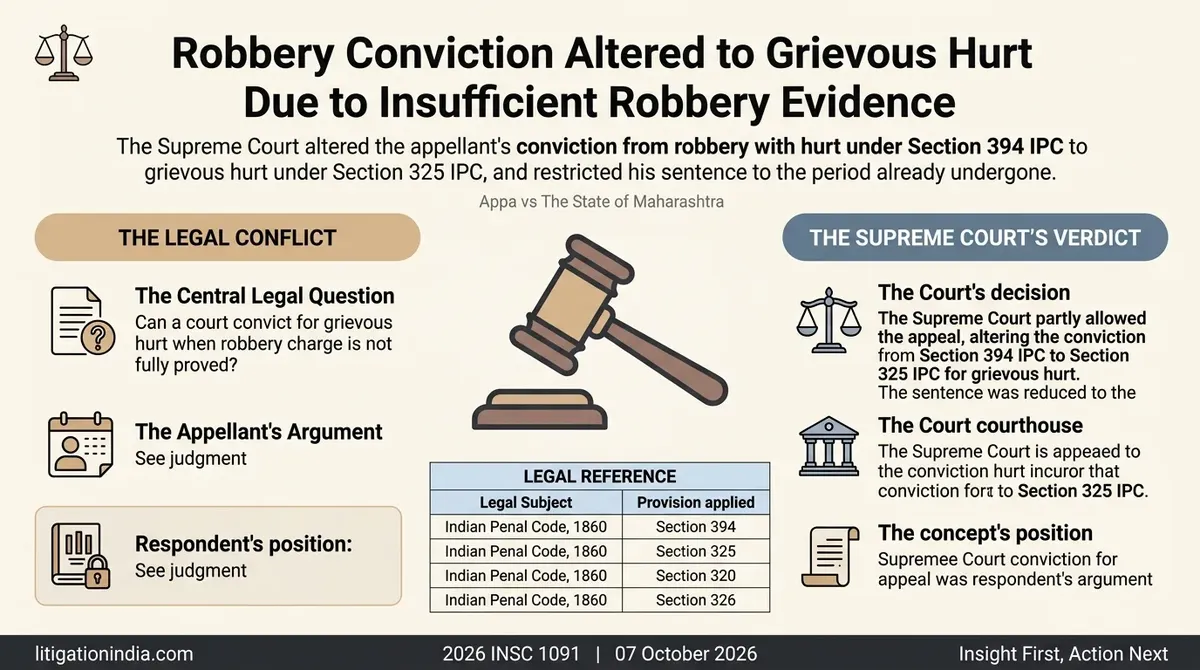
At a glance (infographic)

Appa vs The State of Maharashtra — infographic summary
Download infographic

In short

The appellant, Appa, was accused no. 1 in a case arising from an incident on 23 January 1993, wherein he and three others allegedly entered the complainant's farmhouse at night, threatened her with a knife, punched her causing a tooth to fall out, and snatched her gold mangalsutra and dorle worth Rs. 4,000. An FIR was lodged under Sections 394 and 34 of the IPC. The Trial Court convicted the appellant under Section 394 IPC and sentenced him to seven years rigorous imprisonment with a Rs. 1,000 fine. The Bombay High Court dismissed his appeal and affirmed the conviction. Before the Supreme Court, the appellant challenged identification, noting that assailants' faces were covered, no Test Identification Parade was conducted, and prior acquaintance was denied in cross-examination. The Supreme Court upheld the identification finding, noting the complainant's prior acquaintance with the appellant, the porch light being on, the incident lasting about an hour, and corroboration by three eyewitnesses. However, the Court found the robbery element unsustainable: there was no recovery of the jewellery, no purchase receipt or corroborating material, and though wooden beads were found at the spot, they were never linked to the mangalsutra. Invoking Section 222 CrPC (Section 245 BNSS) and the principle of cognate offences established in Rafiq Ahmed @ Rafi vs. State of U.P. (2011 INSC 546), the Court altered the conviction to Section 325 IPC for grievous hurt, as knocking out a tooth falls squarely within Section 320 IPC. The Court declined to apply Section 326 IPC as the knife was never recovered and the wound was shallow. Considering the appellant's age of about 63-64 years and his total incarceration of about ten months, and following Mathai vs. State of Kerala (2005 INSC 30), the sentence was restricted to the period already undergone, with the fine of Rs. 1,000 maintained. The appeal was partly allowed.

Background

On 23 January 1993, the appellant and three others entered the complainant's farmhouse at night. He threatened the complainant with a knife, punched her in the face knocking out a tooth, and allegedly snatched her gold jewellery. An FIR was registered and only the appellant and one co-accused were traced; the Trial Court convicted the appellant under Section 394 IPC, which was affirmed by the Bombay High Court.

The Decision

The Supreme Court partly allowed the appeal, altering the conviction from Section 394 IPC to Section 325 IPC for grievous hurt. The sentence was reduced to the period already undergone (approximately ten months) while the fine of Rs. 1,000 was maintained. The appellant was directed to be released forthwith unless required in custody for any other case.

Why it matters for you

This judgment shows that an accused cannot be convicted for robbery merely on the complainant's say-so without corroborating material evidence such as recovery of stolen property. Courts can, however, convict for a lesser cognate offence — such as grievous hurt — if the evidence supports it, ensuring that an acquittal on the major charge does not automatically mean freedom where harm is proven. It also demonstrates that age and long pendency of proceedings are relevant considerations in moderating sentence.

Relevant Legal Provisions

Key Acts and sections cited or relied upon in this judgment

“Provides punishment where an offender voluntarily causes hurt while committing or attempting to commit robbery; the Court found this charge unsustainable due to absence of recovery of stolen jewellery and no corroborating material evidence.”
“Provides punishment for voluntarily causing grievous hurt; the Court altered the appellant's conviction to this section after finding that knocking out a tooth constitutes grievous hurt under Section 320 IPC.”
“Defines 'grievous hurt', including fracture or dislocation of a bone or tooth; applied by the Court to categorise the knocking out of the complainant's upper incisor tooth as grievous hurt.”
“Provides punishment for voluntarily causing grievous hurt by dangerous weapon; the Court declined to apply this section as the alleged knife was never recovered and the wound was relatively shallow.”
“Allows conviction for a minor offence when the proved facts constitute it, even if not separately charged; applied by the Court to convict the appellant under Section 325 IPC instead of Section 394 IPC under the principle of cognate offences.”
“Corresponds to Section 222 of the Code of Criminal Procedure, 1973; noted by the Court as the new-code equivalent when invoking the principle of conviction for cognate minor offences.”

Full text of the judgment

Text extracted from Appa vs The State of Maharashtra. For the authoritative version refer to the Supreme Court of India's official website.

2026 INSC 1091 SLP (Crl.) No.4575/2026

Page 1 of 8

REPORTABLE IN THE SUPREME COURT OF INDIA CRIMINAL APPELLATE JURISDICTION CRIMINAL APPEAL NO. 4766 OF 2026 (ARISING OUT OF S.L.P. (CRIMINAL) NO. 4575 OF 2026)

…APPELLANT(S) VERSUS

THE STATE OF MAHARASHTRA

...RESPONDENT(S) J U D G M E N T

PRASHANT KUMAR MISHRA, J. 1. Leave granted. 2. This Appeal is directed against the judgment and order dated 16.01.2026 passed by the High Court of Judicature at Bombay in Criminal Appeal No. 690 of 1998, whereby the High Court dismissed the appeal qua the present appellant and affirmed his conviction under Section 394 of the Indian Penal Code, 18601 and the sentence of rigorous imprisonment for seven years with a fine of ₹1,000 (in default of which he would undergo further rigorous imprisonment for six months) passed by the Additional

1 For short, ‘the IPC’ Digitally signed by NISHA KHULBEY Date: 2026.10.07 17:02:31 IST Reason: Signature Not Verified

SLP (Crl.) No.4575/2026

Page 2 of 8

Sessions Judge, Malegaon, District Nashik, Maharashtra. The appellant was accused No. 1 before the Trial Court. 3. The prosecution’s case arises out of an incident dated 23.01.1993 and is as follows. The family of the complainant consisted of her, her husband, and their minor daughter, who lived together in a three-roomed farmhouse situated in their agricultural fields. After dinner, the complainant was sleeping on a ‘baj’ (cot) on the ‘otta’ (porch) outside the house, her daughter was sleeping on the floor nearby, and her husband had gone to irrigate the onion crop near the well in the field, when four persons came to the farmhouse. The complainant’s daughter shouted on seeing them. The complainant arose from slumber and saw the appellant sitting near her on her cot. He threatened her by pointing a knife at her neck and told her to stop talking. When she attempted to resist and seize the knife, she sustained an injury to her hand. The appellant then punched her in the face, causing an upper tooth to fall out. He also removed her gold mangalsutra and ‘dorle’, weighing approximately five tolas and worth ₹4,000. Another assailant, Kailas/Accused No. 2 took the daughter inside the house, assaulted her, and demanded to know where money received from the onion crop was kept. The remaining two assailants restrained the husband, tied his hands and took him into the room of the house. After some time, the complainant untied her husband’s hands. The family shouted, and villagers eventually approached. All four assailants fled toward the railway line. A ‘battery’ (torch) was also taken while fleeing.

SLP (Crl.) No.4575/2026

Page 3 of 8

4. After the Sarpanch sent word, a police van was sent. All three injured persons were taken to the police station and a complaint was lodged. Consequently, an FIR, being Crime No. 21 of 1993, came to be registered at Police Station Manmad City under Sections 394 read with Section 34 of the IPC. The complainant and her family were referred to the Rural Hospital, Manmad and examined by Dr. Lalchand Jadhav the same night. In the course of investigation, only the appellant and accused No. 2 were traced and arrested, and the other two assailants could not be found. The police filed the chargesheet on 25.04.1993. 5. The Trial Court convicted the appellant under Section 394 of the IPC, and the same was affirmed by the High Court on appeal. Accused No. 2 was tried alongside the appellant, convicted under Section 376 of the IPC, and similarly sentenced to rigorous imprisonment for seven years with a fine of ₹1,000 (with default stipulation of rigorous imprisonment for six months), but was subsequently acquitted by the High Court. However, since the instant Appeal has been preferred by the sole appellant, it is accordingly confined to the extent of only his conviction and sentence. 6. The appellant principally urges that his identity was not established, as the incident occurred at night, the faces of the assailants were admittedly covered, no Test Identification Parade was conducted, the appellant was shown to the witnesses by the police after his arrest, and the complainant’s husband as well as her daughter stated in cross-examination that the

SLP (Crl.) No.4575/2026

Page 4 of 8

assailants were not previously known to them. However, in our view, the Courts below have already comprehensively considered these circumstances and were quite justified in treating the identification of the appellant as satisfactorily proven. 7. To briefly recapitulate, the FIR was lodged at 1:50 a.m., within four hours of the incident, though it occurred late at night. The complainant (PW- 1) categorically identified the appellant, stated his name and place of residence, the nature and manner of their prior acquaintance. She reiterated this in her examination-in-chief and cross-examination. Her daughter (PW- 2) and her husband (PW-6), the injured eyewitnesses, corroborated her identification. Her husband also stated that the appellant used to visit their village to meet his relatives. Moreover, the act that the complainant attributed to the appellant was that he sat close to her on the cot and threatened and assaulted her. The entire incident is said to have lasted about an hour, and multiple witnesses have stated that the bulb of the porch was switched on at the time. Therefore, the High Court has rightly found that the complainant could not be disbelieved on the point of the appellant’s identification. In these circumstances, the lack of a Test Identification Parade cannot be fatal either. 8. The medical evidence also materially corroborates the prosecution’s case qua the appellant. Dr. Lalchand Jadhav (PW-5) examined the complainant and noted seven recent injuries (sustained ≥2 hours prior to examination), namely: (i) linear abrasion on the right side of the chest over

SLP (Crl.) No.4575/2026

Page 5 of 8

the fourth and fifth ribs; (ii) an abrasion on the right side of the neck; (iii) a left upper incisor tooth that had fallen out, with bleeding gums and swelling of the upper lip; (iv) an incised wound on the dorsum of the left hand extending obliquely from the base of the thumb to the wrist joint; (v) blunt trauma to the back in the lumbar region with tenderness; (vi) blunt trauma to both eyes with tenderness; and (vii) blunt trauma to the chest with tenderness. Dr. Lalchand Jadhav opined that injury (iii) was grievous, and the rest were simple in nature. 9. However, at this point, we must examine whether the appellant’s conviction under Section 394 of the IPC, specifically, is sustainable. Said provision applies where the offender, in committing or attempting to commit robbery, voluntarily causes hurt. The robbery or attempted robbery is not at all a peripheral circumstance and is rather an essential component of the offense. In the present case, such allegation of robbery rests entirely upon the assertion of the complainant that the appellant snatched her mangalsutra and dorle from her neck. There was no recovery of the alleged jewellery and nothing incriminating was seized from the appellant’s possession either. There was no purchase receipt or any other material establishing the identity or value of the articles, as admitted by the complainant herself in cross-examination. Though the High Court relied on the observation in the spot panchanama that wooden tulsi beads and black beads were found scattered on the porch, these beads were never connected through evidence to the mangalsutra, and only pieces of rope were exhibited

SLP (Crl.) No.4575/2026

Page 6 of 8

and their seizure from the spot proved through Subhash Kisan Kakad (PW- 3), one of two panch witnesses, before the Trial Court. Therefore, in our considered opinion, we cannot sustain the conviction under Section 394 of the IPC. 10. Under Section 222 of the Code of Criminal Procedure, 1973 (corresponding to Section 245 of the Bharatiya Nagarik Suraksha Sanhita, 2023), a person charged with an offence consisting of several particulars may be convicted where the proved facts constitute a minor offence, notwithstanding that the minor offence was not separately charged. This Court in Rafiq Ahmed @ Rafi vs. State of U.P.2 had rightly described this as the principle of cognate offences, which enables Courts to convict and sentence offenders for a ‘minor’ or less grave offence whose essentials are satisfied by the evidence on record, even when the original charge was framed for the ‘major’ offence. 11. We have considered the complainant’s account that the appellant had threatened her with a knife, and during a brief ensuing scuffle, slashed her left palm with it. Though this is partly corroborated by the medical evidence showing presence of injury (iv), mentioned above; however, Dr. Lalchand Jadhav (PW-5) only opined that it was caused by a sharp, hard object, and no such weapon was ever recovered from the appellant or linked to injury (iv). Moreover, the wound itself, measuring 7×½×½ cm, is relatively shallow in

2 2011 INSC 546

SLP (Crl.) No.4575/2026

Page 7 of 8

nature. Therefore, this is not a fit case attracting offence under Section 326 of the IPC. 12. However, we find that, from the evidence on record, the assertion of the complainant that the appellant struck her in her mouth and caused her left upper incisor tooth to fall out is sufficiently proved through witness testimony and medical evidence. The same falls squarely within the definition of ‘grievous hurt’ given in Section 320 of the IPC viz. fracture or dislocation of a bone or tooth. We thus consider it appropriate to alter the conviction of the appellant to one under Section 325 of the IPC. 13. Lastly, on the point of sentence, we note that the appellant was in custody for 91 days between 27.01.1993 and 27.04.1993. He remained on bail thereafter during the long pendency of the proceedings but surrendered pursuant to the direction of this Court dated 27.02.2026. Thus, as on date, the appellant has suffered incarceration for about 10 (ten) months. His age is stated to be around 63-64 years old. We may refer here to the decision of this Court in Mathai vs. State of Kerala3: “In the instant case considering the size of the stone which was used, as revealed by material on record, it cannot be said that a dangerous weapon was used. Therefore, the conviction is altered to Section 325 IPC. No hard and fast rule can be applied for assessing a proper sentence and a long passage of time cannot always be a determinative factor so far as sentence is concerned. It is not in dispute that a major portion of the sentence awarded has been suffered by the appellant. On the peculiar facts of the case we restrict it to the period already undergone.”

3 2005 INSC 30

SLP (Crl.) No.4575/2026

Page 8 of 8

14. Having regard to the overall circumstances, we are of the opinion that the ends of justice in this case would be met by similarly restricting the substantive jail sentence under Section 325 of the IPC to the period already undergone by the appellant, without interfering with the fine sentence of Rs.1,000/-. 15. For the foregoing reasons, the Appeal is partly allowed. The appellant is convicted for the offence punishable under Section 325 of the IPC. The sentence of the appellant is reduced to the period already undergone by him with fine of Rs.1,000/-. The appellant shall be released forthwith, unless he is required to be in custody in connection with any other case. Pending applications, if any, stand disposed of.

………………………………………J. (PRASHANT KUMAR MISHRA)

………………………………………J. (SHREE CHANDRASHEKHAR)

NEW DELHI; OCTOBER 07, 2026.

AI-assisted summary, reviewed and verified by our editorial team.

In the Court's words

“Under Section 222 of the Code of Criminal Procedure, 1973, a person charged with an offence consisting of several particulars may be convicted where the proved facts constitute a minor offence, notwithstanding that the minor offence was not separately charged.”
“This Court in Rafiq Ahmed @ Rafi vs. State of U.P. had rightly described this as the principle of cognate offences, which enables Courts to convict and sentence offenders for a 'minor' or less grave offence whose essentials are satisfied by the evidence on record.”
“The same falls squarely within the definition of 'grievous hurt' given in Section 320 of the IPC viz. fracture or dislocation of a bone or tooth.”
“No hard and fast rule can be applied for assessing a proper sentence and a long passage of time cannot always be a determinative factor so far as sentence is concerned.”

Need help with your case?

Facing a similar legal challenge in the Supreme Court or High Court? Connect with our pro bono volunteer advocates today.

Request Free Callback
Litigation India

Insight First, Action Next. A public-service initiative to make justice understandable for every Indian.

contact@litigationindia.com

+91 9956486585

New Delhi, India

Quick Links

Our Mission

To empower ordinary citizens, litigants, and junior advocates across India by translating complex Supreme Court of India judgments into editor-verified, plain-language summaries in both English and Hindi. We aim to bridge the gap between judicial proceedings and everyday citizens by delivering verified legal insights and offering free, pro bono guidance from experienced Supreme Court advocates—ensuring no individual suffers injustice merely for lack of correct guidance.

Legal Disclaimer: The information provided on this website is for general informational purposes only and does not constitute legal advice. Accessing this website or receiving any guidance does not create an attorney-client relationship. A formal attorney-client relationship is established only upon signing a formal engagement agreement with a lawyer. Litigation India is an informational platform — it does not provide legal representation, legal services, or legal advice.

Disclaimer: These summaries are provided for general public understanding only and do not constitute legal advice. Please consult a qualified advocate before acting on any information relating to your specific matter.

© 2026 Litigation India. All rights reserved.