Anand Kumar @ Sanjay Lalwani v. The State of Madhya Pradesh And Ors.
The big legal question
Can a criminal case be ended if the actual victim settles, but the informant disagrees?
“The Supreme Court ruled that a criminal case can be canceled if the actual victim of the crime compromises with the accused, even if the person who filed the complaint disagrees.”
Story Slides
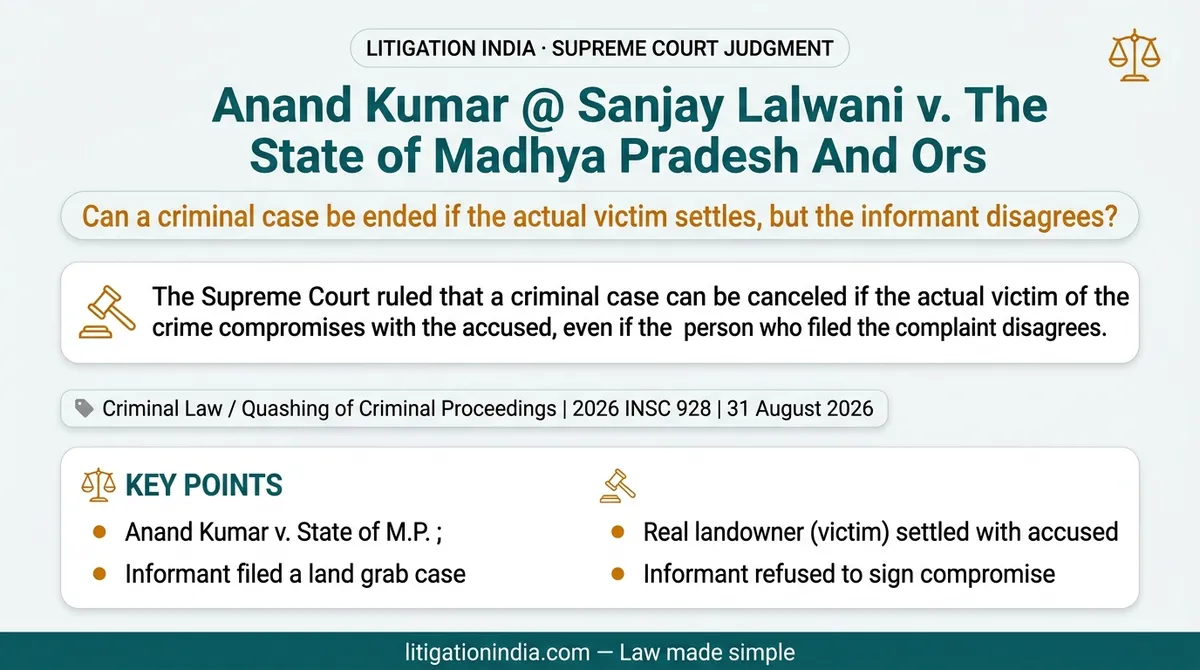
In short
This case explains the vital legal difference between an 'informant' (the person who reports a crime to the police or court) and a 'victim' (the person who actually suffers the loss or injury from the crime). The dispute arose over 54.48 acres of land in Bhopal, Madhya Pradesh. Subhash Chandra Lalwani (the informant) filed a criminal case alleging that his cousin Anand Kumar (the appellant) forged a Power of Attorney to grab the land of Pradeep Singh Mehta (the actual owner and victim). Initially, the case proceeded, but later, the actual victim, Pradeep Singh Mehta, settled all disputes with the accused cousin and filed a sworn affidavit in court stating that he had willingly entered into a partnership, had no grievances, and wanted the case closed. Following this compromise, the accused requested the High Court of Madhya Pradesh to cancel (quash) the criminal proceedings under Section 482 of the Code of Criminal Procedure (CrPC). However, the High Court refused, stating that since the informant (Subhash) was not a party to the compromise, the case could not be settled or compoundable under Section 320 of the CrPC. The Supreme Court reversed the High Court's decision and quashed the criminal case. The Court held that compounding an offence under Section 320 CrPC (where the law allows specific crimes to be settled) is completely different from the High Court's power to quash a case under Section 482 to prevent the abuse of law. Crucially, the Supreme Court clarified that only the actual victim who has suffered the loss has the right to settle a dispute. Since the actual owner settled the matter and the informant had no documented legal right to the land, continuing the trial would be a complete waste of judicial time and an abuse of the court system.
Background
Subhash Chandra Lalwani filed a criminal complaint against his cousin Anand Kumar, claiming Anand forged a Power of Attorney to grab the land of Pradeep Singh Mehta. Although Pradeep initially supported the allegation of forgery, he later resolved all disputes with Anand and filed an affidavit saying he willingly partnered with him and had no grievances.
The Decision
The Supreme Court allowed the appeal and completely quashed the criminal proceedings against the accused. The Court ruled that because the actual victim (the landowner) had voluntarily compromised, forcing a trial when the star witness would not support the prosecution is a futile exercise.
Why it matters for you
This judgment clarifies that an informant who is not the actual victim cannot block a legitimate settlement between the victim and the accused in personal/civil-natured disputes. It prevents third parties from exploiting criminal cases to settle personal scores when the affected victim has moved on.
AI-assisted summary, reviewed and verified by our editorial team.
In the Court's words
“Quashing of offence or criminal proceedings on the ground of settlement between an offender and victim is not the same thing as compounding of offence.”
“It is not always necessary that the complainant/informant is also a 'victim'... It will only be the victim who can authorize a settlement.”
“In the teeth of this affidavit, we are convinced that Pradeep Singh Mehta, who being the star witness, would be of no support to the prosecution... continuing the proceedings would be an abuse of process...”
Need help with your case?
Facing a similar legal challenge in the Supreme Court or High Court? Connect with our pro bono volunteer advocates today.
Related Supreme Court services