
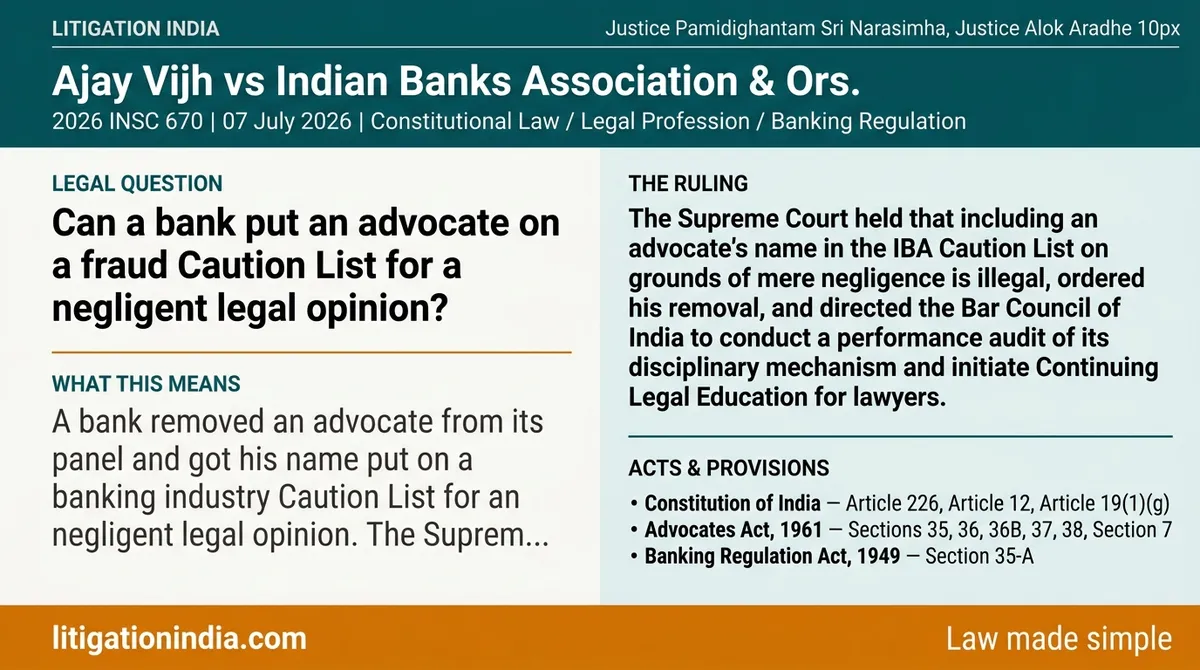
Can a bank put an advocate on a fraud Caution List for a negligent legal opinion?
Supreme Court removes advocate's name from IBA Caution List, orders BCI performance audit
Case: Ajay Vijh vs Indian Banks Association & Ors.Citation: 2026 INSC 670Decided on: 07 July 2026
What this case means
A bank removed an advocate from its panel and got his name put on a banking industry Caution List for an allegedly negligent legal opinion. The Supreme Court held that the Caution List is meant only for fraud cases, not negligence, and ordered his name removed. The Court also directed the Bar Council of India to conduct a performance audit of its disciplinary system and to work towards institutionalising Continuing Legal Education for lawyers.
“The Supreme Court held that including an advocate's name in the IBA Caution List on grounds of mere negligence is illegal, ordered his removal, and directed the Bar Council of India to conduct a performance audit of its disciplinary mechanism and initiate Continuing Legal Education for lawyers.”
Story Slides
In short
The appellant, an advocate enrolled since 1998, was on the panel of Canara Bank. In 2015, he gave a legal opinion on property offered as collateral for a Rs. 2 crore loan. The bank later alleged the opinion was erroneous as a portion of the property had been sold earlier. After receiving the advocate's explanation, the bank removed him from its panel in January 2019 for negligence. The bank then forwarded his name to the Indian Banks' Association, which included him in its Caution List titled 'Third Party Entities Involved in Fraud' from February 2020, without prior notice or hearing. The advocate's empanelment with other banks was also terminated as a consequence. He filed a writ petition before the Allahabad High Court, which dismissed it holding the IBA is not 'State' under Article 12. The Supreme Court set aside the High Court's order. On maintainability, the Court held that Article 226 writs can be issued against any body discharging a public function, and the IBA's Caution List mechanism has sufficient public law character since it affects an advocate's fundamental right under Article 19(1)(g). On merits, the Court held that the RBI's Caution List framework, rooted in its 2009 Circular and subsequent directions under Section 35-A of the Banking Regulation Act, 1949, is confined to fraud cases and cannot be extended to cases of mere professional negligence. Fraud requires mens rea; an erroneous opinion without dishonest intent is not fraud. The Court further held that professional misconduct of advocates falls exclusively within the disciplinary jurisdiction of Bar Councils under the Advocates Act, 1961, and banks cannot bypass this framework. Accordingly, the appellant's name was directed to be removed from the Caution List immediately. Additionally, the Court directed the Bar Council of India to conduct a performance audit of its disciplinary mechanisms and to work towards establishing Continuing Legal Education and a National Legal Academy for lawyers.
Need clarity on a similar legal issue?
Request free pro bono guidance from a Supreme Court Advocate.
Background
The appellant, an advocate enrolled since 1998, provided a legal opinion in 2015 to Canara Bank on property offered as security for a Rs. 2 crore loan. The bank alleged in 2018 that the opinion was erroneous as part of the property had been alienated three years earlier, which the appellant's opinion failed to detect. After receiving the appellant's explanation, the bank removed him from its panel in January 2019 for negligence and then had his name placed on the IBA's Caution List titled 'Third Party Entities Involved in Fraud' from February 2020, without prior notice or a hearing, causing him to lose empanelment with other banks as well.
The Decision
The Supreme Court allowed the appeal, set aside the Allahabad High Court's order, and declared that inclusion of the appellant's name in the IBA Caution List was impermissible and without jurisdiction, directing its immediate removal. The Court further directed the Bar Council of India to constitute a committee for a comprehensive performance audit of its disciplinary mechanisms and to constitute a team to evolve the idea of establishing a National Legal Academy for lawyers, with the appeal listed for further directions on 31 August 2026.
Why it matters for you
This judgment protects advocates from being blacklisted by banks for mere professional errors, clarifying that such action requires fraud and not just negligence. It reaffirms that only Bar Councils can discipline advocates, preventing banks from bypassing the legal profession's self-regulatory framework. The directions on performance audit and Continuing Legal Education have the potential to strengthen accountability and competence across India's legal profession.
Relevant Legal Provisions
Key Acts and sections cited or relied upon in this judgment
“Article 226 empowers High Courts to issue writs to any person or authority; the Court held that a writ petition under Article 226 was maintainable against the IBA because its Caution List function has a public law character affecting the appellant's fundamental right to practise his profession under Article 19(1)(g), even though IBA is not 'State' under Article 12.”
“This Act vests exclusive disciplinary jurisdiction over advocates in State Bar Councils and the Bar Council of India; the Court held that banks and IBA cannot adjudicate or punish professional negligence of advocates, as that power belongs exclusively to Bar Councils under this Act.”
“This section empowers the Reserve Bank of India to issue directions to banking companies in public interest; the Court held that RBI's power under this section to issue fraud-prevention circulars cannot be extended to authorise banks or IBA to declare advocates professionally negligent through a Caution List.”
AI-assisted summary, reviewed and verified by our editorial team.
In the Court's words
“The Caution List maintained by the IBA is intended to operate only in cases involving fraud, dishonesty, criminality, or other serious misconduct affecting the banking system. It was never designed to address cases resting merely on alleged negligence or errors of professional judgment.”
“Banks have the choice of disengaging a legal professional and also to remove his/her name from the panel if the services are not up to the mark, but an action in the nature of public declaration to all other banks about the conduct, competency or incompetency of an advocate is clearly beyond their power and jurisdiction and clearly illegal.”
“Permitting banks or banking associations to bypass the disciplinary process under the Advocates Act and unilaterally portray an advocate as professionally incompetent by including his name in a Caution List is illegal, unsustainable and impermissible.”
“Fraud, by its very nature, imports an element of mens rea and deliberate intention and design to defraud. An erroneous legal opinion or an omission in the course of due diligence, absent any allegation of dishonest intent or deliberate facilitation of illegality, cannot be elevated to the level of fraud.”
Need help with your case?
Facing a similar legal challenge in the Supreme Court or High Court? Connect with our pro bono volunteer advocates today.
Related Supreme Court services